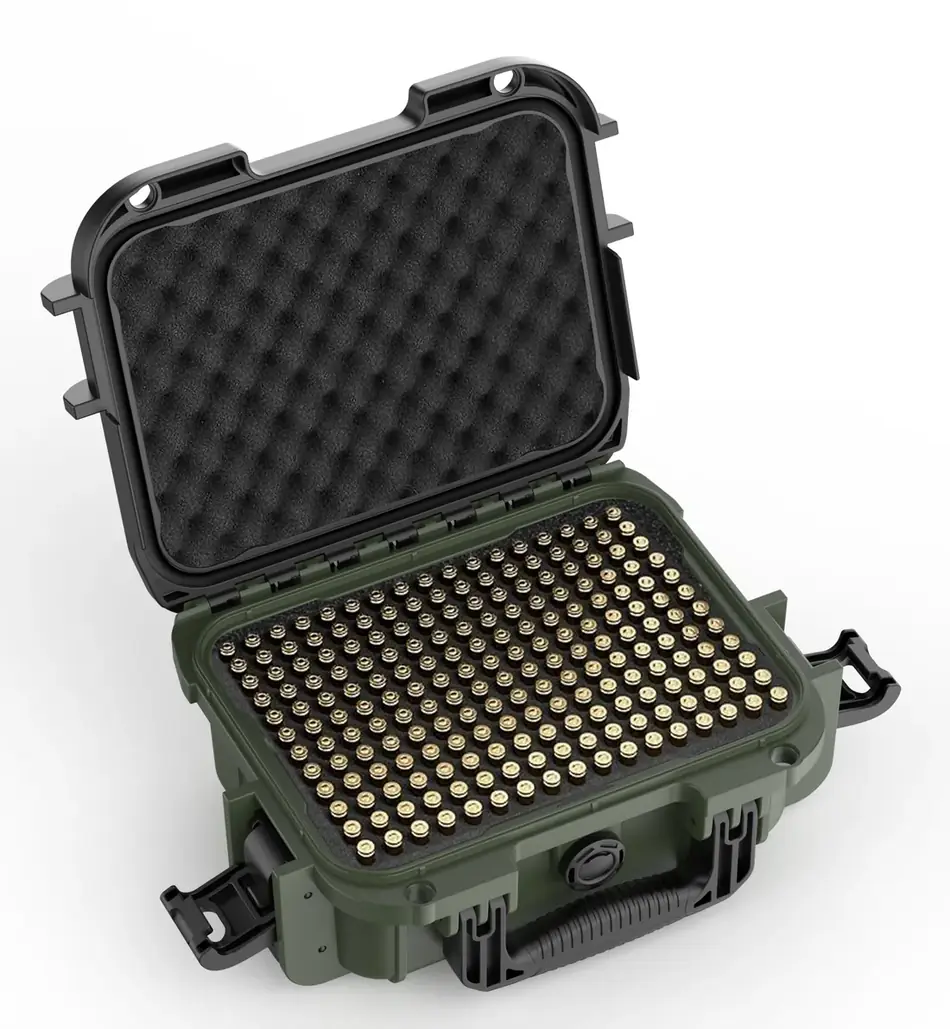
How should stackable cases be selected?
Select stackable cases from the stack you need, not from the box in front of you: fix your pallet or container height first, choose an external footprint that divides into it with minimal overhang, then match wall thickness to the loaded column height and payload mass. A locating rim that captures the case above matters more than raw shell strength, and every figure you compare must say whether it describes empty nesting or a loaded column. KeXin publishes these values per model; where a pallet or container number is not measured for your exact build it is supplied with the quotation rather than copied from a different part.
Key points
- Start from the stack: fix pallet or container height and target layers first, then pick the case whose footprint divides into that layout with the least overhang.
- Choose wall thickness for the loaded column, not the empty box; the ammunition family is published at roughly 3.0 to 5.0 mm, and taller or denser stacks belong at the thicker end.
- Read every stacking figure as empty or loaded before you compare two models, because a shallow-wall case that nests when empty is not the same as one that carries a tall loaded column.
- Prefer a moulded locating rim over a stronger flat lid; the rim routes compression through the walls so the lid, latch and seal keep working.
- Consistency across the batch sets the safe height, so spec the same tooling and wall for the whole order rather than trusting one good sample.
Define the stack before you choose the case
The selection problem is easier to solve from the top down. Write down the surface the cases will sit on, the maximum stack height your rack, container or forklift can accept, and the mass each loaded case will carry. Those three numbers fix the footprint, the column height and the compression at the bottom of the stack. A box selected to a stack you never defined tends to either waste vertical space or collapse, even though the moulding itself is sound.
Only after the stack is set does the part number become a matching exercise. Because many KeXin models share a plan footprint while varying only in depth, you can keep one clean column layout and simply trade depth for capacity. The WL3207 and WL3213, for example, both measure about 315 by 260 mm externally but run 70 and 128 mm deep, so a layout sized for that footprint holds either one without changing how the pallet fills.
Match the external footprint to your pallet and container
Overhang and dead gaps are what turn a stackable case into an unstable one. Take the external length and width of the shortlisted model and check how whole units divide across a standard pallet or your container floor; a footprint that leaves a strip of unused deck wastes volume and gives the top layer nothing to sit squarely on. Ammunition and transport sizes cluster around a handful of footprints, so a small shortlist usually covers most layouts without a custom tool.
Footprint also governs how a column behaves when the load is not identical at every level. Wide, low footprints such as the 360 by 310 mm WL3609 sit stably and suit high warehouse racks, while narrower footprints stack neatly but reward a deeper locating rim. Decide which failure you are guarding against, wasted space or sideways creep, and let that pick the plan dimensions for you.
Where the same footprint reappears across depths, keep it as your baseline and treat depth as a variable. That single habit lets one pallet pattern serve light shallow parts and heavier deep parts on the same lane, which is the cheapest form of flexibility in a mixed consignment.
Choose wall thickness for the loaded column
Wall thickness is the published number that best predicts how much a shell will deform under the weight above it. Across the catalogue the range is wide, but within the ammunition family models are specified at roughly 3.0 to 5.0 mm: the WL3213 sits near the light end at 3.0 mm, while a taller loaded part such as the WL9-2817 is published at 5.0 mm. Match the thickness to the mass and the number of layers above the base case, not to the heaviest single box.
The base case carries the sum of everything above it, so the rule of thumb is to move up the thickness range as the column grows or as the payload density rises. A thin wall that behaves well in a three-high lane can bow and change latch compression in a seven-high one. Where you are unsure, request the per-model datasheet value and the recommended stack height for your specific payload rather than extrapolating from the sample on the table.
Treat wall thickness as a system with the rim: a thick wall pressed on a flat lid still bows the lid, while a moderate wall with a capturing rim transfers load down the corners. Thickness decides how far you can go; the rim decides whether you get there intact.
State empty nesting versus a loaded column
Two different questions both get called stackability, and mixing them is the most common cause of damaged goods. Empty nesting asks whether bare cases sit inside one another or pile up for the return leg and for storage, which most models do and which is how they ship, often eight to twenty-four pieces to a carton depending on size. Loaded stacking asks whether a column of filled cases can bear compression for weeks without a wall taking a permanent set.
When you read a supplier figure, confirm which of the two it describes. KeXin marks models as stackable and publishes geometry per part; the pallet and container quantities, however, are stated only where measured, and where they are not measured for your build they come with the quotation. That keeps an empty-nesting convenience from being misleading a pallet or container number into a tested load rating it was never given.
Creep is the quiet failure that separates the two: a stack stable in week one can slowly deform under constant load. Where the payload is dense and the storage long, spec the thicker wall, interlock your layers and cap the height at what the weakest case in the batch will carry.
How selection criteria compare across options
| Criterion | Select For This | Watch Out For | Published Per Model |
|---|---|---|---|
| External footprint | Divides into pallet or container with minimal overhang | Dead gaps and top-layer overhang | External dimensions in millimetres |
| Wall thickness | Heavier or taller loaded columns | Thin wall used far above its layer count | Roughly 3.0 to 5.0 mm in ammunition family |
| Locating rim | Inland movement and repeated handling | Load borne on the flat lid | Moulded rim or corner geometry |
| Load state | Stating empty and loaded separately | Empty figure read as load capacity | Datasheet note on empty or loaded |
Where stackable cases are used
The selection logic shifts slightly by role. For ammunition and field-equipment transport, the priority is a locating column that survives repeated forklift handling, so a capturing rim and a 4 mm or thicker wall earn their weight. For warehouse and depot storage, height and footprint fill matter most, and a moderate wall in a clean pallet pattern usually wins on cost per stored unit. For the return leg, the value is in empty nesting, and a lightweight shallow part can be the better buy.
The same families also serve mixed fleets, where a carrier wants one footprint reused across depths so that different consignments stack on the same lane. That is where the shared-footprint models do their quiet work: the buyer standardises on the plan size and orders the depth each job needs, keeping the stacking behaviour predictable across the whole set.
Customising a stackable case for your stack
Where an off-the-shelf footprint misses your deck by a few centimetres, tooling changes are usually simpler than they sound. KeXin works on a wholesale and OEM basis: an OEM first sample typically takes around 45 days and a new tool around 125 days, on a 30 percent deposit, priced EXW or FOB. Depth, rim profile, wall thickness and insert fit are the practical levers; the goal is a case that locates squarely on your own pallet rather than an imported standard you then have to band and shim.
Bring three things to the conversation: your pallet or container floor plan, your maximum stack height, and the loaded mass per case. With those, the wall and rim can be set correctly the first time, and the pallet and container quantities are calculated from your figures instead of assumed from a different part.
What to confirm before you buy
A short pre-order checklist prevents most stacking disappointments. Confirm the per-model wall thickness and external dimensions, confirm whether any stack figure you were given describes empty or loaded cases, and confirm the recommended stack height for your payload rather than your sample. Ask how the batch is held to one tool and one wall spec, since the weakest case in a column sets the safe height. KeXin does not sell retail and does not ship DDP or from overseas warehouses; terms are wholesale and OEM, EXW or FOB.
Finally, treat a pallet or container number that is not published for your exact build as a quotation item, not a catalogue fact. A supplier who states what was measured, what was calculated and what was assumed is the one whose stacks you can trust in the warehouse.

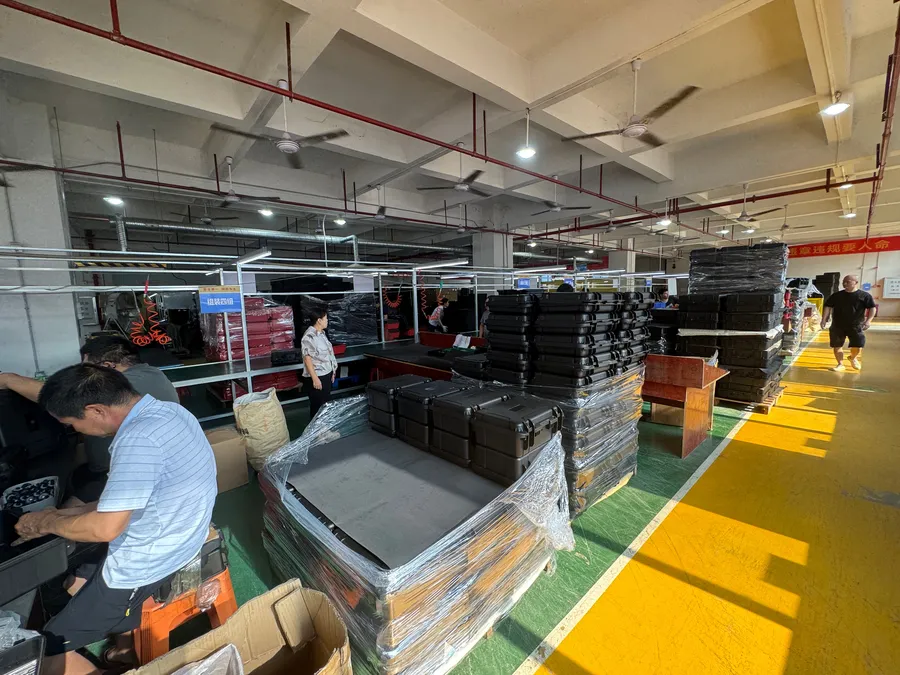
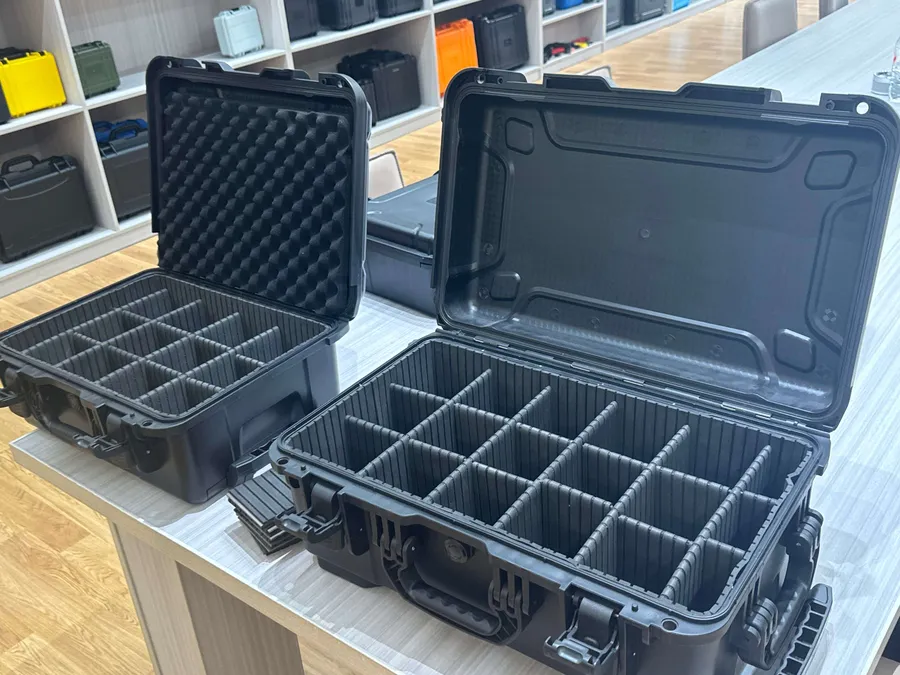
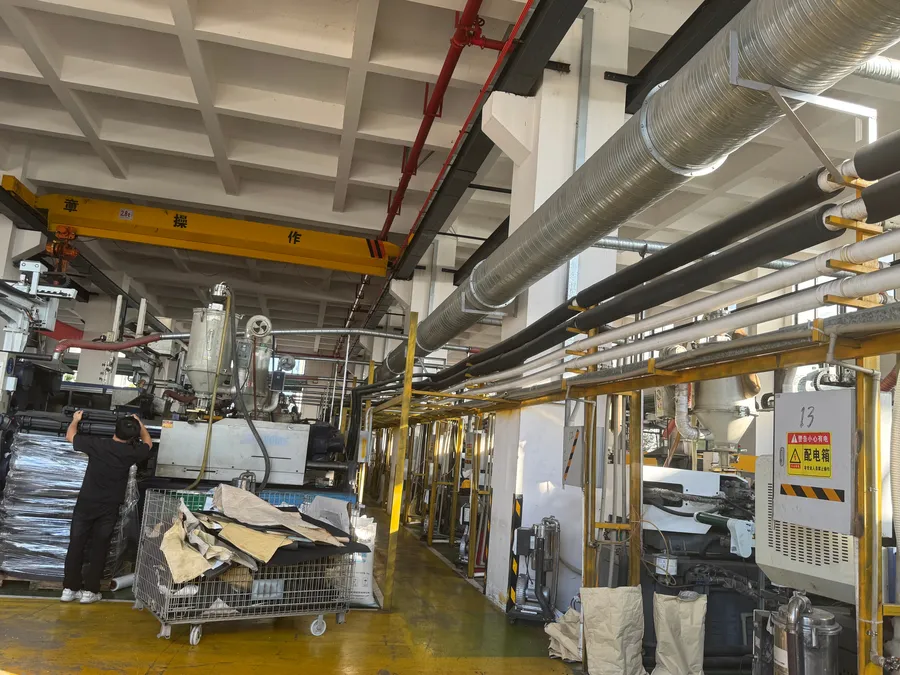
Customisation
Everything described above is configurable on a standard shell: interior layout (pick-and-pluck, die-cut or CNC-cut), foam grade and thickness, colour, logo method, latch and lock count, pressure-equalisation valve, cable ports, document holder and identification plate. A bespoke exterior geometry requires a new mould — 125 days, from 3,000 units per moulded component.
Procurement considerations
| Question | What to send us |
|---|---|
| Which shell fits? | Equipment L × W × H as packed, plus required clearance per axis |
| What does it cost? | Order quantity and estimated annual quantity — the two drive different answers |
| Is tooling needed? | Whether an existing shell clears the envelope with usable foam depth |
| Lead time? | Your required delivery date, not just the order date |
| Certification? | The exact standard your tender names — we will say whether we can test to it |
| Freight? | Destination and preferred terms; carton and pallet data supplied with the quotation |
Comparison and selection guide
The tables on this page exist because a protective case is chosen by comparing three things: the envelope, the environment and the handling chain. Where no table applies, the rule below is.
| Situation | What To Do |
|---|---|
| Fixed installation | Choose a box whose external height matches your racking pitch, and check the narrow internal width if the shell tapers. |
| Mobile use | Prefer a four-latch configuration and a lid that can be removed cleanly with gloves. |
| Inventory control | Specify a foam or partition layout so that a shortage is visible without opening compartments. |
- Size on internal dimensions plus clearance, never on a product name.
- Choose the carrying method before the shell: it changes the series, not just the price.
- Specify the interior last, and decide up front whether the end user will reconfigure it.
How should stackable cases be selected? relates to Storage & Transport Box Guide. Related families: Ammunition Storage & Transport Boxes. Related sectors: field and industrial equipment. Continue in the Storage & Transport Box Guide cluster.
This page is written from our own production data. If your requirement differs, send the dimensions and we will tell you which of the 155 models fits, or whether a custom route is needed.