What materials are suitable for heavy-duty boxes?
Three shell materials are suitable for heavy-duty boxes in our range: polypropylene for impact tolerance and chemical resistance, engineering polypropylene for added stiffness where stacks get tall, and ABS where a rigid panel and a print-ready surface matter. All three appear across the 68 models in our published storage box range, with wall thickness from 2.0 mm to 5.0 mm depending on the model. No material on its own makes a box heavy-duty: the wall class, the lid-to-base geometry, the closure and the interior decide how it actually carries. Choose the material for the environment and the load profile first, then choose the wall thickness for the stacking plan, and verify both on the datasheet of the exact model before you compare prices.
Key points
- PP is the default for heavy loads in cold, wet or chemically active environments; it flexes rather than fractures.
- Engineering PP buys stiffness for tall stacks at a mid-range cost; deep stacking shells in our range use it at up to 5.0 mm walls.
- ABS gives the most rigid panel and the best surface for print and paint; shells in our range publish walls up to 4.8 mm.
- Material decides chemistry and temperature behaviour; wall thickness and geometry decide stacking. Specify both, not either.
- Every model datasheet names its shell material; if a quotation cannot, ask before comparing prices on weight alone.
- For OEM programmes, colour and logo options start at 300 units and a custom mould at 3,000 units.
Material is one part of a heavy-duty system
A box earns the description heavy-duty from four decisions made together: the polymer the shell is moulded from, the wall thickness it is moulded at, the geometry of the base and rim, and the closure that keeps the halves clamped. Buyers who specify only the material get a shell that behaves well in a lab summary and poorly under a stack, because stiffness without wall thickness is a thin rigid panel that cracks, and thickness without the right polymer is a heavy box that goes brittle in cold weather. Our product database therefore publishes the material and the wall thickness side by side for every model, from 2.0 mm on small utility shells to 5.0 mm on deep stacking shells.
The 68 models in our storage box range use all three of the materials below, which is itself the practical answer: there is no single heavy-duty polymer, only pairings of material and wall class that fit a load profile. Treat the material choice as the environmental decision and the wall class as the mechanical one.
Polypropylene: the working default
PP is the material most of our range is moulded in, and for heavy contents it is usually the starting point. It has the lowest density of the three, so a PP shell of the same size weighs less; the 8.4 litre model at 315 x 260 x 128 mm with a 3.0 mm wall has a published net weight of 860 g, while a similar-volume ABS shell carries noticeably more mass. PP tolerates cold handling, resists fuels, solvents and cleaning agents, and when it is overloaded it tends to deform and recover rather than fracture, which is the behaviour you want in a box that gets dropped onto a shelf edge once a month.
Published walls in our PP shells run from 2.0 mm on the smallest utility models to 5.0 mm on deep stacking models such as the 280 x 225 x 111 mm shell, and 4.9 mm on the 345 x 290 x 135 mm model. Because grades differ, the datasheet for each model is the authority; do not generalise one model's figures across the range.
Engineering polypropylene: stiffness for stacks
Engineering PP is a modified grade of the same polymer family, formulated to raise stiffness and hold shape under sustained load. That matters most where boxes form tall columns: on shelving, on pallets, or in vehicles where the bottom box carries the column above it for weeks at a time. Under that kind of sustained stacking load, a shell that is stiff enough avoids the slow outward bulge that eventually unseats the rim of the box above.
In our published range the engineering PP shells sit in the deeper, stacking-oriented end: the 334 x 287 x 150 mm model at a 4.1 mm wall with a 1,670 g net weight, the 280 x 225 x 165 mm model at a 5.0 mm wall, and the 350 x 300 x 79 mm model at a 3.0 mm wall. Cost sits between commodity PP and ABS. If your stacking plan is the demanding part of the requirement rather than the chemistry, this is the material to ask about first.
ABS: rigidity and finish
ABS is the most rigid of the three and holds its surface finish, which makes it the choice where panels must stay flat and presentable, or where the shell will be printed, painted or labelled as part of the product identity. Our ABS shells occupy their own series in the range: the 356 x 267 x 120 mm model at a 3.5 mm wall with a 1,300 g net weight, the 339 x 310 x 125 mm model at a 4.8 mm wall, and the 328 x 232 x 167 mm model at a 4.0 mm wall with a 1,370 g net weight, eight pieces to a carton.
The trade-offs are weight and chemistry. ABS is denser than PP, so an equal-volume shell is heavier, and its resistance to solvents and to hard cold is grade-dependent rather than class-leading. Where the requirement is dominated by cold-weather handling or chemical exposure, we usually steer buyers back to PP; where the requirement is a stiff, dimensionally stable, good-looking panel, ABS earns its cost.
The three materials side by side
| Property | Pp | Engineering Pp | Abs |
|---|---|---|---|
| Role in a heavy-duty build | Working default for impact and chemistry | Stiffness for tall or long-duration stacks | Rigid panel with a print-ready surface |
| Published wall range in our box range | 2.0 - 5.0 mm per model | 3.0 - 5.0 mm per model | 3.0 - 4.8 mm per model |
| Mass at equal volume | Lowest of the three | Intermediate, grade-dependent | Highest of the three |
| Overload behaviour | Deforms and recovers | Deforms less than commodity PP | Rigid; low-temperature behaviour is grade-dependent |
| Chemical resistance | Strong against fuels and solvents | Strong, follows the base polymer | Lower than PP; check the exposure list |
| Surface finish | Functional | Functional | Holds print, paint and labelling |
Choosing by load profile and environment
Decide in this order. First the environment: cold stores, vehicle decks and chemical exposure point to PP; presentation surfaces and printed branding point to ABS. Second the stack plan: column height and dwell time decide whether commodity PP at a thicker wall is enough or whether engineering PP is the better spend. Third the seal requirement, which is marked per model rather than assumed, since a few small utility shells are offered without a gasket. Only then compare wall thickness across candidate models, published from 2.0 mm to 5.0 mm in our range. If two models clear the mechanical bar, the material class should be the tiebreaker, because the environment punishes the wrong polymer long before it punishes a millimetre of wall.
Application: ammunition and inventory transport
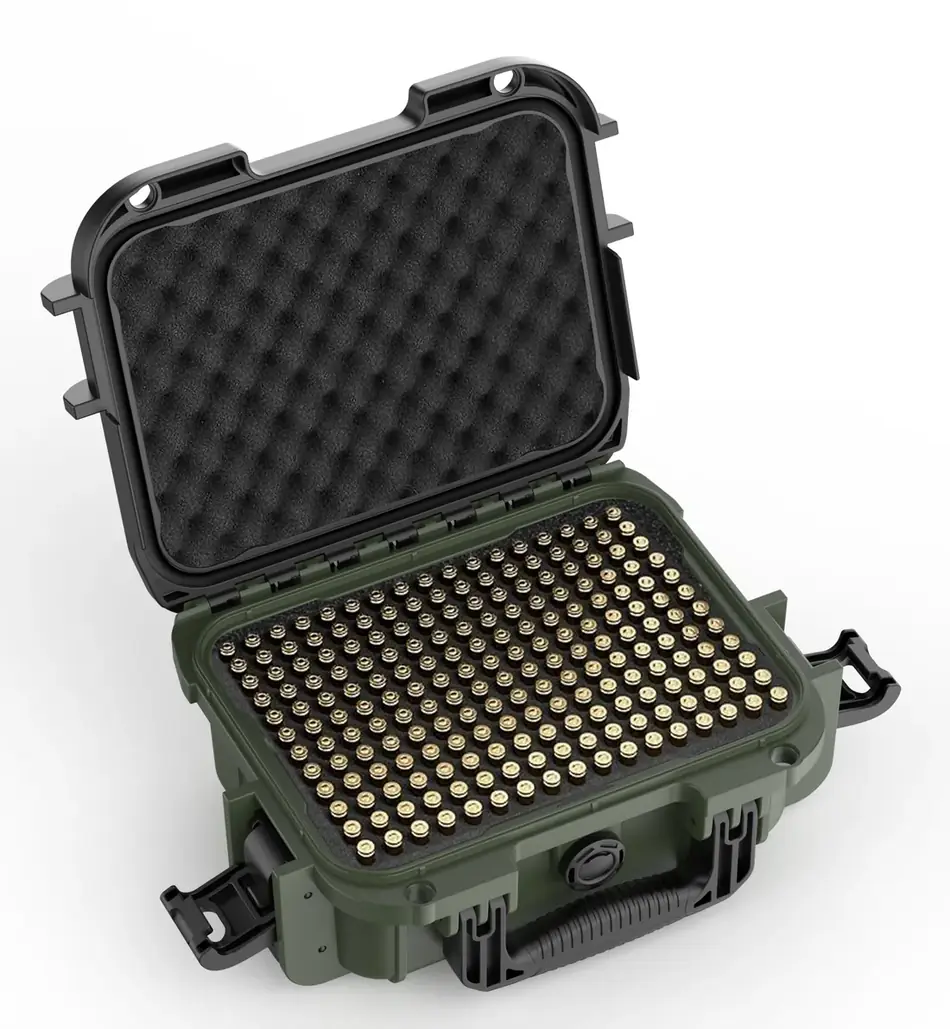
Ammunition and inventory transport concentrates all three decisions in one product. The contents are dense relative to their volume, the boxes live in stacks on shelves and trolleys, and the shells may meet fuels, solvents and outdoor storage over their service life. That is why the range publishes PP, engineering PP and ABS shells with sealing gaskets available on most models, all stackable, with wall thickness stated per model. Buyers matching this application usually start from the stacking plan, confirm the material against the storage environment, and then let the interior be engineered for the load; our ammunition transport application page collects these handling cases, and the storage box guide explains the rest of the specification.
Custom colours, grades and moulds
Material is not a fixed menu on an OEM programme. Colour and logo options start at 300 units, and a custom mould for a shell outside the published range starts at 3,000 units. Programme timelines are fixed parameters: a first OEM sample takes about 45 days, and a new mould about 125 days, with a 30 percent deposit to open tooling. Terms are wholesale only, quoted EXW or FOB; we do not sell retail, do not ship DDP, and do not operate overseas warehouses. If your environment needs a grade we do not list, say so in the RFQ rather than settling for the nearest stock colour, because the material class is the part of the specification that is hardest to correct after the first shipment.
Buying notes: verifying material claims
Comparing quotations across suppliers only works when the material is stated. Ask for three things in writing: the shell material of the quoted model, its wall thickness, and its net weight. Our database publishes all three for every model, alongside packing data such as 20 pieces per carton for the 6.6 litre engineering PP model and 8 pieces per carton for the 8.1 litre ABS model; pallet quantities are calculated from the carton footprint against your pallet size, and 20GP, 40GP and 40HQ container loading figures are supplied with the quotation. With those numbers in hand, two quotes can be compared like for like, and a supplier who cannot name the material has told you something before the first order.
Customisation
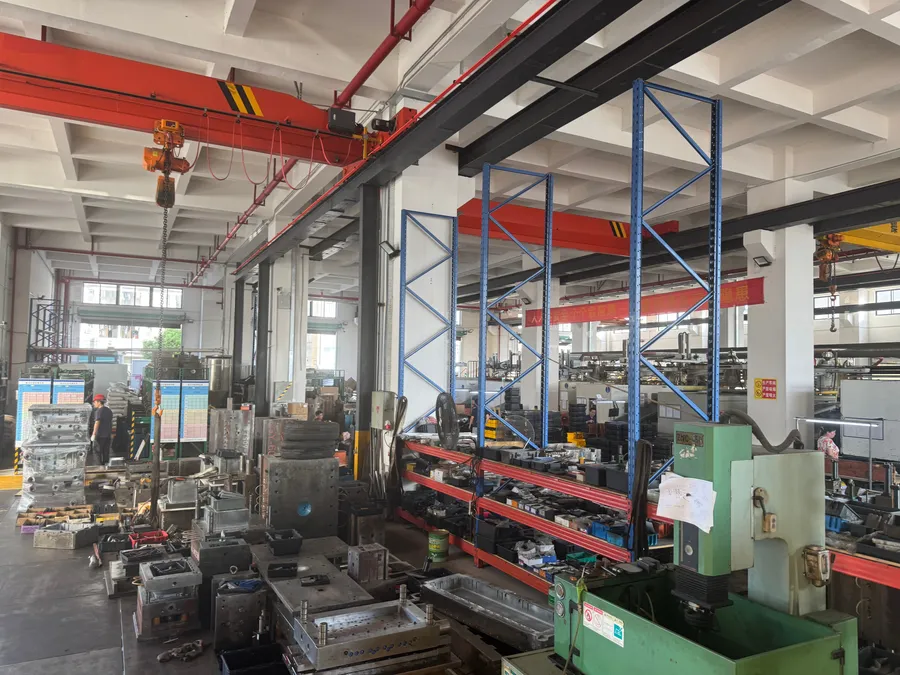
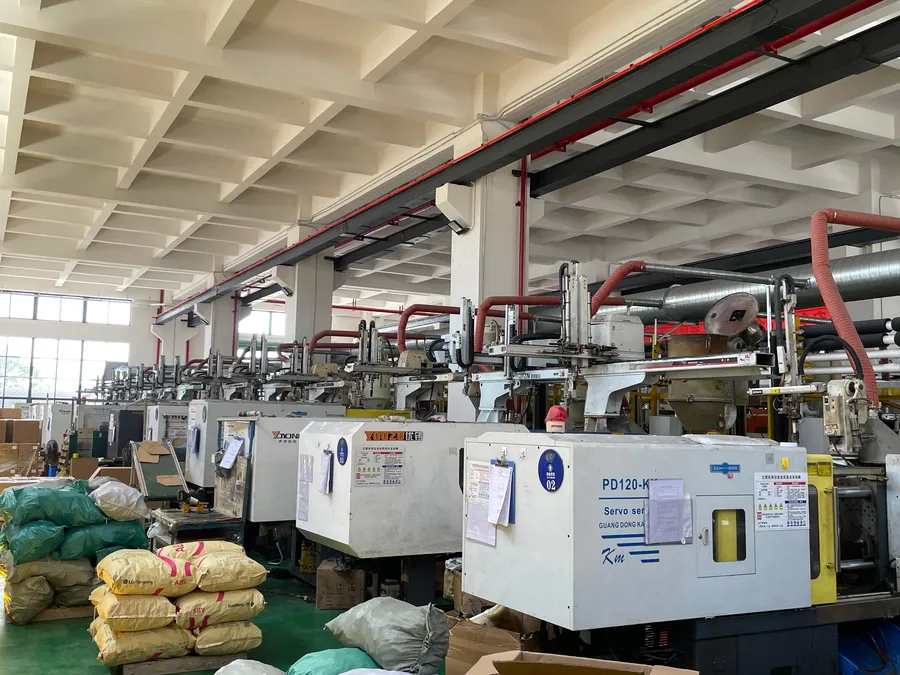
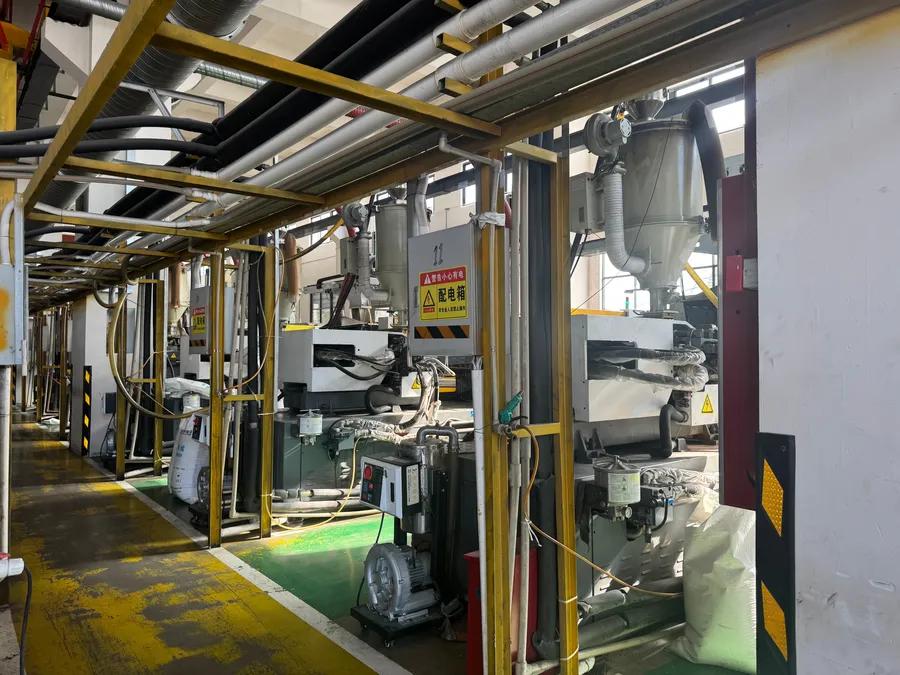
Everything described above is configurable on a standard shell: interior layout (pick-and-pluck, die-cut or CNC-cut), foam grade and thickness, colour, logo method, latch and lock count, pressure-equalisation valve, cable ports, document holder and identification plate. A bespoke exterior geometry requires a new mould — 125 days, from 3,000 units per moulded component.
Procurement considerations
| Question | What to send us |
|---|---|
| Which shell fits? | Equipment L × W × H as packed, plus required clearance per axis |
| What does it cost? | Order quantity and estimated annual quantity — the two drive different answers |
| Is tooling needed? | Whether an existing shell clears the envelope with usable foam depth |
| Lead time? | Your required delivery date, not just the order date |
| Certification? | The exact standard your tender names — we will say whether we can test to it |
| Freight? | Destination and preferred terms; carton and pallet data supplied with the quotation |
Comparison and selection guide
The tables on this page exist because a protective case is chosen by comparing three things: the envelope, the environment and the handling chain. Where no table applies, the rule below is.
| Situation | What To Do |
|---|---|
| Fixed installation | Choose a box whose external height matches your racking pitch, and check the narrow internal width if the shell tapers. |
| Mobile use | Prefer a four-latch configuration and a lid that can be removed cleanly with gloves. |
| Inventory control | Specify a foam or partition layout so that a shortage is visible without opening compartments. |
- Size on internal dimensions plus clearance, never on a product name.
- Choose the carrying method before the shell: it changes the series, not just the price.
- Specify the interior last, and decide up front whether the end user will reconfigure it.
What materials are suitable for heavy-duty boxes? relates to Storage & Transport Box Guide. Related families: Ammunition Storage & Transport Boxes / Military Equipment Cases. Related sectors: field and industrial equipment. Continue in the Storage & Transport Box Guide cluster.
This page is written from our own production data. If your requirement differs, send the dimensions and we will tell you which of the 155 models fits, or whether a custom route is needed.