What information should be included in an RFQ?
A request for quotation is complete when a supplier can price it without guessing. For a wholesale order of stackable storage and ammunition boxes, that means nine fields on one page: the model you want or the internal envelope you need in millimetres; the published wall and mass figures you are comparing; first-order quantity plus a twelve-month forecast; the closure and seal expectation written per model; the interior choice, bare shell, foam base or cut tray; the carton and pallet target; the delivery term, EXW or FOB; the acceptance method you will actually inspect on arrival; and the date you need the goods. Every gap gets filled differently by each bidder, which is why two quotations for what looks like the same box can differ by a third.
Key points
- Name the model or state the internal envelope in millimetres; an external footprint alone cannot be checked against your contents.
- Quote quantity as two numbers, first order and twelve-month forecast, because tier price and tooling advice follow both.
- Write seal and latch expectations per model, because a gasket is listed on some sizes and not offered on others in one range.
- Say whether the interior ships bare, with a foam base or with a cut tray, and attach a drawing, a photo of the kit or a sample.
- Put the packing plan in the enquiry: pallet size and deck height decide carton counts, which are not published as one range figure.
- Fix the commercial term in the same document: wholesale and OEM only, EXW or FOB, thirty percent deposit, no DDP, no overseas stock.
- Ask bidders to mark unmeasured items as unmeasured instead of filling the gap with a marketing number.
Why an RFQ needs nine fields rather than a part number and a quantity
A price request asks what something costs. A request for quotation asks what the answer will be built to, and the difference shows up in the replies. If the enquiry says only thirty thousand boxes, one bidder quotes the cheapest wall it owns, another quotes the model you half-remembered from the catalogue, and a third quotes a colour you never asked for. None of them is wrong; all three filled the blank differently. The nine fields below are the blanks that actually move a number: interior, published specification, quantity tier, forecast, closure, interior fit, packing plan, delivery term and acceptance.
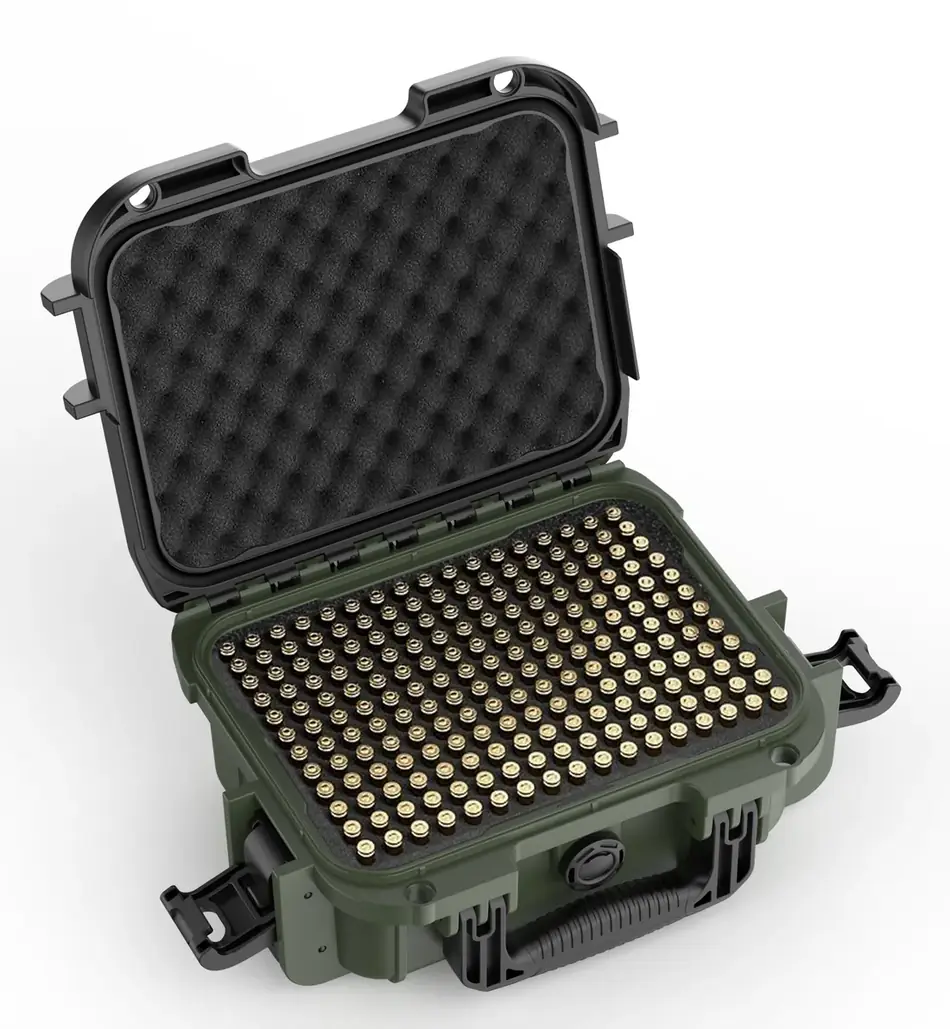
For a box programme specifically, two of those fields carry more weight than they would on a single custom case. You are buying many units of an existing mould rather than paying for a new one, so the variables are quantity tier and packing, and the model pages already publish the geometry you are supposed to check yourself. A complete box RFQ therefore reads less like a design brief and more like a well-specified purchase order with the evidence attached.
Fields one and two: the model line and the interior it buys you
Field one is the model, written as the SKU plus the internal dimensions, not as a picture or a phrase such as medium ammo box. The published interior is what your contents sit in, and the gap between external and internal is wall, flange and lid geometry. On our box pages a KX-2811 is listed at 280 by 225 by 111 millimetres outside and 253 by 180 by 98 inside with a 5.0 millimetre wall, while a shallower KX-3207 is 315 by 260 by 70 outside and 308 by 230 by 64 inside with a 3.0 millimetre wall. Same family, opposite design points, and only the interior tells you which one holds your item.
Field two is the specification you want echoed back in the quotation: wall thickness and net mass per model, plus the usable interior volume. Usable volume is published separately from internal volume because a foam base and the lid take space, so a KX-3213 lists 8.4 litres of internal volume against 7.2 litres usable. Ask the bidder to repeat your numbers in the reply line. A quotation that returns different figures than the ones you sent is answering a different question.
Fields three and four: quantity tier and the twelve-month forecast
Quantity in a box RFQ has to be written against the tier it unlocks, because the minimum order changes by an order of magnitude between a stock purchase and a tooling commitment. Published tiers are simple: standard stock models and a custom foam insert begin at one unit; a printed logo, a body colour change and an OEM build each begin around three hundred units; a dedicated custom mould begins around three thousand units per component. A buyer who writes five hundred units and wants a logo gets a clean answer. A buyer who writes fifty units and wants a logo gets a lecture they could have avoided.
Field four is the forecast, which costs nothing to give and changes the advice you receive. Stock availability, carton consolidation across two or three sizes, and whether a colour change is worth negotiating at all all depend on repeat volume. State the first order, the expected reorder quantity and the twelve-month estimate, and ask the bidder to price the first order while commenting on the forecast. Lead time follows the same ladder: an OEM build on an existing mould is planned around forty-five days to first sample, and a new mould around one hundred and twenty-five days, so the forecast is what lets a supplier reserve capacity honestly.
Fields five and six: closure, seal and hardware written per model
Sealing is not switched on for an entire range. Some box models are published with a compressible gasket between lid and base and some are not: the KX-1204 lists no seal on its shell, while the KX-3315 and the KX-63413 both list one. Write the requirement against the specific model line, and if a seal is required, say whether the use is dust exposure, damp storage or transport in an open vehicle, because that decides how much attention the latch layout needs. Where a gasket exists it only resists ingress where the latches pinch it closed, so latch count and position are part of the same field. Latch count is specified per configuration rather than fixed per mould, and the published hardware note is that the latch body accepts a standard padlock, which is worth stating if your store is secured that way.
The same discipline applies to the remaining hardware. Carry handle type, whether feet or a stacking rim is expected, and whether a pressure-equalising valve is wanted are all configuration choices rather than catalogue constants. A one-line statement per field beats a paragraph of adjectives, and it is auditable when the goods arrive.
Field seven: the interior brief, from bare shell to cut tray
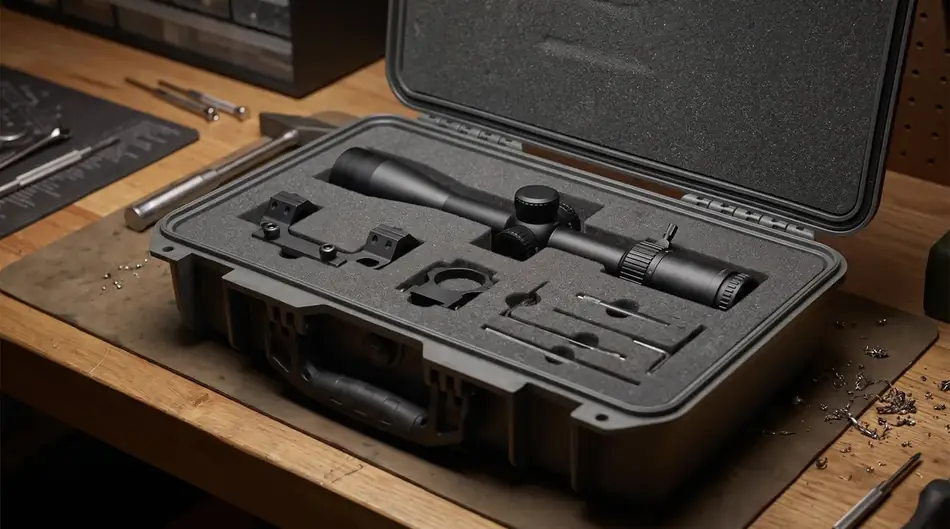
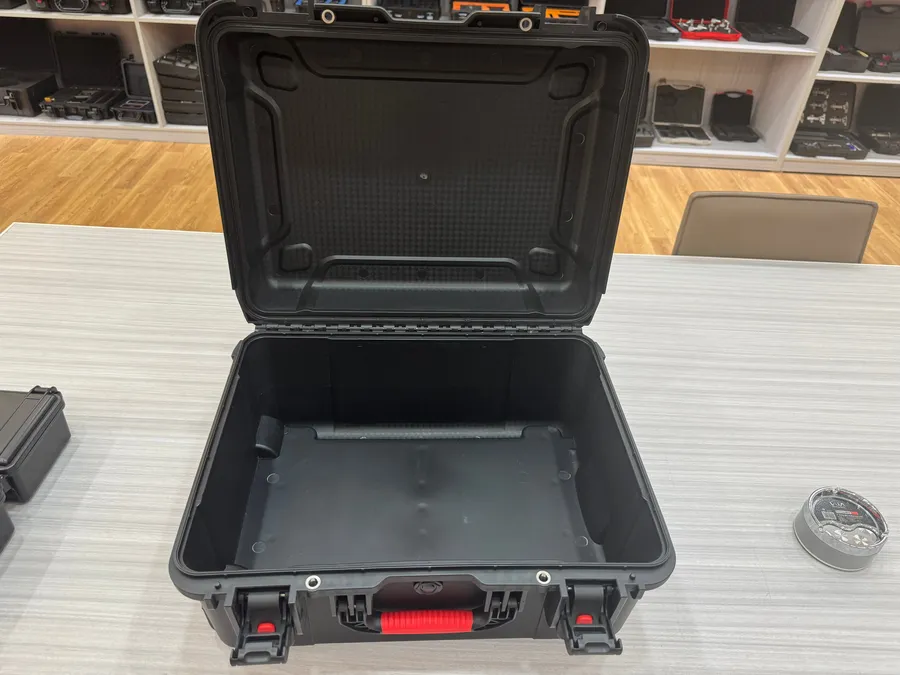
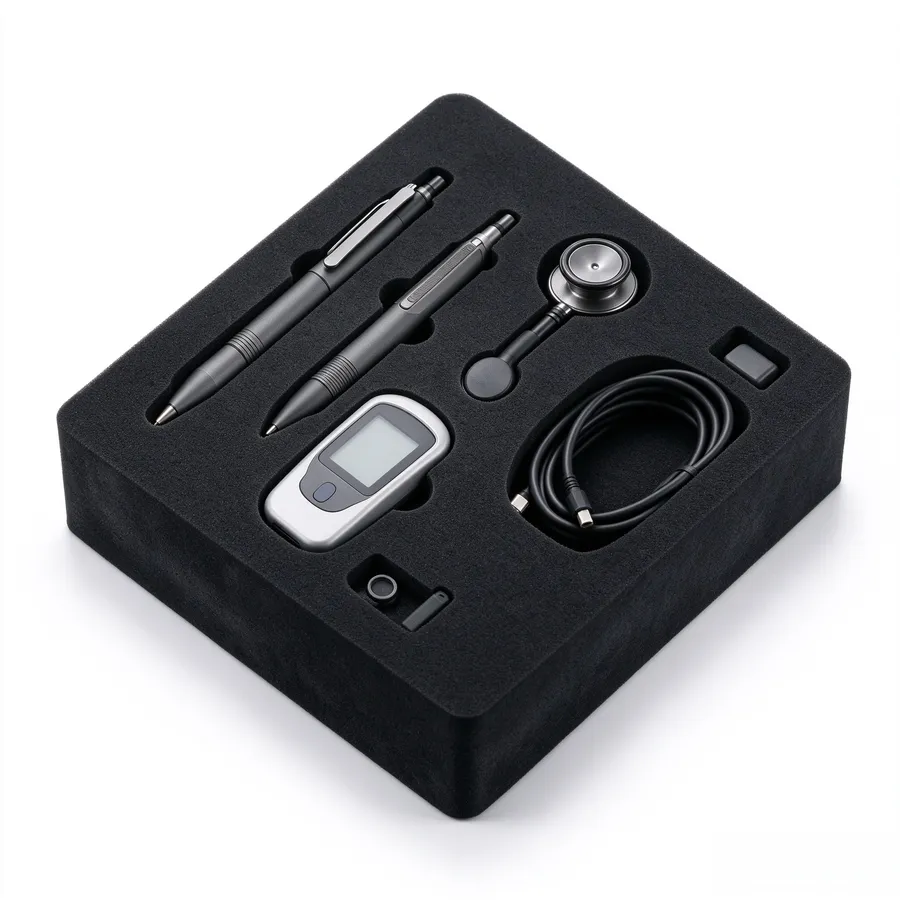
Say plainly whether the boxes ship empty or fitted. A bare shell is a legitimate answer for a consumables store; a routed base is what keeps a load from travelling; a cut tray is what you want when the contents are issued and returned repeatedly. Our published interior options cover pick and pluck, die-cut and CNC-cut foam in cross-linked PE, EVA or EPS, in top, base, convoluted or layered layouts. Because a cut insert is machined rather than tooled, a fitted interior can start from a single unit, so a trial pallet does not have to arrive empty.
The one thing the RFQ must attach is reference material. A drawing, a photograph of the kit as it is packed, or a physical sample is what we ask for, and the field is left blank in far more enquiries than it should be. If you cannot supply any of the three, write that instead and ask for the interior to be quoted as a bare base layer you can route locally.
Fields eight and nine: the packing plan and the acceptance wording
Packing is where a box order quietly becomes a freight problem. Pallet quantities are not published as a single range figure, because the count is calculated from the carton footprint against the buyer's pallet size and deck height, and container loading for a twenty-foot, forty-foot or high-cube unit is supplied with the quotation rather than assumed from a generic table. So field eight is your own logistics data: pallet dimensions you load to, target units per pallet if you have one, whether you want mixed-model pallets, and the destination port if the term is FOB. Give the supplier the deck and it will give you a count; withhold it and you will plan your warehouse from a guess.
Field nine is how you will accept the delivery. A short line such as interior dimensions and net mass checked against the confirmed model sheet on arrival, plus lid closure and latch engagement on a sampled carton, tells the bidder what quality has to survive and sets a reference you can hold in a dispute. Ask for a signed dimensional report for the exact model if incoming inspection requires one, and request it before the order rather than after the container lands.
How the nine fields look against published models
| Field | What To Write | Published Example | Why It Moves Price |
|---|---|---|---|
| Model line | SKU plus interior in mm | KX-2811: 253 x 180 x 98 mm internal | Fixes which mould is being bought |
| Specification echo | Wall and net mass per model | KX-3315: 4.1 mm wall, 1670 g | Stops a thinner substitute being quoted |
| Quantity tier | First order in units | Stock and cut foam from 1; logo or colour near 300 | Determines which price band applies |
| Forecast | Reorder size and twelve-month estimate | Mould route near 3000 per component | Decides tooling advice and capacity |
| Seal and closure | Seal required yes or no, per model | KX-1204 no seal; KX-63413 gasket listed | Changes hardware and lid specification |
| Interior | Bare, foam base or cut tray | PE, EVA or EPS; CNC or die cut | Adds labour, not necessarily tooling |
| Packing plan | Pallet size and deck height | Counts calculated from carton footprint | Drives freight cost per usable unit |
Choosing the response path your RFQ unlocks
Once the nine fields are filled, the order normally resolves into one of four paths, and a good RFQ makes the choice obvious to both sides. Path one is stock: your interior fits a published model, quantity is anywhere from a pallet upward, nothing is bespoke, and the quotation is a unit price plus packing data. Path two is stock box with a fitted interior, where the shell stays standard and only the foam is cut to your reference, still starting from a single unit. Path three is OEM on an existing mould: a printed logo, a body colour or your hardware choices, which is where the three-hundred-unit tier and the forty-five-day first-sample plan apply. Path four is a dedicated mould, which needs the three-thousand-unit order, the one-hundred-and-twenty-five-day schedule and a component-level agreement. Naming your path in the enquiry is faster than asking for a quote on all four.
Where a complete box RFQ gets used
The same nine fields serve every use of these boxes, which is why it is worth writing them once as a template. Ammunition and pyrotechnic consumables are the obvious case, where count, closure and a settled load matter more than anything else. The identical document works for batteries and power packs, spares and tooling kits, rations and water, comms accessories, and any item a store issues and receives repeatedly. Wholesale buyers and distributors use it to compare two or three moulds across a whole catalogue, and integrators use it to price the box layer of a larger equipment programme. What changes between those uses is the interior brief and the acceptance line, not the structure.
Customisation and OEM lines worth attaching
If the enquiry is an OEM build, three attachments save a round of correspondence: your artwork or logo file with the print method you expect and a stated position on the shell; the colour reference, given as a recognised colour standard rather than a word; and the packaging brief if the boxes go to retail or to a distribution centre under your own brand, including carton printing and any labelling. Colour and logo work sits near three hundred units, so it is worth grouping several sizes into one enquiry to reach the tier instead of paying for a bespoke insert on each. What we do not offer is retail quantity, DDP landed pricing or overseas warehouse stock, and stating that expectation in the RFQ avoids a quotation for a service that will never be provided.
Purchasing notes: what a complete RFQ exposes in the bids
A well-filled enquiry is also a screening tool. Compare replies line by line against your own fields rather than comparing the totals. A bidder who returns your published dimensions unchanged, states wall and mass per model, answers the seal question for the exact model and gives a pallet count calculated from your deck is working from data. A bidder who rounds your numbers, quotes one wall thickness across three sizes, or supplies an ingress or drop figure that appears on nobody's test record has told you how the order would be handled. On our side we publish measured dimensions and mass per model and leave untested protection items marked as not measured, with accredited testing quoted per configuration on request; commercial terms are wholesale and OEM, EXW or FOB, against a thirty percent deposit.

Customisation
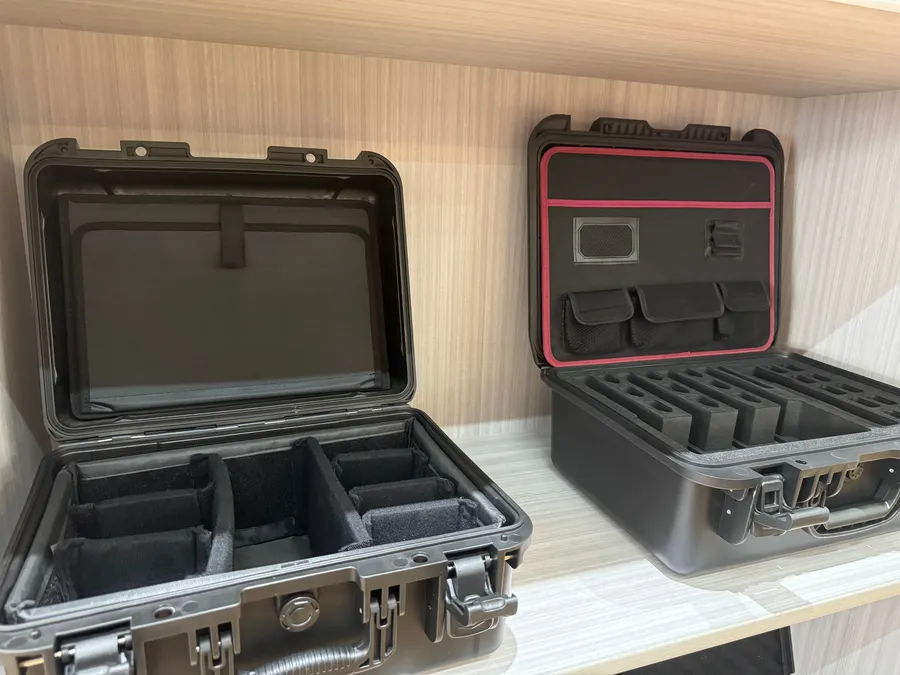
Everything described above is configurable on a standard shell: interior layout (pick-and-pluck, die-cut or CNC-cut), foam grade and thickness, colour, logo method, latch and lock count, pressure-equalisation valve, cable ports, document holder and identification plate. A bespoke exterior geometry requires a new mould — 125 days, from 3,000 units per moulded component.
Procurement considerations
| Question | What to send us |
|---|---|
| Which shell fits? | Equipment L × W × H as packed, plus required clearance per axis |
| What does it cost? | Order quantity and estimated annual quantity — the two drive different answers |
| Is tooling needed? | Whether an existing shell clears the envelope with usable foam depth |
| Lead time? | Your required delivery date, not just the order date |
| Certification? | The exact standard your tender names — we will say whether we can test to it |
| Freight? | Destination and preferred terms; carton and pallet data supplied with the quotation |
Comparison and selection guide
The tables on this page exist because a protective case is chosen by comparing three things: the envelope, the environment and the handling chain. Where no table applies, the rule below is.
| Situation | What To Do |
|---|---|
| Fixed installation | Choose a box whose external height matches your racking pitch, and check the narrow internal width if the shell tapers. |
| Mobile use | Prefer a four-latch configuration and a lid that can be removed cleanly with gloves. |
| Inventory control | Specify a foam or partition layout so that a shortage is visible without opening compartments. |
- Size on internal dimensions plus clearance, never on a product name.
- Choose the carrying method before the shell: it changes the series, not just the price.
- Specify the interior last, and decide up front whether the end user will reconfigure it.
What information should be included in an RFQ? relates to Storage & Transport Box Guide. Related families: Ammunition Storage & Transport Boxes / Tool Cases / Tactical Equipment Cases. Related sectors: field and industrial equipment. Continue in the Storage & Transport Box Guide cluster.
This page is written from our own production data. If your requirement differs, send the dimensions and we will tell you which of the 155 models fits, or whether a custom route is needed.