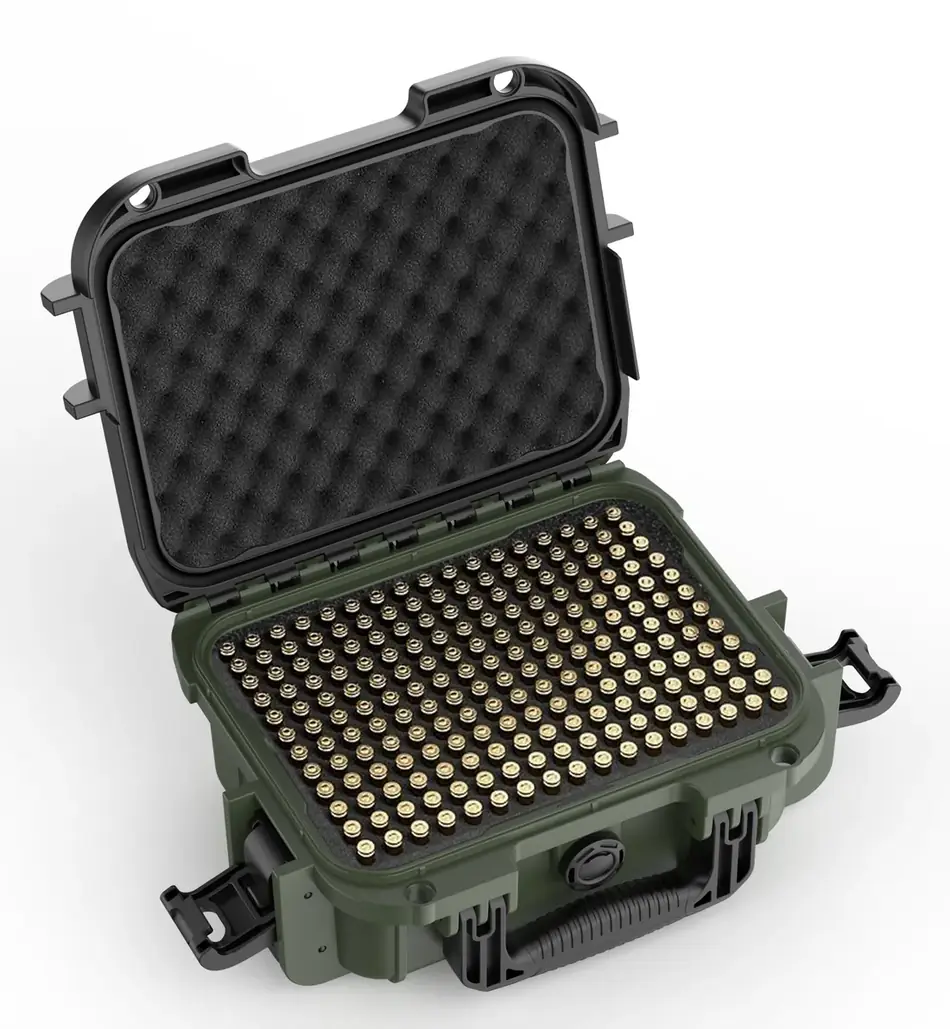
What is an ammunition storage box?
An ammunition storage box is a rigid, stackable, reusable box used to store and move a defined quantity of items as inventory rather than to carry a single object. The real product is not the plastic but the system it creates: a fixed internal volume, a stacking rim that lets loaded boxes ride safely on top of one another, a closure that keeps the contents settled and out of dust, and carton data that lets a buyer plan a pallet. Ammunition is one use; the same boxes serve as an inventory and transport system for parts, batteries, rations, tools and any consumable that must be counted, stacked and issued. In our published range, sixty-eight models cover this role, with internal volumes from 0.3 litres up to 19.9 litres and wall thickness published per model between 2.0 mm and 5.0 mm, every one of them stackable and none of them fitted with wheels.
Key points
- A storage box is bought as a system: internal volume, stacking rim, closure and carton count decide it; everything else follows.
- Stacking load is carried by the rim and the walls, never by the lid panel, so wall thickness is a stacking number, not a styling one.
- A box that tapers has a narrow internal width smaller than its external width — check it before you plan a rack.
- Carton pieces-per-box are published per model, so an order is planned on cartons and pallets, not on single pieces.
- Pallet fit is calculated from the carton footprint against your pallet size; where a figure is not measured we do not state it.
What actually makes it a storage box
A storage box is distinguished from a carrying case by what you ask it to hold and how long you ask it to hold it. A carrying case protects a specific object for a journey; a storage box holds a quantity of small, interchangeable items as stock, sits on a shelf or a pallet for long periods, and is opened and closed many times by different hands. That reframes the design brief around four things: a known internal volume so a given quantity fits, a rim geometry that lets loaded boxes stack without crushing the ones below, a closure that keeps the contents settled and out of dust and grit, and a lid-to-base depth split that suits how the items actually lie down. Ammunition is the name people use because it is the classic bulk-issued consumable, but the same logic is why the identical boxes end up storing spare parts, batteries, rations, fasteners and field tools. The box is an inventory unit that happens to be a physical container.
Why stacking behaviour matters more than the shell
In an armory, a storeroom or a supply container, boxes are not stored one at a time — they are stacked, several high, usually with the ones at the bottom fully loaded. So the value of a storage box is how predictably it behaves in a stack. The load is carried by the rim and the walls, never by the flat of the lid panel; if the walls are too thin, a column of loaded boxes bulges the lower shells, the lid no longer closes evenly, and the whole stack goes unstable. That is why wall thickness, published per model between 2.0 mm and 5.0 mm across this range, is really a stacking specification, and why the external footprint and the rim shape matter more to a warehouse than to a person carrying one box by hand. A box that tapers to a narrower internal width is fine for loose contents but a problem in a fixed rack, so the narrow internal width is a figure you check against the slot you plan to store it in. Get the stacking right and the box becomes a repeatable volume you can count and re-count.
Sizes and the numbers that matter
The numbers that decide a storage order are the internal envelope, the resulting internal volume, the wall thickness that governs stacking, and the carton pieces-per-box that lets you turn a quantity into pallets. The six models below use published measured figures; they are examples from the range, not a general capability claim, and the box you order is specified from its own data.
| Model | Internal Mm | Internal Volume L | Wall Mm | Material | Pieces Per Carton |
|---|---|---|---|---|---|
| KX-2005 | 190 x 135 x 40 | 1.0 | 2.0 | PP | 40 |
| KX-2406 | 230 x 155 x 50 | 1.8 | 2.0 | PP | 20 |
| KX-3207 | 308 x 230 x 64 | 4.5 | 3.0 | PP | 24 |
| KX-3213 | 308 x 230 x 118 | 8.4 | 3.0 | PP | 16 |
| KX-4010 | 390 x 315 x 88 | 10.8 | 3.0 | PP | 10 |
| KX-4321 | 411 x 208 x 202 | 17.3 | 3.0 | Engineering PP | 12 |
How the range is built
The shells are injection-moulded thermoplastic in a lid and a base: polypropylene for most of the small and mid boxes where impact and cost balance, engineering polypropylene on the deeper, heavier boxes where stiffness in a stack matters, and ABS where a rigid structure and a clean finish are wanted. Empty mass is published per model and runs from about 100 grams on the smallest 0.3 litre utility box up to roughly 2.3 kilograms on the largest deep boxes, so a full column is planned on mass as well as on volume. Every model in this range is stackable and none is fitted with wheels — a storage box is meant to sit on a shelf or a pallet and be lifted, not rolled, and adding a wheel set would only add mass, cost and a stacking problem. The lid-to-base depth split varies per model: shallow even boxes for a flat spread of small items, and deep-base boxes such as the 17.3 litre KX-4321 for taller contents that need to stand in the base with the lid simply closing over them.
Choosing the right box
Size the box to the quantity you need to store, not to the item you happened to measure first. Work out the total volume of the contents as they will actually sit, allow a little headroom so the closure still seals, and choose the internal volume that matches — the range runs from a 0.3 litre KX-1204 utility box up to a 19.9 litre deep box, so a given stock item usually narrows to two or three sizes. Then read the box against how it will be stored: check the wall thickness for the stack height you intend, check the narrow internal width if the box tapers and has to fit a rack slot, and check the external footprint against the shelf or pallet bay. Finally pick the interior. Many bulk consumables travel loose and need nothing but a divider; anything that must be issued as a kit is better with a cut or pluck foam layer so a missing item is obvious. The last decision is commercial: confirm the carton pieces-per-box against your order quantity, because a bigger box usually ships fewer per carton, and it is the carton, not the single box, that sets your freight.
Where these boxes are used
The obvious use is armory and unit stock, where a fixed box volume turns a count of items into a count of boxes and a stack becomes an inventory. The same boxes do the same job outside ammunition: spare-parts bins in a workshop, battery and charger sets in a field kit, rations and consumables on a supply run, hardware and fasteners in a maintenance store, and tools that are issued to a crew. What every one of these has in common is that the contents are numerous, interchangeable and individually unremarkable, but the set has to be complete, and it has to survive being lifted, stacked and re-counted by many different hands. That is exactly the situation a stackable, fixed-volume, closed box handles well, and it is why these boxes are ordered by the unit, the fleet or the storeroom rather than one at a time — the external footprint and the published carton packing let a buyer work out how many complete boxes fit a shelf, a pallet or a container.
Customising for a stock system
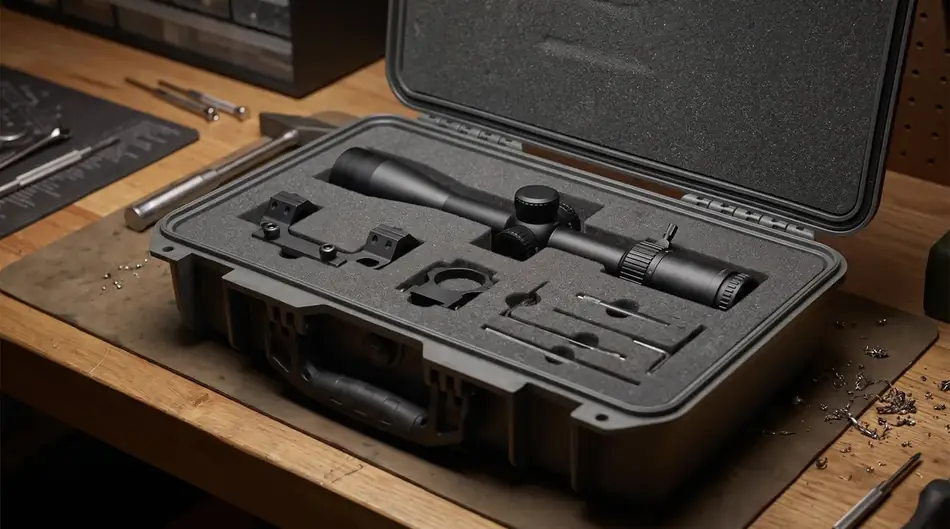
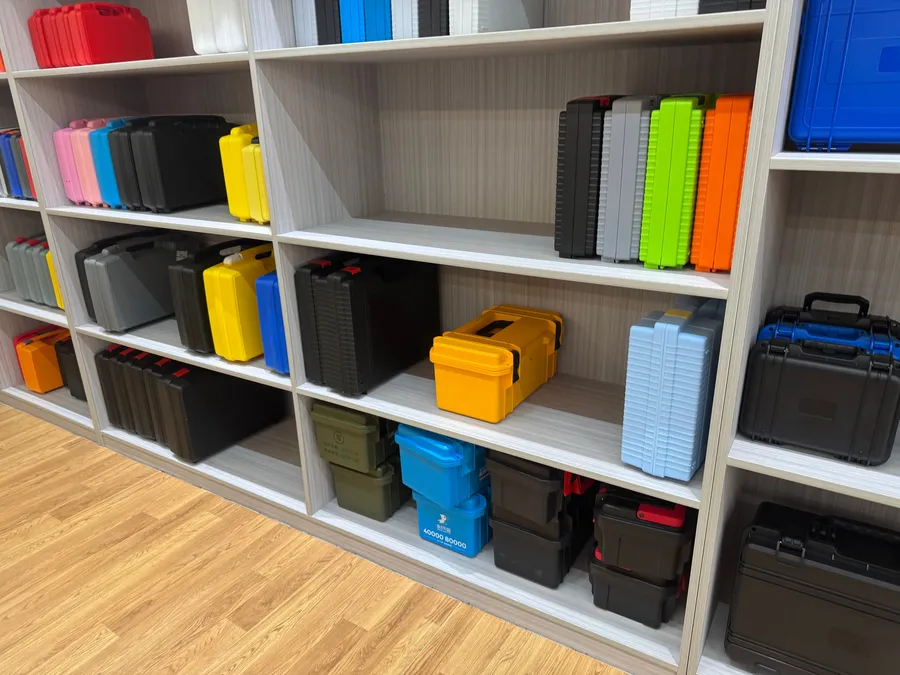
As a wholesale and OEM supplier we adapt the box to your inventory rather than forcing your inventory into a catalogue size. The interior is where most of that value is added: a cut or pluck foam layer turns a plain box into a kit issuer, a shallow removable tray keeps pins, screws and small parts out of the loose contents, and dividers split one box into counted compartments. Colour matching and a moulded or printed marking let different stock lines be told apart at a glance, which matters most in a storeroom where speed and accuracy are the same thing. On a new mould the published terms apply: about 45 days to a first OEM sample, about 125 days to a new tool, a 30 percent deposit on the tooling, and production on EXW or FOB terms. For a colour or logo change on an existing shell, the lead time is normally far shorter than a new tool.
Notes before you buy
We sell to distributors, integrators and OEM programmes on wholesale terms and do not retail single units; quotations are EXW or FOB, and we do not offer DDP or hold stock in an overseas warehouse, so plan freight and clearance yourself. Order against the datasheet of the exact model, because internal and external dimensions, wall thickness, empty mass and carton pieces-per-box are published per model and differ across the sixty-eight boxes here. Two things to ask any supplier about: the narrow internal width of a box that tapers, and the packing quantity, because those two numbers decide whether a storage plan works at pallet scale even when the internal volume looks right on paper. On protection we keep the same narrow position as everywhere else on this site — we publish measured physical figures and, where a specific property has not been tested on a model, we do not claim it.
Customisation
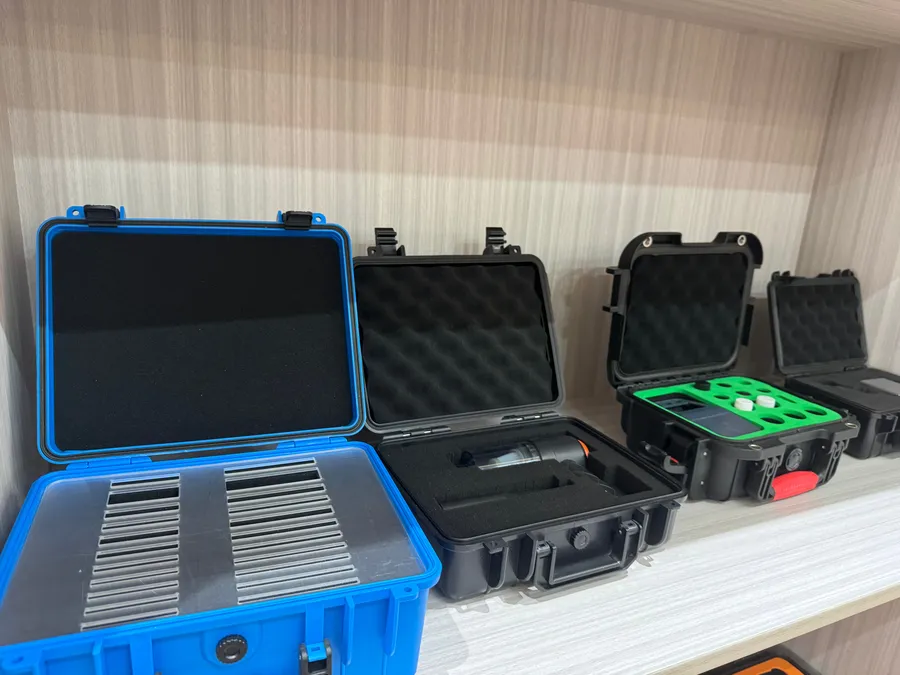
Everything described above is configurable on a standard shell: interior layout (pick-and-pluck, die-cut or CNC-cut), foam grade and thickness, colour, logo method, latch and lock count, pressure-equalisation valve, cable ports, document holder and identification plate. A bespoke exterior geometry requires a new mould — 125 days, from 3,000 units per moulded component.
Procurement considerations
| Question | What to send us |
|---|---|
| Which shell fits? | Equipment L × W × H as packed, plus required clearance per axis |
| What does it cost? | Order quantity and estimated annual quantity — the two drive different answers |
| Is tooling needed? | Whether an existing shell clears the envelope with usable foam depth |
| Lead time? | Your required delivery date, not just the order date |
| Certification? | The exact standard your tender names — we will say whether we can test to it |
| Freight? | Destination and preferred terms; carton and pallet data supplied with the quotation |
Comparison and selection guide
The tables on this page exist because a protective case is chosen by comparing three things: the envelope, the environment and the handling chain. Where no table applies, the rule below is.
| Situation | What To Do |
|---|---|
| Fixed installation | Choose a box whose external height matches your racking pitch, and check the narrow internal width if the shell tapers. |
| Mobile use | Prefer a four-latch configuration and a lid that can be removed cleanly with gloves. |
| Inventory control | Specify a foam or partition layout so that a shortage is visible without opening compartments. |
- Size on internal dimensions plus clearance, never on a product name.
- Choose the carrying method before the shell: it changes the series, not just the price.
- Specify the interior last, and decide up front whether the end user will reconfigure it.
What is an ammunition storage box? relates to Storage & Transport Box Guide. Related families: Ammunition Storage & Transport Boxes / Tool Cases / Tactical Equipment Cases / Military Protective Cases / Field Equipment Cases. Related sectors: field and industrial equipment. Continue in the Storage & Transport Box Guide cluster.
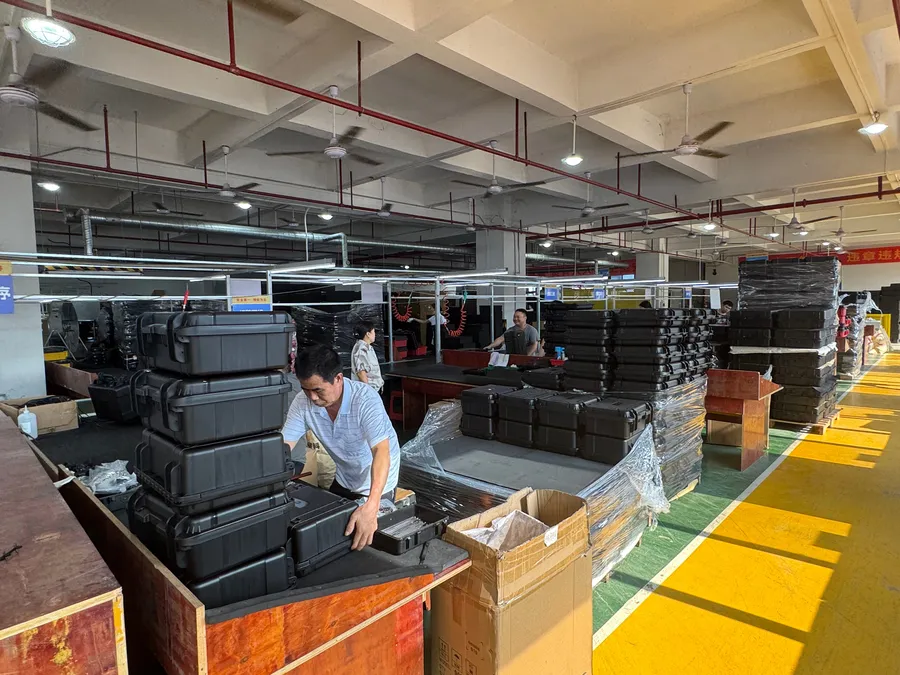
This page is written from our own production data. If your requirement differs, send the dimensions and we will tell you which of the 155 models fits, or whether a custom route is needed.