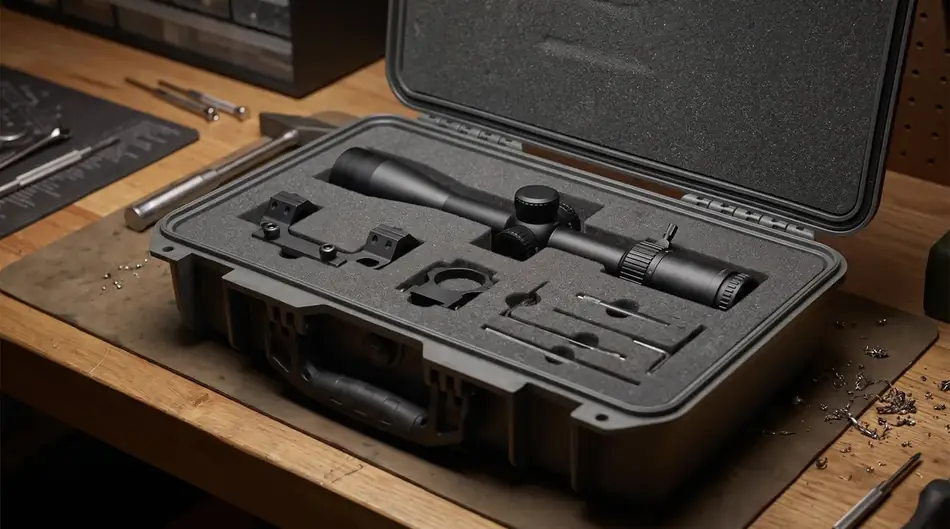
Industrial Case Quality Inspection Items
Industrial case quality inspection items are the specific checks you run on a delivered batch before accepting it: latch and hinge function, handle and foot condition, internal and external dimensions against the published model data, wall thickness, net weight, seal or gasket presence where ordered, and carton marking. On our 155 models the hinge, feet, and lock are recorded as measured features present on the tool, while latch count, pressure valve, and document holder are manufacturer options set per configuration, so a good inspection sheet separates what the mould fixes from what was agreed on your order.
Key points
- Inspect industrial cases against published model data: dimensions, wall thickness, and net weight, plus the hardware you actually ordered.
- Hinge, feet, and lock are recorded as measured features on all 155 models, so they are a physical check on the tool, not a paperwork item.
- Latch count, a pressure valve, and a document holder are manufacturer options, so test them against the order rather than a default.
- Only 93 of 155 models publish a net weight and 148 publish a wall thickness, so confirm the exact SKU before flagging a missing figure.
- 124 of 155 shells offer a seal and 31 do not, so a gasket gap on arrival is a configuration question, not automatically a defect.
- Set the acceptance criteria and the sampling plan in the purchase order before the batch ships, so both sides inspect to one standard.
Industrial Case Quality Inspection Items: The Short List
A practical inspection sheet for industrial case quality inspection items is short and physical. A receiver should check that every latch closes and releases cleanly, that the hinges lift without binding or side-play, that the handle and the feet are intact, that the internal and external dimensions match the published model, and that the wall thickness and net weight line up with the datasheet for the exact SKU. Those five checks catch most shipping and moulding faults before a case ever reaches the production floor.
The rest of the list depends on what was ordered. Latch count, a pressure valve, a document holder, a compressible gasket, casters, and a telescopic handle are configuration items, so the inspector compares the delivered build against the purchase order rather than against a generic spec. Writing the sheet that way stops a correct order from being rejected for a feature nobody bought, and stops a wrong build from passing because the bare shell looked fine.
What the Catalogue Fixes Versus What You Agree Per Order
The cleanest way to build an inspection standard is to split the features into two columns. In our data the hinge, the feet, and the lock are recorded as measured features on all 155 models, meaning they exist on the moulded tool and can be located and dimensioned on a drawing, so an inspector treats their presence and function as a fixed expectation. The handle is present across the range, and stackability is published model by model, which is why a passing hinge on a rolling case and on a stacking case can both be checked the same way.
The second column is configuration. Latch count, pressure-equalisation valves, and document holders are recorded as manufacturer options across the catalogue, so they are added to your build rather than fitted by default. An inspection item that ignores that split will either fail a correct order or wave through a wrong one, so your acceptance sheet should name the SKU and the agreed options in the same row where it records the pass or the defect.
Dimensions, Wall Thickness, and Weight: The Measurable Checks
Three inspection items are genuinely quantitative and worth measuring on every incoming batch: the internal and external dimensions, the wall thickness, and the net weight. Our catalogue publishes internal and external dimensions per model, a wall thickness on 148 of the 155 models, and a net weight on 93, so a receiver can hold the delivered case against a number rather than an impression. Where a figure is not published for a given SKU, that is a data gap to raise at the quotation stage, not a reason to reject goods on the dock.
| Model | Internal Dimensions (Mm) | Wall Thickness | Net Weight | Wheels |
|---|---|---|---|---|
| KX-2507 | 245 x 175 x 64 | 2.0 mm | 340 g | No |
| KX-62109 | 195 x 128 x 81 | 3.0 mm | 470 g | No |
| KX-85021 | 437 x 308 x 164 | 4.5 mm | 4,912 g | Yes |
| KX-85424 | 483 x 363 x 190 | 4.5 mm | 6,000 g | Yes |
Latches, Hinges, Handles, and Feet: Function Checks
Hardware is where industrial cases fail in the field and where an inspection finds it quickly. Open and close every latch, confirm the latch body accepts the padlock you intend to use, and check that the latches sit flush without a gap that would let dust or water reach the seal line. Work each hinge through its full travel; a hinge that binds or shows side-play under light hand pressure is a moulding or assembly fault, and because hinges are recorded as a measured feature you should expect them to work on delivery.
Then the carrying points. The handle should seat and deploy without cracking the shell around its mount, and the feet, which are recorded as measured on every model, should be complete and level so a stack sits true. For the 19 rolling models, spin each wheel and check the axle and the telescopic handle, because a rolling case is bought to be pulled, and a seized wheel is a genuine defect rather than a cosmetic issue.
Seals, Foam, and Finish: Configuration Checks
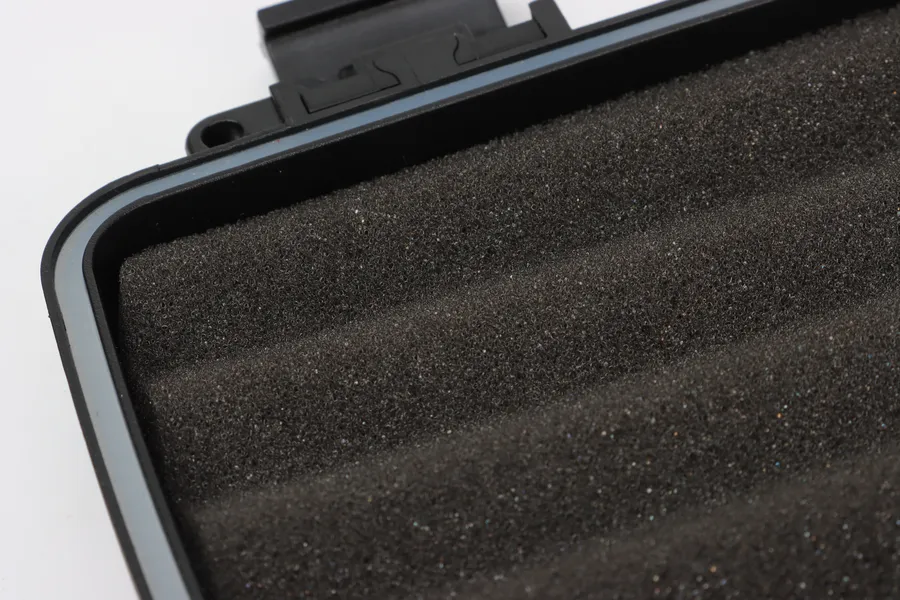
Seal and interior are the most common cause of a disputed delivery. A compressible gasket is offered on 124 of our 155 shells and not on the other 31, so the inspector should first confirm whether the SKU was ordered with a seal before logging a missing gasket as a defect. Where a seal is specified, check that it runs continuously in its moulded channel with no twist, gap, or lifted corner, and that the lid compresses it evenly around the whole perimeter.
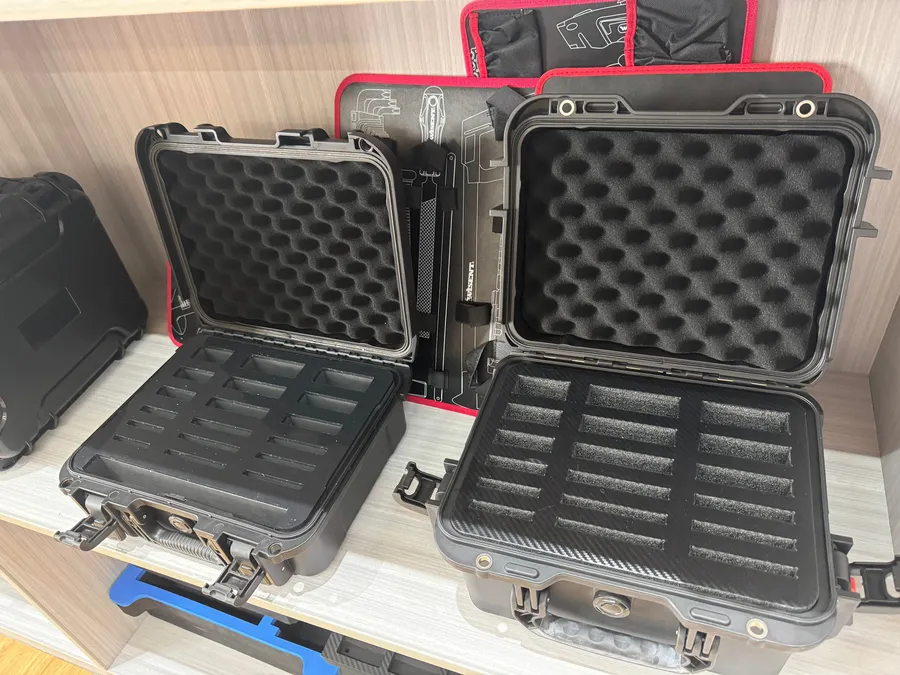
Foam is likewise built to order. Pick-and-pluck, die-cut, and CNC-cut interiors, and the top, base, and convoluted layers, are all configuration, so inspect them against the drawing or the approved sample you signed off, not against a default. A visual and tactile pass on cosmetic finish, colour, and any printed logo should also be tied to the order, because logo, colour, and custom foam move in their own quantities and are agreed on each purchase.
How to Turn These Items into an Incoming Inspection Plan
A defensible incoming plan fixes the acceptance criteria and the sampling before the batch ships. Name the SKU, the published dimensions, the wall thickness and net weight you expect, the hardware that is standard on the tool, and the options you ordered, then set a sampling level and a maximum acceptable defect rate for cosmetic, functional, and critical items. Put that same table in the purchase order so the supplier inspects to it at the factory and the receiving team inspects to it on the dock.
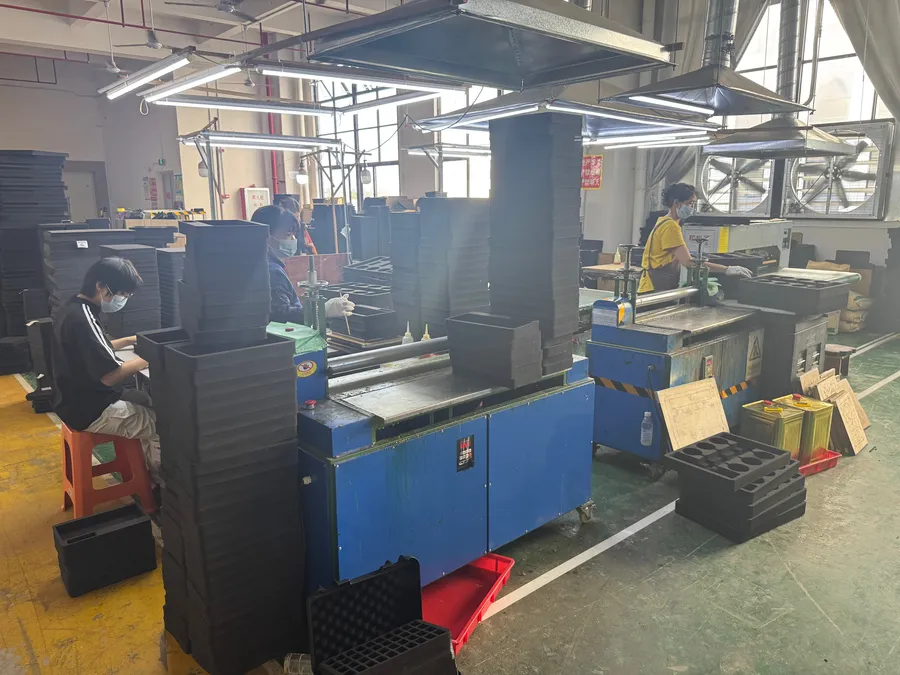
Keep the critical bucket narrow and real: a latch that will not hold, a cracked load-bearing corner, a missing or short wall, or a wrong seal on a case ordered with one. Treat cosmetic variance as its own category so a colour shade does not stall an otherwise sound order. Because we work wholesale and OEM or ODM on EXW or FOB terms, the goods are inspected before the balance of a 30 percent deposit order is released, and third-party factory audits are welcome before shipment.
Quality Inspection Items at a Glance
The one-page view below maps each inspection item to what the catalogue can back up and what depends on your order, which is the distinction a supplier should respect when a claim is raised.
| Inspection Item | What The Catalogue Supports | What Stays Order Dependent |
|---|---|---|
| Hinge and feet | Recorded as measured features on all 155 models | Whether this build matches the tool |
| Latch function | Lock body is measured; latch count is a manufacturer option | How many latches and which padlock you specified |
| Internal and external dimensions | Published per model | Which SKU and interior were agreed |
| Wall thickness | Published on 148 of the 155 models | The band you ordered for that shell |
| Net weight | Published on 93 of the 155 models | Weight of the packed build including foam |
| Seal or gasket | Offered on 124 shells and not on 31 | Whether your SKU includes a seal |
Related Checks and Where to Send a Claim
If your inspection touches hardware, latches, hinges, handles, wheels, or load capacity in depth, each of those topics has its own comparison and specification guide in the knowledge centre, and reading the latch and hinge pages before you write the sheet sharpens the pass criteria. The same is true for dimensions and for how a case is evaluated, because the testing-methods guide explains the difference between a published construction feature and a commissioned result.
Send inspection findings, the SKU, the order reference, and photographs to Fred Zhao or the KeXin Sales Team, reachable on WhatsApp at +86 135 3588 0002. KeXin New Materials (Guangdong) Co., Ltd. works wholesale and OEM or ODM only on EXW or FOB, with first OEM samples in 45 days on an existing mould and a new mould in 125 days, so a documented claim comes back as a factory response rather than a reseller reply.

Customisation
Everything described above is configurable on a standard shell: interior layout (pick-and-pluck, die-cut or CNC-cut), foam grade and thickness, colour, logo method, latch and lock count, pressure-equalisation valve, cable ports, document holder and identification plate. A bespoke exterior geometry requires a new mould — 125 days, from 3,000 units per moulded component.
Procurement considerations
| Question | What to send us |
|---|---|
| Which shell fits? | Equipment L × W × H as packed, plus required clearance per axis |
| What does it cost? | Order quantity and estimated annual quantity — the two drive different answers |
| Is tooling needed? | Whether an existing shell clears the envelope with usable foam depth |
| Lead time? | Your required delivery date, not just the order date |
| Certification? | The exact standard your tender names — we will say whether we can test to it |
| Freight? | Destination and preferred terms; carton and pallet data supplied with the quotation |
Comparison and selection guide
The tables on this page exist because a protective case is chosen by comparing three things: the envelope, the environment and the handling chain. Where no table applies, the rule below is.
| Situation | What To Do |
|---|---|
| Fixed inventory | CNC or die-cut silhouette with part numbers printed on the foam. |
| Variable kit | Pluck foam plus a loose tray. |
| Bench work | Removable trays that lift out square so the case doubles as a stand. |
- Size on internal dimensions plus clearance, never on a product name.
- Choose the carrying method before the shell: it changes the series, not just the price.
- Specify the interior last, and decide up front whether the end user will reconfigure it.
Industrial Case Quality Inspection Items relates to Procurement Guide. Related families: Tool Cases / Equipment Transport Cases / Field Equipment Cases / Custom Protective Cases / Outdoor Protective Cases. Related sectors: field and industrial equipment. Continue in the Procurement Guide cluster.
This page is written from our own production data. If your requirement differs, send the dimensions and we will tell you which of the 155 models fits, or whether a custom route is needed.