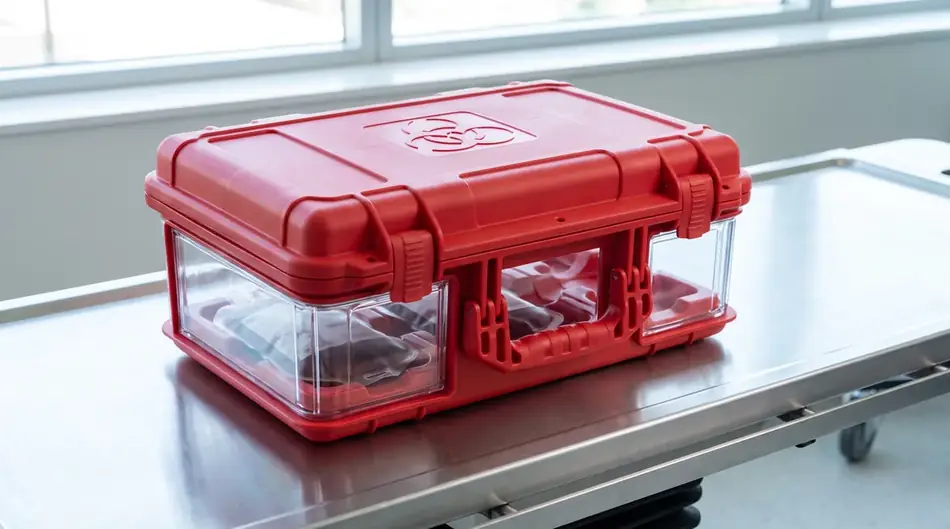
Medical Case Technical Purchasing Specifications
A medical case technical purchasing specification is worth writing only if every line in it can be matched against a published record. The useful core is short: model number, external and internal dimensions, lid depth and base depth, wall thickness, net weight, internal volume, shell material, whether a gasket is fitted, handle and wheel configuration, insert drawing reference, and the commercial block of quantity, tooling, lead time and delivery basis. Across our catalogue we publish 71 models under medical equipment cases, of which 64 record a gasket, with internal volumes from 0.3 to 139.5 litres and wall thickness from 2 to 6 mm. Ingress and impact codes are recorded as not measured, so a specification that asks us to print one is asking for a number we do not hold.
Key points
- Specify the model number, not an adjective. Internal volume across our medical-listed range runs from 0.3 to 139.5 litres, which is a wider spread than any word like small or rugged can carry.
- Ask for lid depth and base depth separately. A single internal height hides the split, and the split decides whether a tall assembly clears the lid line.
- Name the shell material. Medical-listed models are recorded as polypropylene, engineering polypropylene or ABS; a specification that says only plastic cannot be checked on receipt.
- Put quantity, tooling status and delivery basis in the same block: OEM on an existing mould is 45 days, a new mould is 125 days at 3000 units per component.
- Name the insert drawing in the order line. A shell and a cut layout are two deliverables, and the second is what actually protects the device.
- Treat any protection code offered without a named procedure and a laboratory reference as a marketing field, not a specification field, and leave it out of your acceptance criteria.
Why most medical case RFQs come back unpriced or mispriced
The usual failure is not ambition but vagueness. A request that says the case must be rugged, waterproof and medical grade gives a factory three adjectives and no geometry, so the reply is either a guess or a refusal. The version that works is a table of fields the buyer can check on arrival: which model, what internal box, how deep the lid is, how thick the wall is, what the shell is made of, whether a gasket is fitted, and how many per carton. Every one of those is a published field in our data, and none of them requires a claim about a standard.
The second failure is asking the shell to carry a responsibility it cannot. A case does not make a device sterile, does not keep a cold chain, and does not by itself define a regulatory status. What a case does is hold an assembly in a known position, resist abrasion and point loading, keep dust out to the extent a gasket and a flat sealing line achieve, and let the kit be carried and stacked safely. Writing the specification around those four verbs produces a document a supplier can answer honestly, which is also the cheapest way to avoid a dispute later.
The fields that must appear, and where they come from
Our model records publish external and internal dimensions in millimetres, lid and base depth where the mould defines them, wall thickness, net weight, internal and usable volume, shell material, and the boolean fields for wheels, telescopic handle, fixed handle and stackability. Gasket availability is a per-model field rather than a range-wide promise: 64 of the 71 models listed under medical equipment cases record one, and the remainder do not. Hardware fields go further on some shells - a latch body that accepts a standard padlock is published, while latch count itself is set per configuration.
Logistics fields belong in the specification too, because they decide landed cost more often than the shell does. 19 of our medical-listed models publish a carton size and a pieces-per-carton figure; pallet quantity is calculated from the carton footprint against your pallet size rather than pre-published, and 20GP, 40GP and 40HQ loading is supplied with the quotation. If your receiving dock works to a specific pallet, put that number in the RFQ, because it changes the stacking plan and therefore the carton.
A specification line, filled from published records
The rows below are assembled from the records we publish, chosen to span the size range a medical purchasing office actually compares. They are not a recommended list; they are a demonstration of what a complete line looks like, including the places where our own record is silent. Where lid and base depth are blank we say not published rather than halving the internal height, because an invented split is the kind of number that ends up in an acceptance test.
| Model And Envelope | Depth And Volume | Shell And Wall | Configuration Flags |
|---|---|---|---|
| KX-1204: 120x90x40 external, 115x78x32 internal | 16 lid + 16 base, 0.3 litres | PP, 2.6 mm wall, 100 g net | no gasket on this shell; stackable; fixed handle |
| KX-3609: 360x310x90 external, 355x280x80 internal | 40 lid + 40 base, 8 litres | PP, 3 mm wall, 900 g net | gasket recorded; stackable; fixed handle |
| KX-3315: 334x287x150 external, 303x224x135 internal | 100 lid + 35 base, 9.2 litres | Engineering PP, 4.1 mm wall, 1670 g net | gasket recorded; stackable; fixed handle |
| KX-4010: 400x360x100 external, 390x315x88 internal | 44 lid + 44 base, 10.8 litres | PP, 3 mm wall, 1015 g net | gasket recorded; stackable; fixed handle |
| KX-65522: 545x440x215 external, 507x385x190 internal | not published lid + not published base, 37.1 litres | ABS, 5.3 mm wall, 4860 g net | gasket recorded; stackable; fixed handle |
| KX-86136: 612x427x355 external, 530x360x304 internal | 260 lid + 44 base, 58 litres | PP, 5 mm wall, 8500 g net | gasket recorded; not stackable; wheels and telescopic handle |
| KX-88442: 843x592x415 external, 740x518x364 internal | 320 lid + 44 base, 139.5 litres | PP, 5 mm wall, 15320 g net | gasket recorded; not stackable; wheels and telescopic handle |
How to state the size requirement so it survives the factory floor
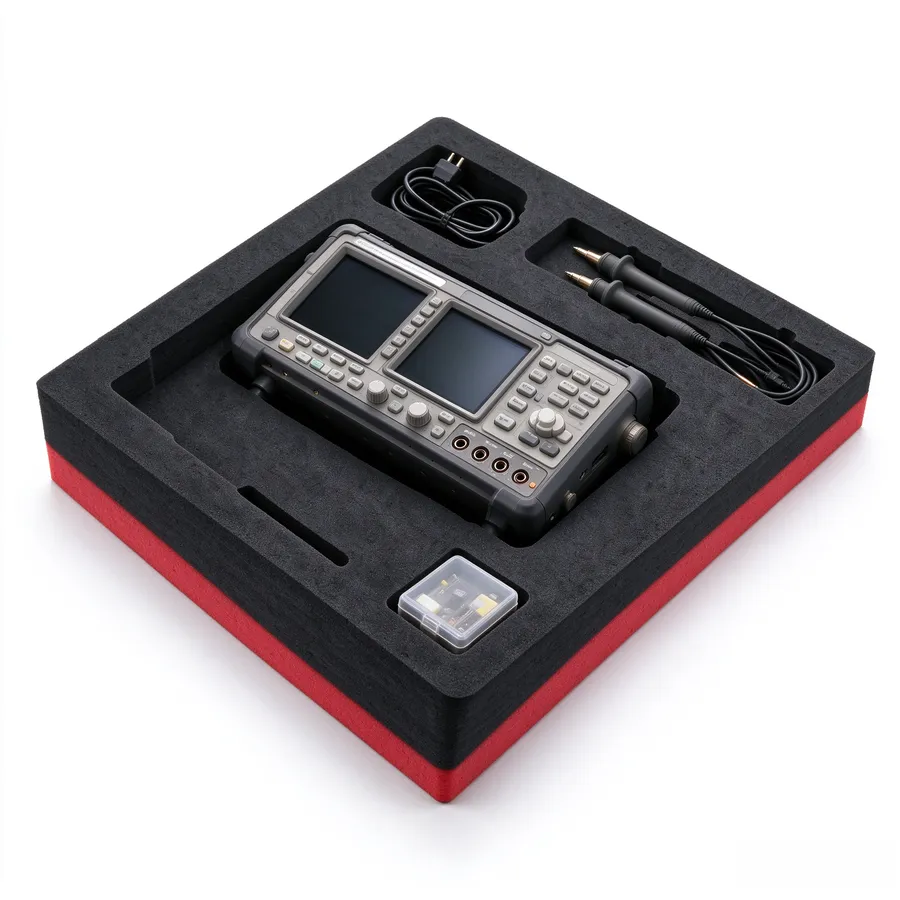
State the device as it travels, not as it is drawn. A monitor head on its bench drawing is a box; a monitor head in service has a coiled cable, a probe, a power brick and a mount, and the coil diameter is usually what breaks a layout. Give the packed envelope, then give the tallest single item, then give the number of positions and whether the count is fixed or varies. That last question matters more than it sounds: a layout cut for eight positions that ships with three leaves the items free to move inside their own foam.
Then leave a tolerance you can defend. Foam compresses and recovers differently with temperature, and a cut made to the exact device dimension will feel tight in a cold store and slack in a warm vehicle. Our practice is to define the cavity from the packed kit and to state the clearance in the drawing rather than in prose, so the same number is used by the cutting file and by whoever inspects the first article.
Material and hardware decisions that belong in the document
Shell material is published per model: in the medical-listed range, 42 records read polypropylene, 20 engineering polypropylene, 8 ABS and 1 a polypropylene and ABS combination. Thermoplastic shells have no ferrous corrosion path, which is the one environmental property we state as measured rather than as an option; the rest of the protection fields sit in the not measured column until a laboratory is engaged. Wall thickness is the practical stiffness lever, with 74 models across the catalogue at 4.0 mm or above and the published range running 2 to 6 mm.
Carry hardware changes who can move the case, so put it in the specification as a requirement rather than an assumption. 19 models in our catalogue ship with wheels and a telescopic handle, and that combination tends to appear on the larger shells, where a person cannot lift the loaded mass to shoulder height. Stackability is the opposite trade: a stackable shell saves cube on the outbound leg, while a wheeled deep shell usually cannot stack, so a fleet that returns empty containers should specify both roles explicitly instead of expecting one model to do them.
The commercial block: quantity, tooling, lead time, delivery basis
Our minimum order fields are published per model: standard and custom foam start at 1 unit, logo marking at 300 units, colour at 300 units, general OEM at 300 units, and a new mould at 3000 units per component. Lead time is 45 days for OEM work on an existing mould and 125 days for new tooling. Deposit is 30 percent. We sell wholesale and OEM on EXW or FOB; we do not sell retail, we do not quote DDP, and we hold no overseas warehouse stock, so landed cost has to be assembled by your forwarder and any delivered-price line in your purchase order needs to say whose Incoterm it is.
Write the tooling question into the first RFQ rather than the second. If a stock shell plus a cut insert meets the need, you are buying a 45-day build. If it does not, you are committing to a 3000-unit tooling programme before you have proven the layout, and the cheaper sequence is almost always to prove the insert on a stock shell, then decide about moulds with the field data you gathered.
Acceptance criteria you can actually run
Three checks are worth the paper. First, dimensional conformity against the drawing: the internal box, the lid and base depths, and the cavity positions, measured on the first article before any production quantity is released. Second, fit of the packed kit, which means the device as actually cabled, not the bare instrument, and a lid that closes without straining the sealing line. Third, the documentation set: insert drawing reference, marking artwork, carton mark and the packing list that your goods-in will reconcile.
Beyond that, buy testing deliberately. If your quality system needs an ingress, impact or temperature figure, name the procedure and the sample configuration in the purchase order and have it run by an independent laboratory; we will quote accredited third-party testing against a defined configuration. What is not available from us is a code printed in a catalogue line without a procedure behind it, and a specification that demands one will either be refused or answered with a number nobody is accountable for.
What our data deliberately leaves blank
Waterproof and dust fields on these shells are recorded as not measured, along with temperature range, stack load and payload. Shock and impact are recorded as configuration-dependent, with the note that a specified foam layout is required and the shell alone is not a shock rating. Those blanks are the point of this page: a purchasing specification is a device for separating what a supplier has from what a supplier is willing to arrange, and the honest column is more useful than a confident one.
So the practical output of this article is a short form to copy into your RFQ template: model, external and internal dimensions, lid and base depth, wall thickness, net weight, volume, shell material, gasket yes or no, handle and wheel configuration, insert drawing reference, marking, carton and pallet basis, quantity, tooling status, lead time, and delivery basis. Ask for those fields by name and you will get a comparable quote from any two suppliers, which is the only reliable definition of a technical specification.
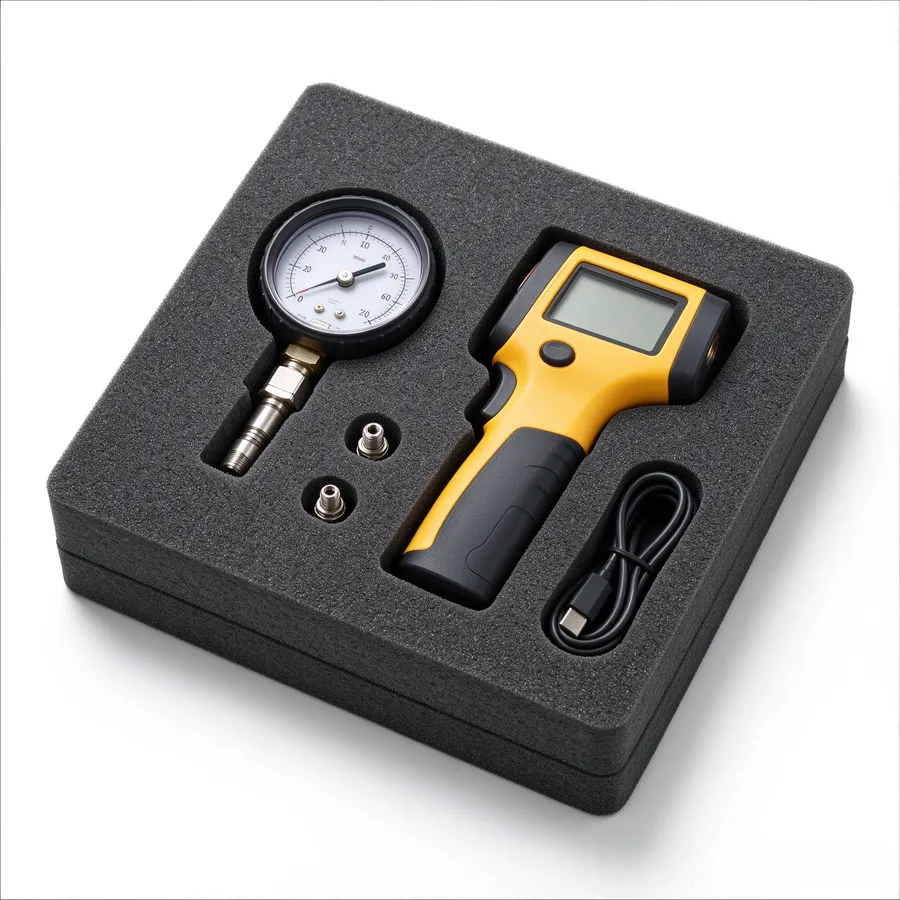
Customisation
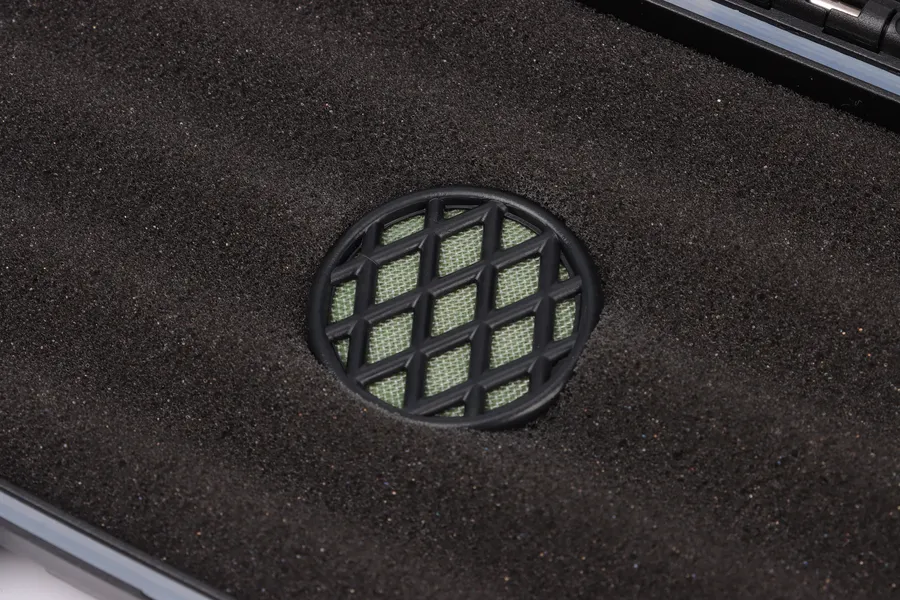
Everything described above is configurable on a standard shell: interior layout (pick-and-pluck, die-cut or CNC-cut), foam grade and thickness, colour, logo method, latch and lock count, pressure-equalisation valve, cable ports, document holder and identification plate. A bespoke exterior geometry requires a new mould — 125 days, from 3,000 units per moulded component.
Procurement considerations
| Question | What to send us |
|---|---|
| Which shell fits? | Equipment L × W × H as packed, plus required clearance per axis |
| What does it cost? | Order quantity and estimated annual quantity — the two drive different answers |
| Is tooling needed? | Whether an existing shell clears the envelope with usable foam depth |
| Lead time? | Your required delivery date, not just the order date |
| Certification? | The exact standard your tender names — we will say whether we can test to it |
| Freight? | Destination and preferred terms; carton and pallet data supplied with the quotation |
Comparison and selection guide
The tables on this page exist because a protective case is chosen by comparing three things: the envelope, the environment and the handling chain. Where no table applies, the rule below is.
| Situation | What To Do |
|---|---|
| Clinical environment | Closed-cell foam or a wipeable tray; no open-cell pluck foam. |
| Emergency use | Latches that open with one hand and a lid that stays up unaided. |
| High-value device | Deeper base foam, a separate transducer zone, and a documented drop test if required. |
- Size on internal dimensions plus clearance, never on a product name.
- Choose the carrying method before the shell: it changes the series, not just the price.
- Specify the interior last, and decide up front whether the end user will reconfigure it.
Medical Case Technical Purchasing Specifications relates to Procurement Guide. Related families: Medical Equipment Cases / Instrument & Equipment Cases / Equipment Transport Cases / Custom Protective Cases. Related sectors: field and industrial equipment. Continue in the Procurement Guide cluster.
This page is written from our own production data. If your requirement differs, send the dimensions and we will tell you which of the 155 models fits, or whether a custom route is needed.