Military grade plastic safety case mass production?
Military grade plastic safety case is buyer language for a thick-wall moulded thermoplastic transport case, and mass-producing that category is our core business: 155 models are published with real dimensions, wall thickness and weights, moulded in PP (94 models), engineering PP (38) and ABS (22) on hydraulic injection machines, with wall thickness from 2.0 mm to 6.0 mm and net weights from 100 g to 15.3 kg. Volume runs on our mould library with a 45-day first sample on an existing mould and a 30% deposit, or on a new mould at 125 days from 3,000 pieces per component. We supply wholesale and OEM buyers only, on EXW Zhongshan or FOB Shenzhen terms; this page sets out the published numbers behind the phrase and the production path from sample to container.
Key points
- Treat 'military grade' as a specification conversation: we answer it with published wall thickness, shell material and measured weights, not with a standard number.
- The catalogue is production-ready: 155 published models across seven series, and 124 of them offer a compressible gasket seal option.
- Start volume from a stock model (minimum 1) plus custom-cut foam, or step to OEM branding at 300 units and a dedicated mould at 3,000 pieces per component.
- Lead times are structural, not promises: 45 days to a first sample on an existing mould, 125 days when a new mould must be cut, 30% deposit on confirmation.
- Weight is the honest quality signal in plastics: published net weights run from 100 g (WL1204) to 15.3 kg (WL8-8442 Trolley) as size and wall thickness scale up.
- Every spec table carries a claim label - measured, manufacturer option or not measured - so you know which numbers are records and which depend on configuration.
- We sell wholesale and OEM only: EXW Zhongshan or FOB Shenzhen, no retail channel, no DDP terms and no overseas warehousing.
What buyers actually mean by a military grade plastic safety case
In tender documents and RFQs the phrase usually stands for a short list of construction expectations rather than a named standard: a moulded thermoplastic shell with substantial wall thickness, a lid and base that close under latches, hardware that survives repeated handling, and an interior that holds equipment in foam. Because no single number defines the phrase for cases, the useful move is to replace it with figures you can audit on the delivered goods. That is how we answer it: per model we publish outside and inside dimensions, wall thickness, net weight, shell material and the gasket option, so the words in your requirement become line items a receiving inspection can check.
The published catalogue behind the production run
Mass production starts from a mould library, not from a blank page. Our published catalogue covers 155 active models in seven series, from 100 g pocket boxes to 15.3 kg trolley shells, and every entry carries the same specification fields. The shell material split is PP on 94 models, engineering PP on 38, ABS on 22 and one PP/ABS hybrid. The three columns below show how the same published fields look at three very different points in that range.
| Specification | Wl1204 (Mini) | Wl8-5021 Trolley | Wl6-6232 Trolley |
|---|---|---|---|
| Outside mm | 120 x 90 x 40 | 495 x 370 x 210 | 615 x 440 x 320 |
| Wall thickness | 2.6 mm | 4.5 mm | 5.3 mm |
| Net weight | 100 g | 4.9 kg | 7.9 kg |
| Internal volume | 0.3 L | 22.1 L | 56.6 L |
| Gasket option | No (seal not offered) | Yes | Yes |
How mass production actually runs here
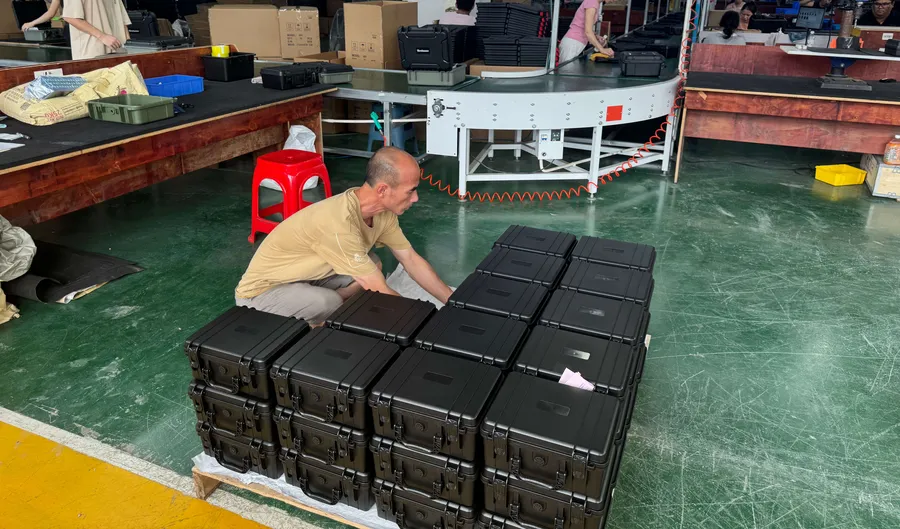
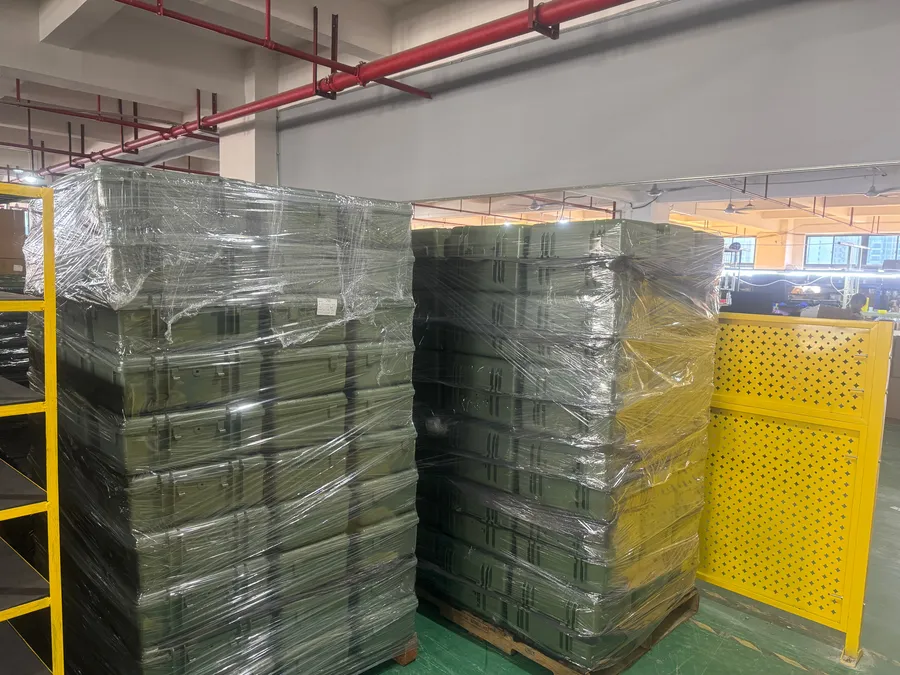
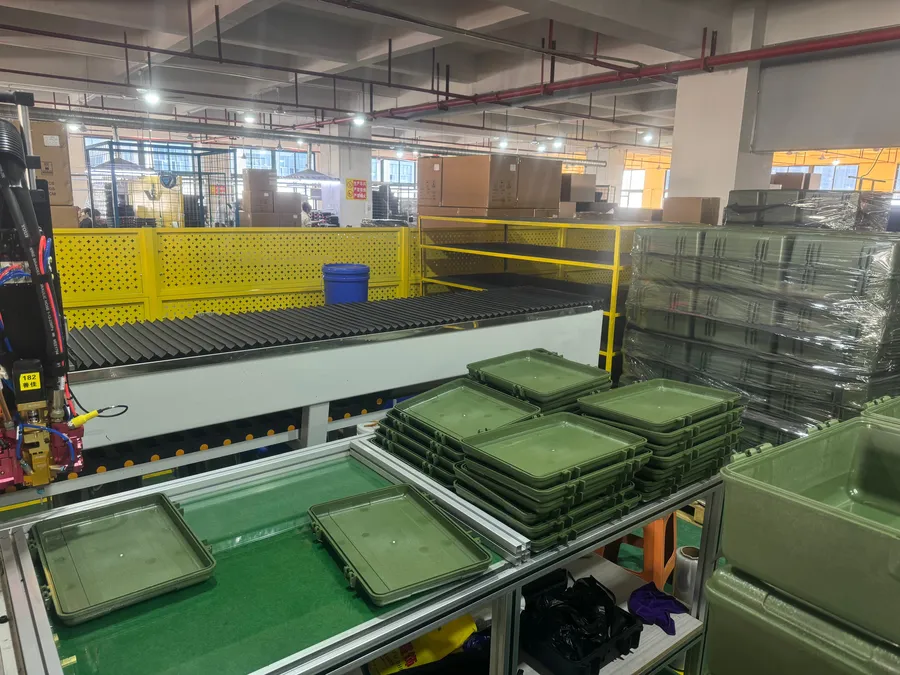
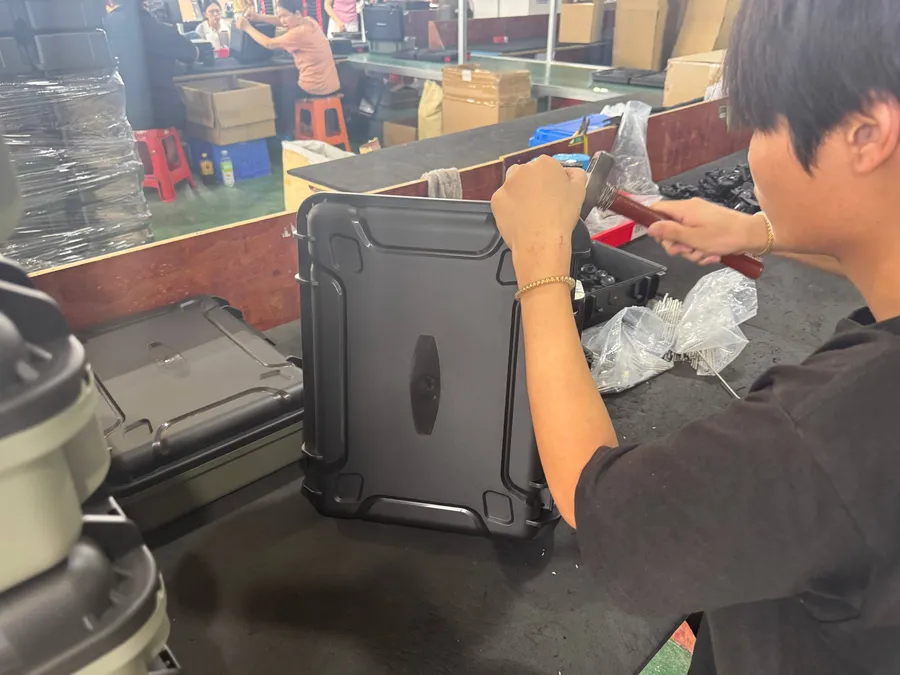
The production path has two entry points. On an existing mould, a first sample takes 45 days from drawing approval and deposit, and volume then follows the quotation schedule; shell material, colour at the 300-unit threshold and packaging are configured per order. On a new mould - a case dimensioned to your equipment rather than to our catalogue - development takes 125 days and starts from 3,000 pieces per component, with a 30% deposit securing the slot. Between those poles sit the standard customisation tiers: custom-cut foam from one piece, then logo, colour and packaging from 300 units. Our injection moulding page describes the machines and the PP and ABS materials the shells are moulded from.
What is measured and what is not: reading our claim labels
Every figure in our product data carries one of three labels. Measured means the value comes from our own production or incoming-material records; manufacturer option means the construction is available but the final number depends on the configuration you order; not measured means no test record exists for that model and configuration, so we state no value at all. Ingress figures, temperature ranges, stack loads and container loading all sit in the not measured column today, which is why our pages say so explicitly instead of printing a rating. If your programme needs any of those numbers verified, we will quote accredited third-party laboratory testing as a separate work package against the method your specification names.
Customisation paths for volume buyers
Volume buyers rarely order a bare shell. The interior is the usual starting point: foam is cut per drawing, with cross-linked PE, EVA or EPS assigned by zone so that dense items and delicate items get different support, and foam projects carry no minimum beyond one piece. Hardware is metal or polymer by configuration, and the seal option - a compressible gasket in a continuous moulded channel - is offered on 124 of the 155 published models. Branding and packaging reach production grade at 300 units: printed logo, custom colour, retail-ready cartons with barcodes and inserts, or plain neutral packing for onward distribution. The distinction between stock, OEM and private-label routes is set out in our dedicated comparison.
Commercial terms for wholesale and OEM orders
We are a manufacturer selling wholesale and OEM to institutional buyers - distributors, contractors and integrators - and we do not run a retail channel. Quotations are issued on EXW Zhongshan or FOB Shenzhen; we do not quote DDP and we do not operate overseas warehouses. Carton dimensions and pieces per carton are published per model where packing data exists - for example the WL2005 mini case packs 40 pieces into a 410 x 360 x 495 mm carton - and pallet counts are calculated against your pallet size rather than stated as fixed figures, with 20GP, 40GP and 40HQ loading supplied with the quotation. Payment follows our standard structure with a 30% deposit on confirmation.
How to qualify the claim before you commit volume
Whatever the phrase on the requirement, the qualification sequence is the same. Ask for the per-model specification table, not a family datasheet, because wall thickness and weight are model properties. Ask which figures are measured records and which are configuration options; our claim labels exist precisely to make that question easy to answer. Order one stock case with production foam and run it through your own handling routine, which our minimum of one makes cheap to do. Then, if your specification calls for a rating number we have not measured, commission accredited third-party laboratory testing on the ordered configuration and let the report travel with the shipment. Buyers who follow that sequence end up with numbers they can defend in their own acceptance process.
Customisation
Everything described above is configurable on a standard shell: interior layout (pick-and-pluck, die-cut or CNC-cut), foam grade and thickness, colour, logo method, latch and lock count, pressure-equalisation valve, cable ports, document holder and identification plate. A bespoke exterior geometry requires a new mould — 125 days, from 3,000 units per moulded component.
Procurement considerations
| Question | What to send us |
|---|---|
| Which shell fits? | Equipment L × W × H as packed, plus required clearance per axis |
| What does it cost? | Order quantity and estimated annual quantity — the two drive different answers |
| Is tooling needed? | Whether an existing shell clears the envelope with usable foam depth |
| Lead time? | Your required delivery date, not just the order date |
| Certification? | The exact standard your tender names — we will say whether we can test to it |
| Freight? | Destination and preferred terms; carton and pallet data supplied with the quotation |
Comparison and selection guide
The tables on this page exist because a protective case is chosen by comparing three things: the envelope, the environment and the handling chain. Where no table applies, the rule below is.
| Situation | What To Do |
|---|---|
| Fastest | Standard shell plus CNC foam — typically 45 days from approved drawing. |
| Branded | Standard shell plus custom colour and logo — MOQ applies to the resin colour. |
| Bespoke geometry | New mould — 125 days, MOQ from 3,000 units per component. |
- Size on internal dimensions plus clearance, never on a product name.
- Choose the carrying method before the shell: it changes the series, not just the price.
- Specify the interior last, and decide up front whether the end user will reconfigure it.
Military grade plastic safety case mass production? relates to Procurement Guide. Related families: Custom Protective Cases / Military Protective Cases / Military Equipment Cases / Equipment Transport Cases. Related sectors: field and industrial equipment. Continue in the Procurement Guide cluster.
This page is written from our own production data. If your requirement differs, send the dimensions and we will tell you which of the 155 models fits, or whether a custom route is needed.


