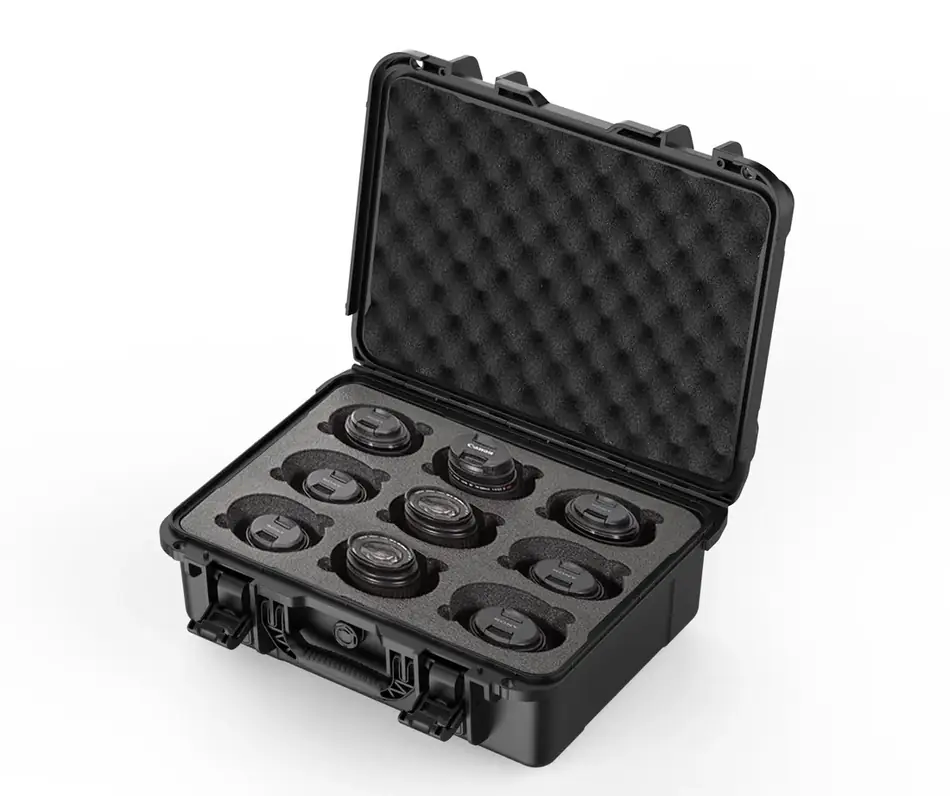
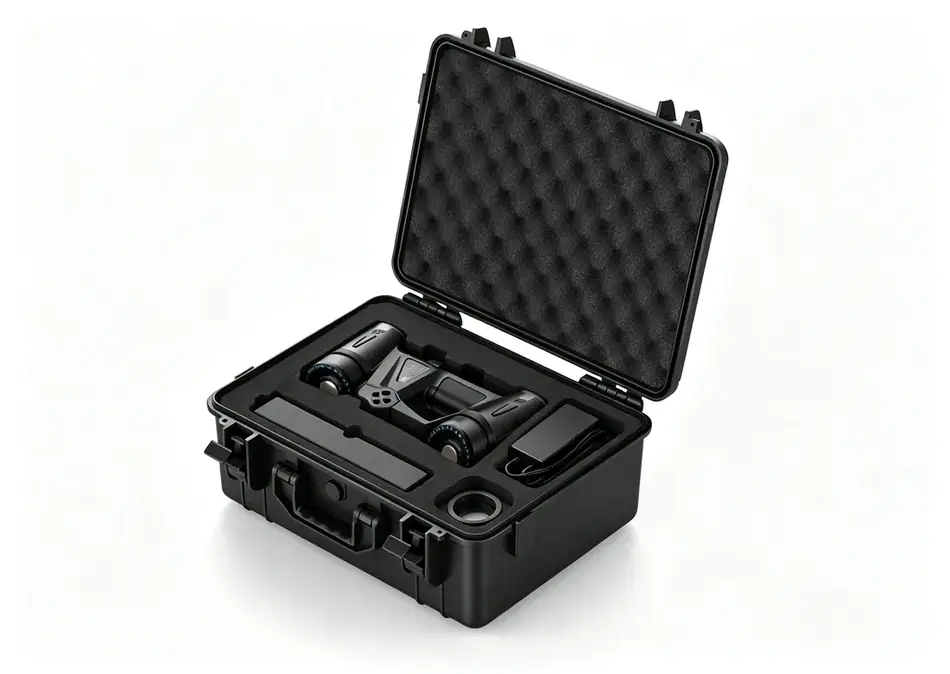
Photography Case Technical Purchasing Specifications: The Fields That Decide Fit
A photography case specification is only worth signing when it states internal length, width and depth per model, the narrow internal width, wall thickness, the lid and base foam split, net weight, hardware and the commercial block of MOQ, tooling and lead time. Our published photography case data carries all of those fields for the models we make, and records protection figures as not measured wherever no test record exists, so you can compare fit and freight against numbers instead of marketing adjectives.
Key points
- Spec the internal dimensions first: internal depth and narrow internal width decide whether your kit fits, while external size only decides freight cost.
- Require a wall thickness figure per model. Published values run from 2.1 mm to 5.8 mm across the catalogue, so an unquantified heavy-duty phrase cannot be compared.
- Ask for the lid and base foam split rather than one total depth; a tall lens or a monitor usually needs the lid share increased, not a bigger shell.
- Treat protection claims as a separate work package: our photography model data records waterproof and dust fields as not measured, with accredited testing quotable.
- Put MOQ, tooling and lead time on the same sheet as the size table: 1 unit stock, 300 units for logo, colour or OEM, 3,000 units for a new mould.
- Confirm packing data before you plan a pallet: carton dimensions and pieces per carton are published per model, pallet and container figures are calculated to order.
Photography Case Technical Purchasing Specifications, In One Comparable Sheet
Buyers who look for photography case technical purchasing specifications are usually trying to turn a stack of supplier PDFs into a single table they can defend in a meeting. The fields that make that possible are narrow: internal dimensions, the narrowest internal width, wall thickness, lid and base foam depth, net weight, usable interior volume, the hardware list and the commercial terms. Every model page on this site publishes those items in the same order, which means two or three candidates can be pasted side by side and the difference is visible in millimetres. Where a value does not exist for a model we mark it as not measured, and we do not close the gap with a range-wide claim, because a specification that cannot be audited is not a specification.
Internal dimensions and the numbers that decide fit
External size is a freight number; internal size is a fit number. The 0 Series KX-3607 measures 360 by 310 by 70 mm outside and 355 by 280 by 60 mm inside, while KX-3609 keeps the identical footprint and gives 355 by 280 by 80 mm inside. That twenty millimetres of internal depth is the whole reason a two-body kit with grips closes or does not. Some shells also taper near the handle wall, which is why a separate narrow internal width is published: KX-3607 lists 255 mm against a 280 mm nominal internal width, and KX-4610 lists 302 mm against 338 mm. Measure your tallest standing item, add the foam you intend to put under it, then check that sum against the narrow width rather than the nominal one.
Volume is the third cross-check. Usable interior volume is published per model and it separates shells that look similar on plan: KX-2614 is 5.0 litres, KX-3213 is 7.2 litres, KX-4610 is 11.1 litres and KX-4616 is 19.6 litres. If a supplier gives you external volume, or no volume at all, you are being asked to guess the interior.
| Model | External Mm | Internal Mm | Narrow Internal Mm | Usable Volume L |
|---|---|---|---|---|
| KX-2614 | 255 x 245 x 135 | 240 x 200 x 120 | 180 | 5.0 |
| KX-3308 | 330 x 272 x 82 | 325 x 236 x 76 | 217 | 5.0 |
| KX-712 | 315 x 290 x 110 | 308 x 250 x 96 | 220 | 6.4 |
| KX-3213 | 315 x 260 x 128 | 308 x 230 x 118 | 205 | 7.2 |
| KX-3609 | 360 x 310 x 90 | 355 x 280 x 80 | 255 | 6.9 |
| KX-4610 | 460 x 367 x 95 | 455 x 338 x 84 | 302 | 11.1 |
| KX-4616 | 460 x 367 x 155 | 455 x 338 x 148 | 302 | 19.6 |
Wall thickness and shell material, stated per model
Wall thickness is the field buyers generalise most often and verify least often. Across our catalogue the published figures run from 2.1 mm on the 7 Series KX-705, through 3.0 mm on the 0 Series shells, to 4.0 mm on the ABS KX-64114, 4.5 mm on the T Series KX-85021 and 5.8 mm on KX-5321. Those are model fields rather than a house standard, and a purchasing sheet that says thick walls without a number cannot be placed next to ours. Material is listed the same way, because material changes mass at the same external size: KX-64114 is an ABS shell at 4.0 mm and 2,100 g net, while KX-4012 gives a comparable interior in engineering PP at 3.5 mm and 1,480 g, and KX-92817 reaches 5.0 mm in a 280 by 225 mm footprint at 940 g by using a tall, narrow layout rather than more plastic.
Read thickness together with the depth ladder rather than alone. KX-4610, KX-4613 and KX-4616 are one 460 by 367 mm mould family at 3.0 mm wall, offered at 84, 116 and 148 mm of internal depth. Choosing between them is a foam and payload decision, not a structural one, and that is why the specification should carry both the wall figure and the depth figure for the exact model you intend to buy.
| Model | Wall Thickness Mm | Shell Material | Net Weight G |
|---|---|---|---|
| KX-705 | 2.1 | Engineering PP | 830 |
| KX-707 | 2.5 | Engineering PP | 1360 |
| KX-3609 | 3.0 | PP | 900 |
| KX-4610 | 3.0 | PP | 1115 |
| KX-4012 | 3.5 | Engineering PP | 1480 |
| KX-64114 | 4.0 | ABS | 2100 |
| KX-85021 | 4.5 | Engineering PP | 4912 |
| KX-92817 | 5.0 | Engineering PP | 940 |
Lid and base depth: the foam split to specify, not one total number
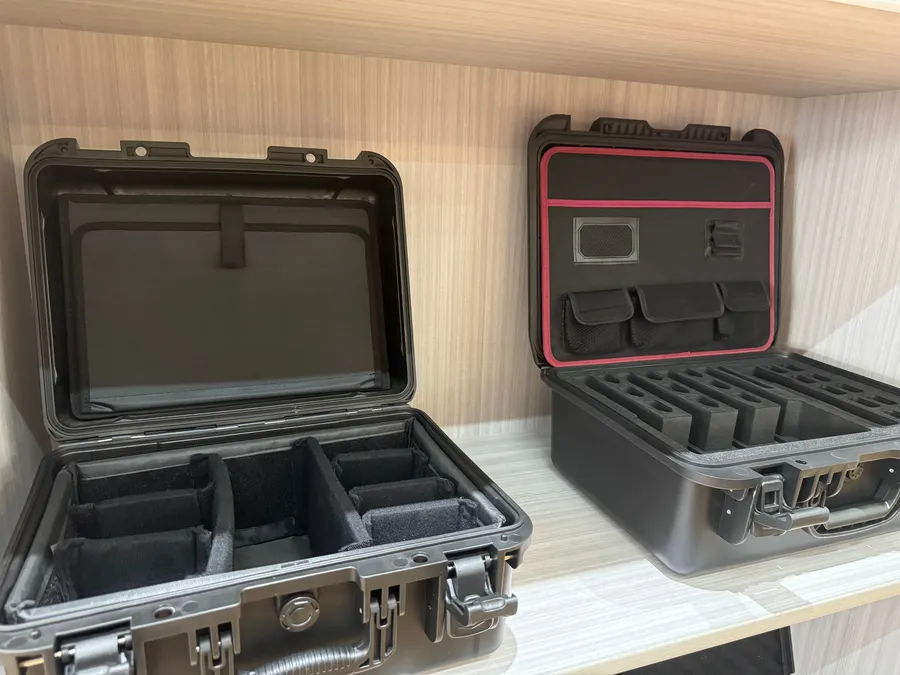
A shell with 148 mm of internal depth is two decisions, not one: how much of that depth belongs to the base and how much to the lid. We publish the split wherever the mould defines it. KX-2614 is 60 mm lid over 60 mm base, KX-3308 is 38 over 38, KX-3609 is 40 over 40, KX-3213 is 86 over 32, KX-4613 is 74 over 42, KX-92817 is 125 over 27 and KX-4321 is 164 over 38. A shallow base under a deep lid suits a body and lens stack lying flat or a control unit standing in a pocket; a balanced split suits two trays of interchangeable glass. If you move depth from base to lid, interior volume does not change but the usable layout changes completely, so record the split in the specification instead of leaving it to whoever packs the first sample.
What we publish about protection, and what we deliberately leave blank
This is the section where most photography case sheets go wrong. On our photography-oriented models the waterproof and dust-resistance fields are recorded as not measured; shock protection is described as a configuration that depends on the foam layout you order, because a shell alone is not a shock figure; impact resistance is tied to the stated wall thickness with no drop height claimed unless a test is commissioned; and corrosion resistance is recorded as measured because a thermoplastic shell has no ferrous corrosion path. We do not print an ingress code on a photograph, and we do not describe a shell as meeting a standard against which no record exists. If your tender needs a third-party report, we treat it as a separate work package: you name the standard and the procedure, we quote accredited testing against it, and the resulting report belongs in your file. That is slower than copying a badge from a datasheet, and it is the only version that survives an audit or a returned container.
The practical consequence for a purchasing sheet is that the protection column should contain two kinds of entries only: a measured record with a number and a date, or the words not measured with the cost and lead time of commissioning one. Anything else is a marketing field, and it should not be scored in your comparison.
Hardware, latching and identification fields worth specifying
Hardware is where a photography case fails in service rather than in the catalogue. Each model page states whether the handle is fixed folding or telescopic plus fixed folding, how many wheels the shell carries, and whether feet, hinges and a latch body that accepts a standard padlock are recorded as measured for that mould. Latch count and pressure equalisation are listed as configuration options, because both change between variants of the same shell and neither should be assumed. Wheeled T Series shells such as KX-85021 and KX-85022 carry two wheels, a telescopic handle and are marked as not stackable, which is a packing consequence as much as a handling one: they travel singly rather than in a column, and KX-85022 is packed one piece to a carton for exactly that reason.
MOQ, tooling and lead time belong in the same block as the size table
Put the commercial block on the page with the dimensions, because it changes what you order. Our published terms are wholesale and OEM only. Standard stock has no minimum beyond one unit and custom foam likewise starts at one unit, while logo, colour and OEM programmes begin at 300 units and a new mould at 3,000 units per component. Lead time is 45 days for OEM work on a mould we already run and 125 days when a new mould is required, against a 30 percent deposit with the balance settled after inspection. We ship EXW or FOB, do not sell retail, do not offer DDP and hold no overseas warehouse, so your forwarder owns the leg from the port. Third-party factory inspection is welcome, and it is easiest to arrange before the first production run closes.
A specification block you can send back to us
If you want a quotation that returns numbers instead of questions, send six lines: the tallest and widest item measured with caps and hoods fitted, your intended foam layout, the models you are comparing, first-order quantity plus annual forecast, the month you must ship, and whether a third-party report must be in the file. We answer with the published model data and an interior drawing of the foam, and where a field is empty we leave it empty and say why. That is how photography case technical purchasing specifications should behave: one comparable sheet, with gaps labelled as gaps rather than filled with adjectives, and every number traceable to a model you can order.
Customisation
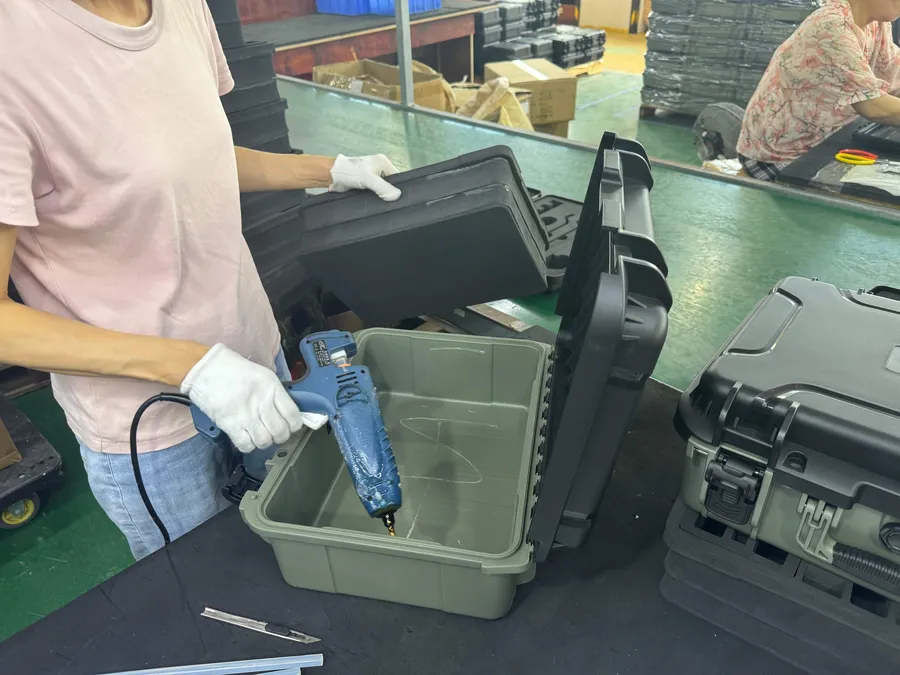
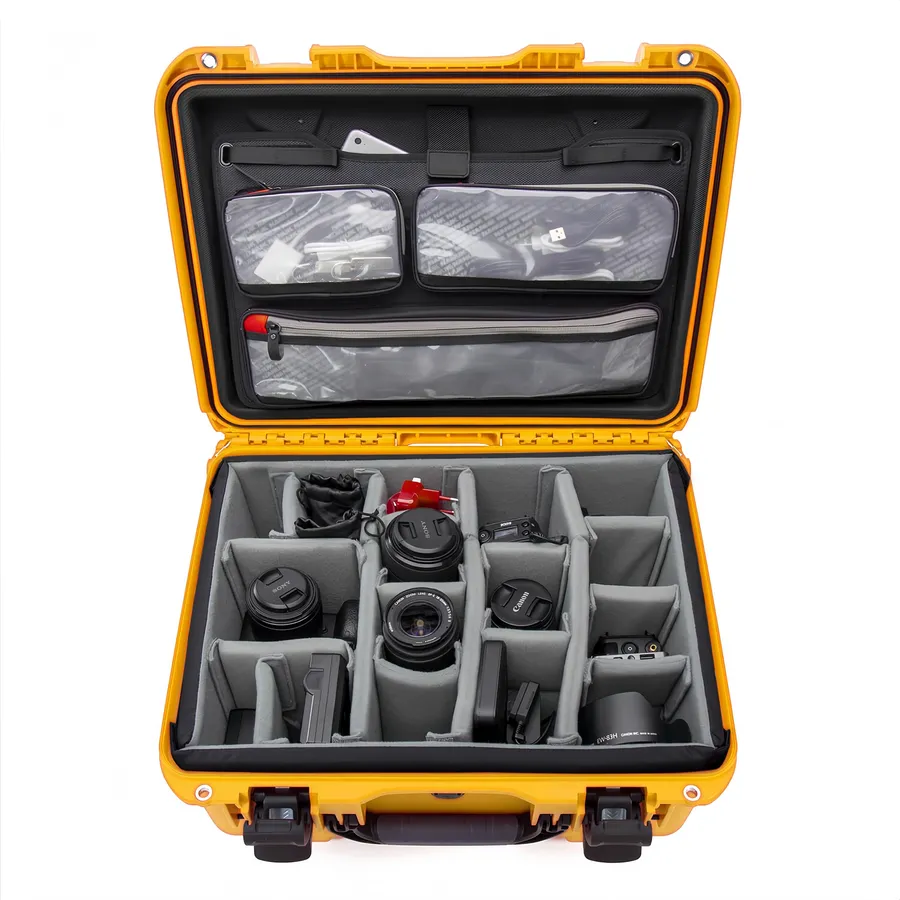
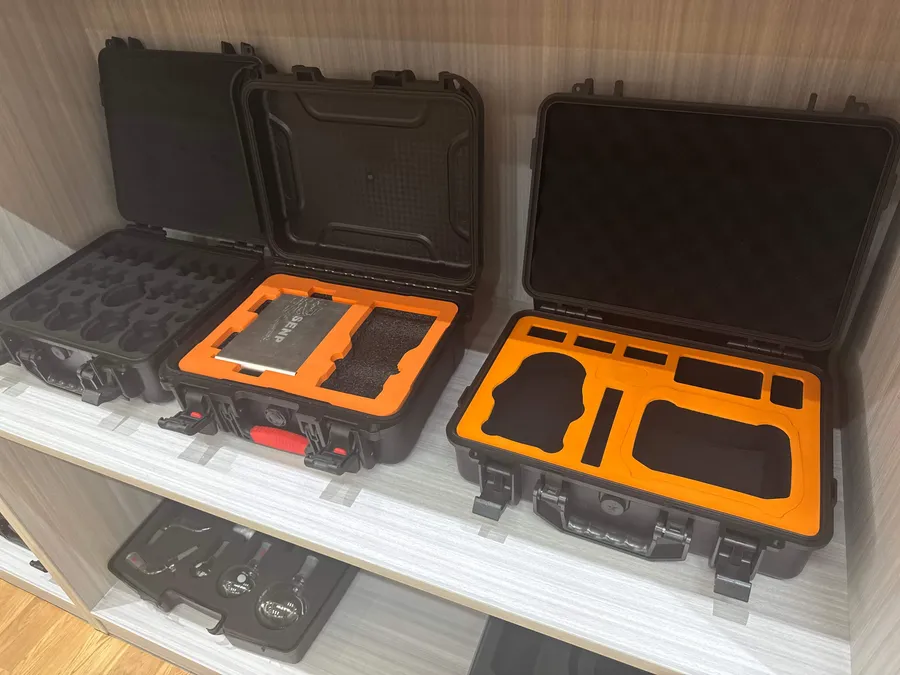
Everything described above is configurable on a standard shell: interior layout (pick-and-pluck, die-cut or CNC-cut), foam grade and thickness, colour, logo method, latch and lock count, pressure-equalisation valve, cable ports, document holder and identification plate. A bespoke exterior geometry requires a new mould — 125 days, from 3,000 units per moulded component.
Procurement considerations
| Question | What to send us |
|---|---|
| Which shell fits? | Equipment L × W × H as packed, plus required clearance per axis |
| What does it cost? | Order quantity and estimated annual quantity — the two drive different answers |
| Is tooling needed? | Whether an existing shell clears the envelope with usable foam depth |
| Lead time? | Your required delivery date, not just the order date |
| Certification? | The exact standard your tender names — we will say whether we can test to it |
| Freight? | Destination and preferred terms; carton and pallet data supplied with the quotation |
Comparison and selection guide
The tables on this page exist because a protective case is chosen by comparing three things: the envelope, the environment and the handling chain. Where no table applies, the rule below is.
| Situation | What To Do |
|---|---|
| Changing kits | Layered pluck foam, rebuilt by hand. |
| Fixed rental fleet | CNC silhouette with serial pockets and an inventory list. |
| Harsh locations | Sealed shell plus desiccant provision in the lid. |
- Size on internal dimensions plus clearance, never on a product name.
- Choose the carrying method before the shell: it changes the series, not just the price.
- Specify the interior last, and decide up front whether the end user will reconfigure it.
Photography Case Technical Purchasing Specifications: The Fields That Decide Fit relates to Procurement Guide. Related families: Camera & Photography Cases / Custom Protective Cases / Optical Equipment Cases / Instrument & Equipment Cases / Electronics Cases / Equipment Transport Cases. Related sectors: field and industrial equipment. Continue in the Procurement Guide cluster.
This page is written from our own production data. If your requirement differs, send the dimensions and we will tell you which of the 155 models fits, or whether a custom route is needed.