What is the difference between a protective case factory and a trading company?
A factory moulds the shell and holds the record behind it; a trading company buys shells somebody else moulded and resells them under its own datasheet. That distinction is not a marketing claim, and you should not have to take anyone's word for it - it shows up in four places you can test during a normal quotation round. First, provenance: ask where each published figure came from, because a moulder can point at a production or incoming-material record and a reseller points at a specification sheet supplied to it. Second, change: ask what happens to a dimension, colour, foam layout or carton plan after the order is placed, and listen for a lead time and a minimum rather than a shrug. Third, silence: watch what an untested field contains, because an invented rating is the clearest sign of a document written by someone who never saw the tool. Fourth, defect: ask who authorises rework and who bears the cost of it. KeXin New Materials (Guangdong) Co., Ltd. publishes 155 moulded models against seven series tooling records, tags 148 wall thicknesses and 93 net weights as figures taken from its own production or incoming-material data, and leaves protection rating and waterproofing recorded as not measured on every one of those 155 models rather than estimating them. That mix - real numbers where we have them, blanks where we do not - is what the factory side of this comparison looks like on paper.
Key points
- Judge the supplier by provenance, not vocabulary: ask which record each published figure came from before you listen to any self-description.
- KeXin lists 155 moulded models filed against seven series tooling records, with internal and external dimensions published for every model.
- Wall thickness is published on 148 models from 2.0 mm to 6.0 mm and net weight on 93 from 100 g to 15,320 g, each tagged as taken from our own data.
- Protection rating and waterproofing are recorded as not measured for all 155 models, and an accredited third-party test is quoted as a separate work package.
- Tooling decisions carry dates and quantities - 45 days on an existing mould, 125 days and 3,000 pieces per component for a new one - because the tool is the constraint.
- A trading company is a defensible buy for consolidated mixed orders and local stock; it is a weak one for colour, logo, foam or dimension work.
The short answer, stated as something you can check
Every supplier page says it is a manufacturer, and the phrase has stopped carrying information. The useful version of the question is operational: when you ask for something to change, can the party you are talking to actually make it change, and can it show the record behind the numbers it gave you? A moulder answers both from its own files, because the shell, the tool and the measurement all sit inside one organisation. A trading company answers the first by going to ask someone, and answers the second with a document it did not create.
Neither arrangement is dishonest by definition. Consolidators genuinely solve problems for buyers - mixed orders across categories, one invoice, one forwarder, sometimes local stock that a factory 8,000 km away cannot offer. The risk is mismatch, not morality: buying a customisation programme from a party that cannot touch the tool, or buying a compliance figure from a document nobody measured. The rest of this page is the test we would apply, together with the figures from our own catalogue so the standard is concrete rather than rhetorical.
Four places the difference shows up
| What You Ask | What A Moulder Can Produce | What A Reseller Usually Produces | How To Test It In A Quote |
|---|---|---|---|
| Where did this number come from? | A production or incoming-material record, with the model and configuration it was taken from | A specification sheet supplied to it, often without the measurement basis named | Ask for the basis tag on three figures: wall thickness, net weight, and one protection field |
| Can you change the foam, colour or carton plan? | A route and a date - foam from one unit, colour, logo and packaging from 300 pieces on an existing mould | An enquiry passed upstream, with a lead time that arrives late and moves | Put one real change in the first order and watch who answers it |
| What does an untested field contain? | A blank plus a policy: no test record exists, and accredited testing can be commissioned separately | A plausible figure inherited from somebody else's datasheet | Ask which field on their own sheet has the least evidence behind it |
| Who authorises rework on a defect? | An internal decision, because the press, the trim jig and the packing bench are in one place | A claim forwarded to a plant that does not know the order | Ask what a mid-production change order costs, in days and in pieces |
| Do you own or control the tool? | Series tooling records and a new-mould programme: 125 days, from 3,000 pieces per component | Access to whatever moulds happen to be free at the plant it buys from | Request a dimension outside the published range and compare the two answers |
| Can I see the whole model family at once? | 155 models on one machine-readable record, sharing a single field schema | A PDF per item, with fields appearing and disappearing between ranges | Ask for the same three fields across ten models and check they mean the same thing |
| What are your shipping terms? | EXW or FOB from the factory, thirty percent deposit, balance before shipment | Delivered prices that include a margin and a handover it does not control | Compare like for like: ask any supplier what the same goods cost ex-works |
What our own record looks like, field by field
The catalogue carries 155 active moulded models, each filed against one of seven series records - 0 Series with 23 models, 1 Series with 7, 6 Series with 20, 7 Series with 6, 8 Series with 62, 9 Series with 18 and T Series with 19 - and every model publishes both internal and external dimensions. That last point is the cheapest factory tell there is: a party that does not run the tool rarely publishes both, because it has to convert one into the other by assumption. Across the range, internal length runs 115 mm to 1,280 mm and external length 120 mm to 1,356 mm, on 96 distinct external footprints.
The measured fields are tagged rather than merely printed. Wall thickness is recorded on 148 models, from 2.0 mm to 6.0 mm. Net weight is recorded on 93 models, from 100 g on the KX 1204 to 15,320 g on the wheeled KX 88442, and each of those 93 entries carries a measured tag tied to our own production or incoming-material data; gross weight is not recorded for any model, and we do not print one. Lid depth and base depth are published on 100 models, at 16 mm to 320 mm and 15 mm to 168 mm. Carton plans - outer carton dimensions plus pieces per carton - exist for 64 models and are simply absent for the other 91. Shell material is stated as PP on 94 models, engineering PP on 38, ABS on 22 and a PP and ABS combination on 1. Every model has a fixed handle; 19 have a telescopic handle with published heights of 240, 295, 310, 385 and 485 mm; 124 are recorded as offering a seal.
And the fields we cannot support are left as they are. Each of the 155 models carries a protection rating recorded as not measured and a waterproof field recorded as not measured, in line with a published claim policy that defines measured as recorded from our own production or incoming-material data, manufacturer option as a construction we can supply whose figure depends on the configuration ordered, and not measured as no test record existing, with accredited testing available as a separate work package. A record that admits its own gaps is a record somebody maintains; a record with no gaps is a document.
When a trading company is the right buy
There are honest cases for the middleman, and pretending otherwise costs buyers money. If you need twelve unrelated items - cases, cables, mounts, consumables - on one invoice and one container, a consolidator is better at that than a moulder, because we run one product family and quote EXW or FOB only. If you need stock held close to your site, a local distributor is the workable answer: we hold no overseas warehouse and do not offer DDP delivery, so a buyer whose plan depends on regional buffer stock has to source that buffer elsewhere, and a trader with a warehouse can supply it. If you need one or two units of a standard size to test an idea, you will often get them faster and cheaper through a reseller than through a factory whose wholesale minimum for a standard model is one unit but whose freight terms are container-scale.
What a reseller cannot do is the second half of this page: change the tool, hold the measurement record, authorise rework on the press, or tell you that a field is not measured. The buying decision is therefore not which label to trust, but which of your problems belongs to which kind of supplier.
How to verify a supplier before you commit
Run the checks on paper before you pay for a sample, because each one costs nothing and most of them finish the argument. Ask for the same three fields across ten models - wall thickness, net weight, and whether the seal is available - and see whether the definitions hold still or drift between entries. Ask what a real change costs: a different colour, a foam layout for your own instrument, a carton plan built around your deck. Ask which published figure has the weakest evidence behind it, and how they are saying so. A supplier that moulds will answer in quantities and days; a supplier that resells will answer in assurances.
Then make it expensive to be wrong: put one customisation into the first order rather than the third, and judge the answer you get inside forty-five days. Tooling and measurement claims are easy to write and hard to sustain across a live programme, which is why the first order - not the factory tour, not the certificate folder - is the real test.
Where the distinction changes the outcome
For an OEM programme - your own instrument, your own foam layout, your own colour and carton print - the moulder is not a preference but a requirement. Colour, logo, packaging and hardware changes on an existing mould start at 300 pieces with a forty-five day first article; anything that moves the shell geometry is a new mould at 125 days from 3,000 pieces per component. Nobody can promise either of those dates who does not control the tool, and a programme built through a third hand will slip without anyone being able to say why.
For a standard-size replenishment order, the distinction matters far less. A KX 2005 is the same shell whoever bought it first, and if a reseller holds your units in the right quantity at the right time, that service is worth paying for. For electronics and instrumentation buyers, what usually matters more than the label is whether the published depth and weight figures are trustworthy, because those are what decide a rack design. For medical and industrial equipment buyers, the decisive question is change control: a probe, a controller or a handle that gains two centimetres in revision B will invalidate a foam layout, and only the plant holding the tool can be told that directly.
For defence, public-safety and government-adjacent buyers, the buying problem is documentation rather than moulding. Those programmes often want a stated test result, and the correct answer from us is that protection rating, waterproofing, stack load and load capacity are recorded as not measured for every model, with accredited third-party testing quoted against a specification as a separate work package. A supplier who produces an instant figure for those fields either has a report - ask to see it and check which model and configuration it names - or is selling you somebody else's assumption.
Customisation and change control: the part that is hard to fake
Every model in the catalogue publishes OEM and ODM availability, custom colour, custom logo, custom hardware, custom packaging, custom foam and private labelling, together with the same commercial spine: one unit for a standard model, one unit for custom foam, 300 pieces for colour, logo or OEM marking, 3,000 pieces per component for a new mould, 45 days to a first article on existing tooling and 125 days for new tooling. Those numbers are the practical signature of a moulder, because they are all consequences of the tool: a press cannot be asked for a colour change without a run, and a tool cannot be cut without a programme.
Change control follows from the same fact. A revision to a foam layout, a latch count or a carton plan can be applied at the bench between two pallets when one organisation holds the tool, the hardware and the packing list. Where those sit in different companies, every change becomes a negotiation, and the cost of that negotiation lands in the unit price or the lead time even when nobody names it. If your product changes twice a year - and most instruments do - the supplier question is really a change-cost question.
What we do not claim about our own plant
This page argues that untested fields should be left blank, so it has to hold that line about itself. We publish no audit score, no certificate, no capacity figure, no machine count and no customer or order reference, and we do not state an ingress protection code, a drop height or a stack load for any model. The protection record for all 155 models carries protection rating and waterproofing as not measured, and the claim policy says what happens next: no value is stated, and accredited testing can be commissioned as a separate work package against a specification you define.
The same rule covers our own weight data. Net weight is published for 93 models from measured production and incoming-material records; gross weight is recorded for none, which is why you will not find it here, and a shipment total is built from the models you order rather than from an inherited table. Where a buyer needs a figure we do not hold, the correct answer is a test plan and a quotation for it, not a number that reads well on a datasheet.
Commercial terms and how to structure the order
KeXin New Materials (Guangdong) Co., Ltd. sells on a wholesale and OEM basis, quoted EXW or FOB from the factory, against a thirty percent deposit with the balance before shipment. We do not sell retail, we do not deliver DDP, and we keep no overseas warehouse - so if your programme needs delivered pricing or regional stock, that part belongs with a distributor and you should budget for one rather than discover the gap at shipment. Model selection and custom foam start at one unit; colour, logo, carton print and hardware configuration start at 300 pieces on an existing mould with 45 days to first article; a new mould runs 125 days from 3,000 pieces per component. Published dimensions, weights and carton plans sit on the model pages and the datasheet library, and a request-for-quotation that names your deck, your instrument and your change cadence will come back with the same fields we publish here - including the ones we leave blank.
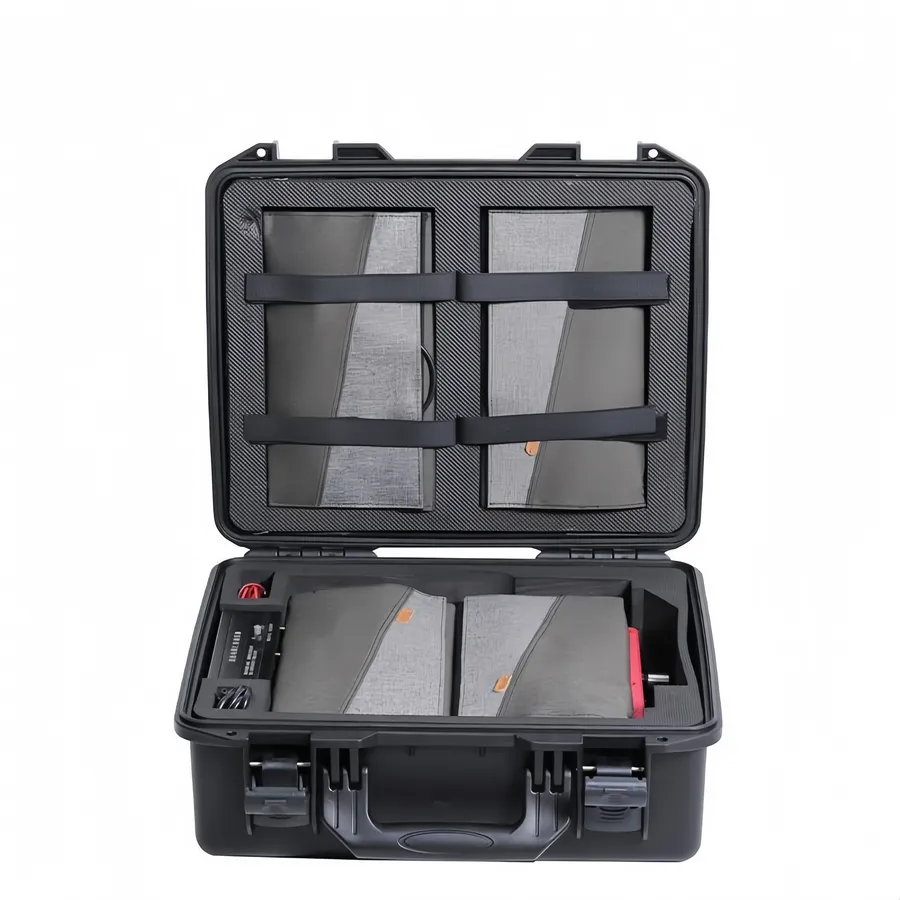
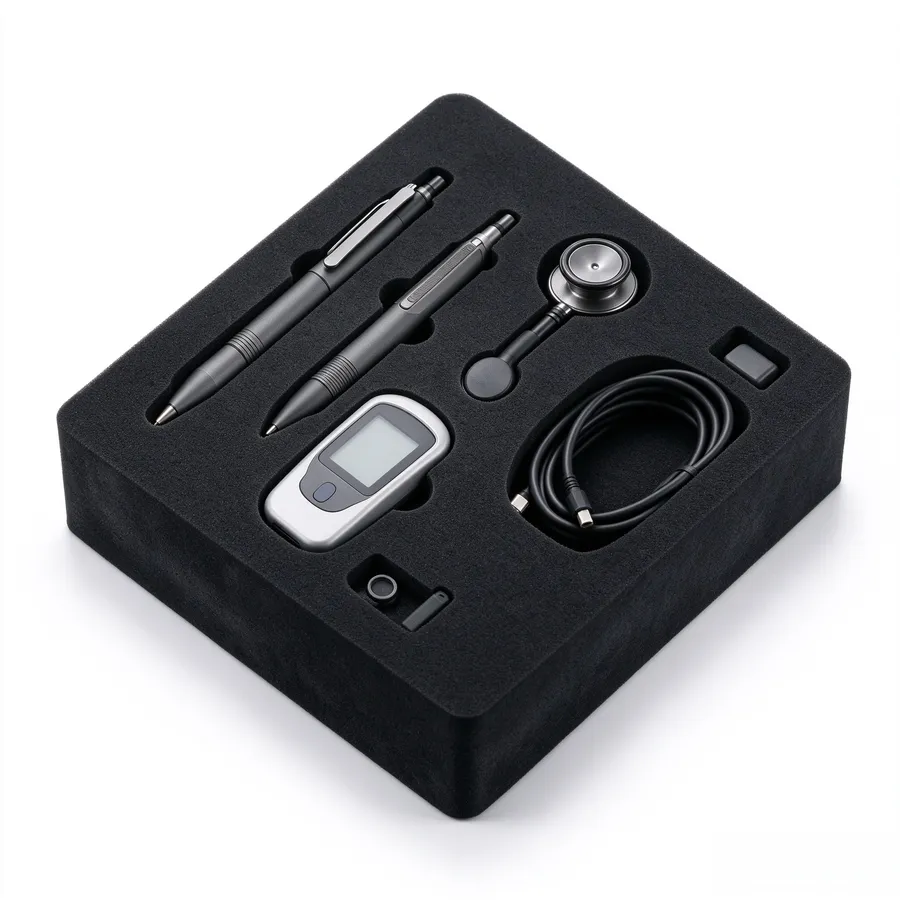
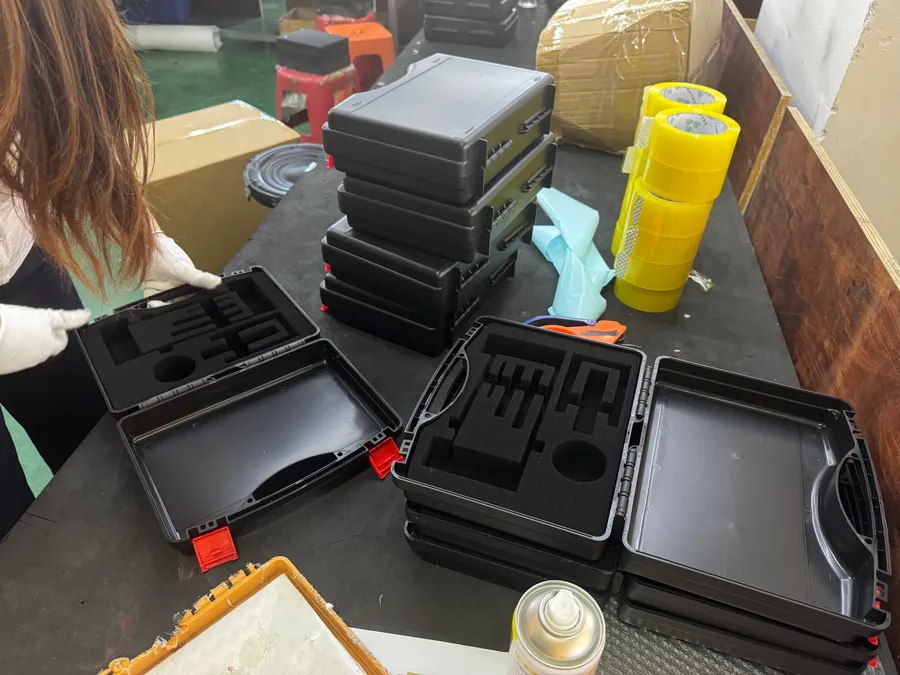
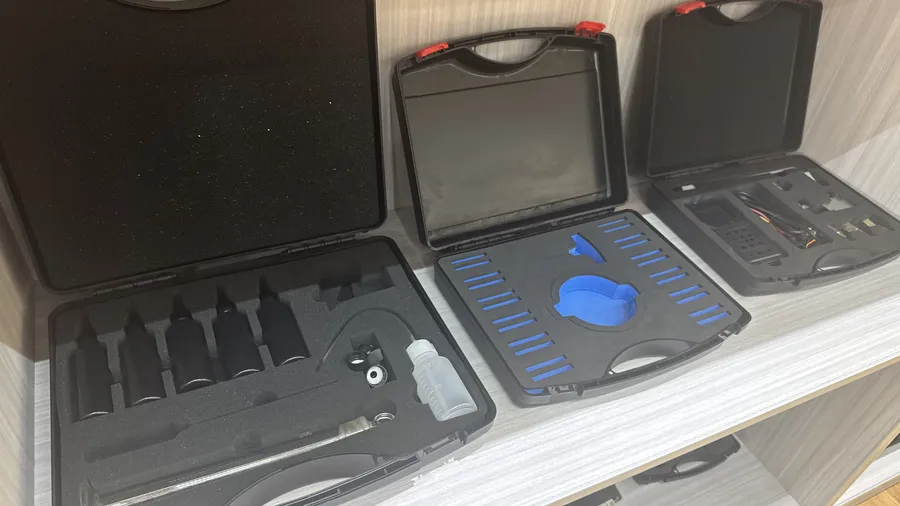
Customisation
Everything described above is configurable on a standard shell: interior layout (pick-and-pluck, die-cut or CNC-cut), foam grade and thickness, colour, logo method, latch and lock count, pressure-equalisation valve, cable ports, document holder and identification plate. A bespoke exterior geometry requires a new mould — 125 days, from 3,000 units per moulded component.
Procurement considerations
| Question | What to send us |
|---|---|
| Which shell fits? | Equipment L × W × H as packed, plus required clearance per axis |
| What does it cost? | Order quantity and estimated annual quantity — the two drive different answers |
| Is tooling needed? | Whether an existing shell clears the envelope with usable foam depth |
| Lead time? | Your required delivery date, not just the order date |
| Certification? | The exact standard your tender names — we will say whether we can test to it |
| Freight? | Destination and preferred terms; carton and pallet data supplied with the quotation |
Comparison and selection guide
The tables on this page exist because a protective case is chosen by comparing three things: the envelope, the environment and the handling chain. Where no table applies, the rule below is.
| Situation | What To Do |
|---|---|
| Sea freight | Sealed configuration plus desiccant; salt spray is a handling issue, not a material issue. |
| Air freight | Mass and external dimensions drive cost more than volume. |
| Repeated movement | Replaceable latches, hinges and gaskets; keep a spares kit with the first order. |
- Size on internal dimensions plus clearance, never on a product name.
- Choose the carrying method before the shell: it changes the series, not just the price.
- Specify the interior last, and decide up front whether the end user will reconfigure it.
What is the difference between a protective case factory and a trading company? relates to Procurement Guide. Related families: Equipment Transport Cases / Custom Protective Cases / Military Protective Cases / Tactical Equipment Cases / Ammunition Storage & Transport Boxes / Medical Equipment Cases. Related sectors: field and industrial equipment. Continue in the Procurement Guide cluster.
This page is written from our own production data. If your requirement differs, send the dimensions and we will tell you which of the 155 models fits, or whether a custom route is needed.


