Can shockproof cases be customized?
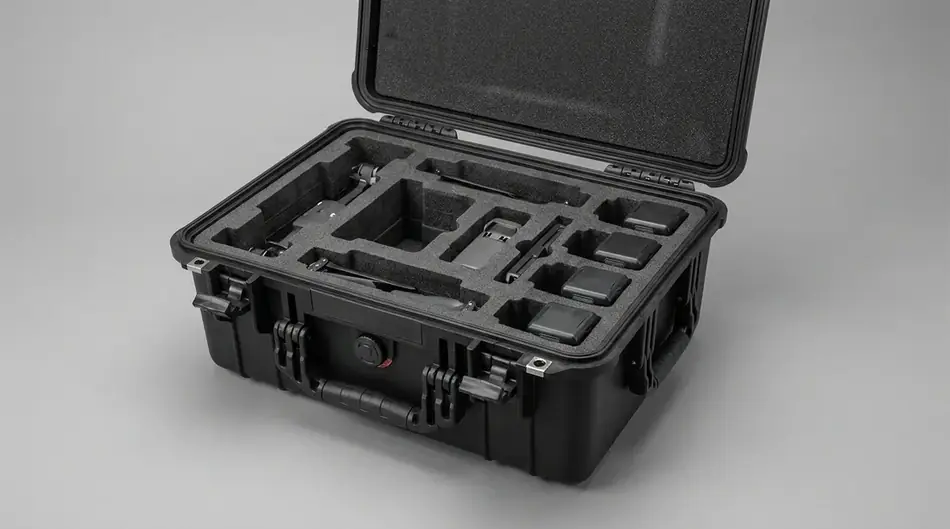
Yes. Nearly every part of a shockproof case can be customized, and the useful question is not whether it is possible but what it costs in tooling. Interior foam layout, cut pattern and thickness, hardware such as latch count, handle, feet, padlock provision, pressure valve, document holder and shoulder strap, plus shell colour, logo and private-label packaging are all changeable on existing moulds, and a foam-only build can start at a single unit. Only a shell geometry that does not exist yet needs a dedicated mould. Note where the shock protection actually sits: our published model records treat it as a construction option that requires a specified foam layout, not as a rating printed on the case.
Key points
- Shock absorption is designed in the foam: a shell with no worked interior transmits the impact to whatever it happens to touch.
- Custom foam starts at one unit and needs only a drawing, a photograph of the packed kit, or a physical sample as its input.
- Colour, logo and private-label packaging move an order to the 300-unit tier, still produced on existing moulds.
- A new shell interior is the only step that needs tooling: about 125 days and a minimum of 3,000 units per component.
- Internal depth, not external size, limits the build: lid and base depths are published per model and foam eats into them.
- Sealed and unsealed bodies are different SKUs, so a water-resistance requirement narrows the shortlist before anything else.
What customizing a shockproof case actually changes
A shockproof case is four separate decisions stacked together, and each one customizes on its own timetable. The interior is the shock system: foam is cut, layered or plucked around the item so that impact energy is absorbed before it reaches a lens, a screen or a connector. The body is a choice from existing moulds, and our published list covers 155 SKUs across seven series, each with fixed external and internal footprints, a published wall thickness and, where recorded, separate lid and base depths. The hardware layer covers latches, hinges, feet, handles and wheels, plus options such as a pressure valve, a document holder or a shoulder strap. The cosmetic layer covers shell colour, logo and the carton the unit ships in. Nothing in that ladder needs new tooling until you want a shell shape that does not already exist.
The most common misunderstanding is to treat shock resistance as a property printed on the case rather than a result of the interior you specify. In our model records shock protection is listed as a construction option with the note that it requires a specified foam layout, and impact resistance is recorded alongside the published wall thickness of that shell with the statement that no drop height is claimed without a test. That distinction is commercial, not academic: a foam enquiry is a workshop job measured in days, while a claim about how far a case can fall is a testing project measured in weeks and paid for separately.
Four levels of customization, from foam only to new tooling
The four tiers below are the ones we publish for the whole range, not figures invented for a single quotation: minimum order quantities of 1 unit for standard stock and for custom foam, 300 units for logo, colour, OEM and private-label lines, and 3,000 units per component where a dedicated mould is cut. Lead time is 45 days for OEM production on existing tooling and about 125 days for a new mould. The practical consequence is that most work on shock protection never touches tooling at all.
| Level | What Changes | Tooling | Published Moq | Lead Time |
|---|---|---|---|---|
| 1 - Interior only | Pick-and-pluck, die-cut or CNC-cut foam; top, base, layered or egg-crate liners | None, existing moulds | From 1 unit | 45 days on existing moulds |
| 2 - Interior plus hardware | Latch count, handle type, feet, padlock-ready latch, pressure valve, document holder, shoulder strap | None, existing moulds | From 300 units | 45 days on existing moulds |
| 3 - Branding | Shell colour, logo, private-label carton and labelling | None, existing moulds | From 300 units per line item | 45 days on existing moulds |
| 4 - New shell interior | Internal footprint, depth split between lid and base, wall thickness | New mould per component | From 3,000 units per component | About 125 days |
The foam is where the shock work is designed
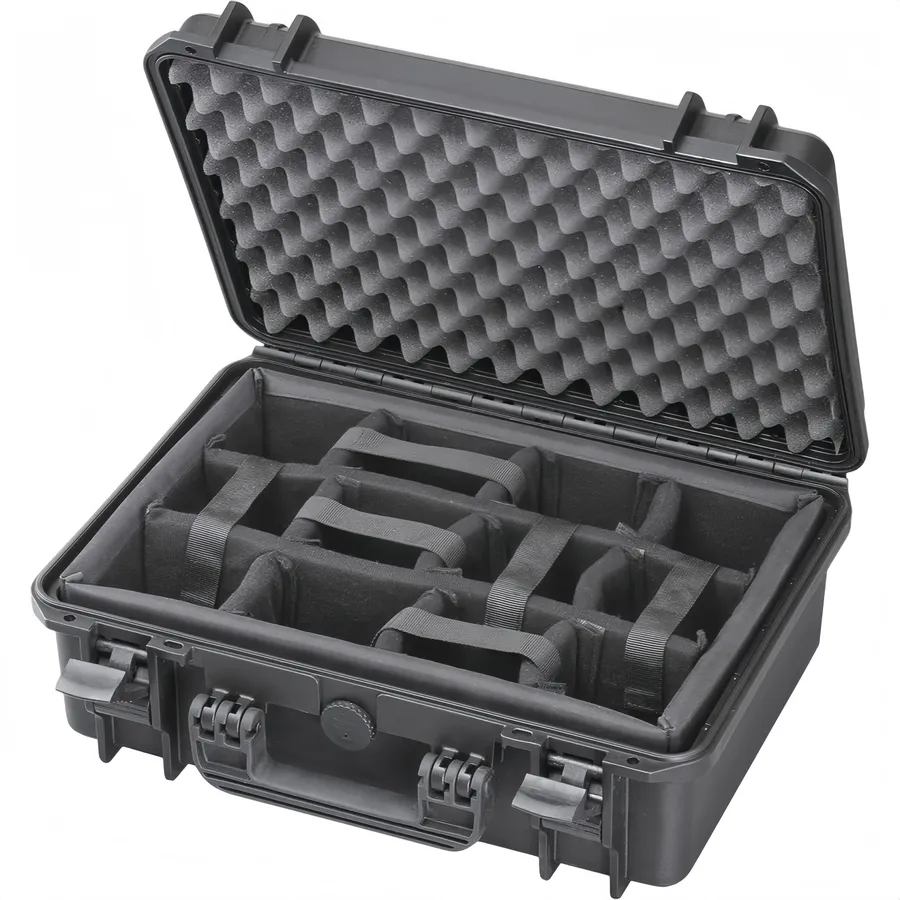
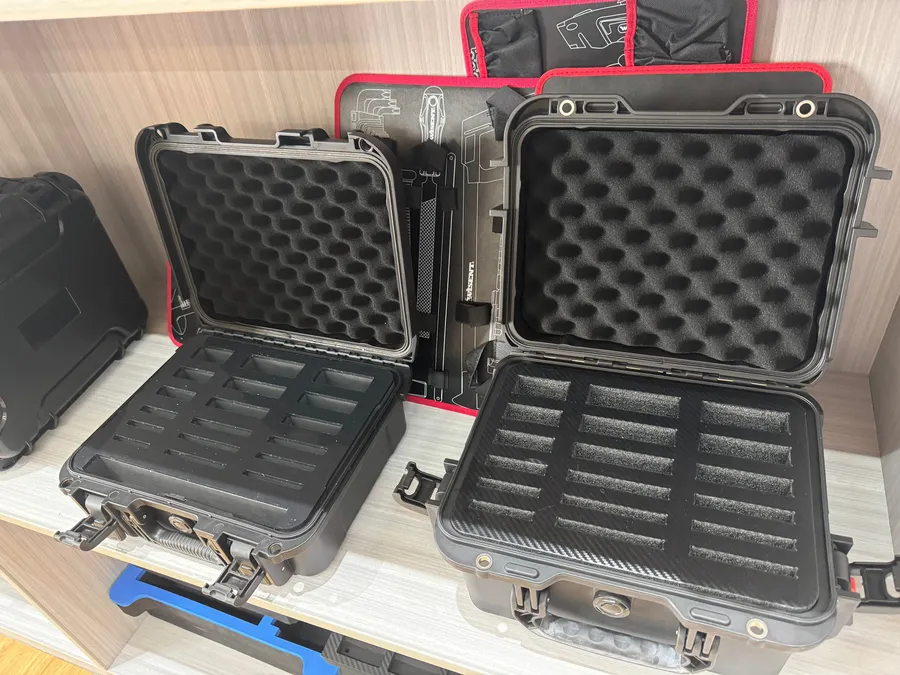
Our published interior options cover six material and process families - pick-and-pluck, die-cut, CNC-cut, EVA, PE and EPE - and five structural patterns: top foam, base foam, egg-crate or convoluted lining, custom cut and layered builds. Both thickness and shape are variable. That gives a buyer more control over how an impact is handled than the shell ever does, because the foam decides which axis of the item is supported, how much clearance surrounds a fragile section, and whether the item is restrained against shifting as well as against a single hit.
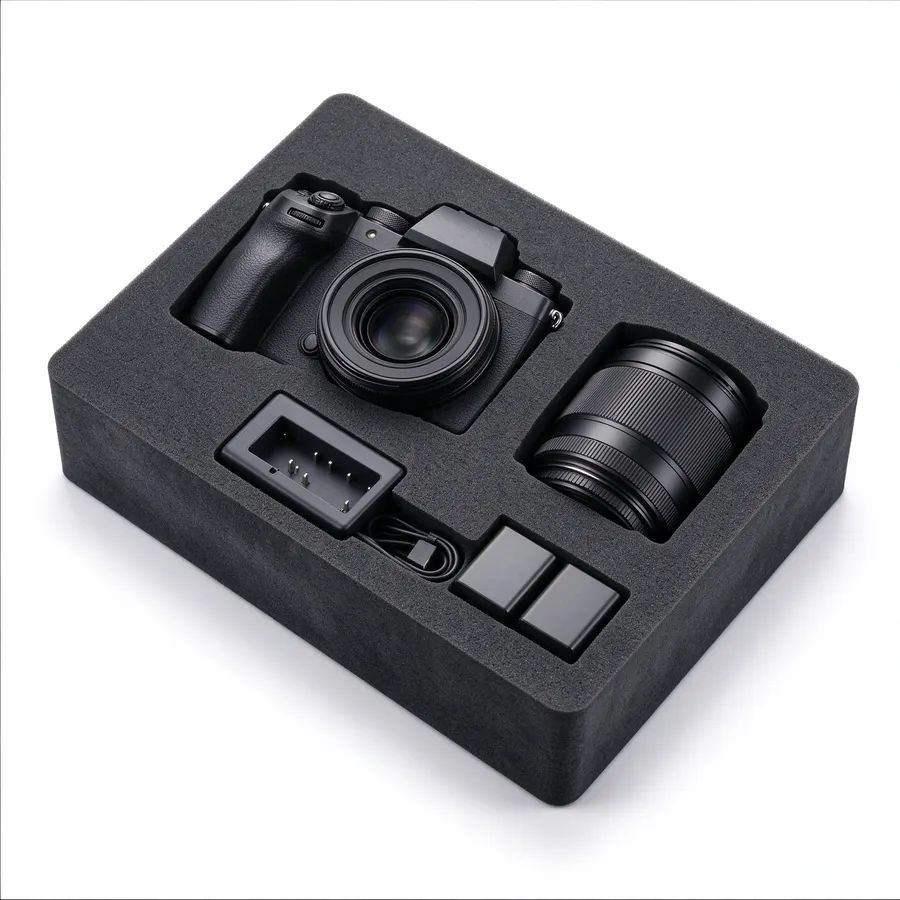
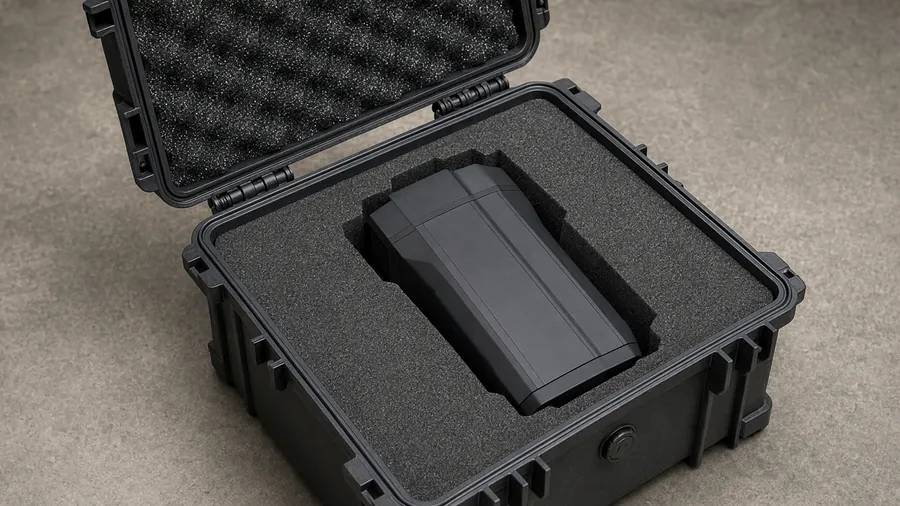
To cut to that specification we need one of three inputs, and we say so in the model records themselves: a drawing, a photograph of the packed kit, or a physical sample. A drawing is best when you already know the mass, the fragile axis and the service items that must stay reachable without full unpacking. A photograph of the kit laid out on a bench is usually enough for pick-and-pluck or a simple die-cut. A physical sample is the honest answer when the item has moulded grips, protruding antennas or a connector you must not let carry any load.
Published figures that bound what you can ask for
Read the depth column before the footprint column, because it decides what the interior can do for you. KX-97227 splits its 210 mm of internal height as 168 mm in the base and 42 mm in the lid, which suits a tall instrument that must sit in a deep tray while the lid stays clear of a raised control panel. KX-86122 does the opposite, with 155 mm of lid depth over a 48 mm base, which suits flatter gear with protrusions that hang into the lid. The two bodies are not far apart in volume at 43.1 and 31.0 litres of usable interior, yet they solve different packing problems.
Wall thickness is published per model and spans 2.0 mm to 6.0 mm across the 155-SKU list; it is fixed by the mould, so it is a selection criterion rather than a customization option. Volume figures are the usable ones, which already discount frame and hardware, and any foam you add reduces them further: a 30 mm base liner plus a 20 mm top liner takes 50 mm out of the internal height you started with. That subtraction is the first calculation in any custom build, and it is why an enquiry that opens with the item's own dimensions moves faster than one that opens with a preferred case size.
| Model | Shell | Internal Mm | Lid And Base Depth Mm | Wall Mm | Usable Volume L | Seal Option |
|---|---|---|---|---|---|---|
| KX-1204 | PP | 115 x 78 x 32 | 16 / 16 | 2.6 | 0.3 | Not offered on this SKU |
| KX-63917 | ABS | 360 x 240 x 150 | Not recorded | 3.8 | 11.2 | EPDM or equivalent compressible gasket |
| KX-86122 | PP | 530 x 360 x 203 | 155 / 48 | 5.0 | 31.0 | EPDM or equivalent compressible gasket |
| KX-85726 | PP | 520 x 296 x 210 | 155 / 55 | 4.2 | 25.8 | EPDM or equivalent compressible gasket |
| KX-97227 | Engineering PP | 590 x 435 x 210 | 42 / 168 | 6.0 | 43.1 | EPDM or equivalent compressible gasket |
| KX-88442 | PP | 740 x 518 x 364 | 320 / 44 | 5.0 | 111.6 | EPDM or equivalent compressible gasket |
Three ways buyers phrase this, and what each one really asks
Requests that reach us phrased as shockproof cases customized usually turn out to be one of three different jobs. The first is a fit problem: the item rattles in transit, or a component is resting on something it should not touch. The second is a route problem: the same item survives a car boot but not an airport handling chain, which is a question of foam density and restraint rather than of the shell. The third is an identity problem: the case has to carry a colour and a logo so that the kit reads as part of a fleet rather than as assorted hardware.
The longer phrasing, waterproof shockproof cases customized, asks for two mechanisms at once and is worth separating. Water management lives in the body and the gasket: 124 of the 155 SKUs record a seal option using EPDM or an equivalent compressible gasket between lid and base, while 31 models, including the small 0 Series utility shells, do not offer one. Impact management lives in the interior. Both can sit on the same case, but they are specified, built and documented as two separate pieces of work.
Where a customized interior earns its cost
Applications with awkward geometry benefit most. Camera and optical kits need lens nests that carry the barrel and not the mount. Drone payloads arrive with gimbal arms and prop hubs that will not lie flat. Handheld radios have antenna stubs and battery packs that must stay reachable. Medical handhelds trail probe cables that need a channel, not a squeeze. Field instruments used outdoors spend their life in a vehicle load bay, where vibration is constant and every stop adds another small shock.
What those jobs share is that damage happens where the item touches something, not where the case touches something. A worked cut removes the contact; generic pluck foam leaves the item standing on its own connector. The published series then do the rest of the work: 6 Series ABS bodies are chosen where a smooth interior and mid-range volume matter, 8 Series PP shells are the largest family in our list at 62 SKUs and carry most deep-body industrial work, and the 19 T Series units pair a telescopic handle with two wheels so that a heavy custom interior can still be moved by one person.
A short decision path for specifying the job
Start with the item rather than the case. Record its three overall dimensions and its mass, mark the axis you would be most upset to see damaged, and note any service item that has to stay reachable. Then decide whether the body needs a gasket, because that choice moves you between SKUs. Then pick a level from the four-step ladder above: if the item fits an existing interior with foam allowance removed, you are at level 1 to 3 and the build stays on existing moulds. Then check packing data, which we publish for 64 of the 155 SKUs: KX-63917 ships 8 units in a 625 x 405 x 717 mm carton, while KX-97227 ships one to a 715 x 515 x 280 mm carton, and those two facts drive very different freight maths.
If the route is doing the damaging, buy the interior first: a restraint change and a density change cost days and no tooling. If the market is driving the change - retail appearance, a brand colour, a bilingual carton - expect the 300-unit tier for colour and logo, and keep the foam design fixed so that only the exterior moves. Only reach for level 4 when the item genuinely cannot be carried by any published internal dimension.
OEM, ODM and private label scope on a shockproof case
The OEM fields we publish are identical across the range: OEM and ODM both available; custom logo, colour, packaging, foam and hardware all available; private label available; and a dedicated mould listed as available at about 125 days with a minimum of 3,000 units per component. Hardware is a configuration list rather than a fixed set - latch count is specified per configuration, and shoulder strap, pressure valve and document holder are options we can supply or leave off the build sheet entirely.
Commercial terms are wholesale and OEM only. We quote EXW or FOB, we do not sell retail, we do not work on DDP landed-price terms and we hold no overseas warehouse stock. A first OEM order on existing moulds runs on a 30% deposit with the balance before shipment and about 45 days of production; a mould project is scheduled on its own timeline. Buyers who need door delivery appoint their own freight forwarder, which is standard for this purchasing model and is exactly why carton and packing figures are published where they are recorded.
What we do not claim about a customized shockproof case
A custom build is not a licence to invent numbers. In our own records, waterproof, dust resistance and the general protection rating are marked as not measured for every model in the 155-SKU list, and temperature range, UV resistance, load capacity and stack load carry the same status. Where a figure has no test record we say so, and we offer accredited third-party testing as a separate commissioned work package rather than printing a rating we cannot stand behind in a tender.
Two related points deserve plain wording. Shock and impact entries describe construction - what the shell and interior are built from - and are not a validated survival threshold. And a colour, logo or private-label change alters nothing structural: the datasheet figures for wall thickness, depth and usable volume stay exactly as published for that SKU, whatever the shell ends up wearing.
What to send with your enquiry
Send the item's dimensions and mass, the fragile axis, a photograph of the kit as it is packed today, the annual quantity and your usual batch size, whether a sealed body is required, the shell colour and logo artwork if branding is in scope, and the destination port or pickup point so that pricing can be issued on EXW or FOB. If you can ship a sample, say so in the first message: a physical sample changes how the cut is drafted and how quickly the first article can be approved.
You should get back a proposed level from the four-step ladder, a candidate SKU with its published internal dimensions and depth split, a foam layout sketch, and a price for that configuration. That exchange costs us little and prevents the most expensive outcome in this business: a mould project opened to solve a problem that a foam change would have solved in three weeks.
Customisation
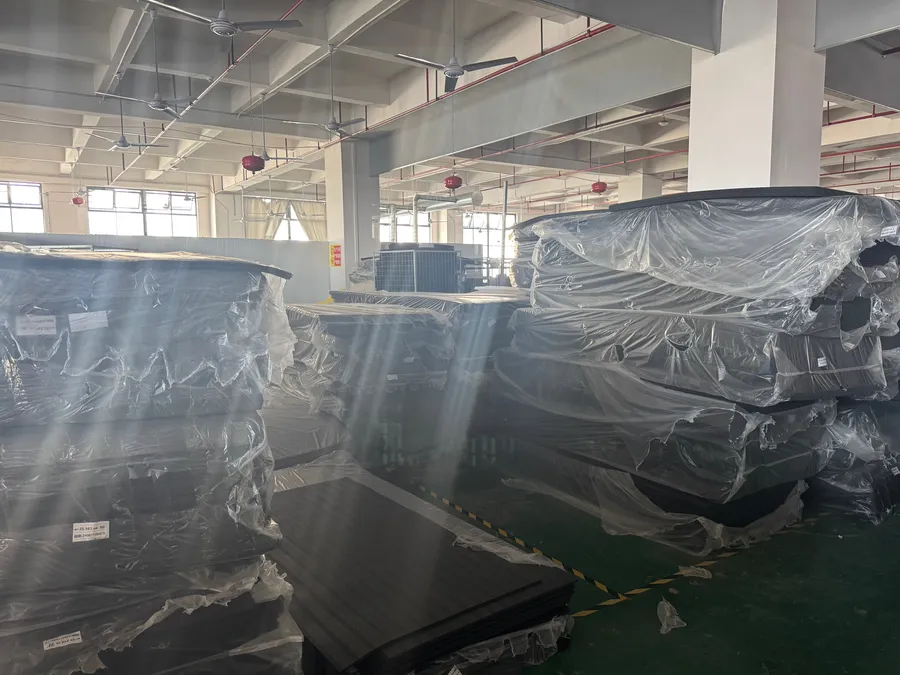
Everything described above is configurable on a standard shell: interior layout (pick-and-pluck, die-cut or CNC-cut), foam grade and thickness, colour, logo method, latch and lock count, pressure-equalisation valve, cable ports, document holder and identification plate. A bespoke exterior geometry requires a new mould — 125 days, from 3,000 units per moulded component.
Procurement considerations
| Question | What to send us |
|---|---|
| Which shell fits? | Equipment L × W × H as packed, plus required clearance per axis |
| What does it cost? | Order quantity and estimated annual quantity — the two drive different answers |
| Is tooling needed? | Whether an existing shell clears the envelope with usable foam depth |
| Lead time? | Your required delivery date, not just the order date |
| Certification? | The exact standard your tender names — we will say whether we can test to it |
| Freight? | Destination and preferred terms; carton and pallet data supplied with the quotation |
Comparison and selection guide
The tables on this page exist because a protective case is chosen by comparing three things: the envelope, the environment and the handling chain. Where no table applies, the rule below is.
| Situation | What To Do |
|---|---|
| Occasional splash | A close-fitting rim without a gasket is cheaper and easier to maintain. |
| Rain and washdown | Sealed configuration, four or more latches, stainless hardware. |
| Immersion or pressure change | Sealed configuration plus a pressure-equalisation valve, and a documented test. |
- Size on internal dimensions plus clearance, never on a product name.
- Choose the carrying method before the shell: it changes the series, not just the price.
- Specify the interior last, and decide up front whether the end user will reconfigure it.
Can shockproof cases be customized? relates to Waterproof & Dustproof Guide. Related families: Waterproof Cases / Outdoor Protective Cases / Custom Protective Cases / Military Protective Cases. Related sectors: field and industrial equipment. Continue in the Waterproof & Dustproof Guide cluster.
This page is written from our own production data. If your requirement differs, send the dimensions and we will tell you which of the 155 models fits, or whether a custom route is needed.