What is impact testing?
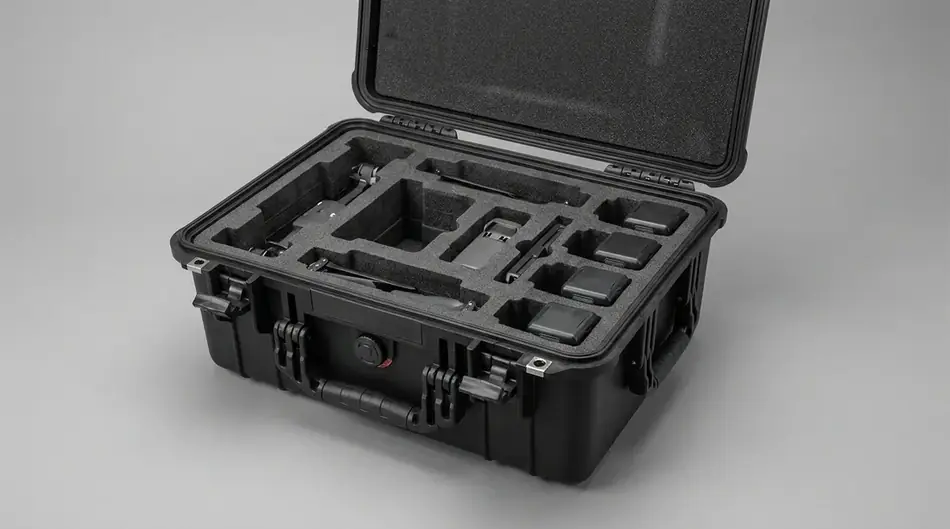
Impact testing is a laboratory procedure in which a defined package - the case, closed as specified, with a stated load inside - is given a sudden input of energy and then inspected against criteria agreed before the test. The common form is a free fall onto a hard surface from a stated height, delivered flat, edge-first or corner-first; the useful output is not whether the shell survived but what the equipment inside actually experienced. On our own sheet we publish structure rather than a catalogue pass: wall thickness is recorded on 148 of 155 models from 2 mm to 6 mm, impact and shock resistance are recorded on all 155 as a manufacturer construction option with no drop height stated, and the foam layout is treated as part of the tested assembly rather than an accessory.
Key points
- Impact testing judges the packaged system - shell, closure, foam and contents together - never an empty shell.
- Drop, edge and corner impact, guided vertical impact and repeated handling shock answer different questions.
- Wall thickness is published on 148 of 155 models (2-6 mm); it is structure, not a drop-height claim.
- Impact and shock resistance appear on all 155 models as a manufacturer option, with no drop height stated.
- Shock protection on our sheet is conditional on a specified foam layout, because the shell alone is not a rating.
- A usable report names specimen, configuration, mass, orientation, height, surface, conditioning and pass criteria.
- Where a qualification number is required, accredited testing is commissioned on the ordered configuration as a separate work package.
What the term actually means
An impact test applies energy in a time short compared with the structure's own response. The package is the specimen: a case closed to its specified latch count, with the foam bed it will ship with, carrying a declared mass, dropped or struck in a declared orientation, onto a declared surface. Before the test the parties agree what counts as a failure - shell crack, latch release, lid displacement, gasket exposure, internal contact, or a functional check of the equipment afterwards. Without that pre-agreed criterion the test produces a photograph, not a result.
It is worth separating impact from the three other families a case survives. Vibration is sustained, low amplitude and moves items inside a bed. Compression and stacking load are slow and constant, and they test the rim and walls. Environmental exposure - rain, dust, sunlight, temperature - tests the sealing rim and the resin, not the structure's reaction to a knock. A case can pass one family and fail another, which is why a purchase description that only says impact resistant is not testable by anyone.
The test families a case is usually put through
Free-fall drop is the base procedure: the package is released onto a flat, rigid surface, and the variables are mass, height, orientation and the number of drops. Orientation matters more than buyers expect, because a moulded shell is not equally stiff everywhere - a corner hits ribs and the rim, a flat face spans between them, and the same shell can survive one and crack in the other. Edge and corner drops are therefore specified as separate cases, not as a note under the flat drop.
A guided drop tower constrains the package as it falls so it cannot rotate freely, which gives a cleaner comparison between designs at the cost of realism. A sled or inclined rig produces a controlled horizontal deceleration and is what you use when the real event is a vehicle bed impact or a trolley dropped from a tail lift. A vertical impact with a guided mass striking the top face is used when the field hazard is something falling onto the case rather than the case falling onto something. Instrumentation is added when the question is the load reaching the equipment: accelerometers mounted on a representative item or on a test mass in its seat, with the shell, closure and foam all present in the configuration being measured.
What the shell contributes, and where our published data stops
A moulded thermoplastic shell handles an impact by spreading a local load over a wider area and by bending without cracking. The published lever is wall thickness: on our 155 active models it is recorded on 148, running from 2 mm to 6 mm with a median of 3.90 mm, and it clusters into 24 models under 3.0 mm, 50 from 3.0 to 3.9 mm, 44 from 4.0 to 4.9 mm and 30 at 5.0 mm and above. The remaining 7 models carry no wall figure on the sheet, and we do not estimate one for them.
Geometry does the rest of the work: corner radii, the lid-to-base depth split, the stacking rim, the gate and parting line, and the position of latch and hinge bosses. Lid and base depths are published on 100 models, lids from 16 mm to 320 mm and bases from 15 mm to 168 mm, which is why two shells with the same total internal height behave differently when a load shifts sideways. The hardware is a separate load path: hinge and feet are recorded as fitted on all 155 models, the latch body accepts a standard padlock on all 155, latch count is set per configuration, 136 models are listed stackable and 19 carry wheels.
Where the sheet goes quiet, it goes quiet deliberately. Waterproof, dust, UV, temperature range, stack load, load capacity and any protection rating are recorded as not measured on all 155 models, so there is no ingress code or drop figure to quote. Impact resistance is recorded on all 155 models as a manufacturer option whose note states the wall thickness and adds that no drop height is claimed without a test. Shock protection is recorded the same way, with the condition that a specified foam layout is required.
What the interior decides
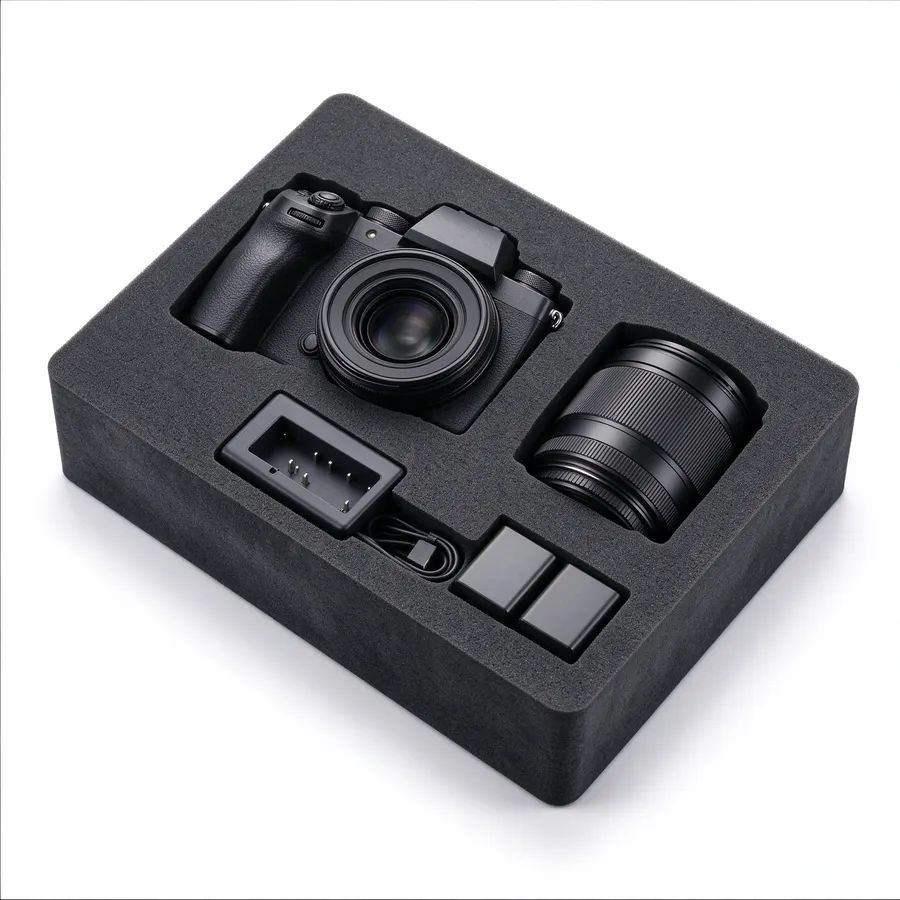
Between the equipment and the shell there is always a layer that can move. Foam sets the stopping distance and therefore the peak force the item sees, and it is the difference between an intact instrument and a case that protected its own contents by transferring the event into a mount face. Our published foam options are pick-and-pluck, die-cut, CNC-cut, EVA, PE and EPE, built as top foam, base foam, egg-crate or convoluted layers, cut or layered to a drawing, a photograph of the packed kit or a physical sample. Because the bed is part of the tested assembly, an impact result obtained with one layout does not license another one.
This is also why the mass range matters when a bed is designed. Published net mass on 93 models runs from 100 g to 15,320 g with a median of 1,480 g, and internal volume across the range runs from 0.3 litres to 139.5 litres. A 20 mm base layer under a 15 kg assembly is close to fully compressed in a modest drop; the same layout under a hand-carried instrument is a different problem with a different answer.
How our claim policy reads
The three states above are the actual fields in our published product data. Read them as an audit trail: each row tells you whether a number exists, who produced it, and against which configuration. If you are screening suppliers, this is the column to ask for; a sheet that prints a single performance word across every row is a marketing sheet, not a specification.
| Claim State On The Sheet | What It Means | Where It Applies To Impact |
|---|---|---|
| Measured | Recorded from our own production or incoming-material data. | Shell material, wall thickness where published (148 of 155 models), fitted hardware, stacking and wheel configuration. |
| Manufacturer option | A construction option we can supply; the figure depends on the configuration you order. | Impact resistance and shock protection on all 155 models, seal material, latch count, pressure valve, custom moulding. |
| Not measured | No test record exists for that model and configuration; we state no value. | Waterproof, dust, UV, temperature range, stack load, load capacity and protection rating on all 155 models. |
| Corrosion resistance | Recorded as measured on all 155 models. | It reflects a thermoplastic shell with no ferrous corrosion path, not a coated or plated finish. |
Published structure across the range
Seven shells taken straight from the published sheet, ordered by wall thickness rather than by size. The thin end is a small utility box: KX-2005 is a 195 x 170 x 46 mm external shell with a 2 mm wall, 175 g empty and no gasket offered, which is a reasonable choice for a light load carried by hand and a poor one for a dense instrument dropped corner-first onto concrete. The thick end is a different structure entirely: KX-88442 carries a 5.0 mm wall around a 740 x 518 x 364 mm interior, 15,320 g empty, on wheels, with a 320 mm lid over a 44 mm base and a 139.5 litre internal volume.
Two other rows are worth reading closely. KX-92817 pairs a 5.0 mm wall with only 940 g of empty mass by being small, and puts almost all its depth in the lid (125 mm of lid over 27 mm of base), which changes where a knock travels. KX-97227 is the thickest shell we publish at 6.0 mm, with wheels, a gasket and 10,000 g empty; at that mass the carry method and the closure, not the resin, decide what happens in a handling event.
| Model | Series | Shell | Wall Mm | Internal Mm | Net G | Gasket Offered | Wheels |
|---|---|---|---|---|---|---|---|
| KX-2005 | 0 Series | PP | 2 | 190 x 135 x 40 | 175 | No | No |
| KX-2813 | 9 Series | Engineering PP | 2.8 | 260 x 200 x 117 | 800 | No | No |
| KX-92817 | 9 Series | Engineering PP | 5 | 253 x 180 x 152 | 940 | Yes | No |
| KX-66232 | T Series | ABS | 5.3 | 507 x 385 x 290 | 7,940 | Yes | Yes |
| KX-6621 | 9 Series | Engineering PP | 6 | 587 x 434 x 192 | 6,420 | Yes | No |
| KX-97227 | T Series | Engineering PP | 6 | 590 x 435 x 210 | 10,000 | Yes | Yes |
| KX-88442 | T Series | PP | 5 | 740 x 518 x 364 | 15,320 | Yes | Yes |
How to specify an impact requirement you can actually be held to
Write the event, not the adjective. State the payload and its mass in the configuration it travels in, the orientation or list of orientations to be tested, the surface, the height or velocity you care about, the number of repetitions, the conditioning temperature, and the acceptance criteria for both the case and the equipment afterwards. Then state the sample size, because a single pass proves a specimen, not a batch.
Send that text to us with the candidate model and we will tell you three things plainly: which of the figures you asked for we already hold as production data, which are construction options we can build to but have not tested, and which need an accredited test body. Where a qualification number is genuinely required, accredited testing is commissioned as a separate work package on the exact model, closure state, foam layout and marking you are ordering, and the report is issued to you. We will not attach an existing result to a different configuration to make a quotation look better.
Where this profile of protection is needed
The enquiries that start with an impact question come from field electronics and instrument sets that are loaded into a vehicle and unloaded at the end of a bad road, from outdoor and survey kit that is put down on rock and gravel, from telecommunications and industrial maintenance teams carrying test gear up ladders, and from medical and laboratory loads where the item inside is calibrated and the case is the calibration's last line. All 155 models on our sheet carry the field-equipment and industrial-equipment application tags, 148 also carry outdoor, 115 are listed under instrument cases and 127 under electronics cases, which is where this question usually lands.
Customising the impact path
Most of what can be changed without new tooling sits in the interior and the closure: foam grade, layering and cut, gasket specification, latch count, pressure valve, corner support, and identification. Custom foam carries no minimum beyond the case order itself, and logo, colour and OEM work on an existing mould are published at 300 pieces, with first samples planned at 45 days on a 30 percent deposit. A new mould is a different programme: 3,000 pieces per component and 125 days, because changing the wall, the rib pattern or the rim changes the structure you would be testing.
If an impact requirement is the reason for the enquiry, tell us at quotation stage rather than after delivery. The wall thickness you are offered, the rib layout, the lid-to-base split and the foam grade are decisions that have to be taken together; taken separately they produce a case that is heavy, expensive and still unprotected.
Before you order
Three cautions. Do not read one model's wall thickness as a family capability - across our 148 published figures the range is 2 mm to 6 mm, and a heavier shell is not automatically a tougher one. Do not accept a result obtained on an empty case as a result for your loaded configuration, because closure compression, the contents and the bed all change the outcome. And do not treat the absence of a printed rating as an absence of engineering: on our sheet 124 models publish a compressible gasket in a continuous moulded channel as measured data while 31 publish no seal offered, and that field is stated per model rather than assumed.
We manufacture for wholesale and OEM buyers on EXW or FOB terms only - no retail, no DDP, and no overseas warehouse, so your own forwarder arranges freight. Send the payload dimensions and mass, the event you want covered, the quantity per delivery and the destination, and we return candidate models with their published internal and external dimensions, wall thickness where recorded, closure state and net mass where recorded. Carton data is published on 64 models with pieces per carton on 58; pallet and container figures are calculated against your pallet size and supplied with the quotation.
Customisation
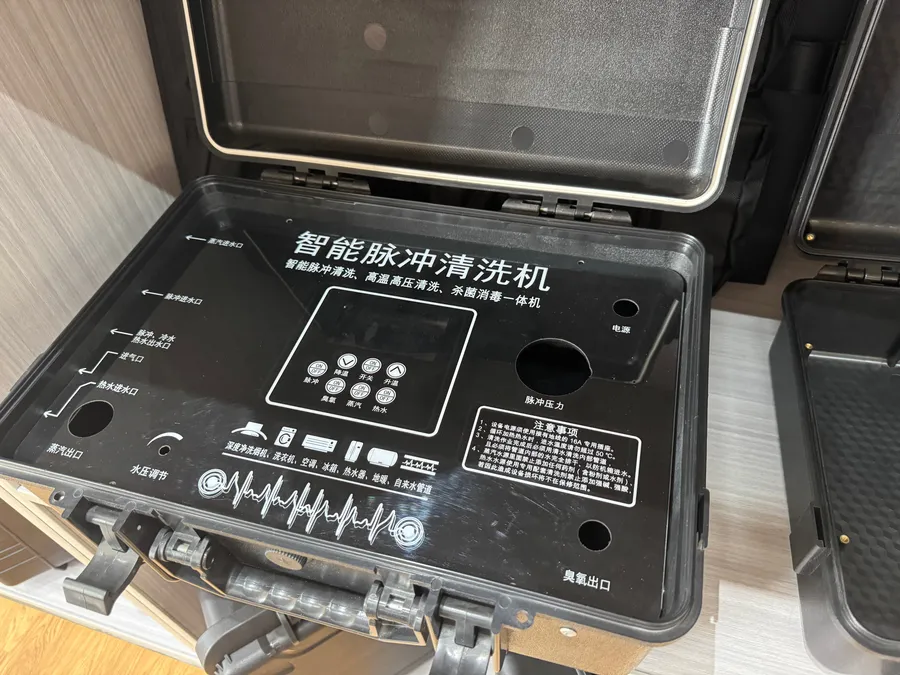
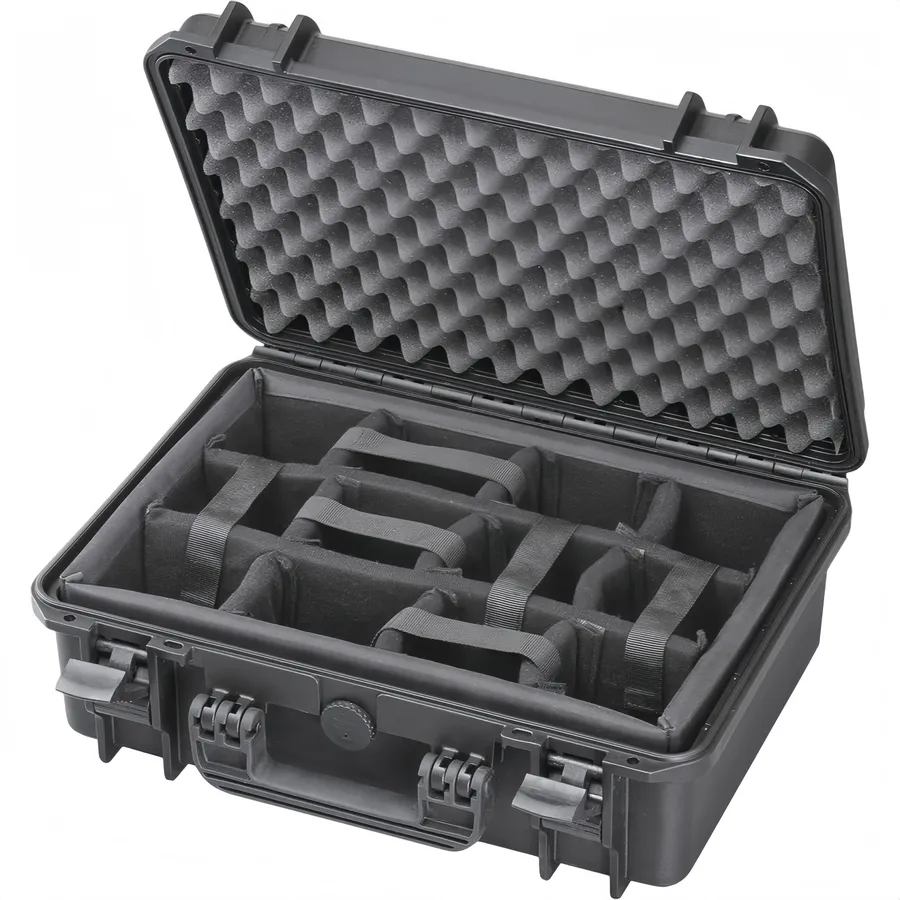
Everything described above is configurable on a standard shell: interior layout (pick-and-pluck, die-cut or CNC-cut), foam grade and thickness, colour, logo method, latch and lock count, pressure-equalisation valve, cable ports, document holder and identification plate. A bespoke exterior geometry requires a new mould — 125 days, from 3,000 units per moulded component.
Procurement considerations
| Question | What to send us |
|---|---|
| Which shell fits? | Equipment L × W × H as packed, plus required clearance per axis |
| What does it cost? | Order quantity and estimated annual quantity — the two drive different answers |
| Is tooling needed? | Whether an existing shell clears the envelope with usable foam depth |
| Lead time? | Your required delivery date, not just the order date |
| Certification? | The exact standard your tender names — we will say whether we can test to it |
| Freight? | Destination and preferred terms; carton and pallet data supplied with the quotation |
Comparison and selection guide
The tables on this page exist because a protective case is chosen by comparing three things: the envelope, the environment and the handling chain. Where no table applies, the rule below is.
| Situation | What To Do |
|---|---|
| Occasional splash | A close-fitting rim without a gasket is cheaper and easier to maintain. |
| Rain and washdown | Sealed configuration, four or more latches, stainless hardware. |
| Immersion or pressure change | Sealed configuration plus a pressure-equalisation valve, and a documented test. |
- Size on internal dimensions plus clearance, never on a product name.
- Choose the carrying method before the shell: it changes the series, not just the price.
- Specify the interior last, and decide up front whether the end user will reconfigure it.
What is impact testing? relates to Waterproof & Dustproof Guide. Related families: Waterproof Cases / Outdoor Protective Cases / Instrument & Equipment Cases / Electronics Cases / Custom Protective Cases. Related sectors: field and industrial equipment. Continue in the Waterproof & Dustproof Guide cluster.
This page is written from our own production data. If your requirement differs, send the dimensions and we will tell you which of the 155 models fits, or whether a custom route is needed.