What is drop testing?
Drop testing is a procedure in which a closed case, loaded to a stated mass and prepared exactly as it will ship, is released into free fall onto a defined hard surface from a stated height, in a stated orientation - corner-first, edge-first, flat on a face, or base-first - and then inspected against acceptance criteria agreed before the release. The measured output that matters is not whether the shell cracked but what the equipment inside actually experienced: the peak force transmitted through the closure and the foam, whether the item still locates in its pocket, whether a lens face or a connector took load, and whether the case still closes and seals afterwards. Height, surface, orientation, mass and the interior are all part of one assembly, so a result belongs to that configuration and cannot be spread across a catalogue. On our own data sheet we publish structure rather than a pass: wall thickness is recorded on 148 of 155 models from 2 mm to 6 mm, impact and shock resistance are recorded on all 155 as a construction option with no drop height stated, and a drop test of a named shell with a named layout and a named load is quoted as a separate work package.
Key points
- A drop test is a configuration test: shell, closure, interior, load and orientation are one assembly, and the result describes only that assembly.
- The useful output is what the contents experienced - transmitted force, retained location, closure still working - not whether the box looks undamaged.
- Orientation changes which part fails: corner loads the shell, edge loads the latch and hinge line, face-flat loads the base foam.
- We publish wall thickness on 148 of 155 models, 2 mm to 6 mm with a median of 3.9 mm, and no drop height for any model.
- The interior is where a drop result is won: base depth is published on 100 models from 15 mm to 168 mm, with a median of 44 mm.
- A drop-test report can be commissioned as a separate work package; the report describes the article that was in the chamber, not the range.
- Terms of business stay fixed: wholesale and OEM only, EXW or FOB, no retail, no delivered-duty-paid quotation and no overseas warehouse.
What the term actually describes
A drop test is a controlled accident. A case is closed as it would be in service, latched, with its handle and any shoulder webbing stowed or noted, and it is released from a gantry or held at a measured height above a rigid surface so that it falls freely without being thrown or spun. Before the release, everyone involved agrees the variables: the mass inside, the height, the orientation at contact, the surface, the ambient condition, how many drops the same article must survive, and what counts as a pass. Change any one of those and you have a different test, which is why a bare phrase without the parameters carries almost no information unless the parameters travel with it.
The instrumentation is the other half. A case can be inspected only - cracked or not, closing or not - and that answers a packaging question. A useful test also tells you what the contents felt, which normally means an instrumented dummy load or a data logger sitting in the pocket where the real item would sit, recording the peak acceleration and its duration through the impact. The difference between those two styles is the difference between asking did the box survive and asking did the instrument inside experience a force it can tolerate, and only the second one protects anything.
Why orientation is not a detail
A drop is not one event, it is four different events that a case can be made to survive. Our own drop-testing page lists them in the order we work through them, because each one attacks a different part of the assembly. The corner is the worst case for the shell, because the entire energy of the fall arrives through a small radius and the wall has nowhere to spread it. The edge is the worst case for the latch and the hinge line, because the closure and its fixing points are what get prised. Landing flat on a face is the worst case for the base foam, because the whole load path goes through the layer between the item and the floor of the box. And dropping base-first or top-down is the one people forget, because it loads the handle, the lid contours and any valve or fitting that stands proud.
| Orientation | What It Attacks | What Usually Shows Up | What To Inspect After |
|---|---|---|---|
| Corner-first | The shell at the moulded radius, and the rim line where lid meets base | A white stress mark or a crack at the radius; a distorted rim that no longer compresses a gasket evenly | Closure and seal line as well as the shell, because a distorted rim can pass a visual check and fail a contents check |
| Edge-first | Latch bodies, hinge pins, the fixing points behind them | A latch that no longer locates, a stripped or lifted fixing, a lid that sits proud | Every latch by hand, and the padlock hasp if one is fitted |
| Flat on a face | The base foam and whatever sits lowest in the layout | Crushed or permanently set foam; an item that has been pushed into the shell wall | Foam recovery, item position, and whether the item now touches a wall |
| Top-down or base-first | Handle, wheels, feet, telescopic tube, anything proud of the shell | A cracked handle fixing, a sheared foot, a bent tube | Hardware function under load, not just appearance |
| Repeat drops on one article | Cumulative damage that a single drop hides | A closure that still latches but no longer holds compression | Seal line and latch tension after each release rather than at the end |
Dummy mass, real load and the centre of gravity
What is inside the case decides the result more than what it is made of. A sealed shell dropped empty behaves like a springboard: the walls flex and recover, and nothing transfers load through the interior. A shell dropped with a dense assembly concentrated in one pocket behaves nothing like that, because the mass keeps travelling after the shell stops, and the only thing that can arrest it is the foam around it. That is why tests are run against a stated mass with a stated centre of gravity, either as water-equivalent ballast blocks fixed so they cannot shift, or as the real item with its cables, magazines, lenses and battery fitted. Ballast is cheaper and more repeatable; the real item is the one that tells you whether a connector survived.
The practical consequence for a buyer is that the mass you quote in a request is a specification, not a footnote. A case listed with a published net shell mass of 940 grams and a 5.0 mm wall, such as the KX 9-2817, is a different problem from a 15.32 kg wheeled body holding more than a hundred litres, such as the KX 8-8442, and the second one drops with far more energy through its own hardware. Our listings record load capacity and stack load as not measured for every model, precisely because those figures belong to a test of a configuration rather than to a shell.
Height, surface and condition: the other three variables
Height sets the energy available: doubling it does not double the severity at the contents, because the peak force also depends on how far the case and the foam travel while stopping. The surface is the second control - a steel plate and a smooth concrete floor give noticeably different local response at a corner, and a specification should name one. Condition is the third: a polyethylene shell at a warm workshop temperature behaves differently from one that has been cold-soaked overnight, and a proper programme either states the condition or tests more than one. Any report worth acting on lists all of these alongside the article identity, and any claim that omits them is a marketing sentence rather than a result.
Our published listings take the conservative line here. Impact resistance is recorded on all 155 models as a construction option with the wall thickness noted and the explicit remark that no drop height is claimed without a test. Shock protection is recorded the same way with a second remark: it requires a specified foam layout, because the shell alone is not a shock rating. Both statements are deliberately unfalsifiable - they describe how the article is built, not what it survived.
What the shell contributes, and where our data stops
The shell contributes stiffness, a defined load path and a location for the closure. Wall thickness is published on 148 of 155 models and runs from 2.0 mm to 6.0 mm, with a median of 3.9 mm; 56 models publish a wall of 4.5 mm or more, and 25 sit at exactly 5.0 mm. That spread is real information about how a case is built, and it is a legitimate input to a drop discussion, but it is not a drop rating. A thin 2.1 mm wall on a small engineering-PP box flexes more and can survive a corner hit by yielding a little; a 5.0 mm wall on a large box transfers more of the shock into whatever is inside unless the foam is designed for it. Neither is universally better, which is exactly why we do not translate a wall figure into an absorbed-energy claim.
The corrosion side is measured and stated: our listings record a thermoplastic shell with no ferrous corrosion path as a measured property on all 155 models, and the seal as a compressible gasket running in a continuous moulded channel on the 124 models that list seal availability, with the remaining 31 recorded as no test record. Those are the ingress and material statements we can make. Everything else on the protection line - water, dust, ultraviolet, service temperature, load and stack capacity - reads not measured, and an accredited test of a named configuration can be commissioned as a separate work package.
Where the drop result is actually won: the interior
Between a falling shell and a travelling item there is only foam, and the physics of that gap is unforgiving: peak force falls as stopping distance rises, so the layer under the item is the single largest control available inside a case of this type, and it costs material rather than tooling. Our own drop-testing page makes the point with an illustration - moving from a thin base layer to a 50 mm one under a 15 kg assembly is the biggest reduction a case of that kind can be given. Note what that is: a description of the mechanism and of what we build, not a reported measurement for a model.
The published geometry is where you can check the arithmetic. On the 100 models that record the lid-to-base split, base depth runs from 15 mm to 168 mm with a median of 44 mm, and lid depth from 16 mm to 320 mm with a median of about 98 mm. A layout that carries mass wants depth in the base: the KX 5321 publishes a 149 mm base against a 43 mm lid, and the KX 9-7227 a 168 mm base against a 42 mm lid, both built to carry weight from underneath. A layout that cradles an item for lift-out is the opposite shape: the KX 8-4430 publishes a 230 mm lid over a 45 mm base. Specifying a drop-resistant interior means choosing the split first and the grade second, and then confirming that the usable interior volume supports it - usable is published against nominal on all 155 models, smaller on 154 of them, with the ratio running from 0.797 to 1.0 and a median of 0.85.
How our claim policy reads
Three positions, published in the data itself. Measured means recorded from our own production or incoming-material data. Manufacturer option means a construction option we can supply, where the figure depends on the configuration you order. Not measured means no test record exists for that model and configuration, we will not state a value, and accredited testing can be commissioned as a separate work package. A drop claim lives in the third box for every model in our catalogue, which is a clearer answer than the one most buyers are used to getting, and it is the reason our listings say so on the page rather than in correspondence.
The policy exists because a single pass is easy to manufacture and useless as a specification. Drop one article, one time, from one height, onto one surface, with one ballast arrangement, and you have a photograph and an anecdote. Drop a small sample set across the orientations that matter, with the real load and instrumentation, and you have something an engineer can design against. The difference is the number of articles, the orientations, the instrumentation and the agreed acceptance criteria - and all four are things a buyer can ask for before the test is booked rather than after.
Commissioning a drop test for your configuration
If a tender or a product safety review needs a drop figure, here is the sequence that produces one worth having. Fix the article first: model, shell material and wall, closure and latch count, and whether a seal is fitted, because a shell with a gasket and one without are different articles. Then fix the interior as a drawing - layer materials and thicknesses, pocket geometry, where the mass sits - and cut the sample against that drawing rather than improvising at the bench. Then fix the load: real item or ballast, its mass and its centre of gravity, and whether it is restrained. Then fix the procedure: height, surface, orientation sequence, number of drops, ambient condition, and the acceptance criteria for shell, closure, seal function and transmitted force.
Send that package to an accredited laboratory and keep the sample count honest - a destructive programme consumes articles, and the number you need is decided by how many orientations and how many repeats the specification calls for, not by convenience. We arrange the build and shipping of test articles and quote the test itself as a separate work package, outside the case price, because it is a service with its own schedule and its own cost, and because a test that is bundled into a unit price is usually the test nobody paid for. Third-party inspection of ordinary finished goods is separately welcome at any time.
How to read a drop-test report before you rely on it
Start at the identity block and check that the article described is the article you intend to buy: model, wall, hardware, seal fitted or not, layout drawing revision, and the mass and its position. Then check the condition - height, surface, orientation, temperature, number of drops - and only then read the results. A report that shows a transmitted-force figure at the instrument is answering a different and more useful question than one that says the shell was undamaged, and a pass recorded against cosmetic criteria tells you nothing about the instrument that was in the pocket.
Two limits apply to every report and are worth writing into the acceptance section of a contract. First, the result belongs to the configuration: a layout changed, a grade substituted, a latch count reduced or a heavier item fitted is a new article, and the old report does not travel with it. Second, a report describes the articles that were in the chamber. It says nothing about a rating across a range, and it should never be quoted as one; our listings deliberately refuse to inherit a figure from a neighbouring size for exactly this reason, and a buyer should treat a supplier who does as a risk in the tender documents rather than a favour.
Where a documented drop profile is actually needed
The need is concentrated in a handful of loads. Optical and measurement instruments concentrate mass in a small envelope and fail at a lens face or a calibration surface rather than at a corner. Drone and controller kits are dropped from a hand at the edge of a field, and the parts that break are the ones standing proud. Portable medical and field-diagnostic equipment goes in and out of vehicles on uneven ground and has to be demonstrably safe rather than probably safe. Handheld survey, telecoms and monitoring equipment is most often lost to a fall onto rock or a hard standing, with the antenna or the connector taking the hit.
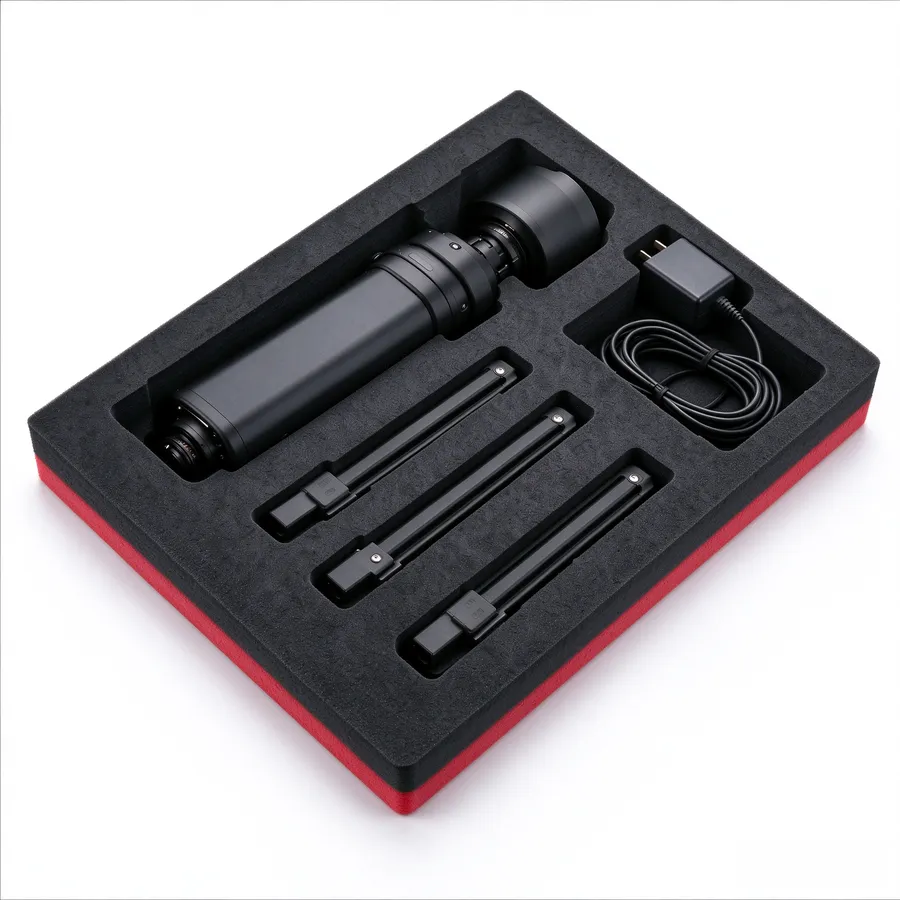
Those are the situations where a documented test is worth paying for, and where a specification should ask for the four variables that decide the answer - article identity, orientation sequence, load and instrumentation - instead of a single headline height. Everywhere else, a well-located interior in a shell chosen for its published envelope, with the wall and depth figures read per model, gets most of the protection for a fraction of the cost. Our case-selection and datasheet guides cover that arithmetic, and the interior layering questions sit in the foam selection pages.
Procurement notes
Ask for evidence in the same shape you intend to use it. If a drop requirement is real, request a test of the named shell with the named layout and the named load, and put the acceptance criteria in the order itself so the batch is built to the article that was tested. If it is not real, ask instead for the figures we do publish per model - internal and external dimensions, narrow internal width where the shell tapers, wall thickness, lid and base depth, net mass, usable interior volume and packing data - and treat the protection line as a set of construction options with the untested items marked as untested.
Commercially the terms do not move: wholesale and OEM volume only, quoted EXW or FOB with a 30 per cent deposit to open production, no retail channel, no delivered-duty-paid quotation and no overseas warehouse stock, so the freight leg from the port of loading and any import step belongs to your own planning. Custom foam starts at one set with no new tooling; colour, logo and OEM work is quoted from 300 units with a first sample on existing mouldings scheduled at 45 days; a genuinely new shell geometry is a mould project at about 125 days from 3,000 units per moulded component. A test programme, like a mould, is quoted as its own work.

Customisation
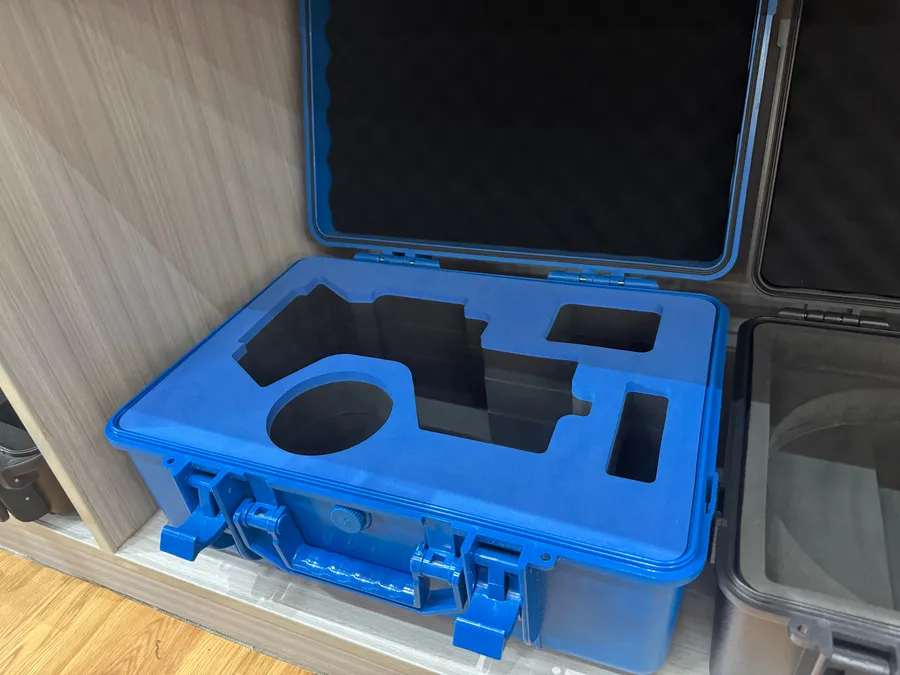
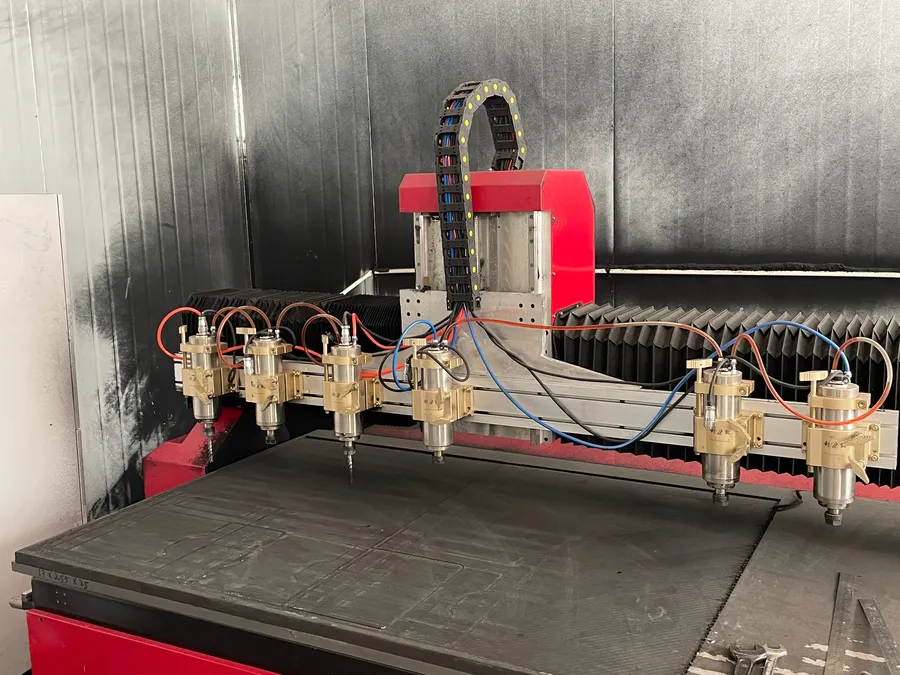
Everything described above is configurable on a standard shell: interior layout (pick-and-pluck, die-cut or CNC-cut), foam grade and thickness, colour, logo method, latch and lock count, pressure-equalisation valve, cable ports, document holder and identification plate. A bespoke exterior geometry requires a new mould — 125 days, from 3,000 units per moulded component.
Procurement considerations
| Question | What to send us |
|---|---|
| Which shell fits? | Equipment L × W × H as packed, plus required clearance per axis |
| What does it cost? | Order quantity and estimated annual quantity — the two drive different answers |
| Is tooling needed? | Whether an existing shell clears the envelope with usable foam depth |
| Lead time? | Your required delivery date, not just the order date |
| Certification? | The exact standard your tender names — we will say whether we can test to it |
| Freight? | Destination and preferred terms; carton and pallet data supplied with the quotation |
Comparison and selection guide
The tables on this page exist because a protective case is chosen by comparing three things: the envelope, the environment and the handling chain. Where no table applies, the rule below is.
| Situation | What To Do |
|---|---|
| Occasional splash | A close-fitting rim without a gasket is cheaper and easier to maintain. |
| Rain and washdown | Sealed configuration, four or more latches, stainless hardware. |
| Immersion or pressure change | Sealed configuration plus a pressure-equalisation valve, and a documented test. |
- Size on internal dimensions plus clearance, never on a product name.
- Choose the carrying method before the shell: it changes the series, not just the price.
- Specify the interior last, and decide up front whether the end user will reconfigure it.
What is drop testing? relates to Waterproof & Dustproof Guide. Related families: Waterproof Cases / Military Protective Cases / Instrument & Equipment Cases / Drone & UAV Cases / Optical Equipment Cases / Camera & Photography Cases / Medical Equipment Cases / Custom Protective Cases. Related sectors: field and industrial equipment. Continue in the Waterproof & Dustproof Guide cluster.
This page is written from our own production data. If your requirement differs, send the dimensions and we will tell you which of the 155 models fits, or whether a custom route is needed.


