What combination of protection features should buyers consider?
Consider five layers as one combination rather than five separate line items: a rim stiff enough to hold its shape (published as wall thickness on the model page), a continuous closure (a compressible gasket in a moulded channel plus enough latches to compress it along the whole edge), an interior that actually stops the content moving (foam type, thickness and layout), the secondary openings (pressure equalisation valve bore, hinge and latch bosses, a rim you can clean), and the logistics interface (stacking, handle, wheels). Each layer is worth very little on its own, and two of them trade directly against each other. Our published catalogue shows the dependency rather than hiding it: all 124 models that record a compressible gasket in a continuous moulded channel also publish a wall thickness between 3.0 mm and 6.0 mm, while the 31 models that state no sealed closure on that shell publish 2.0 mm to 2.9 mm or no wall figure at all. We do not publish a dust, water, drop, stack-load, temperature or UV figure for any model, because we have not run those tests; accredited testing is quoted per configuration as a separate work package.
Key points
- Specify closure and stiffness as one decision: every gasketed model in our 155-model catalogue also publishes a wall thickness of 3.0 mm or more.
- Wheels cost you stacking: the 19 models that publish a telescopic handle and two wheels are exactly the 19 that publish stackability as not offered.
- Foam is half of any shock claim: our model pages state the shell alone is not a shock rating and that a specified foam layout is required.
- Set latch count from lid length, not from a catalogue photo: latch count is recorded as a configuration choice on every one of the 155 models.
- Corrosion resistance is a material fact here, not a coating claim: 155 models publish a thermoplastic shell with no ferrous corrosion path.
- Size the interior twice: internal volume and usable interior volume are published separately because the foam you specify consumes the difference.
- Treat an unmatched combination as a risk: a gasketed shell with an open-cell shedding foam can be worse than a clean unsealed shell with a closed-cell cut.
Why one protection feature on its own buys you almost nothing
Buyers normally shop for a case one attribute at a time, because that is how catalogues are written: a seal here, a thick wall there, foam as an accessory, latches as a picture detail. The protection the equipment actually receives is not an average of those attributes; it is their product. A gasket only excludes anything if the rim it bears on stays flat under latch compression, and a thick rim only helps if the content is held away from it. A wall that is stiff enough to hold a seal is also a wall that transmits more of an impact to whatever is inside unless the interior is specified, and an interior that arrests movement in a shell whose closure has been worked around lets water and grit arrive at the same time the content arrives at the lid.
Two examples from our own published data make the dependency concrete. The first is seal and wall. Of the 155 models in the catalogue, 124 record a compressible gasket in a continuous moulded channel as a measured construction feature, and every one of those 124 also publishes a wall thickness between 3.0 mm and 6.0 mm; 74 of them publish 4.0 mm or more. The 31 models that state no sealed closure on that shell publish 2.0 mm to 2.9 mm, and 7 of them publish no wall figure at all. That is not a coincidence of marketing: a thin wall cannot hold the flat rim a gasket needs, so the two features are decided together or not at all. The second is mobility against stacking. Nineteen models publish a telescopic handle and two wheels, and those same nineteen publish stackability as not offered, because the handle housing and the wheel bosses interrupt the rim geometry that a stacked column depends on.
The five layers, and what each one is actually specified by
Layer one is structural stiffness, published per model as wall thickness, external and internal dimensions and lid depth. One hundred and forty-eight of our 155 models publish a wall figure, 100 publish a lid depth and 36 publish a narrowest internal width, which is the dimension that quietly rejects a piece of equipment a drawing said would fit. Layer two is the closure: the gasket recorded on 124 models, the latch count specified per configuration rather than inherited from a moulding, and the condition of the sealing rim. The gasket compound is published as EPDM or an equivalent compressible material and is a manufacturer option, so it is a line on your specification rather than a property of the series name.
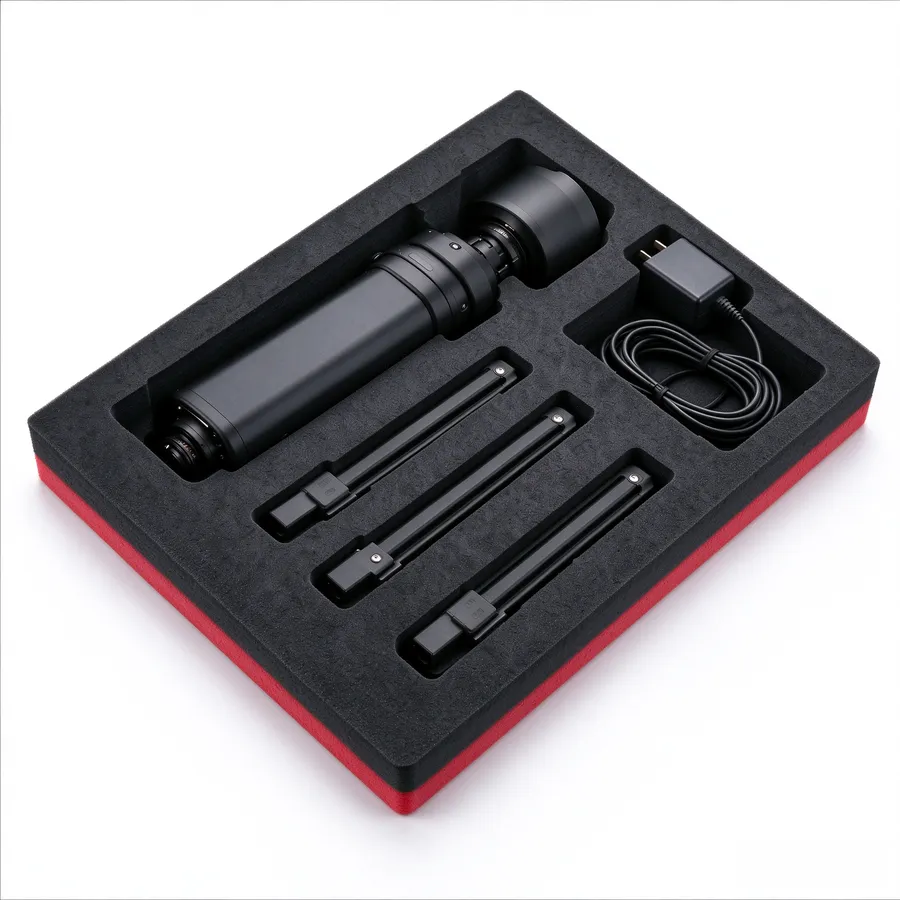
Layer three is the interior. Our catalogue records custom foam as available on every model, with Pick and Pluck, die-cut, CNC-cut, EVA, PE and EPE as the material and layout options, arranged as top foam, base foam, egg-crate or convoluted layers, custom cut or layered builds. The shock-protection entry on each model page is deliberately honest about the split of responsibility: it is recorded as a configuration option with the note that a specified foam layout is required and that the shell alone is not a shock rating. Layer four is the secondary openings and hardware: the pressure equalisation valve bore, the hinges and feet recorded as measured on all 155 models, the latch body that publishes as accepting a standard padlock, and the document holder and shoulder strap that are options rather than fixtures.
Layer five is the logistics interface, and it is the layer that most often quietly cancels the first four. Stackability is published as offered on 136 models and not offered on the 19 rolling ones. Packing data is published unevenly: 64 models publish a carton footprint and 58 publish pieces per carton, while pallet quantity is recorded as unmeasured with the note that it is calculated from the carton footprint against your pallet size, and container loading figures for 20GP, 40GP and 40HQ are supplied with the quotation rather than printed on the page. Weight is published on 93 models, from 100 g to 15,320 g net. If your programme is freight-constrained, that fifth layer belongs in the same decision as the seal.
What the combination looks like when the exposure is decided first
The right pairing changes with where the lid is opened and what the case does between openings. For equipment that travels in a vehicle and is opened on the ground, the combination that behaves is a gasketed shell from the 3.0 mm to 6.0 mm group, latch count set for the lid length, a closed-cell cut that leaves no exposed cell face at the parting line, and a document pocket that does not interrupt the rim. For equipment that lives on a shelf and only travels occasionally, the same combination is pure cost: an unsealed thin-wall shell in the 2.0 mm to 2.9 mm group is the honest answer, and we say so on the model page instead of dressing it up.
Where the content is heavy and the case is handled by people, stiffness and grip have to be bought together: a thick wall that transmits shock is tolerable if 50 mm of base foam under the part carries the stopping distance, and it is not tolerable with a 20 mm layer. Where the content is an instrument whose certificate depends on cleanliness and temperature, the closure and the interior matter more than the wall, and the pressure equalisation valve ceases to be a feature and becomes a bore you have decided to spend a moulding change on. Where the duty is one-person mobility over long distances, the 19 rolling models buy you the carrying and take away stacking, which is a freight decision as much as a handling one.
Combination comparison on published data
| Combination | What Our Catalogue Publishes | Buy It When |
|---|---|---|
| Gasket plus heavy wall (4.5 mm and above) | 56 of the 124 gasketed models publish a wall of 4.5 mm or more; 30 publish 5.0 mm or more; all are in the sealed group | Repeated vehicle service, heavy contents, or a rim that must stay flat for the life of the programme |
| Gasket plus mid wall (3.0 mm to 4.4 mm) | 68 gasketed models publish a wall in this band, including KX-1905, KX-62109 and KX-4010 | Regular field handling of small and mid-size instruments where mass per unit matters |
| Unsealed thin wall (2.0 mm to 2.9 mm) | 31 models state that no sealed closure is offered on the shell; 24 of them publish a wall figure, 7 publish none | Bench, cabinet and shelf storage where grit is controlled and the lid is opened indoors |
| Sealed plus telescopic rolling | 18 of the 19 rolling models record a gasket; all 19 publish stackability as not offered and 11 publish a telescopic height | One-person movement of 20 kg to 40 kg assemblies over pavement and hangar floors |
| ABS shell plus gasket | All 22 ABS models sit in the gasketed group; the rest of the range is PP (94), Engineering PP (38) and one PP / ABS model | A higher-gloss moulded face and a sealed rim are wanted together in mid-size bodies |
| Sealed plus published packing data | 37 models publish both a gasket and a pieces-per-carton figure; pallet quantity is calculated per your pallet and container figures come with the quotation | Freight cost per unit decides the programme and you need the carton footprint before ordering |
| Any shell plus a stated protection rating | Not available. Dust, water, protection rating, stack load, load capacity, temperature range and UV are recorded as unmeasured on all 155 models | Never by catalogue; commission accredited testing on the exact configuration as a separate work package |
Selection guidance: build the combination from the failure you are avoiding
Write down the failure mode first and let it pick the layers. If the failure is water or grit reaching the content, the layers that matter are closure continuity, latch compression and a rim that can be cleaned, and the wall matters only as the thing that keeps the rim flat. If the failure is a broken part after a drop, the layers that matter are foam thickness under and around the part plus the shell that spreads the load, and the gasket matters only so the interior stays where it was cut. If the failure is a rejected shipment, the layers are the carton footprint, the stacking faces and the mass per unit. Three different answers, three different combinations, and none of them is a better case in general.
Then check the combination against the way the case will be used, because this is where specifications quietly fail. A long lid edge with too few latches loses compression in the middle, and latch count is a configuration choice on every model, so it is yours to set. A document pocket, a handle boss or a hinge can interrupt a parting line. An open-cell or torn foam face holds grit and sheds into the cavity, which fights the closure you just paid for. A case selected for stacking will not take wheels, and a case selected for rolling will not stack. Ask us to show the closure, the latch positions and the foam layout on one drawing before tooling is committed; that single step catches most of the arguments that would otherwise happen after 400 units are in service.
Duties where a specified combination earns its cost
Field communication and radio kits combine every layer at once: antenna bosses, cable glands and connector panels interrupt the parting line, the kit is opened beside a vehicle, and the mass is high enough that carrying and stacking cannot both be assumed. The combination that survives that season is a gasketed shell with a wall from the heavier band, a latch count set for the edge length, a closed-cell cut that leaves connector faces accessible, and a deliberate decision about whether the document pocket is worth the interruption. The same kit in a thin-wall unsealed box reaches refurbishment with grit in every socket.
Test, measurement and laboratory instruments moved between sites fail on cleanliness and temperature rather than on crushing, so the interior and the closure lead and the wall follows. A calibration case that keeps grit off a reference face between uses is protecting a certificate. Optical equipment, thermal monoculars and camera bodies sit in the same group, where a single grain on a lens is a rejected image and abrasive grit in a focus barrel is a stripped thread. Drones and payloads add a third requirement: the content has soft, protruding parts, which is why the layered and custom-cut interior options are the ones specified most often on bodies in the 4.0 L to 50 L band, such as KX-2811, KX-63416 and KX-6621.
Industrial and medical duty shifts the balance towards hardware and logistics. Feet and hinges are recorded as measured across all 155 models, the latch body publishes as accepting a standard padlock, and shoulder strap and document holder are options you decide at quotation. For a device that moves between a ward, a van and a store room, security of contents and a defined interior usually beat a heavier wall, and the stacking face matters because the case is stacked while it is full.
Customising the combination under OEM
Almost every layer in the combination is a configuration you can set, which is what makes a wholesale or OEM programme worth running on an existing mould. The gasket compound is offered as EPDM or an equivalent compressible material; a pressure equalisation valve can be specified into the moulding; latch count is specified per configuration; shell material is published per model across PP, Engineering PP and ABS; hardware is metal or polymer by configuration; and foam is custom on every model in cross-linked PE, EVA or EPS by zone, with pick and pluck, die-cut and CNC-cut layouts. Custom colour, logo and packaging, plus ODM and private-label work, are recorded as available on all 155 models.
The commercial frame is fixed, so plan the combination inside it. Minimum order is one unit for a standard shell and one for custom foam, 300 units for logo, colour and OEM work, and 3,000 per component for a custom mould. A first article on an existing mould takes 45 days; a new mould takes 125 days, with a 30 percent deposit. Terms are EXW or FOB, wholesale and OEM only: no retail, no delivery-duty-paid service and no overseas stock. Changing a parting line, adding a valve bore or moving a latch position is a moulding change, so if your combination needs any of those, the 45-day or 125-day clock is the number that decides your programme date, not the shipping line.
Procurement notes: buying a combination instead of a claim
Put the combination in the request for quotation rather than a series name. Ask for the model page dimensions, the wall figure, the closure statement, the latch positions and the foam drawing, and check them against your equipment drawing with clearance allowed on every face. Where your programme needs a stated ingress, drop, stack or temperature figure, treat accredited testing on the exact model and configuration as a separate work package with its own scope, cost and report ownership, and ask before ordering rather than after delivery. We describe only tests we have actually performed, and no such record exists for the models in this catalogue.
Watch for the two silent failure modes that no datasheet prevents. The first is the worked-around closure: a lid opened face-down on gravel picks up grit that the gasket then presses into the rim, so the cleaning step belongs in the procedure and a cleanable channel is a specification item. The second is the trapped load: a sealed cavity around a device that generates heat is a thermal question before it is an ingress question, and the answer is volume and layout rather than a heavier gasket. Our catalogue publishes internal volume and usable interior volume separately on every model so the foam you intend to fit is already accounted for, with usable space ranging from 0.7 L to 111.6 L across the sealed group.
Finally, keep the shell decision and the interior decision in one document. A gasketed shell with an open-cell shedding foam can be worse in a gritty duty than an unsealed shell with a clean closed-cell cut, and we see that pairing ordered often enough to say it plainly. One specification, one drawing, one configuration record, and the combination you paid for is the combination that arrives.
Customisation
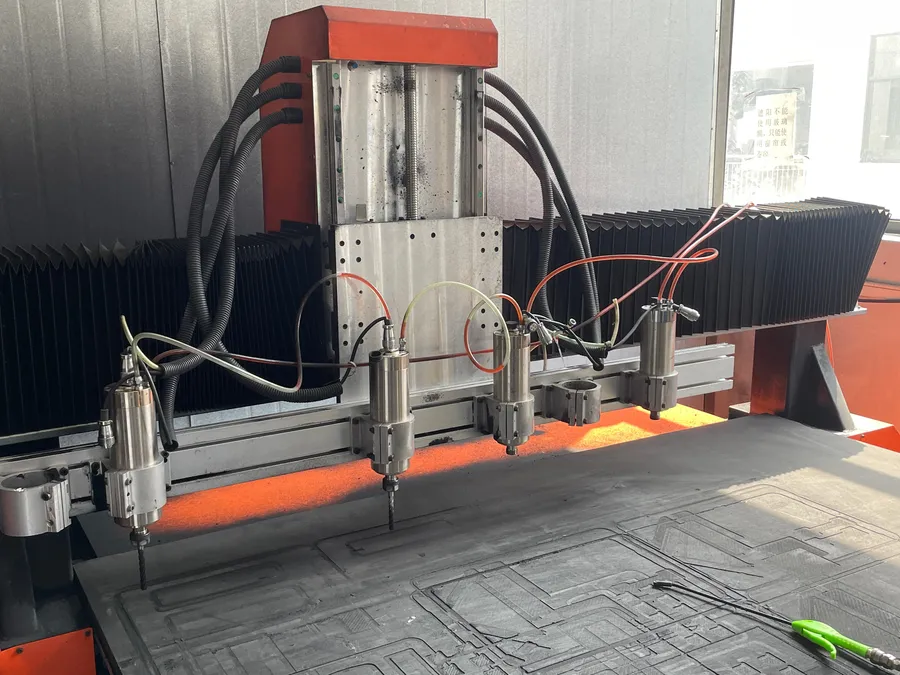
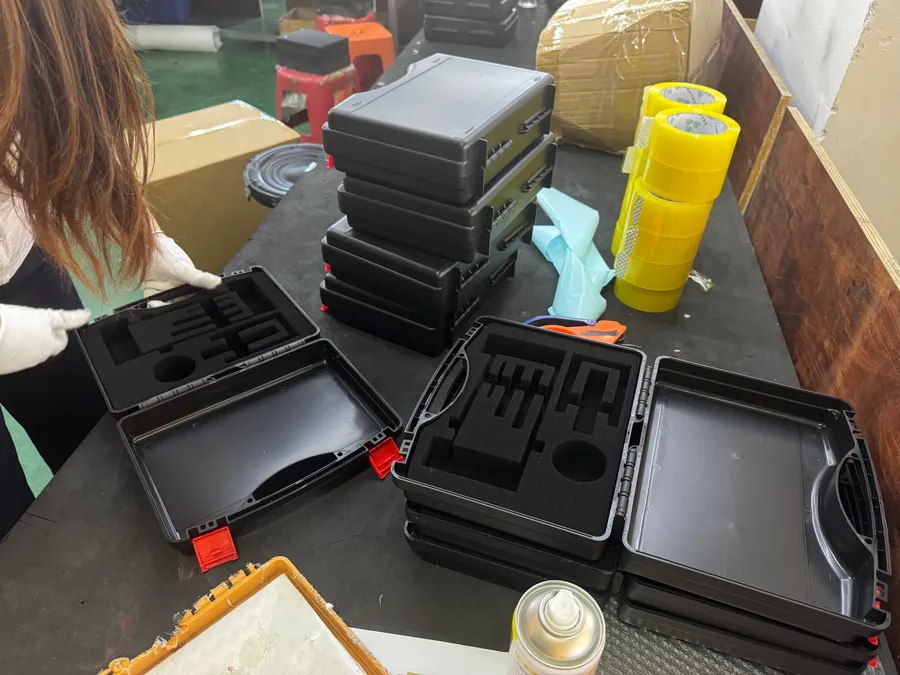
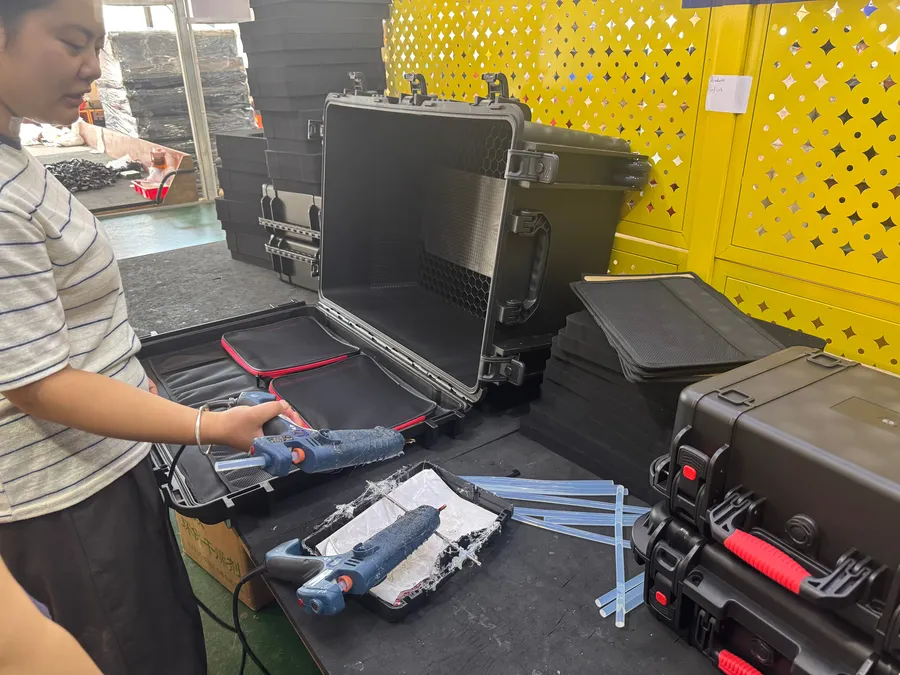
Everything described above is configurable on a standard shell: interior layout (pick-and-pluck, die-cut or CNC-cut), foam grade and thickness, colour, logo method, latch and lock count, pressure-equalisation valve, cable ports, document holder and identification plate. A bespoke exterior geometry requires a new mould — 125 days, from 3,000 units per moulded component.
Procurement considerations
| Question | What to send us |
|---|---|
| Which shell fits? | Equipment L × W × H as packed, plus required clearance per axis |
| What does it cost? | Order quantity and estimated annual quantity — the two drive different answers |
| Is tooling needed? | Whether an existing shell clears the envelope with usable foam depth |
| Lead time? | Your required delivery date, not just the order date |
| Certification? | The exact standard your tender names — we will say whether we can test to it |
| Freight? | Destination and preferred terms; carton and pallet data supplied with the quotation |
Comparison and selection guide
The tables on this page exist because a protective case is chosen by comparing three things: the envelope, the environment and the handling chain. Where no table applies, the rule below is.
| Situation | What To Do |
|---|---|
| Occasional splash | A close-fitting rim without a gasket is cheaper and easier to maintain. |
| Rain and washdown | Sealed configuration, four or more latches, stainless hardware. |
| Immersion or pressure change | Sealed configuration plus a pressure-equalisation valve, and a documented test. |
- Size on internal dimensions plus clearance, never on a product name.
- Choose the carrying method before the shell: it changes the series, not just the price.
- Specify the interior last, and decide up front whether the end user will reconfigure it.
What combination of protection features should buyers consider? relates to Waterproof & Dustproof Guide. Related families: Waterproof Cases / Outdoor Protective Cases / Electronics Cases / Instrument & Equipment Cases / Communication Equipment Cases / Military Protective Cases / Drone & UAV Cases / Medical Equipment Cases / Rolling Cases / Ammunition Storage & Transport Boxes / Custom Protective Cases. Related sectors: field and industrial equipment. Continue in the Waterproof & Dustproof Guide cluster.
This page is written from our own production data. If your requirement differs, send the dimensions and we will tell you which of the 155 models fits, or whether a custom route is needed.


