Can waterproof cases be customized?
Yes, and the useful split is not between possible and impossible but between configurable and moulded. On a sealed shell you can choose the model, cut the interior to your kit, set latch count and padlock provision, add a pressure-equalisation valve, a document holder or a shoulder strap, match the resin colour, apply your logo, and pack it in your own carton - all of it on existing tooling, a foam-only build starting at one unit and colour or logo work starting at 300. What you cannot change without tooling is the sealing line itself: where the rim runs, the shape of the gasket channel, the pitch of the latches along an edge, and any port that passes through the joint. Those are mould geometry, quoted at about 125 days and from 3,000 units per moulded component. Note also which shells are even available to customize this way: 124 of our 155 published models are listed with a compressible gasket in a continuous moulded channel, and 31 are listed with no seal offered, so a water requirement narrows the candidate list before any customization conversation starts.
Key points
- Split the request into configurable and moulded: interior, hardware, colour, logo and carton are line items; the rim is geometry.
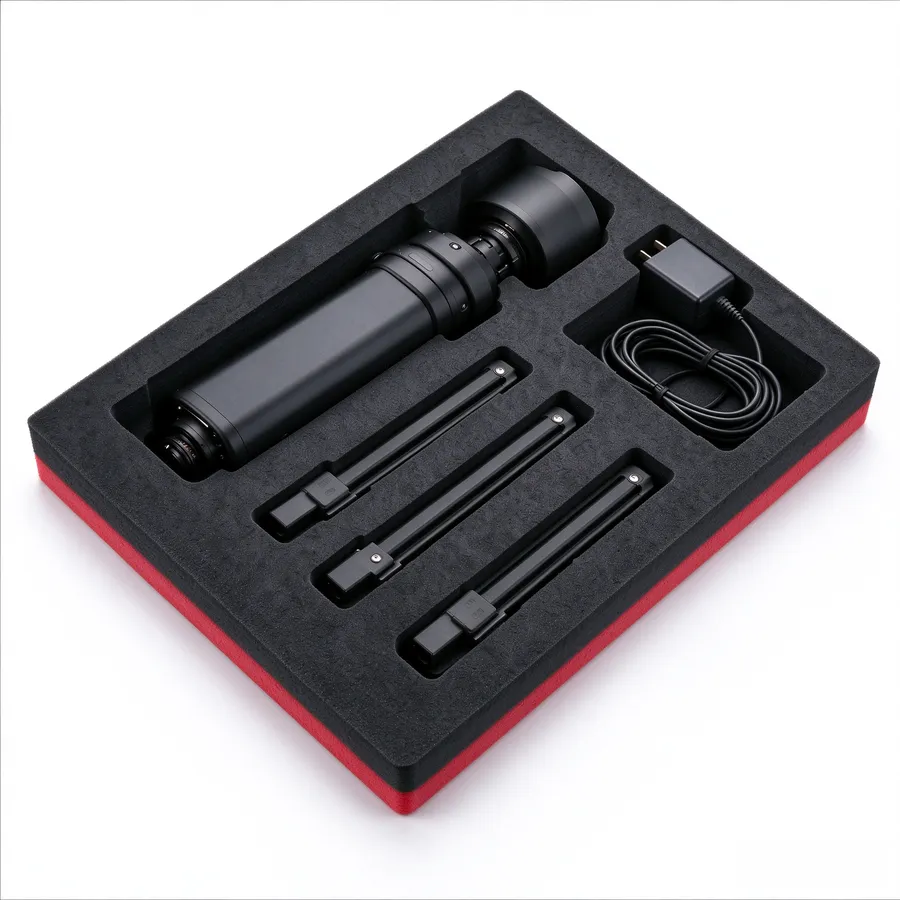
- A foam-only build on a sealed shell starts at one unit and needs only a drawing, a photograph of the packed kit or a physical sample.
- Colour, logo and OEM finishes move an order to the 300-unit tier, produced on existing moulds with about 45 days quoted.
- Only a new geometry costs a tool: about 125 days and from 3,000 units per moulded component, with mould ownership agreed in advance.
- Latch count is the customization with the biggest effect on the seal, because it sets the unsupported span of the lid.
- A cable port through the joint is not a fitting - it breaks rim continuity, so it is a tooling decision, not an accessory.
- We customize to a construction you can inspect, and we publish no ingress figure for it, because no test record exists for the configuration.
The two kinds of customization, stated plainly
Everything a buyer normally wants from waterproof cases customized falls into one of two buckets. The first bucket is specification: choosing a sealed model, deciding how the interior is cut, setting the latch and lock configuration, adding or omitting a valve, matching a colour, adding a logo, and deciding how it ships. Nothing in that bucket changes the shape of the shell, so nothing in it needs a tool, and all of it can be reviewed against our published model data before you commit money. The second bucket is geometry: moving the rim, changing the channel section, altering how far apart the latch mounting points are, adding a port through the joint, or changing the external footprint so the case nests into a rack or a vehicle mount.
The reason the split matters commercially is that the two buckets have different economics and different failure modes. A bad interior decision costs foam and a re-cut. A bad geometry decision costs a tool and sixteen weeks. And a rim that leaks because latch pitch was changed without recomputing unsupported span is a geometry mistake hiding inside what looked like a specification change, which is why we push back when a customer asks to move a latch on a drawing.
Five routes, from a foam cut to a new tool
Those thresholds are the numbers carried in every one of our 155 model records: standard and custom-foam minimum of one unit, logo and colour at 300, OEM at 300, custom mould from 3,000 per component, and lead times of 45 days on existing moulds against 125 days for a new one. A supplier who quotes a bespoke rim at forty-five days is quoting a gasket applied after the fact, which is a different object with a different service life.
| Route | What Changes | Tooling | Minimum | Quoted Lead Time |
|---|---|---|---|---|
| Stock sealed shell, as published | Only which model and how many | Existing moulds | From 1 unit | Stock |
| Sealed shell with a custom interior | Foam type, layout, thickness and cut pattern | Existing moulds | From 1 unit | Runs with production |
| Sealed shell, hardware configured | Latch and padlock setup, valve, strap, document holder, identification | Existing moulds | From 300 units on an OEM line | About 45 days |
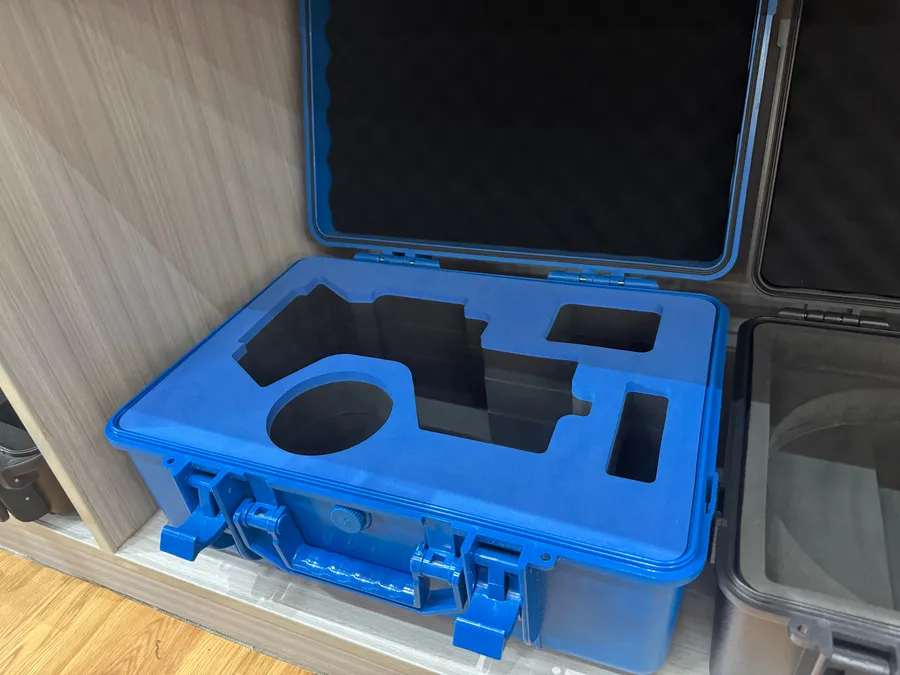
| Sealed shell in your colour with your logo | Resin colour, print or plate, your carton and packing | Existing moulds | From 300 units | About 45 days |
| Bespoke geometry | Rim location, channel section, latch pitch, ports, external footprint | New mould | From 3,000 units per component | About 125 days |
What you can change without touching the sealing line
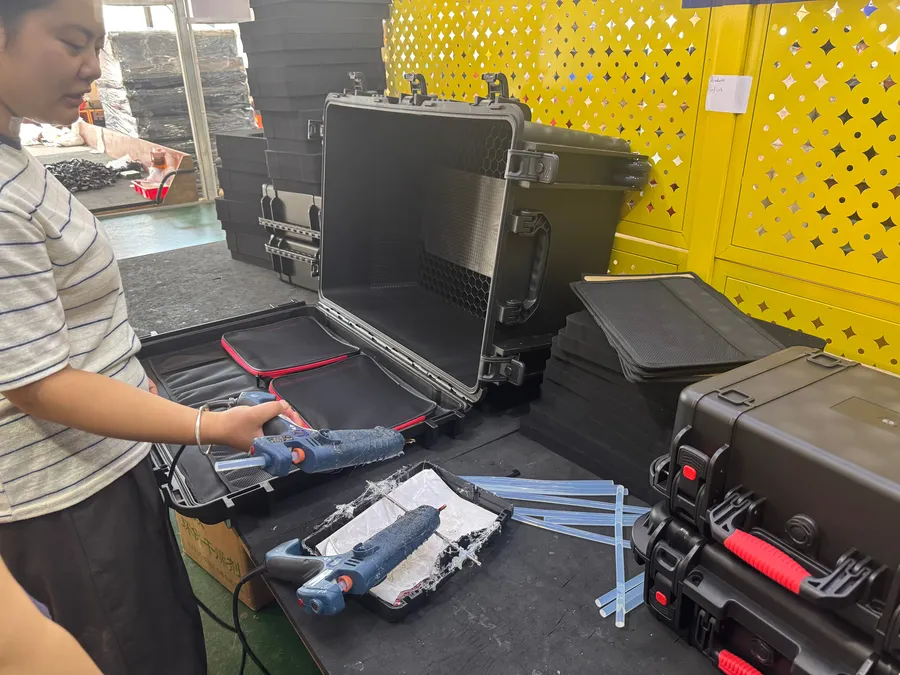
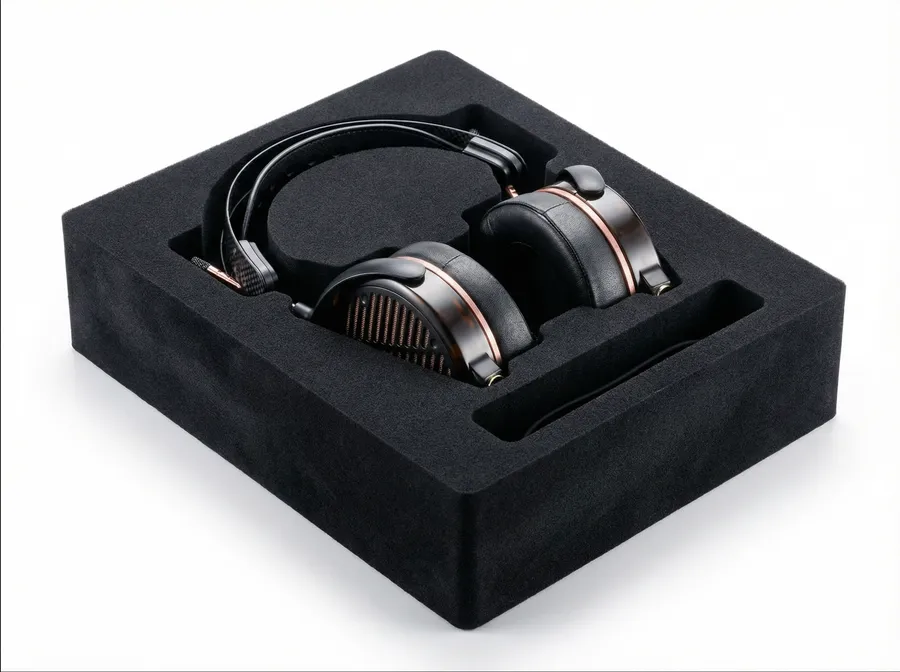
The interior is the biggest single lever and the cheapest to pull. Our records list pick-and-pluck, die-cut, CNC-cut, EVA, PE and EPE as available types, and top foam, base foam, egg-crate or convoluted, custom cut and layered as available structures, with custom thickness and custom shape flagged on all 155 listings. What we need from you to start is one of three things and no more: a drawing, a photograph of the kit as it is actually packed, or a physical sample. That is the whole input requirement, and it is why a one-unit foam build is sensible.
Outside the interior, the configurable list on a sealed shell covers resin colour, logo method - screen or pad print, an embossed mark where the mould allows it, or a riveted identification plate - your carton and packing format, private-label presentation, latch and padlock setup, a shoulder strap, a document holder, feet and stacking behaviour, and the choice of carrying method. Nineteen listings carry wheels and a telescopic handle, eighteen of them sealed models, so a wheeled shell does not have to be an unsealed one.
None of the above changes the geometry of the joint. That is the honest boundary, and it is drawn by the mould rather than by our preference.
What moves the rim, and why that is a tooling conversation
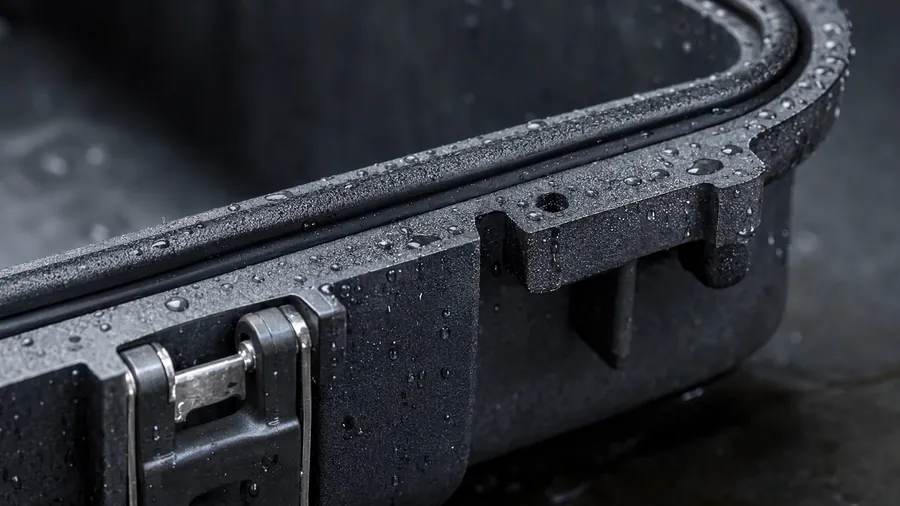
A sealing rim is a moulded feature: the channel that holds the gasket, the face the gasket presses against, the mounting bosses the latches bolt to, and the path the hinge takes where it interrupts the line. Change any of those four and you have changed the tool. In practice three requests arrive most often in this category, and each has a different answer. A cable or connector port through the joint is the commonest: it is a hole in the sealing line, so it needs a moulded boss with its own gasket face, not a drilled shell. A different external footprint, so the case nests into a rack, is genuinely a new tool. A longer lid unsupported between latches, because the case got wider, is a latch-pitch change, which needs new bosses.
There are cheaper answers to most of those requests, and a good matching exercise says so rather than selling a tool. A port can often sit inside the rim rather than through it, which keeps the line continuous and moves the problem to a panel detail. A nesting requirement can often be met by choosing a different series, since external lengths on sealed models run from 190 mm to 1,356 mm across the catalogue. A span problem can often be solved with an added latch on the existing boss pattern or by moving to a thicker wall, which is why wall thickness is published per model rather than as a range claim.
Which shells are even available to customize as sealed ones
Before any configuration conversation, there is a shortlist question. Of the 155 models we publish, 124 are listed with a compressible gasket in a continuous moulded channel and 31 are listed with no seal offered on the shell. The gasketed group is not the big cases only: it runs from 0.8 litres of interior volume to 139.5 litres, and it spans 8 Series with 58 models, 6 Series with 20, T Series with 18, 9 Series with 14, 0 Series with 12 and 1 Series with 2. All 22 ABS listings are in the sealed group; the unsealed group is polypropylene or engineering polypropylene, plus one mixed PP/ABS shell.
The wall-thickness pattern is the fastest way to see why that split is structural rather than cosmetic. Every one of the 124 gasketed models publishes a wall of 3.0 mm or more, up to 6.0 mm. Among the 31 unsealed listings, every published wall is 2.9 mm or less and seven carry no wall figure at all. A rim compressed along its whole perimeter needs a section that resists it; putting a gasket on a thin shell would produce a case that seals in the photograph and leaks in the truck, which is worse than selling it as what it is.
Published figures that bound the interior you can ask for
The gap between the last two columns is the space the foam actually lives in, and it grows with the shell: 0.1 litres on the small ABS model, 1.9 litres on WL4319, 7.7 litres on the mid-size trolley, 27.9 litres on the largest listing. That is why an interior programme is sized on lid and base depth rather than on a photograph of the equipment. Lid depth is published from 16 mm to 320 mm and base depth from 15 mm to 168 mm across the 100 listings that carry those fields, 76 of them sealed models.
One more field is easy to overlook when a customer sends an envelope: 36 listings publish a narrow internal width, from 70 mm to 308 mm, which is the tightest measurement inside that shell rather than the nominal internal width. A kit that clears the internal width but not the narrow width will not sit flat, and no foam layout fixes that after the fact.
| Model | Internal L X W X H (Mm) | Lid / Base Depth (Mm) | Interior (L) | Usable (L) | Empty Mass (G) |
|---|---|---|---|---|---|
| WL6-2205 | 200 x 98 x 41 | Not published | 0.8 | 0.7 | 310 |
| WL1905 | 180 x 160 x 40 | 25 / 15 | 1.2 | 1.0 | 250 |
| WL6-2109 | 195 x 128 x 81 | Not published | 2.0 | 1.7 | 470 |
| WL3213 | 308 x 230 x 118 | 86 / 32 | 8.4 | 7.2 | 860 |
| WL8-3612 | 330 x 260 x 103 | 75 / 28 | 8.8 | 7.6 | Not published |
| WL4319 | 407 x 187 x 178 | 38 / 140 | 13.5 | 11.6 | 1,587 |
| WL8-4816 | 410 x 360 x 140 | 100 / 40 | 20.7 | 16.6 | Not published |
| WL8-5427 Trolley | 483 x 363 x 220 | 150 / 70 | 38.6 | 30.9 | 6,100 |
| WL8-8421 | 740 x 518 x 189 | 145 / 44 | 72.4 | 57.9 | Not published |
| WL8-8442 Trolley | 740 x 518 x 364 | 320 / 44 | 139.5 | 111.6 | 15,320 |
Gasket, channel and latch pitch as specification lines
What is configurable on the sealing system itself is narrower than most buyers expect, and it is worth stating exactly. The gasket material is listed as EPDM or an equivalent compressible profile, recorded in our data as a configuration option rather than a fixed fitting, so the conversation you should have with us is about compatibility - solvents, oils, salt air, storage temperature - and about whether replacement strips are ordered with the case. The channel is moulded and continuous; what we can vary by configuration is hardware around it, not the principle of it. Latch count is recorded as specified per configuration on all 155 models, which makes it a real line item on a quotation rather than a fixed attribute of a SKU.
That last point deserves emphasis, because it is where a customization quietly wrecks a seal. Compression along a rim is a function of how many closing points exist and how far apart they are; a long edge with latches only at the ends has a low-pressure zone in the middle, and a wall section that is thick enough to hold flat will not save a span that is too long. If you change the edge length or the latch hardware while keeping the original pitch, you have changed the sealing system even though no drawing was revised.
Hardware you can configure on a sealed shell, and what it does to the rim
This table is the customization conversation most customers actually need, because it separates the items that are line entries on a purchase order from the items that are engineering changes. Six of the eight rows can be agreed against an existing datasheet. Two of them cannot, and one of those two is requested in almost every first enquiry.
| Configuration Item | How Our Model Data Records It | Effect On The Sealing Line |
|---|---|---|
| Latch count and pitch | Specified per configuration | Sets unsupported span, so this is the most consequential choice on the order |
| Padlock provision | Measured - the latch body accepts a standard padlock | None; it sits outside the channel |
| Pressure-equalisation valve | Option on all 155 models, standard-fitted on none | A second opening in the rim, so it must be named on any test specimen |
| Gasket profile and material | EPDM or equivalent by configuration | Recovery and chemical compatibility; wrong solvents swell it unevenly |
| Hinge and feet | Measured on the listing | Hinges interrupt the line; feet decide how the case sits in a stack |
| Wheels and telescopic handle | On 19 listings, 18 of them sealed | Indirect - it changes how the lid is loaded and opened in the field |
| Document holder and shoulder strap | Configuration option | None, provided nothing is fastened through the rim |
| Cable or connector port through the joint | Not a feature of any stock listing | Breaks continuity, so it is a new mould rather than an accessory |
How this request reaches us, in buyer wording
The doubled entry in the second row is not a typo we invented: strings of the form waterproof waterproof cases customized appear in the search-title library we work from, and they mean exactly what the first row means. Answering the repeated word as if it were a second requirement is how a quotation ends up carrying an obligation nobody asked for, so we treat the two rows as one question and say so on the record.
Read across the other three rows, the pattern is consistent: buyers describe an outcome and expect it to be a configuration line. Most of the time it is. The exceptions are the ones that involve cutting the joint.
| Phrasing We See | What It Is Asking | Realistic Answer |
|---|---|---|
| waterproof cases customized | Whether a sealed shell can carry my interior, colour and brand | Yes, on existing moulds, from 1 unit for foam and 300 units for colour or logo |
| waterproof waterproof cases customized | The same request with the first word doubled, which is a typing artefact rather than a second condition | Identical to the row above, and we say so explicitly |
| custom sealed instrument case with my logo | A gasketed shell plus branding | Colour and print or plate routes on an existing model at 300 units |
| make a watertight case bigger internally | More interior without changing the exterior | Only within the published lid and base depth of that model; the section is fixed by the tool |
| add a cable pass-through to a sealed case | A port in the joint | A mould change; a port inside the rim is the cheaper answer most of the time |
MOQ, deposit and the timeline that is realistic
The commercial frame is the same for sealed and unsealed shells. We sell to distributors, integrators and OEM programmes on wholesale terms and quote EXW or FOB; we do not retail single units, do not quote DDP and hold no overseas warehouse, so freight and clearance are planned on your side. Payment runs a 30 percent deposit with the balance after inspection and before container loading, which is also where an overstated minimum order shows up as working capital rather than as a discount.
On timing: a foam-only interior can be built with a single unit as its first order, because it consumes no tooling and no colour constraint. A colour-and-logo programme is quoted at about 45 days on existing moulds from 300 units, since resin batches and print tooling are scheduled, not created. A new mould is about 125 days from 3,000 units per moulded component, and mould ownership, revision rights and spare-part supply for hardware are agreed in the tooling contract before cutting starts. Third-party inspection of a production batch is welcome at our facility, and we will tell you which of our 155 models clears your drawing before you spend anything on a tool.
What a customized sealed case is not tested for
Customization changes what a test report can describe. A result belongs to the assembly that was put in the chamber - shell, gasket, latch count, valve fitted or omitted, port plugged or absent - and it does not transfer automatically to the same moulding in a different size or with one hardware line changed. That is the single most important sentence in this article for anyone writing a tender, and it is the reason we do not print an ingress figure for a customized configuration either: our data records water ingress, dust ingress, ultraviolet exposure, temperature range, stack load and load capacity as not measured across all 155 listings, and states no ingress code or standard number.
What we do publish is the construction, which is inspectable without a laboratory: whether the model carries a gasket channel, the wall thickness, internal and usable volume, lid and base depth, empty mass where published on 93 listings, and carton data on 64 listings including pieces per carton on 58 of them, from 1 to 40. Pallet figures are calculated from the carton footprint against your pallet size, and container figures are supplied with the quotation, because both depend on what you order rather than on the shell. Where a named method is required, we quote accredited testing on the exact configuration as a separate work package with its own cost and timeline.
A short decision path
Start with the envelope, not the logo. Send the packed dimensions of the equipment with clearance per axis, the mass, and whether the end user opens the case in the field or only at base. That single paragraph decides three things: whether you need one of the 124 sealed models or one of the 31 open ones, which series can carry the span without flexing the lid, and whether the interior you want fits inside the published lid and base depth. A great many of these conversations end there: a stock model, a cut interior, one unit, no tool.
Only after that answer comes back should the branding and colour questions be priced, because they move you to 300 units and to a scheduled resin batch rather than to a new engineering problem. And a request for a new mould should be tested against one question: does the change improve how the case protects or handles, or only how it looks? The second answer rarely justifies 125 days and 3,000 units, and a colour-matched shell with an embossed mark on an existing tool achieves most of it.
What we do not claim, and who to write to
KeXin New Materials (Guangdong) Co., Ltd. publishes model-level specifications and claim status, and nothing in this page should be read as a performance rating for a customized configuration. We state no ingress code, no standard number, no drop height, no stack load and no temperature range for any of the 155 listings; shock protection is recorded as a construction option requiring a specified foam layout, and corrosion resistance - a thermoplastic shell with no ferrous corrosion path - is one of the few protection fields recorded as measured.
Send the drawing or the packed kit to Fred Zhao or the KeXin Sales Team, or start on WhatsApp +86 135 3588 0002, with your quantity and required in-hand date. Ask for the datasheet of the exact model you intend to order, since internal dimensions, wall thickness, lid and base depth and empty mass are published per model and are not interchangeable across a series. If nothing in the catalogue clears your sheet, that answer comes back as a custom route with a costed tool, rather than as a strained fit on a drawing.
Applications
This matters most where the case is part of a movement chain rather than shelf packaging. In outdoor & recreation and field & deployment and electronics & instruments the same shell is specified differently because the handling, the environment and the verification requirement differ.
- Outdoor & Recreation — Consumer and professional outdoor brands buy cases as a component of their product. That means c…
- Field & Deployment — Field deployment removes every assumption a depot specification makes: no forklift, no dry stora…
- Electronics & Instruments — Electronic assemblies rarely fail from a single large impact. They fail from repeated small shoc…
- Medical & Laboratory — Medical cases are audited. Whatever goes inside has to be verifiable at a glance, cleanable, and…
- Drone & UAV Operations — A drone kit is three different protection problems in one box: a light awkward airframe, heavy b…
- Military — Military equipment moves through a chain of handlers, none of whom own the equipment and all of …
Customisation
Everything described above is configurable on a standard shell: interior layout (pick-and-pluck, die-cut or CNC-cut), foam grade and thickness, colour, logo method, latch and lock count, pressure-equalisation valve, cable ports, document holder and identification plate. A bespoke exterior geometry requires a new mould — 125 days, from 3,000 units per moulded component.
Procurement considerations
| Question | What to send us |
|---|---|
| Which shell fits? | Equipment L × W × H as packed, plus required clearance per axis |
| What does it cost? | Order quantity and estimated annual quantity — the two drive different answers |
| Is tooling needed? | Whether an existing shell clears the envelope with usable foam depth |
| Lead time? | Your required delivery date, not just the order date |
| Certification? | The exact standard your tender names — we will say whether we can test to it |
| Freight? | Destination and preferred terms; carton and pallet data supplied with the quotation |
Comparison and selection guide
The tables on this page exist because a protective case is chosen by comparing three things: the envelope, the environment and the handling chain. Where no table applies, the rule below is.
| Situation | What To Do |
|---|---|
| Occasional splash | A close-fitting rim without a gasket is cheaper and easier to maintain. |
| Rain and washdown | Sealed configuration, four or more latches, stainless hardware. |
| Immersion or pressure change | Sealed configuration plus a pressure-equalisation valve, and a documented test. |
- Size on internal dimensions plus clearance, never on a product name.
- Choose the carrying method before the shell: it changes the series, not just the price.
- Specify the interior last, and decide up front whether the end user will reconfigure it.
Can waterproof cases be customized? relates to Waterproof & Dustproof Guide. Related families: Waterproof Cases / Custom Protective Cases / Outdoor Protective Cases / Military Protective Cases / Instrument & Equipment Cases / Electronics Cases / Camera & Photography Cases / Field Equipment Cases. Related sectors: Outdoor & Recreation / Field & Deployment / Electronics & Instruments / Medical & Laboratory / Drone & UAV Operations / Military. Continue in the Waterproof & Dustproof Guide cluster.
This page is written from our own production data. If your requirement differs, send the dimensions and we will tell you which of the 155 models fits, or whether a custom route is needed.



