Solar Panel Tester Portable Waterproof Case: What Our Published Data Says
Short answer: size the cavity first and settle the seal second. A solar panel tester travels as a kit, so the numbers that decide the case are the published internal dimensions, the lid-to-base depth split, the wall thickness and the net weight of a model, not a protection badge printed on a datasheet. KeXin New Materials (Guangdong) Co., Ltd. moulds 155 thermoplastic shell models whose recorded internal volumes run from 0.3 L to 139.5 L, with a wall thickness published on 148 models from 2.0 mm to 6.0 mm, base and lid depth published on 100 models and carton packing published on 64. Water and dust performance are recorded as not measured in our product file and no ingress protection code is printed for any model: 124 of the 155 offer a compressible gasket in a moulded channel, 31 are plain shells, and a pressure equalisation valve is available as a configuration option. Shock and impact follow the foam layout you approve, so the shell alone is not a shock rating and we state no free-fall height. Where a tender needs a documented number, we quote accredited third-party testing against the exact model, gasket configuration and packed load state as a separate work package, and the report is issued to you.
Key points
- Size from the packed kit, not the instrument: coiled leads, the current clamp, the reference sheet and the charger all travel in the same cavity.
- Depth is a lid-to-base decision, not a total: KX-3213 publishes 308 x 230 x 118 mm internal as a 32 mm base with an 86 mm lid, so the probe head sits in the lid half.
- 124 of the 155 models offer a compressible gasket in a moulded channel and 31 do not; the sealed group is the one shortlisted for dusty or wet site work.
- Water and dust are recorded as not measured across the file, and no ingress protection code is printed for any model, so a rating in a tender is a test scope.
- Shock protection is published as a configuration option that needs a specified foam layout; the shell alone carries no fall figure and we state no free-fall height.
- Corrosion is the one protection line we record as measured: a thermoplastic shell with no ferrous corrosion path. Internal volume and usable volume are two different published numbers.
What the solar test kit actually is, and what damages it on site
A solar panel tester is rarely one box. The common kit is an I-V curve tracer for string and module work, with a current clamp, a set of voltage sense leads, a connector adapter family and a reference or calibration sheet; or an irradiance meter and pyranometer with a levelling base; or a module QA set that adds a thermography camera or a visual inspection camera. Each of those has a different failure mode. The display window and the sensor face crack when something heavy lands on the lid. Pin connectors bend when a coiled lead is trapped and the lid is forced shut. Water that reaches a DC input connector corrodes the terminal long after the case looks dry outside. Sand in the hinge and latch turns a latch that used to close with one thumb into a lever you fight with both hands. A dense reference block that shares one pocket with the instrument body is how a housing gets dented in transit, because the block does not deform and the instrument casing does.
The site conditions that break these kits are well known to commissioning crews: rooftops covered in grit, ground-mount arrays in dry soil that turns to dust underfoot, coastal installations where humidity and salt sit on every surface, module washing that sprays the case while it is open, and ladder or rack transport where the case is hooked, dragged and dropped the last two metres. Couriers add a different profile: the case rides flat on a pallet and takes stack load it was never opened to resist. That is why the honest way to specify a case for this work is to separate three questions and answer each with published data rather than with an adjective: what is the cavity and depth split, what is the shell and hardware configuration, and what evidence does the buyer need that we have not measured and must therefore test as a separate package.
The published numbers we compare, and the fields we leave unmeasured
For every one of the 155 models we publish internal length, width and depth and the external envelope, plus internal volume and usable volume. A wall thickness is recorded on 148 models, running from 2.0 mm to 6.0 mm; base depth and lid depth are published on the 100 models where that split is recorded; net weight is published per model and runs from 100 g on the smallest shell to 15,320 g on the largest trolley case; carton dimensions and pieces per carton are published on 64 models. Shell material is recorded as polypropylene, engineering polypropylene, ABS, or a polypropylene and ABS combination, and the hardware block records a moulded hinge, feet, and a latch body that accepts a standard padlock. The seal line records a compressible gasket in a continuous moulded channel as a configuration option, on the 124 models where it is offered.
The protection block is where we are deliberately quiet. Water, dust, ultraviolet exposure, temperature range, stack load and working load are recorded as not measured. Shock protection and impact resistance are recorded as configuration options that depend on the foam layout you approve, with the note that the shell alone is not a shock rating and no drop height is claimed without a test. Corrosion resistance is the line we record as measured, and the reason is simple: a thermoplastic shell has no ferrous corrosion path. Pallet quantity is published as a calculation from the carton footprint against your pallet size, and container figures for 20GP, 40GP and 40HQ are supplied with the quotation rather than asserted on a product page. The practical consequence for a buyer is that geometry is auditable today and protection is quoted work.
Solar panel tester portable waterproof case: what the word waterproof can mean here
A seal on a case is a mechanism before it is a marketing word. On our models the mechanism is a compressible gasket, EPDM or equivalent, carried in a continuous moulded channel that runs around the opening, compressed by latches spaced around the lid. Two details decide whether that mechanism keeps working in the field. The first is a pressure equalisation valve, available as a configuration option across the library: without it, a case that closes warm at midday and cools overnight draws outside air inward through whatever gap exists, and any water sitting on the lid rim is drawn in with it. The second is drainage: a lid that carries a shallow flat pocket lets rainwater stand on the gasket line, which is a maintenance problem before it is a protection problem. None of that is a rating. It is a description of how the assembly resists particles and liquid getting in, and it is the honest half of the answer.
The other half is what we do not print. Water and dust are recorded as not measured on all 155 models, and we state no immersion depth, no immersion time and no solids or liquids digit for any of them, because a digit describes one sample run in one state by one laboratory protocol, not a production batch and not an assembly that a buyer later modifies with a cable pass-through. If your specification needs a documented code, the correct procurement route is a test programme quoted against the model, gasket configuration and packed load state you will actually ship, run by an accredited laboratory, with the report issued in your name. For selection today the useful split is simpler: shortlist the 124 models where a gasket is offered for site work, and keep the 31 plain shells for dry indoor storage and kits that are opened constantly, where a gasket line is more likely to be damaged by haste than to earn its keep.
Published models that fit a solar test kit
The table below is drawn straight from the published specification file; every figure is a recorded value for that model, and where a field is not published the cell says so instead of guessing. Read internal volume and usable volume as two different numbers: KX-3213 records 8.4 L internal against 7.2 L usable, and KX-88442 records 139.5 L internal against 111.6 L usable, because moulded ribs, the gasket channel and the foam you approve take space back. When a buyer sizes to internal volume alone, the kit arrives and the lid will not close.
A single-instrument kit usually lands in the 1 to 2 L band, a tracer with leads and clamp in the 5 to 12 L band, and a two-person commissioning case with a camera in the 20 L band. That is a rule of thumb drawn from published cavities, not a promise about your specific device: measure the packed envelope as it travels, then pick the row.
| Model | Internal Mm | Internal L | Usable L | Base / Lid Mm | Wall Mm | Net Weight G | Gasket Offered | Packing Published |
|---|---|---|---|---|---|---|---|---|
| KX-1905 | 180 x 160 x 40 | 1.2 | 1.0 | 15 / 25 | 3.0 | 250 | Yes | No carton published |
| KX-62209 | 200 x 98 x 78 | 1.5 | 1.3 | Not published | 3.5 | 410 | Yes | 20 per carton, 475 x 285 x 495 mm |
| KX-3308 | 325 x 236 x 76 | 5.8 | 5.0 | 38 / 38 | 2.3 | 575 | No | 20 per carton, 670 x 550 x 425 mm |
| KX-3213 | 308 x 230 x 118 | 8.4 | 7.2 | 32 / 86 | 3.0 | 860 | Yes | 16 per carton, 645 x 530 x 520 mm |
| KX-4010 | 390 x 315 x 88 | 10.8 | 9.3 | 44 / 44 | 3.0 | 1015 | Yes | 10 per carton, 710 x 410 x 500 mm |
| KX-93221 | 300 x 200 x 200 | 12.0 | 9.6 | 35 / 165 | 5.0 | 1230 | Yes | No carton published |
| KX-64618 | 430 x 290 x 165 | 20.6 | 16.5 | 25 / 140 | 4.7 | 2775 | Yes | No carton published |
IP rated waterproof NDT testing instrument protective case
Non-destructive testing kits are the nearest neighbours to solar test kits, and buyers describe them the same way: an IP rated waterproof NDT testing instrument protective case. The shorthand is reasonable, because the duty is dusty, wet and unforgiving: tank farms, bridge decks, wind blade roots, pipe racks, refineries. The kit is an ultrasonic thickness gauge with transducer wedges, couplant and a reference block; or a flaw detector with a twin-probe block and cables; or a hardness tester; or a visual borescope. Wedges and reference blocks are the dense part of that kit, and they are the reason a gauge housing gets dented: they must not share a pocket with the instrument face, and they need a full-depth pocket of their own. What our data contributes is the cavity, the depth split, the wall and the mass. What it does not contribute is a code, because the ingress work is not in the file.
The published models that suit this duty: KX-2811 records 253 x 180 x 98 mm internal as a 27 mm base with a 71 mm lid, a 5.0 mm wall, 890 g net, with a gasket offered; that geometry is why a gauge plus two wedges sits flat. KX-3315 in engineering polypropylene records 303 x 224 x 135 mm internal with a 35 mm base and a 100 mm lid at a 4.1 mm wall and 1670 g. KX-63416 records 310 x 255 x 138 mm internal in a 4.8 mm ABS shell, 1800 g net, packed 8 per carton in a 675 x 365 x 360 mm carton. KX-93221 records a 300 x 200 x 200 mm cube with a 165 mm lid, which is the format a flaw detector with coiled cables needs. If the tender names a digit, treat it as a work package and let us quote accredited testing against the build you order.
Industrial camera & lens dustproof hard case
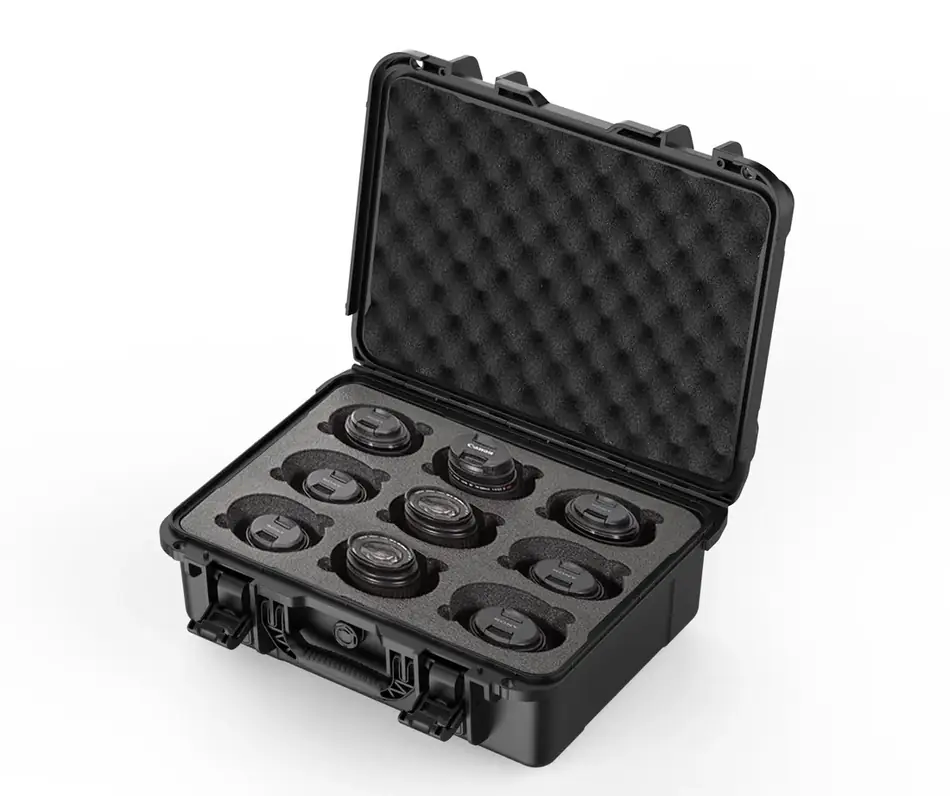
Solar inspection work increasingly travels with a camera: a thermography body for hot-spot scans, a full-frame body for module detail work, or an inspection lens set for close-up documentation. An industrial camera and lens dustproof hard case is a different problem from a meter case. The fragile parts are the lens elements, the mount flange, the sensor window and the rubberised grip surfaces, and dust is abrasive in a way that grit in a meter bay is not: dust at the mount becomes a scratch on the rear element, and grit in a zoom ring becomes a stiff ring. The two geometry decisions that follow from that are length and layout. Internal length has to clear the body with the hood still mounted, because a hood that has to come off every time is a hood that gets dropped. Depth has to match how the lenses stack, not how they lie side by side on a bench.
Published models in that format: KX-3213 records 308 x 230 x 118 mm internal with an 86 mm lid, which suits one body plus two primes stacked. KX-3218 keeps the same 308 x 230 footprint and publishes 172 mm of internal depth as an 86 mm base with an 86 mm lid, 12.2 L internal against 10.5 L usable, 900 g net, 12 per carton. KX-4312 publishes 420 x 260 x 104 mm internal at a 3.5 mm wall and 1170 g for a longer lens carried attached to a body. KX-4010 publishes 390 x 315 x 88 mm internal, 10.8 L, for wide flat sets with a filter tray. Foam is specified as closed-cell polyethylene, EVA or expanded polystyrene by zone, and a desiccant pack is a line item in the configuration, not a property of the shell.
Medical testing device shockproof trolley case
A bench-class device that is moved between wards, field clinics, calibration labs and installation sites is not carried by hand for long; it is rolled. A medical testing device shockproof trolley case is therefore a choice about wheels, handle and mass before it is a choice about a rating. Nineteen of our 155 models are published as trolley cases with wheels and a telescopic handle, and those same 19 are recorded as not stackable, which matters the moment the case goes onto a pallet with other freight. Shock and impact are recorded as configuration options: the outcome depends on the foam layout you approve, the note in the file states plainly that the shell alone is not a shock rating, and we give no free-fall height for any model because such a figure would describe a build we have not tested.
The published figures for the group: KX-85021 records 437 x 308 x 164 mm internal, 22.1 L internal against 17.7 L usable, a 4.5 mm wall, 4912 g net, wheels and a telescopic handle. KX-85424 records 483 x 363 x 190 mm internal, 33.3 L, 4.5 mm, 6000 g. KX-97227 records 590 x 435 x 210 mm internal, 53.9 L against 43.1 L usable, at the top of our published wall range with a 6.0 mm shell and 10,000 g net, packed one per carton in a 715 x 515 x 280 mm carton. KX-88442 is the largest recorded cavity in the file at 740 x 518 x 364 mm internal, 139.5 L against 111.6 L usable, a 44 mm base with a 320 mm lid, 5.0 mm wall and 15,320 g net. Note the base-to-lid split on KX-97227 is 168 mm base with a 42 mm lid, so the device sits in the base half and the lid is a shallow cover; that is the opposite of the KX-88442 layout.
How to size it: the five measurements and the foam decision
Measure the kit as it travels, not as it sits on a bench. First, the packed envelope: instrument with battery and any protective cap fitted, leads coiled the way they are coiled in practice, clamp, charger, printed certificate. Second, the orientation you actually want, because a 308 mm cavity is only useful if the tracer lies flat in it. Third, the depth split, which decides whether a probe head sits in the base or hangs in the lid. Fourth, the carry mass: a 410 g shell with 1.5 L of contents is hand-carried all day, a 4912 g trolley is not carried at all. Fifth, the outbound envelope, which is the carton footprint against your pallet or the courier parcel limit.
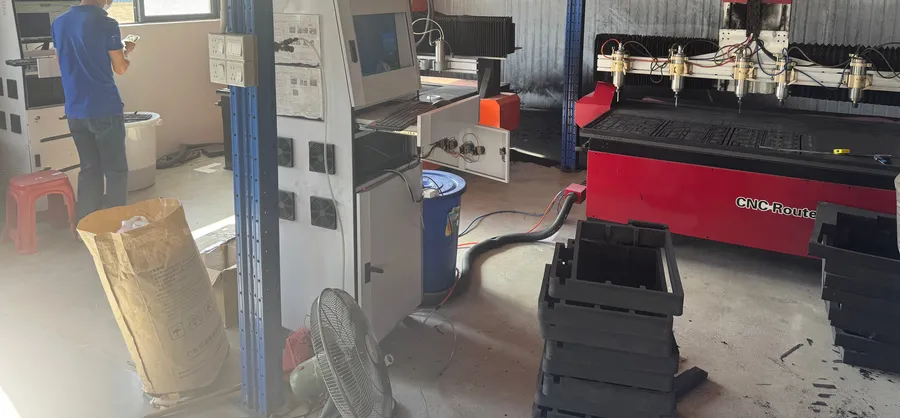
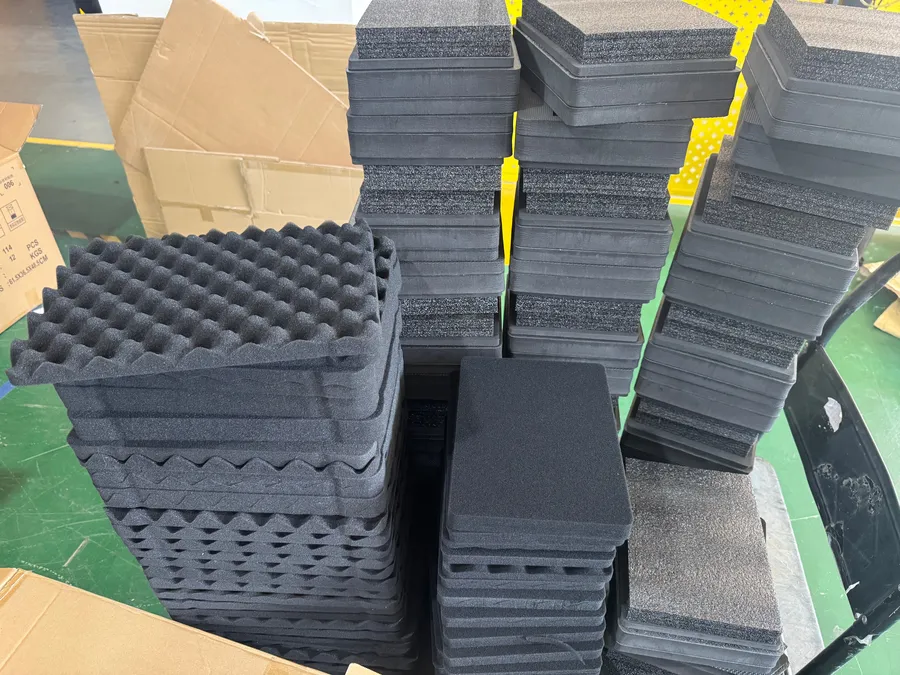
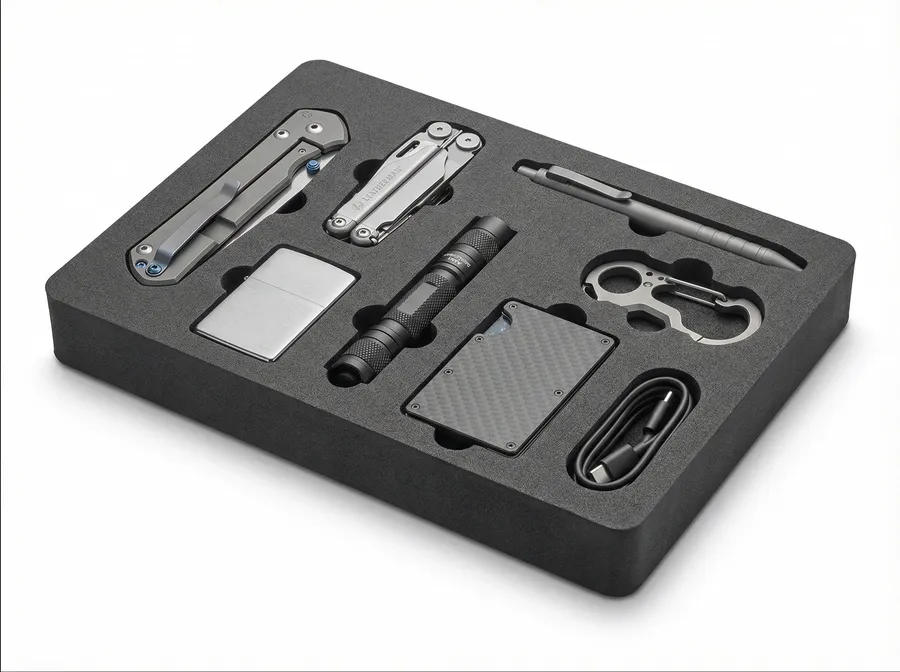
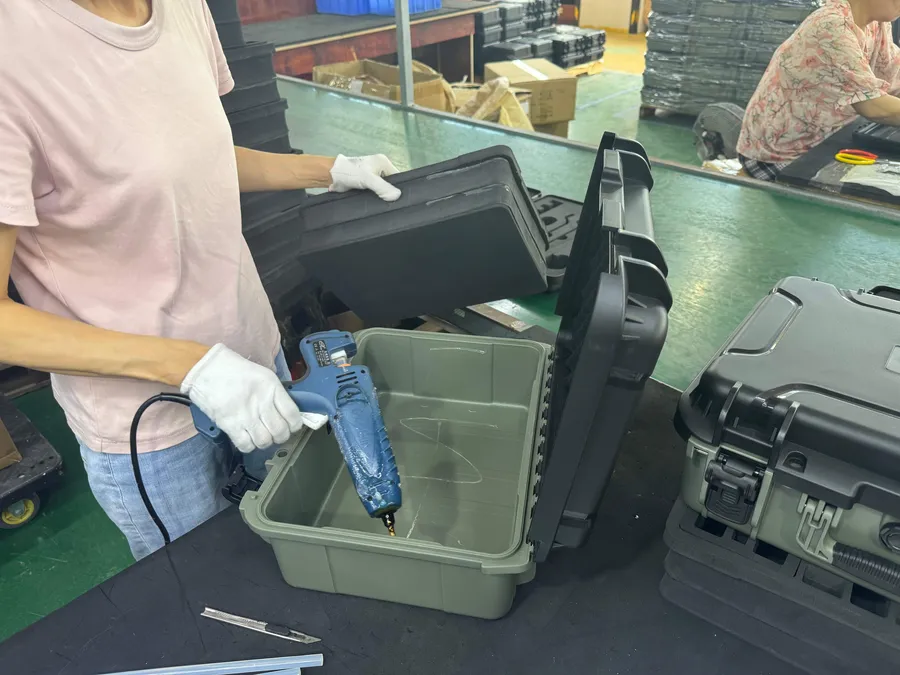
Then the foam, which is where shock performance is genuinely decided. Pick-and-pluck foam is the field-adjustable choice when the kit changes between jobs. Die-cut or CNC-cut foam is the repeatable choice for a production build, and to cut it we need a drawing, a photograph of the packed kit, or a physical sample; that requirement is recorded in the model data rather than invented for the quotation. The layout rules we apply on every instrument build: a wall of foam on all six faces of the instrument, its own pocket for each dense reference item, a separate channel for cable so the lid never closes on a bundle, and nothing that presses on a lens, sensor face or connector when the lid is latched.
Where these kits travel
The instrument formats in this article cover a wider set of duties than solar alone, and the same published cavities keep appearing: solar EPC and commissioning crews running string tests and irradiance readings; utility operations and maintenance teams carrying a tracer up a ladder; module and cell production quality labs sampling between lines; industrial maintenance and inspection teams running thickness and flaw detection on plant; survey and inspection photography carrying bodies and lenses to site; field clinics and veterinary practices moving bench devices room to room; and tower and telecommunications crews carrying test sets with coiled feeder leads. None of those buyers are served by a single model number; they are served by the same geometry logic applied to a different row of the table.
One boundary worth stating plainly: we supply these as wholesale and OEM builds. A commissioning engineer buying one case for personal use is not the customer we serve, and the lead times and minimums below are set for buyers who order in quantities and put their own brand or configuration on the shell.
Customisation: foam, colour, logo, hardware and moulds
Every model in the file is recorded with OEM and ODM availability, custom logo, custom colour, custom packaging, custom foam and custom hardware, plus private label. The published minimums and timings are what make this a decision rather than a promise: custom foam is quoted from a quantity of one because it is a cutting operation on an existing shell, while logo, colour and OEM builds carry a minimum of 300, and a custom mould carries a minimum of 3,000 pieces per component with a 125-day programme. A first OEM sample on an existing mould is quoted at 45 days. Hardware options in the recorded data include a pressure equalisation valve and a document holder, both listed as configuration items; the latch body accepting a standard padlock, the moulded hinge and the feet are recorded values.
| Option | Published Term |
|---|---|
| Custom foam layout | Quoted from quantity 1; drawing, photograph or sample required |
| Custom logo | Minimum order 300 |
| Custom colour | Minimum order 300 |
| OEM build | Minimum order 300; first sample 45 days on an existing mould |
| New mould | 125 days; minimum from 3,000 per component |
| Private label and custom packaging | Available per configuration |
| Pressure equalisation valve | Configuration option across the library |
| Padlock-ready latch, hinge, feet | Recorded values in the hardware block |
| Gasket | EPDM or equivalent compressible gasket; offered on 124 of 155 models |
Purchasing terms a wholesale or OEM buyer should expect
KeXin New Materials (Guangdong) Co., Ltd. sells wholesale and OEM on EXW or FOB terms. We do not sell retail, we do not quote DDP, and we hold no overseas warehouse stock, so landed-cost questions come back to your freight forwarder and the term you choose. A 30% deposit is the standing business parameter on a new build, and balance terms are settled with the proforma invoice. Packing data is published where it exists: carton dimensions and pieces per carton are recorded on 64 of the 155 models, pallet quantity is calculated from the carton footprint against your pallet size rather than asserted as a measured figure, and 20GP, 40GP and 40HQ container counts are supplied with the quotation.
Documentation follows the same discipline. With an order you get the published specification sheet for the ordered model, the material and hardware list and the packing list. You do not get an ingress, immersion, fall, stack-load, ultraviolet or temperature statement, because those fields are recorded as not measured. Where a tender demands that evidence, we quote accredited third-party testing as a separate work package against the exact configuration you receive, which is both cheaper and safer than a datasheet adjective that nobody can support in an audit.
What we do not claim about this category
No ingress protection code for any of the 155 models. No immersion depth or time. No free-fall height and no drop distance. No stack-load or working-load figure. No ultraviolet or temperature range. No third-party conformity statement for a build that has not been submitted to a laboratory. Shock and impact appear in our file only as configuration options that depend on an approved foam layout. The single protection line we record as measured is corrosion resistance, for the narrow reason that a thermoplastic shell has no ferrous corrosion path. An empty column in a specification sheet is a statement about our data, not about the product's limits, and a category name is not a test result. If you need the limit, name the protocol, the sample state and the load condition, and we quote the programme.
Customisation
Everything described above is configurable on a standard shell: interior layout (pick-and-pluck, die-cut or CNC-cut), foam grade and thickness, colour, logo method, latch and lock count, pressure-equalisation valve, cable ports, document holder and identification plate. A bespoke exterior geometry requires a new mould — 125 days, from 3,000 units per moulded component.
Procurement considerations
| Question | What to send us |
|---|---|
| Which shell fits? | Equipment L × W × H as packed, plus required clearance per axis |
| What does it cost? | Order quantity and estimated annual quantity — the two drive different answers |
| Is tooling needed? | Whether an existing shell clears the envelope with usable foam depth |
| Lead time? | Your required delivery date, not just the order date |
| Certification? | The exact standard your tender names — we will say whether we can test to it |
| Freight? | Destination and preferred terms; carton and pallet data supplied with the quotation |
Comparison and selection guide
The tables on this page exist because a protective case is chosen by comparing three things: the envelope, the environment and the handling chain. Where no table applies, the rule below is.
| Situation | What To Do |
|---|---|
| Benchtop mass | Firm base carrier, 50 mm minimum, with a soft contact layer. |
| Optical head | Suspend the body and clear the lenses entirely; never let foam touch a coated surface under load. |
| Field kit | CNC base for the instrument, pluck-foam top for probes and consumables. |
- Size on internal dimensions plus clearance, never on a product name.
- Choose the carrying method before the shell: it changes the series, not just the price.
- Specify the interior last, and decide up front whether the end user will reconfigure it.
Solar Panel Tester Portable Waterproof Case: What Our Published Data Says relates to Waterproof & Dustproof Guide. Related families: Instrument & Equipment Cases / Electronics Cases / Camera & Photography Cases / Medical Equipment Cases / Optical Equipment Cases / Custom Protective Cases. Related sectors: field and industrial equipment. Continue in the Waterproof & Dustproof Guide cluster.
This page is written from our own production data. If your requirement differs, send the dimensions and we will tell you which of the 155 models fits, or whether a custom route is needed.