What is a dustproof equipment case?
A dustproof equipment case is a hard-shell case whose lid-to-base closure resists fine particulate getting in: a compressible gasket runs in a continuous channel around the parting line, latches compress that gasket evenly, and the shell, hardware and interior faces are chosen so there is no easy path for grit to follow. That is the mechanism, and it is worth separating from a rating. Dust entry is a function of the sealing surface, the compression applied to it and what is sitting on the rim when you close the lid - not of a sticker on the shell. In our own data 124 of 155 models publish a compressible gasket in a continuous moulded channel and 31 publish no sealed closure at all, and we record no dust test result for any model, so the honest description of a dustproof case is a closure design you specify deliberately rather than a protection class we claim to have earned.
Key points
- Dust resistance in a hard case is a closure property: gasket continuity, latch compression and a clean parting line.
- 124 of our 155 models publish a compressible gasket in a continuous moulded channel; 31 publish no sealed closure.
- We record no dust or water test result for any model, so a dustproof case is a design you specify, not a rating we claim.
- Secondary openings decide the outcome as much as the gasket: valve bores, handle bolt holes, hinge gaps and document pockets.
- The interior face matters in grit: a pluck or torn surface traps dust, a closed-cell face can be wiped before the lid closes.
- Specify on published geometry: wall thickness 2.0 mm to 6.0 mm, internal height 32 mm to 364 mm, lid-to-base split per model.
The definition, stated as a mechanism
A dustproof equipment case is a case engineered so that airborne particles cannot easily cross the boundary between lid and base. Three things do that work. The first is a compressible sealing element carried continuously around the parting line - in our range that is recorded as a compressible gasket in a continuous moulded channel, which matters because a channel moulded as part of the shell keeps the gasket positioned and compressed at the same thickness all the way round, instead of a glued strip that can lift at a corner. The second is compression: latches pull the lid onto the base so the gasket is squeezed uniformly, and the number and position of latches is a configuration choice we record per order rather than a feature assumed from the shell. The third is the absence of alternative paths, because dust does not need a hole; a film of grit on the rim, a warped parting line or an unsealed bore next to a handle bolt is enough.
Note what is missing from that definition: a number. A rating is a laboratory outcome attached to a specific article under a specific test. Our published data holds no dust result and no water result for any of the 155 models, and no ingress code appears anywhere in it. We can therefore describe how a closure is built and what we offer per model, and we can commission accredited testing of the configuration you buy as a separate work package, but we do not convert a design intent into a claim.
What keeps dust out, part by part
Start with the sealing surface. The gasket has to be continuous, uncompressed beyond its design in service, and clean when the lid comes down. A channel moulded into the shell does most of that; what defeats it is a rim that has been painted over, a gasket that has taken a permanent set after years of being stored closed, or debris pressed into the channel during a site visit. Where a case lives outdoors, the closure is a maintenance item, not a permanent feature.
Then the compression. Two latches at the front and a hinge at the back leave the far corners of a wide lid lightly loaded; the practical consequence in a dusty environment is a fine gap at exactly the two corners that face the wind. Our hardware is published per configuration - latch count is recorded as specified per order, with hinge, feet and a padlockable latch body recorded as measured - so a wide shallow shell destined for grit is a case where you specify the latch count deliberately rather than accepting the default.
Then the secondary openings. Every penetration of the shell is a possible path: handle and bolt bosses, hinge fixings, a document pocket fitted to the outside, and a pressure-equalisation valve where one is fitted. A valve is a real requirement in a case that sees temperature swing, because heating air inside a sealed shell pushes out through whatever is weakest and cooling pulls replacement air in through the same route - and that incoming air carries whatever is floating around it. Our data records a pressure-equalisation valve as a manufacturer option on all 155 models, so it is a line on the specification sheet and the dust question becomes what element is inside that bore.
Finally the interior face. Dust that gets in is one problem; dust that is carried in and then held is another. A torn pick-and-pluck surface and an egg-crate face trap grit in their voids and pass it onto optics and connectors every time something is lifted out, while a closed-cell cut face can be wiped down before the lid closes. On all 155 models we publish top foam, base foam, egg-crate or convoluted, custom cut and layered constructions in pick-and-pluck, die-cut and CNC-cut form and in EVA, PE and EPE grades, so the wipeability of the contact surfaces is a choice you make on the layout drawing.
Dustproof against waterproof: the same shell, different questions
The two are not competing claims about the same object; they are different questions about the same sealing surface. Dust is the harder thing to notice and the easier thing to tolerate briefly, which is why a case can be bought as waterproof and then fail in the field as a dust collector - a rim closed over sandy water leaves a residue that abrades the gasket every time the lid is opened. Buy the closure that fits the dominant exposure, and keep the rim clean whichever it is.
| Question Asked Of The Case | Dustproof Build | Waterproof Build | What Our Data Publishes |
|---|---|---|---|
| What it resists | Fine particulate crossing the parting line and secondary openings | Liquid water at the rim, under head pressure or driven by wind | Closure option per model; no dust or water test record on any model |
| Sealing element | Continuous compressible gasket in a moulded channel | Same gasket, but compression uniformity and rim cleanliness matter more | 124 of 155 models publish a gasket channel; 31 publish none |
| Pressure and breathing | Valve bore is a dust path; the element inside it is the question | Valve relieves cycling that would otherwise pump air at the gasket | Pressure-equalisation valve as a manufacturer option on all 155 |
| Interior surface | Wipeable closed faces; avoid void-rich surfaces that store grit | Closed-cell grades that do not hold water against the item | Six foam types and five structural options listed on all 155 |
| Failure mode to design against | Grit on the rim at closing; set gasket; lightly loaded corners | Submersion or prolonged rain at the weakest corner | Wall thickness, lid-to-base split and narrow width per model |
How to specify a dustproof case in five inputs
Input one is the dominant particulate. Abrasive silica is a different problem from organic dust or metal swarf: the first polishes a gasket and finds a gap, the second insulates contacts, the third is a hazard to whatever is packed. Input two is whether the case sees temperature swing, which is the question that decides whether you want a valve, and therefore which bore you are willing to seal.
Input three is the shell geometry, read from published figures rather than assumed: wall thickness appears on 148 of our models from 2.0 mm to 6.0 mm with a median of 3.9 mm, internal height runs from 32 mm to 364 mm, and on the 100 models that publish the lid-to-base split the base depth runs from 15 mm to 168 mm with a median of 44 mm while lid depth runs from 16 mm to 320 mm. A deep flat lid on a wide footprint is where corner compression needs the most attention, so latch count and gasket continuity are worth specifying there first. Input four is where the case is opened: on a vehicle bed, on the ground, or in a clean bay determines how much grit reaches the rim.
Input five is the interior face, which is a wipeability decision as much as a cushioning one. Then check the volume honestly: usable interior volume is published against nominal on every model, and on 154 of 155 the usable figure is smaller, with the ratio running from 0.797 to 1.000 and a median of 0.850, because radiused corners and hardware take space. A layout that fills a shell to its nominal drawing dimensions will not close cleanly, and an imperfectly closed lid is precisely the failure mode this article is about.
Which of our models carry a gasketed closure
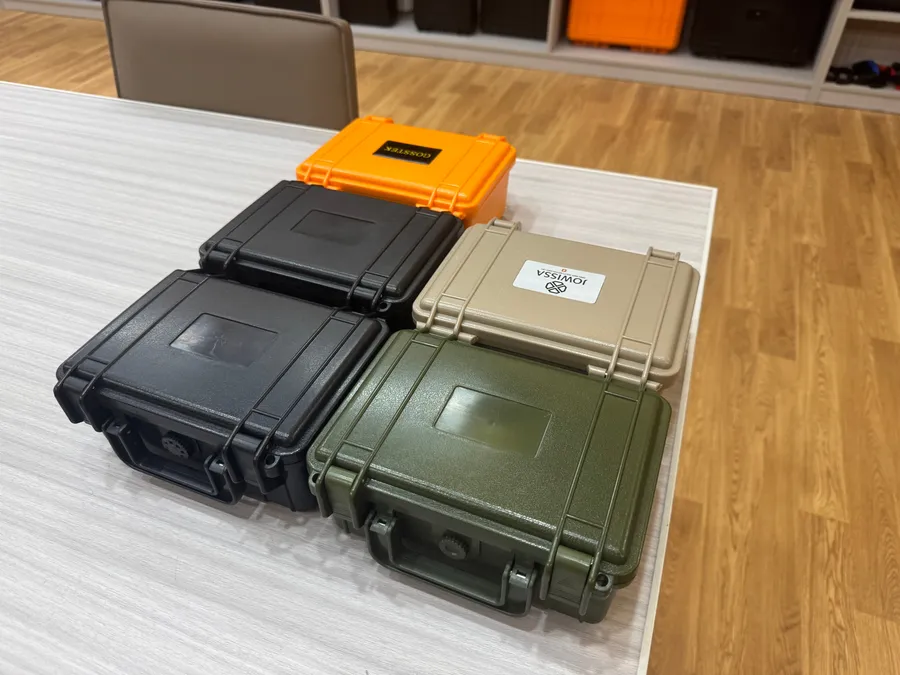
124 of the 155 models in our catalogue publish a compressible gasket in a continuous moulded channel; 31 publish no sealed closure on the shell at all, and we record that as a fact per model rather than describing the range as uniformly sealed. Examples with published pages include KX-3218 at 308 by 230 by 172 mm internal and 900 g empty, KX-4616 at 455 by 338 by 148 mm and 1,395 g, KX-65522 in ABS at 507 by 385 by 190 mm and 4,860 g, KX-6621 with a 6.0 mm wall at 587 by 434 by 192 mm and 6,420 g, and the wheeled KX-85835 at 500 by 400 by 305 mm and 8,520 g.
On the other side sit all ten shells published on our outdoor protective cases page - KX-701, KX-704, KX-712, KX-2614, KX-2808, KX-2808-2, KX-2813, KX-3113, KX-3114 and KX-3308 - which are recorded without a sealed closure, along with engineering-polypropylene shells such as KX-4710, KX-4713 and KX-4716 in 458 by 345 mm footprints. That is a useful pairing to study, because the two groups have similar exterior behaviour outdoors and completely different dust behaviour: an unsealed carry shell is a good grit shield for a job that finishes before the case is stacked, and it is the wrong answer for a site where the case is opened and closed in wind-blown sand all week.
The taper figure matters more than buyers expect in a gasketed shell: a narrow internal width is published on 36 models, from 70 mm to 308 mm, and on KX-4716 the nominal internal width of 345 mm coexists with a 308 mm narrow width. If a load presses against the sidewall near the parting line, the lid can look closed while the sealing line is being held slightly open.
Duties where the closure earns its cost
Field survey and measurement instruments are the clearest case: a level, a scanner or a data logger has connectors, seals of its own and moving readouts, and grit is the failure mode that calibration notices before the owner does. Communication sets in a vehicle or on a mast are the second: radios and their antennas come back coated, and the connector face is where the damage is done.
Machine shops, woodworking, agriculture and forestry are the third group, where the particulate is generated next to the case and is often slightly abrasive and often slightly oily - a combination that turns a gasket into a grinding paste if the rim is not wiped. Marine and beach use is the fourth, because salt-laden sand and closed-wet conditions are harder on a sealing line than either dust or water alone.
Optics and camera kits are the fifth and the most unforgiving, because the dust that survives the closure ends up on a coated surface and is then rubbed. In all five groups the practical answer is the same pair of decisions: a gasketed closure with deliberate latch count, and an interior whose contact faces can be wiped. A drone service kit is a good illustration of the mixed load: a gasketed shell with a cut carrier for the airframe, a wipeable face at the gimbal, separated bores for batteries, and a pluck top layer that the user replaces when it has gone gritty.
Customising a case for a dusty duty under OEM
Closure, hardware and interior are all configurable, and none of it requires new tooling as long as the shell exists. The interior is the cheapest entry point: custom foam starts at one set on every model, with custom thickness and custom shape recorded against all 155, so a wipeable cut face over a load-bearing base can be proven on a single case. Hardware - latch count, hinge type, feet, a padlockable latch body and a pressure-equalisation valve where altitude or temperature cycling demands one - is quoted per configuration, and a valve is recorded as an option on every model.
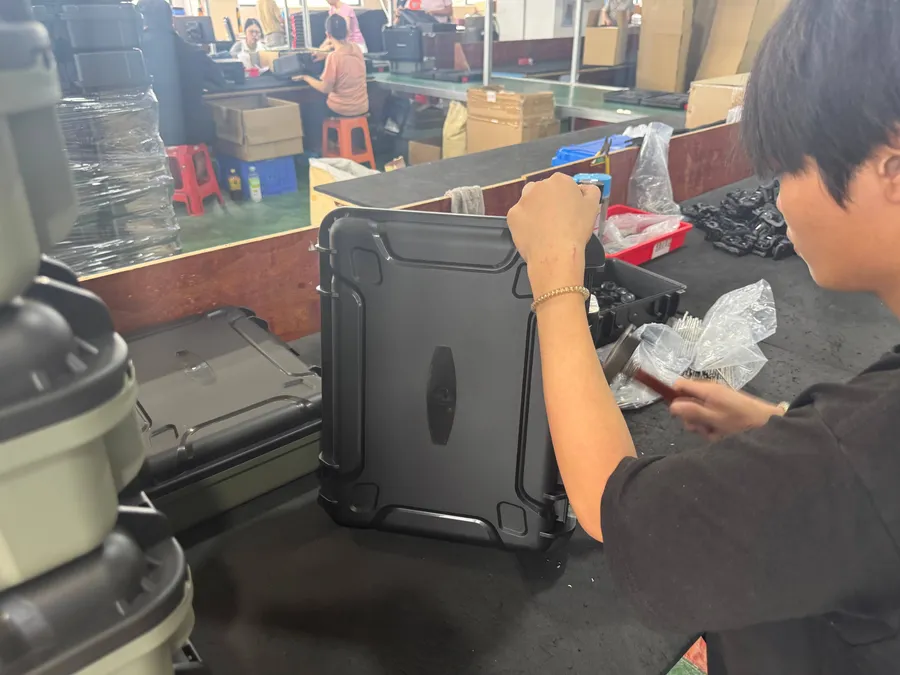
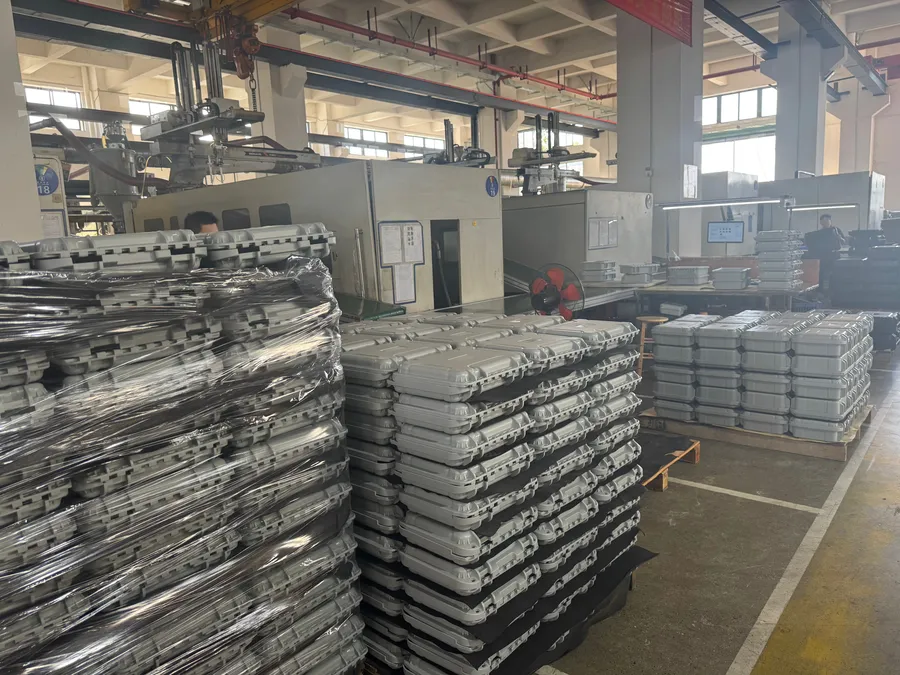
Identification and colour sit one step up: custom logo and matched shell colour, together with OEM production on an existing moulding, start at 300 pieces with a first sample scheduled at 45 days on a 30 percent deposit. A genuinely new shell geometry is a moulding project quoted at 125 days and from 3,000 pieces per moulded component - a decision driven by the mould, not by the gasket.
To place an order, send the dominant particulate, the environment the case is opened in, whether the case sees temperature or altitude cycling, the load list with packed dimensions, and the internal envelope you are working to. We return candidate models with their published closure option, wall thickness, internal and usable dimensions, lid-to-base split and net weight, plus a layout drawing for approval.
What we publish, what we do not, and how to buy safely
Published per model and measured: external and internal dimensions, usable interior volume, wall thickness, lid and base depths, narrow internal width where the shell tapers, net weight, shell material, carton data, whether a sealed closure is offered and the seal construction. Corrosion resistance is recorded as measured on all 155 models on the simple basis that a thermoplastic shell offers no ferrous path to rust - which is worth something outdoors, where a steel frame or a plated fastener is usually the first thing to look bad.
Not published for any model: a dust result, a water result, an ultraviolet figure, a service temperature range, a stack load, a payload limit or an ingress code. Shock and impact resistance are recorded across the range as a construction option that depends on the interior you order, with no drop height stated for an untested configuration. If your tender needs a number, the route is accredited testing of the named shell, named layout and named load, commissioned as a separate work package, and the report will describe the article that went into the chamber - not the catalogue it came from.
Commercially, this is wholesale and OEM manufacture only, quoted EXW or FOB from the factory. We do not sell retail, do not offer delivered-duty-paid terms and hold no overseas warehouse stock, so a case programme is scheduled with the production batch it belongs to and planned into your own inbound freight; third-party inspection of finished goods is welcome. KeXin New Materials (Guangdong) Co., Ltd.
Customisation
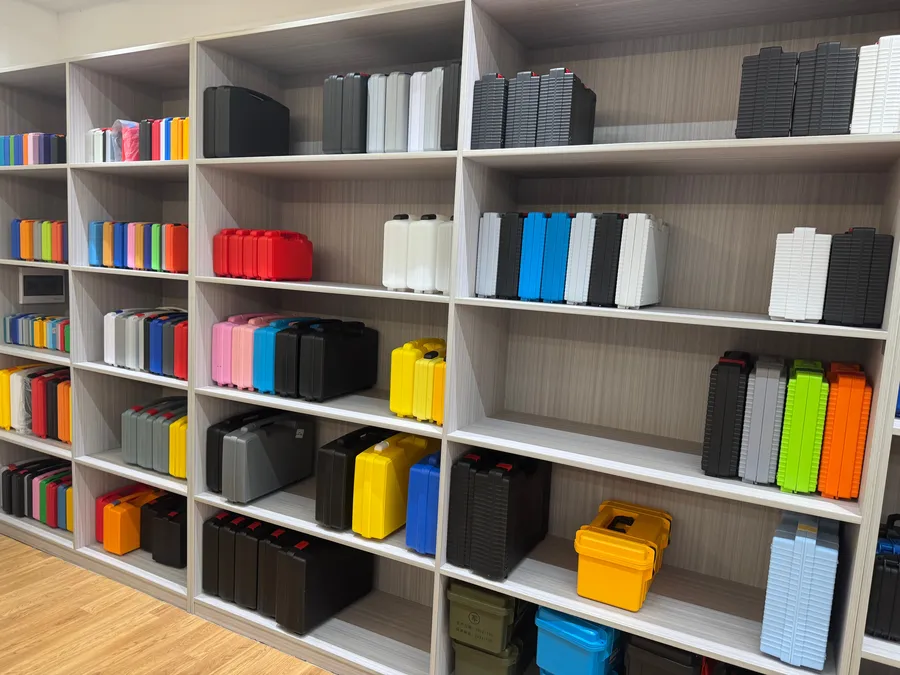
Everything described above is configurable on a standard shell: interior layout (pick-and-pluck, die-cut or CNC-cut), foam grade and thickness, colour, logo method, latch and lock count, pressure-equalisation valve, cable ports, document holder and identification plate. A bespoke exterior geometry requires a new mould — 125 days, from 3,000 units per moulded component.
Procurement considerations
| Question | What to send us |
|---|---|
| Which shell fits? | Equipment L × W × H as packed, plus required clearance per axis |
| What does it cost? | Order quantity and estimated annual quantity — the two drive different answers |
| Is tooling needed? | Whether an existing shell clears the envelope with usable foam depth |
| Lead time? | Your required delivery date, not just the order date |
| Certification? | The exact standard your tender names — we will say whether we can test to it |
| Freight? | Destination and preferred terms; carton and pallet data supplied with the quotation |
Comparison and selection guide
The tables on this page exist because a protective case is chosen by comparing three things: the envelope, the environment and the handling chain. Where no table applies, the rule below is.
| Situation | What To Do |
|---|---|
| Occasional splash | A close-fitting rim without a gasket is cheaper and easier to maintain. |
| Rain and washdown | Sealed configuration, four or more latches, stainless hardware. |
| Immersion or pressure change | Sealed configuration plus a pressure-equalisation valve, and a documented test. |
- Size on internal dimensions plus clearance, never on a product name.
- Choose the carrying method before the shell: it changes the series, not just the price.
- Specify the interior last, and decide up front whether the end user will reconfigure it.
What is a dustproof equipment case? relates to Waterproof & Dustproof Guide. Related families: Waterproof Cases / Outdoor Protective Cases / Field Equipment Cases / Instrument & Equipment Cases / Camera & Photography Cases / Communication Equipment Cases / Electronics Cases. Related sectors: field and industrial equipment. Continue in the Waterproof & Dustproof Guide cluster.
This page is written from our own production data. If your requirement differs, send the dimensions and we will tell you which of the 155 models fits, or whether a custom route is needed.


