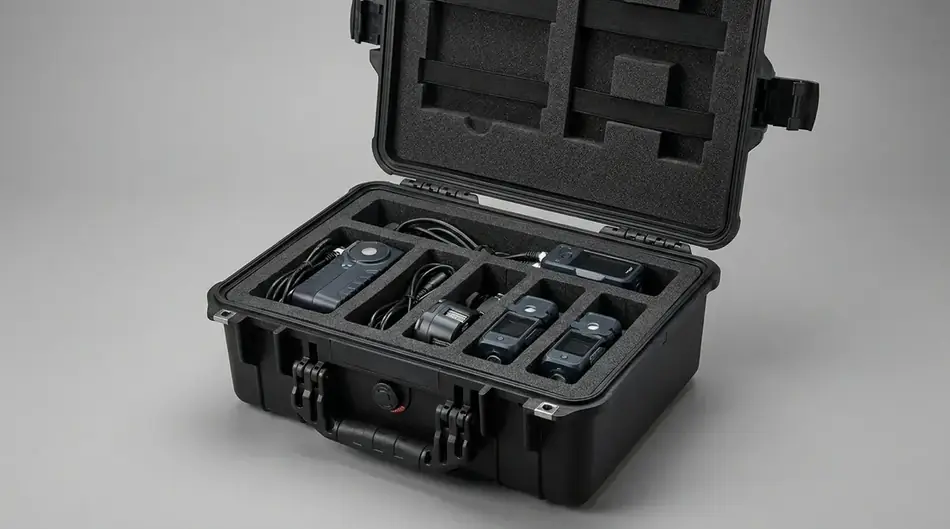
Why is dust protection important for electronic equipment?
Dust protection matters for electronic equipment because dust does four jobs a case can influence: it bridges metal contacts and creates leakage paths, it insulates the surfaces that were designed to shed heat, it abrades connectors, fans, sliders and keypad membranes, and it settles on optics and sensor windows that exist to make a measurement. Almost none of that damage happens while the equipment is switched on and watched; it happens in the vehicle, on the tailgate, in the site container and on the workshop shelf, which is exactly the period a protective case owns. Our answer as a manufacturer is a controlled closure: 124 of our 155 published models record a compressible gasket in a continuous moulded channel and 31 record that no sealed closure is offered on that shell. We publish no dust or water test figure for any model, because we have not run one, so we specify geometry you can measure on the part and quote accredited testing as a separate work package when a programme needs a rating.
Key points
- Treat dust as a closure problem: gasket continuity, latch compression, a clean rim and controlled secondary openings.
- 124 of 155 published models record a compressible gasket in a continuous moulded channel; 31 record no sealed closure.
- Every gasketed shell in our range publishes a wall thickness of 3.0 mm or more; the unsealed group publishes 2.0 mm to 2.9 mm.
- Classify the dust before you size the case: conductive or hygroscopic dust turns a settling problem into a board-level fault.
- Sealed is not the same as cooled. A box that keeps dust out but traps heat is a different failure with the same symptom.
- No dust or water test record exists for any of the 155 models, so write your specification against published geometry, not a rating.
- Dust arrives on the kit and on the rim, so a wipe-down step and a channel you can clean matter as much as the gasket itself.
What dust actually does to electronic equipment
The first mechanism is electrical. Fine dust that carries metal fines, carbon from brush or brake wear, or conductive residue from industrial air settles across a board and creates leakage paths between traces that were designed to be isolated. Hygroscopic dust does a similar job more slowly: it looks harmless while it is dry, absorbs moisture when humidity rises, and becomes a thin conductive film that is worst overnight and in winter. Faults of this kind are intermittent, which is why they are expensive. The unit passes a bench test in a warm, dry room and fails again when it is put back in the environment that produced the dust.
The second mechanism is thermal, and it is the one engineers underestimate because it rarely presents as a breakdown. Dust is an insulator, and it collects precisely where heat has to leave a product: the fins of a heatsink, the anodised face of a converter, the mesh over a fan inlet, the join between a chassis and its mounting plate. Equipment designed to run close to its thermal budget keeps running when that coating builds up, but the margin has gone. Derating curves stop being true, measurement drift appears with temperature, and the visible result is a shutdown, a shortened battery life or a display that degrades rather than a clean fault code you can point at.
The third mechanism is abrasion, and it is the most common reason a serviceable unit gets written off. Grit works into connector mating faces, slider rails, potentiometer spindles, zoom barrels, keypad membranes and fan bearings. Each of those is a service item nobody budgeted for. Optical and sensing equipment carries a fourth exposure: dust on a lens, mirror or sensor window scatters light and degrades the very measurement the instrument exists to take, and wiping a dusty optical surface with a dry cloth is how coatings get damaged in the process of cleaning them.
Why the storage period, not the working period, is the risk
Electronic equipment is usually damaged while it is switched off. It is in the back of a vehicle, on a tailgate, in a site container, on the shelf above a grinder, or being moved between a warm interior and a cold exterior. During those hours the dust concentration around the equipment is set almost entirely by whether the enclosure around it is closed, whether that closure is continuous, and how often it is opened on the dirty side. A case owns that period, which is why a closure specification belongs to the electronics buyer rather than being left to whoever provides the box at the end.
A moulded hard shell contributes something a soft bag or a tarp does not: it holds its shape while the closure works. Gasket compression only keeps dust out if the rim it bears on stays flat, and a thin, flexible wall flexes under the latches, under stack load and as the case is carried by the handle. That relationship is visible in our own published data. All 124 models that record a compressible gasket in a continuous moulded channel publish a wall thickness of 3.0 mm or more, and the 24 unsealed models with a published wall figure run from 2.0 mm to 2.9 mm. The gasket and the stiff rim are one decision, not two separate line items.
The paths dust takes into a closed case
Buyers concentrate on the lid, and the honest failure is usually somewhere else. In our range the primary barrier is the gasket in its channel, and every published model carries the same secondary paths: the bore for a pressure equalisation valve, which is offered as a manufacturer option rather than fitted as standard on a catalogue model; the handle, hinge and latch boss areas, where the wall is locally thicker and the parting line is interrupted; and the latch line itself, where compression has to be adequate at the middle of a long edge as well as at the corners. Latch count is specified per configuration, so it is a number you set, not a number you inherit.
Two further paths are operational rather than moulded. The first is the rim itself: dust that settles on the sealing face is carried into the joint when the lid closes, which is why a channel geometry that can be cleaned is listed as a design requirement on our Dust Protection page rather than as a maintenance note. The second is the interior. An open-cell or torn foam face is a dust reservoir, and a plucked pick-and-pluck surface sheds into the cavity every time the case is jostled in a vehicle. For a dusty duty, a closed-cell foam cut to a shape that leaves no exposed edge at the parting line is the version that behaves.
What our published catalogue states, and what it deliberately does not
The boundary between a construction claim and a test claim is where procurement arguments go wrong, so here is what our product data actually says. Across all 155 models the dust-resistance field and the waterproof field are recorded as unmeasured, and the protection-rating field carries the note that no ingress protection code is stated and that accredited testing is quoted per configuration. What is recorded as measured is construction: 124 models publish a compressible gasket in a continuous moulded channel, 31 publish that none is offered on that shell, and every model in the range publishes its external and internal dimensions, wall thickness and internal volume.
Two further attributes are configuration choices rather than fixed catalogue facts. The gasket compound is published as EPDM or an equivalent compressible gasket, offered as a manufacturer option; so is the pressure equalisation valve. The corrosion entry that is stated as measured across the range is construction-based: a thermoplastic shell with no ferrous corrosion path. That removes one failure route in a coastal or grit-laden site, and it is a genuinely useful fact, but it is a material statement rather than a sealing rating and we do not present it as one.
The practical consequence for an electronics buyer is that you cannot shorten this specification by picking a series name. You pick a shell by published geometry, decide whether it belongs to the gasketed group or the unsealed group, and then set the configuration: gasket compound, valve, latch count, foam type and foam layout. That is more work at the request-for-quotation stage and far less arguing later, because every item is either on the drawing or it is not.
Gasketed shells against unsealed shells, on published data
| Attribute | Gasketed Group (124 Models) | Unsealed Group (31 Models) |
|---|---|---|
| Closure recorded in our data | Compressible gasket in a continuous moulded channel, recorded as a measured construction feature | The model page states that no sealed closure is offered on this shell |
| Published wall thickness | 3.0 mm to 6.0 mm across the group | 2.0 mm to 2.9 mm on the 24 models that publish a wall figure |
| Published internal volume | 0.8 L to 139.5 L | 0.3 L to 50.4 L |
| Series coverage | Present in the 0, 1, 6, 8, 9 and T series; all 20 models in the 6 series publish a gasket | Concentrated in the 0 and 1 series and in the 7 series, where no model publishes a gasketed closure |
| Dust or water test record | None published; both fields recorded as unmeasured | None published; both fields recorded as unmeasured |
| Pressure equalisation valve | Manufacturer option, not fitted as standard | Manufacturer option, not fitted as standard |
| Dust duty it suits | Regular field, worksite and vehicle service where the lid is opened on the dirty side | Bench, cabinet and shelf storage where grit is controlled at room level |
Selection guidance: match the closure to the dust, not to the label
Start from the exposure rather than the case. If the equipment lives on a desk or in a cabinet and only travels occasionally, an unsealed thin-wall shell is the honest answer and you should not pay for a gasket it will never be given credit for. If it is carried to site, opened on a verge, loaded into a vehicle roof box or handed between people who are working with abrasives, cutting, bagging or drilling, the gasketed group is where the specification starts, and the lid depth, internal volume and foam layout are the things that decide whether the closure is used properly or worked around.
Then size the interior for heat as well as for dust. A sealed cavity with a warm device inside it is a thermal problem before it is an ingress problem, and the fix is volume and layout rather than a bigger gasket. Our published internal volume runs from 0.8 L in the smallest gasketed shell to 139.5 L in the largest, with usable interior volume stated separately on each model page so the foam you intend to fit is already accounted for. Two shells with the same external footprint can differ by several litres of usable space once the wall and lid split are taken out, which is why the internal dimension is the one that belongs in your drawing.
Finally, check the closure against the way it will actually be used. A long lid edge with too few latches loses compression in the middle; a document pocket or a handle boss can interrupt a parting line; a lid that is opened face-down on gravel picks up grit that the gasket then presses into the rim. These are cheap to fix at the specification stage and expensive to fix after 400 units are in the field.
Published shells worth specifying against
| Model | External (Mm) | Internal (Mm) | Wall (Mm) | Internal / Usable Volume | Net Weight | Closure Published |
|---|---|---|---|---|---|---|
| KX-1905 | 190 x 190 x 45 | 180 x 160 x 40 | 3.0 | 1.2 L / 1.0 L | 250 g | Gasket in continuous moulded channel |
| KX-62109 | 211 x 165 x 93 | 195 x 128 x 81 | 3.0 | 2.0 L / 1.7 L | 470 g | Gasket in continuous moulded channel |
| KX-4010 | 400 x 360 x 100 | 390 x 315 x 88 | 3.0 | 10.8 L / 9.3 L | 1,015 g | Gasket in continuous moulded channel |
| KX-4610 | 460 x 367 x 95 | 455 x 338 x 84 | 3.0 | 12.9 L / 11.1 L | 1,115 g | Gasket in continuous moulded channel |
| KX-65522 | 545 x 440 x 215 | 507 x 385 x 190 | 5.3 | 37.1 L / 29.7 L | 4,860 g | Gasket in continuous moulded channel |
| KX-97227 | 720 x 500 x 270 | 590 x 435 x 210 | 6.0 | 53.9 L / 43.1 L | 10,000 g | Gasket in continuous moulded channel |
| KX-1204 | 120 x 90 x 40 | 115 x 78 x 32 | 2.6 | 0.3 L / 0.3 L | 100 g | No sealed closure offered on this shell |
| KX-2813 | 280 x 240 x 130 | 260 x 200 x 117 | 2.8 | 6.1 L / 5.2 L | 800 g | No sealed closure offered on this shell |
Duties where the closure earns its cost
Field communication and radio equipment is the clearest case. Antenna bosses, cable glands and connector panels are all interruptions to a parting line, and the equipment spends its life in vehicles and on the ground beside them. A gasketed shell with a defined latch count and a closed-cell foam cut that leaves the connector faces accessible is the version that survives a season of that treatment; the same kit in a thin-wall unsealed box arrives at refurbishment with grit in every socket.
Test and measurement instruments fail differently but for the same reason. Their accuracy claim is a temperature and cleanliness claim, and dust attacks both. A calibration case that keeps grit off the reference faces between uses is protecting the certificate, not just the enclosure. Survey optics, thermal monoculars and camera equipment belong in the same group: a single grain on a lens element is a rejected image, and abrasive dust in a focus mechanism is a stripped thread.
Drone and payload cases, industrial hand-held terminals, medical and laboratory devices moved between sites, and tool-side electronics all share the pattern that the equipment is opened where the work is. Wherever the opening point is dirty, the closure is the control. Wherever the equipment is opened only in a controlled room, an unsealed shell is a legitimate, cheaper answer and we say so on the model page rather than pretending otherwise.
Customising a case for a dusty duty under OEM
Everything that decides dust behaviour in our range is a configuration choice you can make at quotation stage. The gasket compound is offered as EPDM or an equivalent compressible material. A pressure equalisation valve can be specified into the moulding. Latch count is set per configuration, which is what you adjust on a long lid edge to keep compression near the middle. Shell material is published per model, with PP and engineering PP across most of the range and ABS on 22 models, and foam is custom on every model in the catalogue, in cross-linked PE, EVA or EPS by zone.
Foam is where a dust specification is most often left half-done. Pick-and-pluck, die-cut and CNC-cut layouts are all available, and the choice that matters for grit is whether the cut leaves an open cell face exposed at the parting line. We ask for a drawing, a photograph of the packed kit, or a physical sample, because that is the only way to see where dust will settle and where it will be trapped against a connector when the lid comes down.
Commercially the range is wholesale and OEM only, on EXW or FOB terms, with no retail, no delivery-duty-paid service and no overseas stock. Minimum order quantities are one unit on a standard shell and one on custom foam, 300 on logo, colour and OEM work, and 3,000 per component for a custom mould. First articles on an existing mould take 45 days and a new mould takes 125 days, which is the lead time to plan around if a changed parting line, an added valve bore or a new latch position is part of your dust specification.
Procurement notes: how to buy this without a dispute later
Write the requirement as geometry and configuration, and put the evidence question in the request for quotation. Ask for the model page dimensions, the wall thickness, the closure statement and the latch position drawing, and compare them against your equipment drawing with clearance allowed for foam on every face. If your programme needs a stated ingress figure, treat accredited testing against the exact model and configuration as a separate work package with its own scope and cost, and specify who holds the report. That is the honest way to buy this class of product, and it is how we quote it.
Two practical points save more field failures than any gasket. First, put a cleaning step into the procedure: the rim and the channel are where dust is carried in, and a channel geometry that can be wiped is only useful if someone wipes it. Second, let a cold case acclimate before opening it in a warm room, because the moisture that condenses on the equipment came in with the air that was already in the cavity, and no seal can prevent that. Temperature and cleanliness claims on an instrument certificate are yours to protect, and the case is only one of the controls.
Third, keep the shell family decision separate from the interior decision. A gasketed shell fitted with an open-cell, shedding foam is worse than an unsealed shell fitted with a clean closed-cell cut, and we see that combination ordered often enough to say it plainly. Specify the closure and the interior as one system, and ask us to show both on the same drawing before tooling is committed.
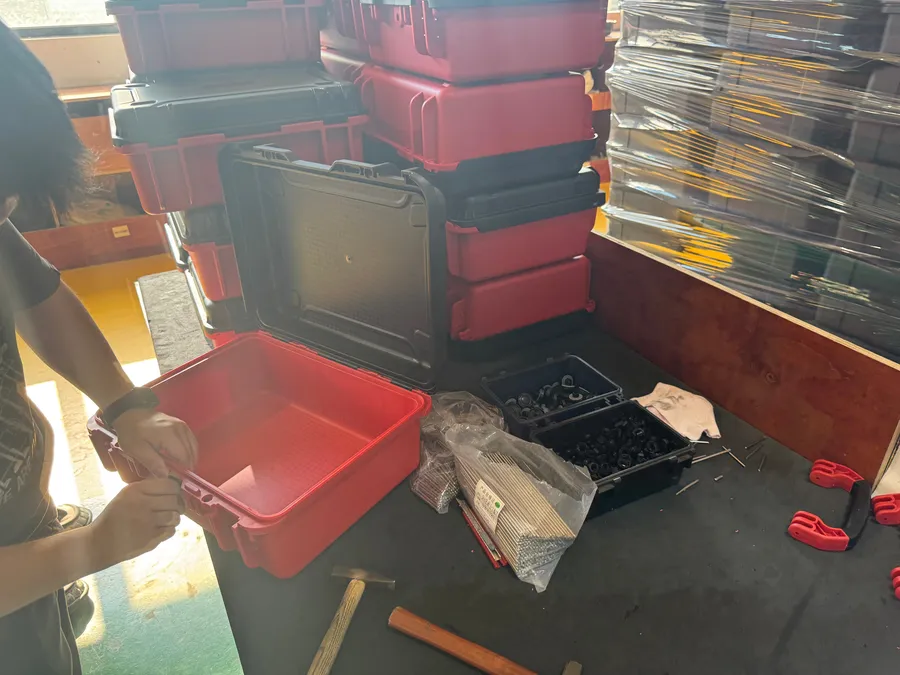
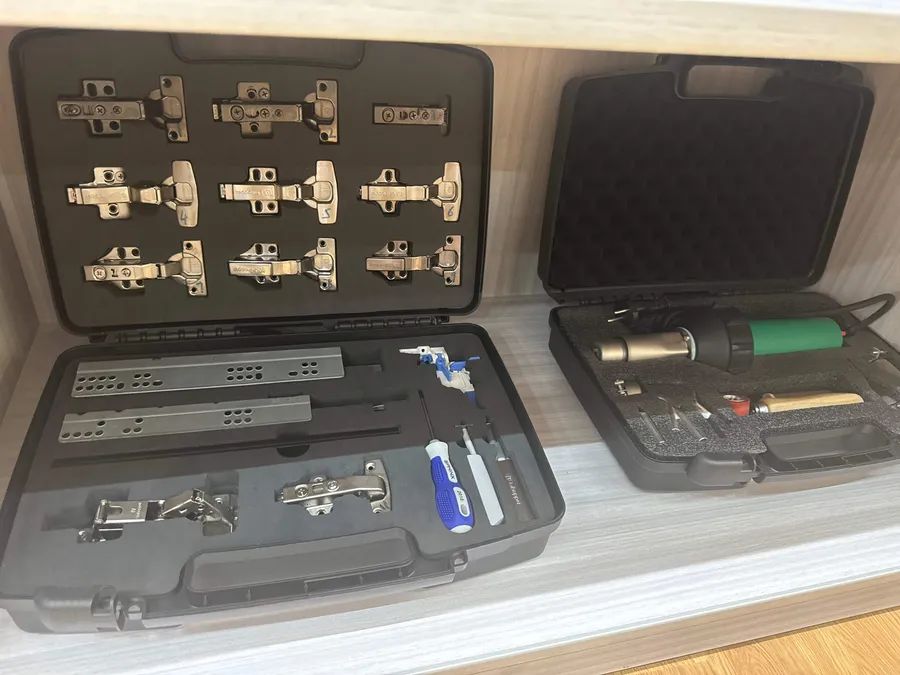
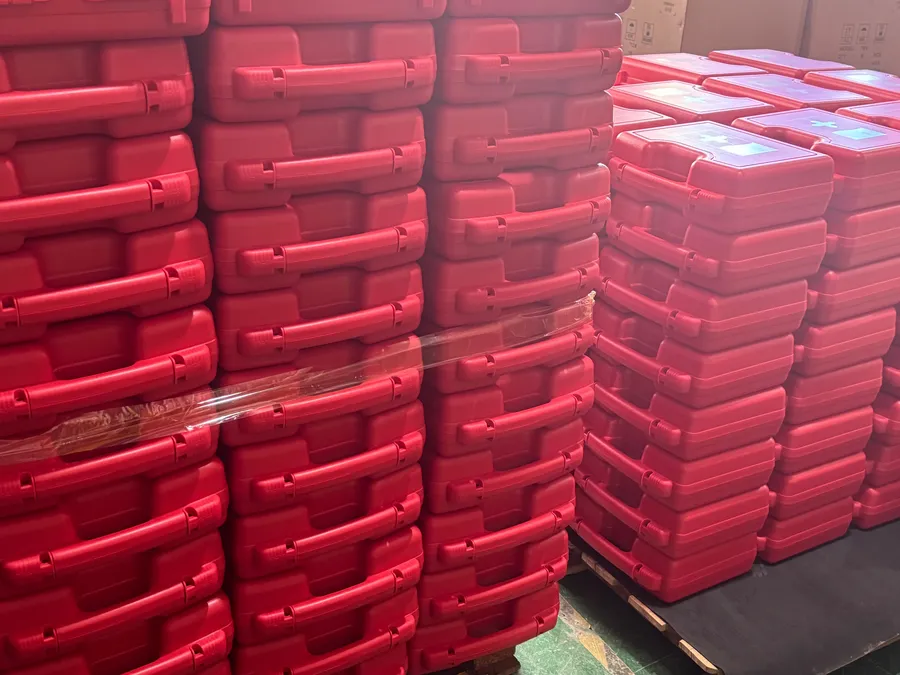
Customisation
Everything described above is configurable on a standard shell: interior layout (pick-and-pluck, die-cut or CNC-cut), foam grade and thickness, colour, logo method, latch and lock count, pressure-equalisation valve, cable ports, document holder and identification plate. A bespoke exterior geometry requires a new mould — 125 days, from 3,000 units per moulded component.
Procurement considerations
| Question | What to send us |
|---|---|
| Which shell fits? | Equipment L × W × H as packed, plus required clearance per axis |
| What does it cost? | Order quantity and estimated annual quantity — the two drive different answers |
| Is tooling needed? | Whether an existing shell clears the envelope with usable foam depth |
| Lead time? | Your required delivery date, not just the order date |
| Certification? | The exact standard your tender names — we will say whether we can test to it |
| Freight? | Destination and preferred terms; carton and pallet data supplied with the quotation |
Comparison and selection guide
The tables on this page exist because a protective case is chosen by comparing three things: the envelope, the environment and the handling chain. Where no table applies, the rule below is.
| Situation | What To Do |
|---|---|
| Shock | Base layer thickness and grade sized to the packed mass. |
| ESD | Anti-static PE, specified by surface resistivity range. |
| Dust | Sealed configuration with a continuous rim. |
- Size on internal dimensions plus clearance, never on a product name.
- Choose the carrying method before the shell: it changes the series, not just the price.
- Specify the interior last, and decide up front whether the end user will reconfigure it.
Why is dust protection important for electronic equipment? relates to Waterproof & Dustproof Guide. Related families: Electronics Cases / Communication Equipment Cases / Instrument & Equipment Cases / Waterproof Cases / Camera & Photography Cases / Military Protective Cases / Outdoor Protective Cases / Drone & UAV Cases / Medical Equipment Cases. Related sectors: field and industrial equipment. Continue in the Waterproof & Dustproof Guide cluster.
This page is written from our own production data. If your requirement differs, send the dimensions and we will tell you which of the 155 models fits, or whether a custom route is needed.