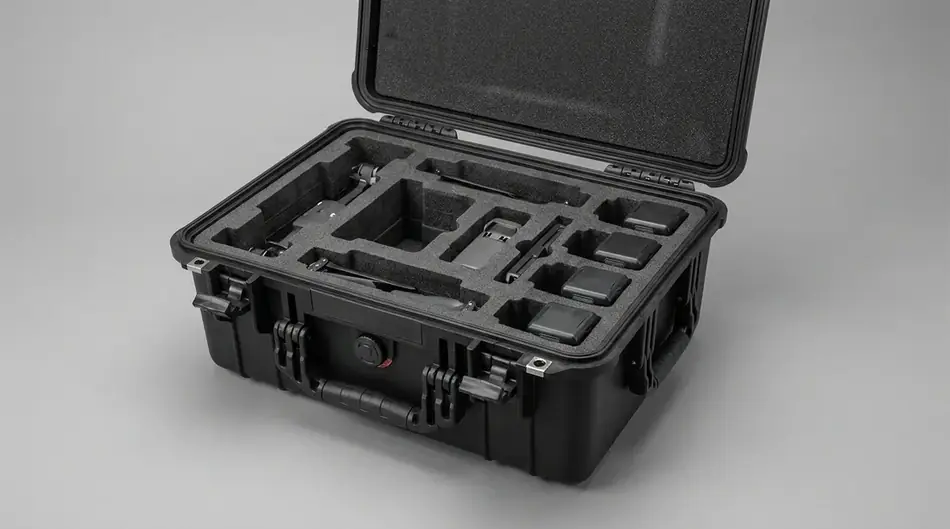
What environmental protection should field equipment cases provide?
Provide protection against the four things that actually reach a case in the field - abrasive dust, driven liquid, moisture that forms inside, and cumulative sun and heat - and provide it as construction you can inspect rather than as a rating you have to trust. The mechanism for dust and splash is a continuous joint: a compressible gasket set in a moulded channel, published on 124 of our 155 models and published as none offered on the other 31, closed by enough evenly spaced latches that compression is a property of the rim rather than of two corners. The mechanism for internal moisture is not the seal at all but the layout and the venting choice. The mechanism for heat and sun is material and colour, and here we have to be direct: no ultraviolet resistance figure and no temperature range is published for any model, so outdoor environmental protection field equipment is specified by naming those exposures as tests to run on the ordered configuration, not by reading an adjective off a catalogue page.
Key points
- Ask which joint keeps dust out and which keeps water out - they are usually the same moulded channel plus latch compression, and both are published per model.
- Condensation forms inside a closed case with no help from outside; a venting option and a layout that keeps water off the item matter more than a thicker gasket.
- Wall thickness is recorded on 148 of 155 models between 2.0 and 6.0 mm, and it is the figure that decides rim behaviour under a stacked load.
- No ingress, ultraviolet or temperature figure is published for any model - name the exposure as a test and we quote accredited testing on that configuration.
- Corrosion is the one environmental field we can state: a thermoplastic shell has no ferrous corrosion path, and hardware is metal or polymer by configuration.
- Choose the sealed shells deliberately: the light thin-walled small cases are the ones published with no gasket offered.
What Environmental Protection Field Equipment Actually Meets
A field instrument is not attacked by weather in the abstract. It is attacked by four specific mechanisms, and a case either addresses them or it does not. The first is abrasive dust: fine silica and grit do not need a pressure difference to get in, they accumulate in the joint line and then act as lapping paste every time the lid moves, on hinge pins, on a latch cam and on the rim face that is supposed to compress. The second is driven liquid - rain blown sideways, a hose, a wash-down, a case dropped in a puddle - which needs a continuous path with no gap to exploit, and which finds the latch line and the handle fixings long before it finds the moulding. The third is moisture that comes from inside: a cold case carried into a warm tent, or a daytime temperature swing that pulls humid air through a case every time the pressure changes, condensing on the coldest surface, which is usually the metal body of the instrument. The fourth is cumulative exposure - sun, heat trapped in a vehicle or on a rack, and the slow embrittlement and colour change that follow - which nobody notices on the day it starts. Everything in the rest of this page is an attempt to say honestly what our published data supports against those four and what it does not, because environmental protection field equipment is a list of exposures matched one at a time rather than a single grade a case either has or lacks.
Dust: The Joint Line, Not The Material
Dust ingress is a geometry problem. A moulding can be perfect and still leak through a joint that is designed to close at two points, so what we publish is the joint construction rather than a rating: a compressible gasket of EPDM or equivalent set in a continuous moulded channel is recorded on 124 of the 155 models, and 31 models record it plainly as none offered on that shell. Alongside it, latch count is specified per configuration, which is the mechanism by which the rim is closed evenly, and the latch body is recorded on every model as accepting a standard padlock. Where dust is the dominant exposure - a desert route, a quarry, a seed and grain site, a construction compound - the practical additions are a lid that does not have to be opened in the open air, an interior whose pockets can be wiped out, and a gasket channel that can be inspected and replaced as a service item rather than treated as permanent. Choose a shell whose published construction supports that: the polypropylene KX-3207 at 308 by 230 by 64 millimetres with a 32 millimetre lid over a 32 millimetre base, a 3.0 millimetre wall, about 570 grams and 3.9 litres is a gasketed small utility shell, and the KX-3213 in the same footprint opens to a 118 millimetre depth and 7.2 litres with an 86 millimetre lid over a 32 millimetre base, which keeps a wired controller or a meter in the base rather than the lid. For a site kit that must also stack, the engineering-polypropylene KX-3315 gives 303 by 224 by 135 millimetres on a 4.1 millimetre wall at about 1,670 grams with 7.4 litres.
Water: Driven Spray, Standing Water And The Difference
Rain off a truck tarpaulin and a case sitting in five centimetres of water are different exposures, and a specification that conflates them buys the wrong thing. Spray and wash-down are resisted by the joint: gasket continuity, rim flatness, and latch spacing that does not let one corner lift. Standing or running water adds a head pressure that finds anything the spray test tolerated, and it adds a second route - the handle fixings, the hinge pins and any opening made later for a cable. This is where the honest position has to be stated: no ingress figure of any kind is published for any of the 155 models, so we do not offer a case as waterproof or dustproof in the sense a purchaser's specification means it, and the protection-rating field in our own record says no code is stated and that accredited testing is quoted per configuration. What we can put in front of you is the construction, model by model - the gasket channel on 124 shells, the wall thickness recorded on 148 between 2.0 and 6.0 millimetres, the latch and padlock detail, and the lid-to-base split, which decides whether an item sits below the joint line at all. If your procedure names an exposure, send the procedure: the answer is a test quotation against the exact SKU and the exact foam layout, not a brochure sentence.
Condensation: The Moisture A Seal Cannot Stop
The most common cause of a wet circuit board in a dry case is the case itself. A sealed volume moved from cold to warm brings the cold surfaces below the dew point of the warm air that enters when the lid opens, and a sealed volume cycled through a day of temperature swings breathes through any path it has, carrying humid air in and dropping water on the coldest body inside - usually metal. Nothing in the moulding prevents this, and over-sealing can make it worse by holding the moisture in. Three answers work, and all three are choices at the specification stage. The first is a pressure-equalisation option, published as a manufacturer option across the catalogue, which removes the pumping action rather than the humidity. The second is interior design: a layout that keeps the instrument off the base wall where water collects, channels that move liquid away from a connector, and a closed-cell face layer that does not hold water against a finished surface. The third is a desiccant provision, which is a pocket to be cut rather than a product to be bought. A good candidate is the deep-lidded, gasketed engineering-polypropylene KX-93221 at 300 by 200 by 200 millimetres with a 165 millimetre lid over a 35 millimetre base, about 1,230 grams and 9.6 litres, which lets a wet item stand in the base while the electronics ride in a dry pocket above the joint line.
Heat, Cold And Sun: Where Our Data Runs Out
This is the section that costs us orders, and it is still the right one to publish. No temperature range and no ultraviolet resistance figure is published for any model in this catalogue. A field case in a closed vehicle, on a metal roof rack or on a desert floor sees internal temperatures far above air temperature, and a thermoplastic shell that behaves perfectly at twenty degrees can soften, creep under a stack, or lose gasket compression at fifty or sixty. The opposite end is a different problem: a polymer and a foam both get harder and more brittle when cold, so a layout that cushioned an instrument in May may transmit rather than absorb in January, and a lid closed hard in warm weather can be tight and springy in cold. Colour is not cosmetic in this duty - a dark shell on a sunlit rack runs considerably hotter than a pale one - but we do not publish the surface temperature either, so treat colour as a thermal decision you should test rather than a branding decision. What can be said from published data: all 155 shells are thermoplastic mouldings, and the corrosion field is recorded as measured on every model with the note that a thermoplastic shell has no ferrous corrosion path. That is a real advantage in salt air, coastal spray and wash-down duty, and it is the reason this catalogue is polymer rather than steel. If your specification names a temperature, a UV exposure or a salt-air condition, name it in the enquiry and we will quote accredited testing of the nominated model and configuration as a separate work package rather than guessing on your behalf.
Outdoor Environmental Protection Field Equipment: The Mechanisms That Resist It
| Exposure | Mechanism | Published Example |
|---|---|---|
| Abrasive dust and grit | Continuous moulded gasket channel plus latch count specified per configuration for even rim compression | KX-4010: 390 x 315 x 88 mm internal, PP, 3.0 mm wall, 44/44 mm lid/base, gasket published, about 1,015 g, 9.3 L |
| Driven rain and wash-down | Gasket continuity, rim flatness and an item kept below the joint line by base depth | KX-4312: 420 x 260 x 104 mm internal, 3.5 mm wall, 52/52 mm lid/base, gasket published, about 1,170 g, 9.8 L |
| Internal condensation | Pressure-equalisation option, closed-cell face layer, and a layout that keeps water off the instrument | KX-93221: 300 x 200 x 200 mm internal, engineering PP, 5.0 mm wall, 165/35 mm lid/base, about 1,230 g, 9.6 L |
| Sun and trapped vehicle heat | Material and colour decision - no UV or temperature figure is published, so the exposure must be tested | KX-5321: 481 x 373 x 192 mm internal, engineering PP, 5.8 mm wall, 43/149 mm lid/base, about 4,810 g, 27.5 L |
| Cold and repeated flexing | Thicker wall and a firmer carrier layer; shock and impact remain configuration items, not ratings | KX-6621: 587 x 434 x 192 mm internal, engineering PP, 6.0 mm wall, about 6,420 g, 39.1 L |
| Salt air and corrosion | Thermoplastic shell with no ferrous corrosion path, recorded as measured on all 155 models | KX-65522: 507 x 385 x 190 mm internal, ABS, 5.3 mm wall, gasket published, about 4,860 g, 29.7 L |
| Stacking and transport load | Wall thickness and rim geometry; no stack load in kilograms is published for any model | KX-4821: 447 x 312 x 194 mm internal, engineering PP, 4.5 mm wall, 144/50 mm lid/base, about 3,670 g, 21.7 L |
| Mud, water and a loaded carry | Gasketed wheeled shell with feet and a padlockable latch body, chosen where loaded mass decides | KX-85827: 500 x 400 x 220 mm internal, PP, 5.0 mm wall, wheels and telescopic handle, about 7,800 g, 35.2 L |
| The whole specification at once: environmental protection field equipment | Read as four separate decisions - joint construction, latch compression, interior and venting, then material and colour tested for the exposure | KX-92817: 253 x 180 x 152 mm internal, engineering PP, 5.0 mm wall, 125/27 mm lid/base, gasket published, about 940 g, 5.5 L |
| The worst of the four together: outdoor environmental protection field equipment | Sun and trapped heat plus dust plus wash-down, where no UV or temperature figure is published and the exposure list becomes a test list | KX-5723: 500 x 340 x 211 mm internal, engineering PP, 5.0 mm wall, 169/42 mm lid/base, gasket published, about 4,680 g, 28.7 L |
Choosing A Shell For The Exposure You Actually Have
Match the shell to the dominant exposure rather than to the worst case in the specification. For dusty dry sites, a gasketed small shell with a shallow working lid is easy to keep clean and cheap to replace: the KX-3207 at 308 by 230 by 64 millimetres and 3.9 litres, or the gasketed engineering-polypropylene KX-3508 at 344 by 268 by 72 millimetres with a 36 millimetre lid over a 36 millimetre base, about 995 grams and 5.7 litres. For wet and muddy duty where the item must sit above the joint line, a deep base is the deciding figure: the KX-3218 gives 308 by 230 by 172 millimetres with an 86 millimetre lid over an 86 millimetre base and 10.5 litres at about 900 grams, and the KX-84430 gives 395 by 295 by 275 millimetres with a 230 millimetre lid over a 45 millimetre base and 25.6 litres. For a survey or monitoring kit that travels on foot, the KX-92817 at 253 by 180 by 152 millimetres on a 5.0 millimetre wall at about 940 grams is a tough small box, and the KX-4012 at 380 by 305 by 110 millimetres with an 85 millimetre lid over a 25 millimetre base, about 1,480 grams and 10.9 litres covers a receiver with a tripod head. Where the load is genuinely heavy, the wheeled gasketed KX-97227 publishes a 6.0 millimetre wall, 590 by 435 by 210 millimetres internal and about 10,000 grams empty, with stackable recorded as false - which is the honest consequence of putting wheels on a shell.
The Unsealed Shells, And Why They Are Still Sold
Thirty-one models publish no gasket offered, and they are not mistakes - they are the light, thin-walled, low-mass end of the catalogue, bought by people who would rather carry 340 grams than 1,015. The KX-2507 at 245 by 175 by 64 millimetres and about 340 grams, the KX-2614 at 240 by 200 by 120 millimetres and about 460 grams, the engineering-polypropylene KX-3113 at 296 by 258 by 121 millimetres and about 1,060 grams, and the KX-707 at 465 by 310 by 140 millimetres and 17.4 litres on a 2.5 millimetre wall all sit in this group, along with the thin-walled 458 by 345 millimetre KX-4713 and KX-4716 shells. What these give you is carry economy and a stiff moulded box with the same padlockable latch body, hinge and feet detail recorded as measured, in a package a person will actually carry on day seven of a trip. What they do not give you is any resistance to driven liquid, and in a dusty environment the bare joint line is where grit collects. That trade is worth making deliberately. The failure mode is a buyer who assumed the whole catalogue shared one construction standard and then discovered it when a meter failed in the field, so the published field says none offered, in those words, rather than leaving the row blank.
Selection Guidance: Four Questions Before An Environmental Specification
Question one: what is the worst exposure in a normal week, not in a normal tender? Dust dominates where joints abrade; liquid dominates where cases get washed or left out; heat dominates where a case lives in a vehicle or on a rack; condensation dominates wherever the temperature swings and the lid gets opened. Question two: does the item sit below the joint line when the lid is closed? Read the published base depth against the height of the instrument, because an item that bridges the lid line loads the seal rather than the base. Question three: is the internal volume or the wall the binding constraint? A thick wall protects a rim and stacks better but takes litres away and adds grams - the KX-6621 buys 6.0 millimetres at about 6,420 grams empty, and the KX-707 buys 17.4 litres at about 1,360 grams on a 2.5 millimetre wall. Question four: which sentences in your specification are tests rather than features? Every code, rating, temperature and exposure limit is a test, and a manufacturer who publishes construction and quotes the test is telling you the truth about where the evidence stops. Send the exposure list, the packed dimensions and the annual quantity, and we will confirm the nominated model's material record rather than assuming one grade across the catalogue.
Where Environmental Protection Is Decided
Field programmes that get this right treat the case as part of the equipment definition rather than as an accessory bought afterwards. Survey, monitoring and environmental research teams carry receivers, dataloggers, sensors, spare batteries and a tripod through the same exposure every week, and their failure rate is almost always a joint-line or condensation story rather than a crush story. Utilities, telecoms contractors and rail maintenance crews keep cases in vehicles where the temperature story dominates. Defence, public-safety and rescue organisations specify against a documented exposure list and are the buyers most likely to ask for test evidence, which is exactly the right instinct. Agricultural, marine, mining and construction users bring grit, wash-down and chemical contact, where the corrosion behaviour of a thermoplastic shell earns its place and hardware choice earns its scrutiny. Outdoor and expedition users trade mass against protection with their eyes open. In all of these the deliverable is the same: a named model, a published construction record, a cut interior, a stated list of what was measured and what was not, and a test quotation for whatever the purchaser still has to evidence.
Procurement Notes: Wholesale Terms, Testing And Lead Time
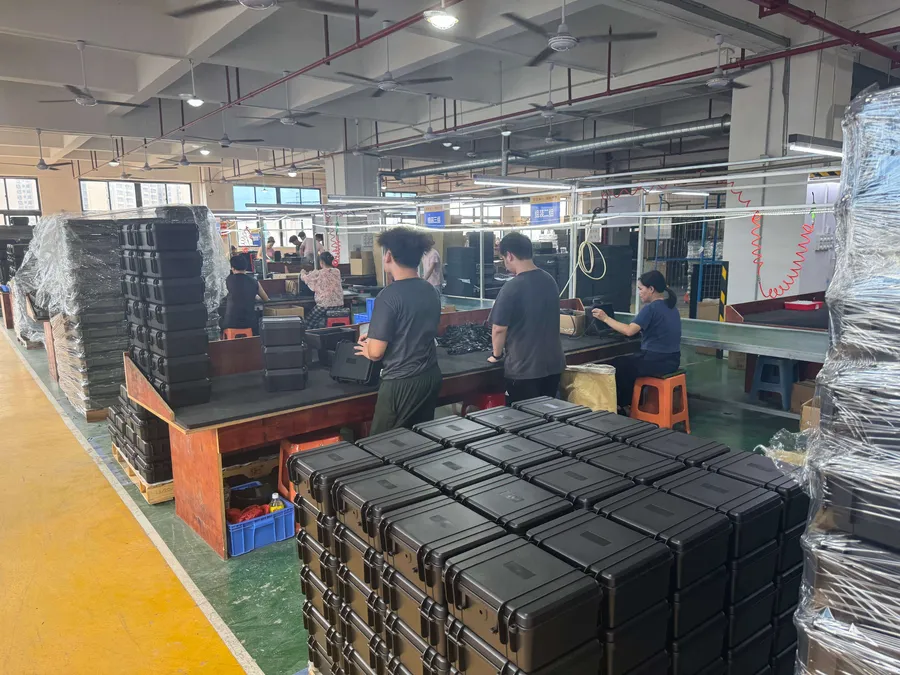
KeXin New Materials (Guangdong) Co., Ltd. supplies on wholesale and OEM or ODM terms only, on EXW or FOB, with no retail channel, no delivered-duty-paid quotation and no overseas warehouse. Minimums: one piece on a standard model, one piece for a custom foam layout, about 300 pieces for colour, logo or OEM production and about 3,000 pieces per component for a dedicated new mould; a first OEM article on existing tooling takes about 45 days and a new mould about 125 days from approved drawings, with a 30 per cent deposit and the balance before shipment after inspection, and third-party inspection at our facility is welcome. Published per model: internal and external dimensions, wall thickness where recorded, lid and base depth, usable volume, empty mass, narrow internal width, gasket construction, handle, hinge, feet, latch count per configuration and padlockable latch bodies. Not published for any model, and therefore quoted as a test rather than stated as a feature: ingress figures, ultraviolet resistance, temperature range, stack load, load capacity and any shock or drop performance. Accredited testing against a named standard is arranged on the configuration you order and priced as a separate work package. Contact Fred Zhao or the KeXin Sales Team, WhatsApp +86 135 3588 0002.
Customisation
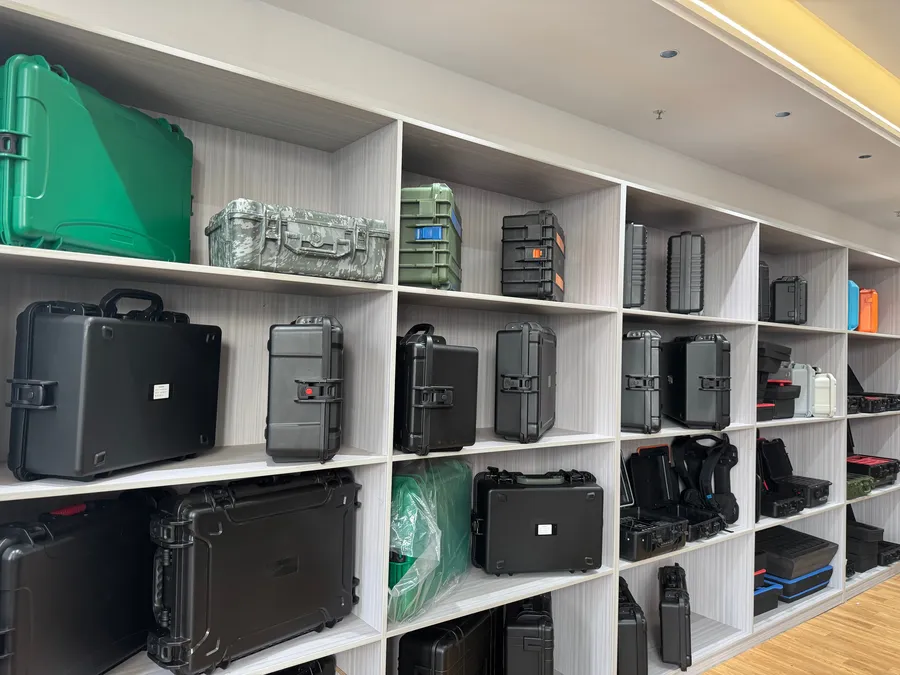
Everything described above is configurable on a standard shell: interior layout (pick-and-pluck, die-cut or CNC-cut), foam grade and thickness, colour, logo method, latch and lock count, pressure-equalisation valve, cable ports, document holder and identification plate. A bespoke exterior geometry requires a new mould — 125 days, from 3,000 units per moulded component.
Procurement considerations
| Question | What to send us |
|---|---|
| Which shell fits? | Equipment L × W × H as packed, plus required clearance per axis |
| What does it cost? | Order quantity and estimated annual quantity — the two drive different answers |
| Is tooling needed? | Whether an existing shell clears the envelope with usable foam depth |
| Lead time? | Your required delivery date, not just the order date |
| Certification? | The exact standard your tender names — we will say whether we can test to it |
| Freight? | Destination and preferred terms; carton and pallet data supplied with the quotation |
Comparison and selection guide
The tables on this page exist because a protective case is chosen by comparing three things: the envelope, the environment and the handling chain. Where no table applies, the rule below is.
| Situation | What To Do |
|---|---|
| Marine or wet | Sealed configuration with a drain-friendly interior and stainless hardware. |
| Dry and dusty | A close-fitting rim and a lid that can be opened one-handed without spilling contents. |
| Carried far | Under 10 kg packed, with a padded handle or shoulder webbing. |
- Size on internal dimensions plus clearance, never on a product name.
- Choose the carrying method before the shell: it changes the series, not just the price.
- Specify the interior last, and decide up front whether the end user will reconfigure it.
What environmental protection should field equipment cases provide? relates to Waterproof & Dustproof Guide. Related families: Outdoor Protective Cases / Waterproof Cases / Field Equipment Cases / Equipment Transport Cases / Military Protective Cases / Instrument & Equipment Cases / Electronics Cases / Custom Protective Cases / Rolling Cases / Tactical Equipment Cases. Related sectors: field and industrial equipment. Continue in the Waterproof & Dustproof Guide cluster.
This page is written from our own production data. If your requirement differs, send the dimensions and we will tell you which of the 155 models fits, or whether a custom route is needed.