How does a waterproof case protect equipment?
A waterproof case protects equipment by controlling four separate things inside one assembly: liquid water arriving at the lid-to-base junction, airborne grit arriving at the same junction, the humidity that was already in the air when the lid was closed, and the shock transmitted through the shell wall into whatever is packed inside. The first two are handled by a compressible gasket seated in a continuous moulded channel between lid and base, held under even load by enough latches that the middle of the longest edge is compressed as hard as the corners. The third is not excluded at all: a rim tight enough to hold water out also holds indoor moisture in, so it is managed by packing dry and by desiccant rather than by the gasket. The fourth is not a property of the plastic; our model records list shock protection as a construction option that requires a specified foam layout. Of the 155 models we publish, 124 are listed with a compressible gasket in a continuous moulded channel and 31 are listed with no seal offered, and we publish no water-ingress figure for any of them, because a range-wide number would have to come from a test record that does not exist.
Key points
- Water enters through a gap, so protection is decided by rim geometry and latch spacing long before the quality of the rubber matters.
- A lid that flexes between latches reopens the gap on every knock: all 124 gasketed models in our catalogue publish a wall of 3.0 mm or more.
- A rim that keeps water out also keeps indoor humidity in, so condensation is handled with dry packing and desiccant, not with the gasket.
- Shock and vibration are a second system: our records treat them as a foam layout to be specified, not a rating printed on the shell.
- No ingress-protection code is published for any of the 155 models; accredited testing on the exact assembly is quoted as a separate work package.
- Grit in the channel and a gasket stored under compression cause more field leaks than defective rubber, and both cost nothing to avoid.
- The 31 models listed with no seal offered publish walls of 2.9 mm or less, so a water requirement narrows the shortlist before anything else.
Four damage paths, one assembly
Type the question the way buyers type it - waterproof case protect equipment - and the honest answer still starts with a split: water is only one of four things that damage gear in transit and in storage, and a moulded rim addresses two of them directly, one indirectly and one not at all. Liquid ingress and airborne grit are both stopped at the same place, the line where the lid meets the base. Ambient humidity is a property of what you sealed inside, and no rim on earth removes it. Mechanical shock is a property of the interior and of the wall between the interior and the ground. Treating those four as one question is why buyers get surprised: a case can pass a hose test and still arrive with a fogged lens or a cracked display.
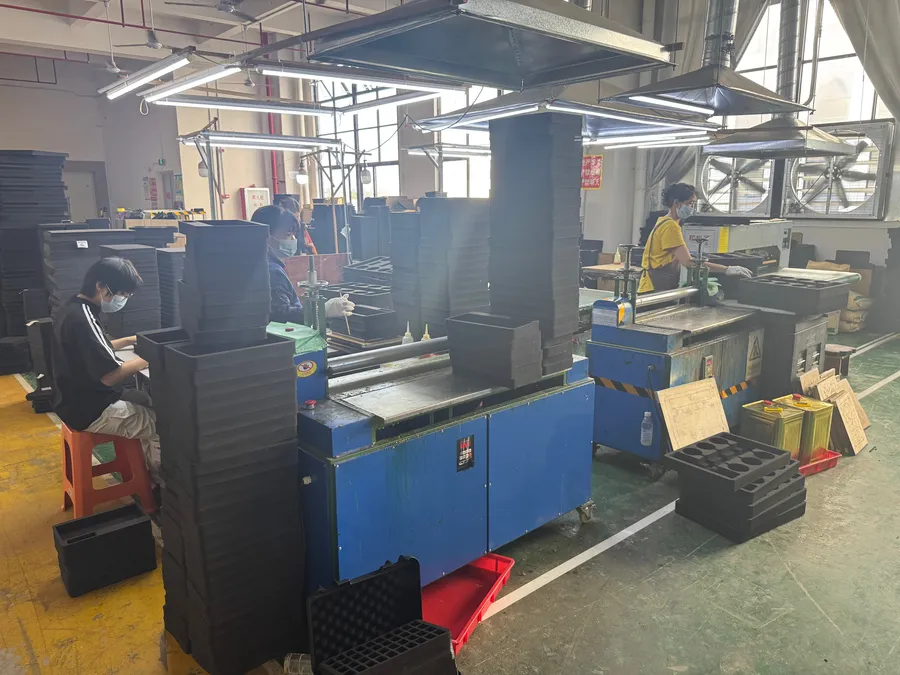
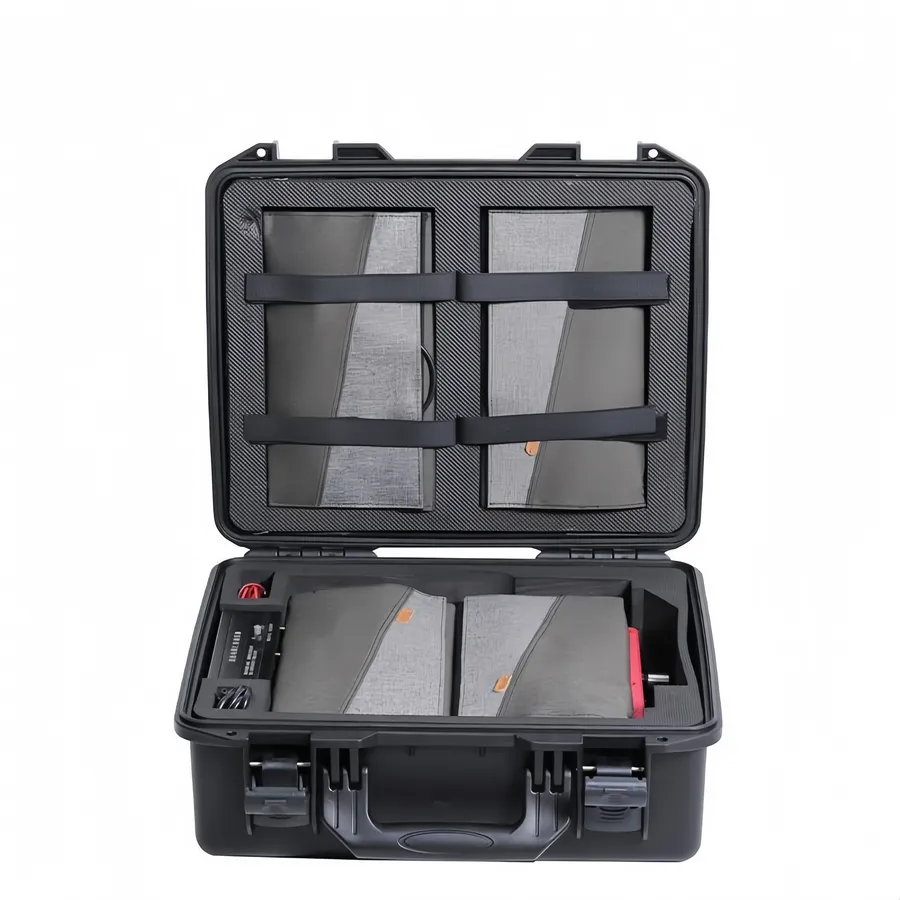
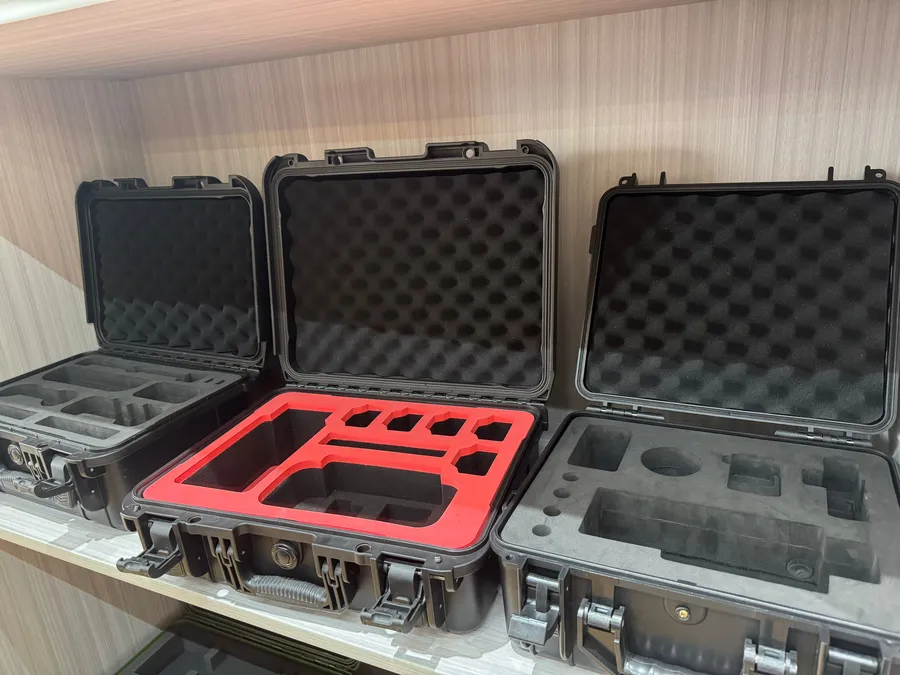
The assembly we publish is the same for every model: a thermoplastic shell, a sealing rim, a compressible gasket, latches, hinges, feet and a padlockable latch body, with a worked foam interior as a separate specification line. What differs across the catalogue is whether that rim is offered with a gasket channel at all, how thick the wall is between the latch points, and how much interior depth is left once foam is cut. Those three variables are the ones we can put a number against.
Path one: liquid water arriving at the closure line
Water does not pass through polypropylene or ABS in any meaningful time; it passes through openings. In a case the openings are the joint between lid and base, any valve, any cable port, and the small gaps that hinge and latch hardware create where they break the rim. The protection mechanism is therefore compression over a continuous line: a gasket pressed between two moulded faces, with the pressing force distributed so that no segment of the line is under-compressed while another is over-compressed. A long edge with two latches at its ends has a low-compression zone at its middle, which is exactly where a case sitting in a truck bed accumulates a sheet of water.
That is why we describe latch count as a configuration input rather than a fixed feature: our published records list latch count as specified per configuration on all 155 models. The same shell can be ordered with a different number of latches, and the practical effect on the closure line is larger than most buyers expect. Where a lid is thin, adding a third latch down a long edge helps; where the lid flexes along its whole span, adding a latch does not fix the span, and the fix is either a stiffer wall or a shorter unsupported distance.
Path two: grit arrives at the same rim
The junction that admits water in a submerged or hosed condition also admits airborne abrasive in a dry one, and grit is the more common of the two failure modes in the field because it is present in every environment between a beach, a quarry, a construction site and the bed of a pickup. Sand in a gasket channel does two jobs at once: it lifts the gasket off its seat locally, so the line is no longer continuous, and it abrades the gasket and the channel floor where the lid is closed and shifted. A leak that appears after a season of use is far more often explained by that than by rubber that has lost its elasticity.
Our catalogue records dust resistance as not measured on all 155 models, in the same way it records water ingress as not measured. That is not an oversight. It means we describe the construction - a compressible gasket in a continuous moulded channel on 124 models - and leave the behaviour to a test report on the assembly actually ordered. What we will state is the maintenance behaviour: a channel that can be wiped clean is a channel that will still seal next season, which is why a moulded-in channel is preferable to a glued-on lip that lifts at the corners.
Path three: the humidity you sealed in with the gear
A closed rim is a boundary, not a climate control. Air packed inside at 60 percent relative humidity in a warm warehouse is above saturation by the time the same case sits outside on a cold morning, and the excess leaves the air as a film of water on the coldest surface in the box - usually the lens, the display, the connector or the metal chassis. Nothing has leaked. The water was already in there. This is the path a buyer most often blames on the case, and the one a case cannot fix by itself.
The practical controls are packing behaviour and desiccant quantity. Pack the kit and the case at the same temperature and at the humidity you can actually tolerate, close the lid, then add a desiccant charge sized to the interior volume rather than to the box footprint; our published interior volumes run from 0.3 litres to 139.5 litres across the 155 listings, which is a factor of well over four hundred, so a fixed sachet count is never a real specification. On sealed models that publish lid and base depth, that is where a desiccant pocket can go without taking stand-off height away from the equipment.
Path four: shock reaches the equipment through the interior
The shell is the last thing between an impact and your instrument, and the first thing that decides where that impact goes. Our model records list impact resistance as a manufacturer option whose note states the wall thickness and explicitly declines to claim a drop height without a test. Shock protection is listed the same way: a construction option that requires a specified foam layout, because the shell alone is not a rating. Those two entries are the honest version of what a hard case does: it spreads and deflects load into the packing material, and the packing material is where the energy is actually absorbed.
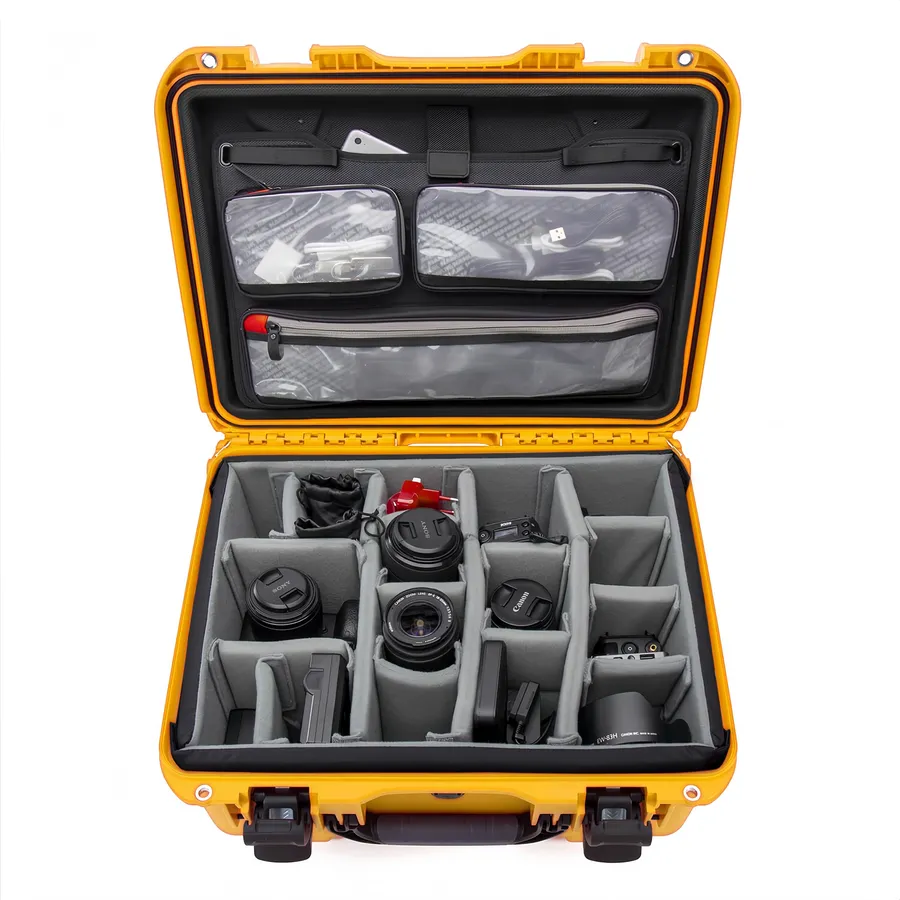
The consequence for a buyer is that the sealing question and the shock question are specified on different lines of the same order. Interior volume is one number, usable interior volume is another, and the gap between them across our catalogue is where foam lives; lid depth is published from 16 mm to 320 mm and base depth from 15 mm to 168 mm on the 100 models that carry those figures. A case chosen for a snug exterior, with no allowance for a worked interior, will protect the case and not the contents.
How each protection field is recorded in our product data
The three labels used above are not marketing words; they are the claim policy printed in our own data file. Measured means the figure came from our production or incoming-material records. Manufacturer option means a construction we can supply, where the number depends on the configuration you order. Not measured means no test record exists for that model and configuration, that we will not state a value, and that accredited testing can be commissioned as a separate work package. A supplier who writes all three the same way in one sentence is the one to be careful about.
| Field In Our Records | Status Across 155 Models | What A Buyer Can Rely On |
|---|---|---|
| Water ingress | Not measured | Construction drawings and the gasket specification, not a depth or duration |
| Dust ingress | Not measured | The same continuous-channel description, plus cleanable geometry |
| Sealing construction | Measured on 124, none offered on 31 | Which SKUs are gasketed, taken straight from the model datasheet |
| Gasket material | EPDM or equivalent, offered by configuration | A named material option you specify, not a default fitted to everything |
| Shock protection | Manufacturer option | A foam layout agreed before production |
| Impact resistance | Manufacturer option, wall noted | Published wall thickness from 2.0 mm to 6.0 mm; no drop height claimed |
| Corrosion resistance | Measured | Thermoplastic shell with no ferrous corrosion path |
| UV and temperature range | Not measured | Nothing yet - both are test packages we can commission |
| Stack and load figures | Not measured | Carton data on 64 listings; pallet and container figures supplied per order |
| Ingress code or standard number | No code is stated | An accredited test report for the configuration you order |
Published figures on sealed models, from the smallest rim to the largest
Every figure in that table is the published specification of that model, not a range statement about the family. Empty mass is published on 66 of the 124 sealed listings and runs from 250 g to 15,320 g; lid and base depth are published on 76 of them. Where a cell says not published, the honest reading is that the datasheet for that SKU does not carry the field, so ask for the datasheet of the exact model rather than assuming the nearest neighbour matches. External lengths on sealed models run from 190 mm to 1,356 mm, and 18 of the sealed listings carry wheels.
Two columns in that table are worth more attention than the rest. Wall thickness is what holds the rim closed under a knock, and the usable-interior column is the space that survives after the foam is cut. A buyer who sizes on interior volume alone ends up with a case that seals well and protects nothing.
| Model | Internal L X W X H (Mm) | Wall (Mm) | Lid / Base Depth (Mm) | Interior (L) | Usable (L) | Empty Mass (G) |
|---|---|---|---|---|---|---|
| WL6-2205 | 200 x 98 x 41 | 3.5 | Not published | 0.8 | 0.7 | 310 |
| WL1905 | 180 x 160 x 40 | 3.0 | 25 / 15 | 1.2 | 1.0 | 250 |
| WL6-2109 | 195 x 128 x 81 | 3.0 | Not published | 2.0 | 1.7 | 470 |
| WL8-2812 | 219 x 160 x 100 | 3.4 | Not published | 3.5 | 3.0 | Not published |
| WL3213 | 308 x 230 x 118 | 3.0 | 86 / 32 | 8.4 | 7.2 | 860 |
| WL8-3612 | 330 x 260 x 103 | 3.3 | 75 / 28 | 8.8 | 7.6 | Not published |
| WL4319 | 407 x 187 x 178 | 3.0 | 38 / 140 | 13.5 | 11.6 | 1,587 |
| WL8-4816 | 410 x 360 x 140 | 4.2 | 100 / 40 | 20.7 | 16.6 | Not published |
| WL8-5427 Trolley | 483 x 363 x 220 | 4.5 | 150 / 70 | 38.6 | 30.9 | 6,100 |
| WL8-8421 | 740 x 518 x 189 | 5.0 | 145 / 44 | 72.4 | 57.9 | Not published |
| WL8-8442 Trolley | 740 x 518 x 364 | 5.0 | 320 / 44 | 139.5 | 111.6 | 15,320 |
Sealed rims and open rims, compared on what we publish
The pattern in the second row is the one that should change a shortlist fastest: a sealing channel and a heavy wall arrive together in this catalogue. The gasketed group publishes nothing below 3.0 mm; the open group publishes nothing above 2.9 mm. That is a moulding reality rather than a marketing one - a rim that is compressed along its whole perimeter needs a section stiff enough not to fold under it - but for a buyer it means the waterproof question and the durability question are usually answered by the same set of SKUs, and the cheapest compact shells are not in that set.
The ABS group is the exception that proves the point in the other direction: all 22 ABS listings are gasketed models, which is why the material question and the sealing question get confused so often. ABS and polypropylene differ in stiffness, surface hardness and behaviour in cold, but neither property is what closes a rim.
| Attribute | Sealed (124 Models) | Open (31 Models) |
|---|---|---|
| Sealing construction | Compressible gasket in a continuous moulded channel | No seal offered on this shell |
| Published wall thickness | 3.0 mm to 6.0 mm, published on all 124 | 2.0 mm to 2.9 mm where published; 7 listings carry no wall figure |
| Shell material split | PP 75, engineering PP 27, ABS 22 | PP 19, engineering PP 11, PP/ABS 1 |
| Series spread | 8 Series 58, 6 Series 20, T Series 18, 9 Series 14, 0 Series 12, 1 Series 2 | 0 Series 11, 7 Series 6, 1 Series 5, 8 Series 4, 9 Series 4, T Series 1 |
| Interior volume published | 0.8 L to 139.5 L | 0.3 L to 50.4 L |
| Empty mass published | 66 of 124, 250 g to 15,320 g | 27 of 31, 100 g to 6,140 g |
| Carton data published | 43 of 124 | 21 of 31 |
| Wheels on the listing | 18 models | 1 model |
| Ingress figure | None stated | None stated |
How this question reaches us, in buyer wording
The second row is not a joke about typing. Queries of the form waterproof waterproof case protect equipment appear in the search-title library we work from, and they are the same request as the first row with a word repeated. We answer them the same way, and we say so here because the alternative is a specification conversation in which a doubled word quietly turns into a second performance promise nobody intended.
What all five rows have in common is that they ask about a behaviour and expect a construction answer. Any supplier who answers a behaviour question with a construction sentence, without saying which is which, is the one to test.
| Phrasing We See | What It Is Really Asking | Where The Answer Comes From |
|---|---|---|
| waterproof case protect equipment | Which physical mechanism keeps the contents working | Rim, latch spacing, wall section and foam layout on the named SKU |
| waterproof waterproof case protect equipment | The same question, typed twice; the doubled word is a search artefact, not a second requirement | Identical to the row above, which is worth saying out loud |
| how does a hard case keep water out | Whether the gasket alone is enough | No: compression distribution and lid stiffness decide it |
| will a sealed case stop my gear getting wet in transit | Splash and road spray, not immersion | Construction quality, latch count and how the load is tied down |
| does a waterproof case stop condensation | Moisture that is already inside | Desiccant charge and packing conditions, not the rim |
What a specification that names an ingress code or a standard is really asking for
Tender documents often require an enclosure to carry an ingress-protection code, a military standard number or a named test method. That is not a request about plastic. It is a request for a test report: a specimen, an apparatus, an exposure, a duration and an acceptance observation, recorded by somebody with an accreditation to defend. A code printed in a catalogue is a compressed summary of one such report, and it belongs to the assembly that was put in the chamber, with the valve fitted, the port plugged and the latches closed the way the report says they were closed.
Our catalogue states no code and no standard number for any model, because the records behind those numbers do not exist yet for these configurations. What we will do is quote accredited testing against a named method on the exact assembly you intend to buy, as a separate work package with its own cost and timeline, and the resulting report describes the specimen that was tested. A buyer who needs the code should treat that as the normal route; a buyer who is offered the code for free, across a whole range, should ask whose chamber it came from.
There is a narrower version of this question that is easy to answer honestly: is the rim continuous, is the channel cleanable, is the gasket a named material you can replace, and are the latches spaced to the edge length? Those four are construction facts we can show you from the datasheet and from the mould, without a chamber.
Where a sealed shell earns its cost, and where it does not
A gasketed shell pays for itself where the contents are optically or electronically sensitive and the route is unpredictable: survey and measurement instruments travelling open country, radios and repeaters deployed to a mast, medical devices carried between sites, camera and lens kits moving through salt air, drone payloads that land in wet grass. In all of those the cost of one failed instrument is more than the difference between a sealed and an open shell, and the sealing line is the cheapest insurance in the order.
It does not pay where the real risk is a drop onto a hard floor and the weather is a warehouse. For that job the money belongs in the interior and in a thicker base section, not in a channel that will spend its life closed in a heated room - where a permanently compressed gasket is a defect, not a feature. 31 of our 155 listings are exactly that kind of shell, and we list them without offering a seal rather than dressing them up as something they are not.
What changes when you customize the closure, and what does not
Interior layout, foam grade and thickness, colour, logo method, carton and identification plate, latch and padlock configuration, a pressure-equalisation valve, a document holder and a shoulder strap are all configured on existing moulds. None of them changes the sealing geometry, and none of them is a reason to re-measure anything, although a valve is a hole in the rim and should be named in any test specimen you later commission. Our data lists the valve as a configuration option and fits it as standard to none of the 155 models.
What does change the closure is geometry: a rim that no longer runs where the mould put it, a port through the sealing line, a different latch pitch that alters unsupported span. Those are tooling decisions, quoted at about 125 days for a new mould from 3,000 units per component, against about 45 days for OEM work on existing moulds. Anyone who tells you a sealing rim can be moved without a tool is describing a gasket stuck on afterwards, which is a different product.
Maintenance that keeps the rim doing its job
Three checks cover most field failures. Wipe the channel and the gasket with a damp cloth and inspect for grit, nicks and a twisted length, particularly at the corners where a strip is joined. Condition the gasket with the product the seal material is compatible with, not with anything oily, since an EPDM or equivalent strip swells in the wrong solvent and swells unevenly. Then store the case open, or with the latches backed off, because a gasket left compressed for months takes a permanent set and the rim that sealed in the factory stops sealing in the field.
Replacement strips are a consumable line, not a repair, and it is worth ordering the length with the case rather than matching a profile off the shelf later. Where a case spends its life in salt air, rinse the hardware as well as the rim: the latch body is the part that keeps the compression, and corrosion there reopens the gap without damaging the gasket at all.
What we do not claim
We do not state a water or dust ingress figure, a code or a standard number for any model. We do not state a drop height, a stack load, a usable temperature range or an ultraviolet life, because those fields are recorded as not measured in our own data. We do not describe shock protection as a property of the shell. Where a figure is published, it is the specification of that model: internal and external dimensions, wall thickness, lid and base depth where published, interior and usable volume, and empty mass on 93 of the 155 listings.
What we do state is who we are and how we sell. KeXin New Materials (Guangdong) Co., Ltd. makes these shells for distributors, integrators and OEM programmes on wholesale terms, quoting EXW or FOB, and we do not sell single units at retail, offer DDP or hold stock in an overseas warehouse, so plan freight and clearance yourself. OEM on existing moulds is quoted at about 45 days and a new mould at about 125 days, with a 30 percent deposit and the balance after inspection and before container loading; third-party inspection of a production batch is welcome. Send the packed dimensions of the equipment and the annual quantity to Fred Zhao or the KeXin Sales Team, or start on WhatsApp +86 135 3588 0002, and ask for the datasheet of the exact model before you commit anything to a drawing.
Applications
This matters most where the case is part of a movement chain rather than shelf packaging. In outdoor & recreation and field & deployment and military the same shell is specified differently because the handling, the environment and the verification requirement differ.
- Outdoor & Recreation — Consumer and professional outdoor brands buy cases as a component of their product. That means c…
- Field & Deployment — Field deployment removes every assumption a depot specification makes: no forklift, no dry stora…
- Military — Military equipment moves through a chain of handlers, none of whom own the equipment and all of …
- Telecommunications — Communications equipment is never one object. It is a unit plus a set of accessories that determ…
- Medical & Laboratory — Medical cases are audited. Whatever goes inside has to be verifiable at a glance, cleanable, and…
- Drone & UAV Operations — A drone kit is three different protection problems in one box: a light awkward airframe, heavy b…
Customisation
Everything described above is configurable on a standard shell: interior layout (pick-and-pluck, die-cut or CNC-cut), foam grade and thickness, colour, logo method, latch and lock count, pressure-equalisation valve, cable ports, document holder and identification plate. A bespoke exterior geometry requires a new mould — 125 days, from 3,000 units per moulded component.
Procurement considerations
| Question | What to send us |
|---|---|
| Which shell fits? | Equipment L × W × H as packed, plus required clearance per axis |
| What does it cost? | Order quantity and estimated annual quantity — the two drive different answers |
| Is tooling needed? | Whether an existing shell clears the envelope with usable foam depth |
| Lead time? | Your required delivery date, not just the order date |
| Certification? | The exact standard your tender names — we will say whether we can test to it |
| Freight? | Destination and preferred terms; carton and pallet data supplied with the quotation |
Comparison and selection guide
The tables on this page exist because a protective case is chosen by comparing three things: the envelope, the environment and the handling chain. Where no table applies, the rule below is.
| Situation | What To Do |
|---|---|
| Occasional splash | A close-fitting rim without a gasket is cheaper and easier to maintain. |
| Rain and washdown | Sealed configuration, four or more latches, stainless hardware. |
| Immersion or pressure change | Sealed configuration plus a pressure-equalisation valve, and a documented test. |
- Size on internal dimensions plus clearance, never on a product name.
- Choose the carrying method before the shell: it changes the series, not just the price.
- Specify the interior last, and decide up front whether the end user will reconfigure it.
How does a waterproof case protect equipment? relates to Waterproof & Dustproof Guide. Related families: Waterproof Cases / Outdoor Protective Cases / Military Protective Cases / Electronics Cases / Instrument & Equipment Cases / Camera & Photography Cases / Custom Protective Cases / Field Equipment Cases. Related sectors: Outdoor & Recreation / Field & Deployment / Military / Telecommunications / Medical & Laboratory / Drone & UAV Operations. Continue in the Waterproof & Dustproof Guide cluster.
This page is written from our own production data. If your requirement differs, send the dimensions and we will tell you which of the 155 models fits, or whether a custom route is needed.



