What affects case seals for a hard-shell equipment case?
Four published things decide how a seal behaves on a hard-shell case, and none of them is the gasket itself. The first is whether the tool has a channel at all: 124 of our 155 published models record a compressible gasket in a continuous moulded channel and 31 record that no seal is offered on that shell. The second is the wall that channel is formed in - every listing publishing a wall of 3.0 mm or more records a gasket (124 of 124), while all 24 listings below 3.0 mm and all 7 listings with no wall figure record none. The third is the closure that loads the bead: latch count is recorded as specified per configuration on 155 of 155 listings, so the field that decides seal compression is the one field nobody publishes. The fourth is lid travel and span - lid depth runs from 16 mm to 320 mm on the 100 listings that state it, and rim span computed from published external dimensions reaches 3,528 mm on KX-814641. What we do not publish for any model: an ingress result, an IP code, a temperature range, a durometer, a cross-section or a service interval.
Key points
- Seal presence is a per-model field, not a range claim: 124 of 155 listings record a gasket in a continuous moulded channel and 31 record none offered on that shell.
- Wall thickness separates the two groups exactly: all 124 gasket listings publish 3.0-6.0 mm, median 4.2 mm, and all 31 unsealed listings are either below 3.0 mm (24 of them) or blank (7 of them).
- The bead is loaded by the closure, not by itself: latch count is recorded as specified per configuration on all 155 listings, so spacing and even loading have to be written into the order text.
- Lid travel and span set how hard that loading has to be: lid depth reaches 320 mm on KX-88442 and rim span reaches 3,528 mm on KX-814641, against a file median of 97.5 mm and 1,560 mm.
- Differential pressure is a separate problem from the bead: a pressure equalisation valve is recorded as a manufacturer option with no fitted value on 155 of 155 listings.
- Over-packing shows up in published data: internal minus usable volume is 2.8 L at the median and 27.9 L on KX-88442, which is the foam and wall that steals the lid's travel.
- No ingress, temperature or ultraviolet figure is measured on any of the 155 listings; accredited testing of the ordered configuration is quoted as a separate work package.
What affects case seals, in the order the lid meets the base
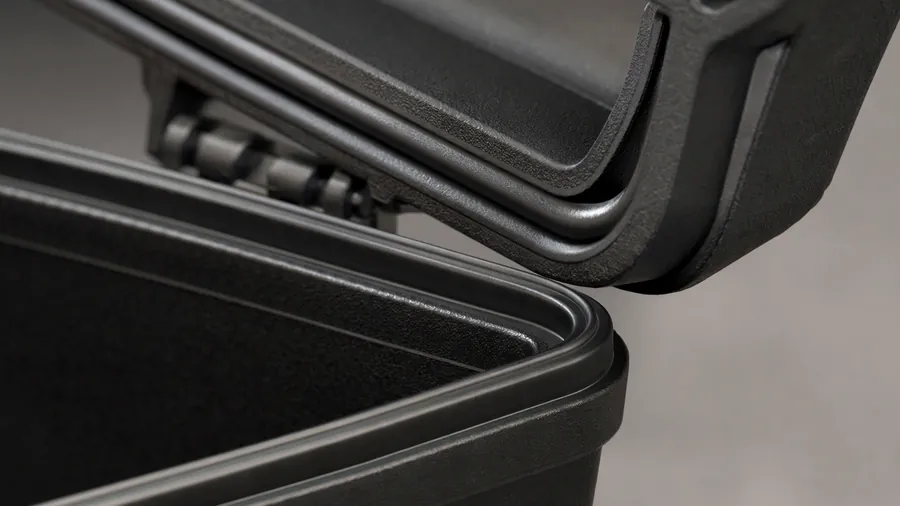
A hard-shell case keeps the outside out at exactly one place: the line where the lid rim presses the gasket against the base rim. Everything that affects a seal is therefore an input to that line, and the inputs can be read in a fixed order from published data. First the tool - whether a continuous channel exists at all, because a bead cannot be expected where the moulding offers none. Second the wall that the channel is formed in, because a sealing surface is only as stable as the section behind it. Third the closure, because the gasket does not compress itself; latches do. Fourth the lid above it, because travel and span decide how evenly that load can be distributed.
Two further inputs are easy to forget and both are published in some form: what the interior pushes back with, and what the freight does to a closed case between the factory and the site. A packed interior that over-fills the cavity holds the lid open by a fraction of a millimetre, which is enough; and a stacked pallet that squashes a lid distorts the same line from the other side. This page walks each input against our own 155-model file, including the fields where the file is honest about being blank.
The seal record our file keeps, and the fields it does not
There is exactly one seal value in our data and it appears in two forms. On 124 of 155 published listings the protection field reads a compressible gasket in a continuous moulded channel, recorded as measured construction. On the remaining 31 it reads none offered on this shell. The materials field adds one more line, and its wording matters: EPDM or equivalent compressible gasket appears on all 155 listings as a manufacturer option - a construction we can supply, with the figure depending on the configuration ordered - rather than as a measured property of the batch you buy.
Nothing finer about the bead is published anywhere in the file. No cross-section profile, no durometer, no compression or compression-set figure, no join method and no service interval appears on any listing. Ingress is recorded as not measured on all 155 models, and the protection note for every listing says the same thing: no IP code is stated, with accredited testing quoted per configuration. So an honest answer to what affects case seals has to be built from the surrounding geometry and closure, because the bead itself is specified at order stage rather than catalogued.
Factor one: the wall the channel is moulded in
The strongest pattern in the data is also the one buyers look for least. Wall thickness is published on 148 of 155 listings, running from 2.0 mm to 6.0 mm with a median of 3.9 mm, and it separates the sealed shells from the unsealed ones without a single exception. Every listing that states a wall of 3.0 mm or more carries a gasket: 50 listings in the 3.0-3.9 mm band, 44 in the 4.0-4.9 mm band and 30 at 5.0 mm or above, 124 in total with a median wall of 4.2 mm. Every listing below 3.0 mm carries none - 24 of them, from 2.0 mm on KX-2305 to 2.9 mm on KX-3113 - and the 7 listings with no wall figure at all also record no seal.
That is a moulding logic rather than a marketing one. A continuous channel is formed by two walls with a bead pocket between them, and a thin utility shell simply does not have the section to hold one while staying light enough for the job it is sold for. The consequence for a buyer is that a seal is a family decision, not an accessory line: asking for a gasket on a 2.2 mm mini shell is asking for a different tool, and asking what a gasket costs on a 4.2 mm shell is the wrong question - the right question is whether the tool you are buying was built with the channel. The thin families are built to be light and to take ordinary shop-floor handling, which is a different engineering brief from a sealed rim.
| Published Wall Band | Listings | Gasket Recorded | None Offered | Typical Example |
|---|---|---|---|---|
| Below 3.0 mm | 24 | 0 | 24 | KX-2305 at 2.0 mm, KX-2808 at 2.2 mm |
| 3.0 - 3.9 mm | 50 | 50 | 0 | KX-1905 at 3.0 mm, KX-82812 at 3.4 mm |
| 4.0 - 4.9 mm | 44 | 44 | 0 | KX-83821 at 4.2 mm, KX-85424 at 4.5 mm |
| 5.0 mm and above | 30 | 30 | 0 | KX-88442 at 5.0 mm, KX-97227 at 6.0 mm |
| No wall figure published | 7 | 0 | 7 | KX-84814, KX-95419, KX-6922, KX-5126 |
Factor two: the closure that actually loads the bead
A gasket is a passive part; the load comes from the hardware. In our file that hardware is recorded only as a configuration line: latch count is specified per configuration on 155 of 155 listings and published as a number on none, while hardware material reads metal or polymer by configuration on all 155. What is measured on all 155 is that a hinge is present, that moulded feet are present, and that the latch body accepts a standard padlock - the last of these describing an aperture, not a closure load. So the single biggest influence on whether a seal does its job is the one influence that has to be agreed on a drawing for your model rather than read off a page.
The mechanism is worth stating because it explains most field leaks. Latches placed too far apart let the rim flex back between loading points, and the gap that opens is measured in fractions of a millimetre - far less than the bead's recovery, which is why a case can leak on a flat floor with an undamaged gasket. Latches tightened in sequence at one corner first tilt the lid rather than compress it. And a lid that closes cleanly on an empty cavity may not close cleanly on your foam: check the interior before blaming the bead. The maintenance consequence is on our seal-care page; the specification consequence is that count, spacing and closing order belong in the order text.
Factor three: lid travel and the span that has to stay flat
Lid depth is published on 100 of 155 listings, from 16 mm to 320 mm with a median of 97.5 mm, and it behaves very differently between the two seal groups. On the 124 gasket listings, lid depth appears on 76 with a median of 127.5 mm and eleven listings at or above 200 mm, led by KX-88442 at 320 mm. On the 31 unsealed listings it appears on 24 with a median of 39 mm and a maximum of 92 mm. Base depth on the same 100 listings runs from 15 mm to 168 mm with a median of 44 mm - and KX-97227 shows the inverted case, a 42 mm lid on a 168 mm base.
Span matters for the same reason it matters to a latch: the sealing line gets longer while the stiffness of the rim does not. Computed from published external dimensions as twice the sum of the two longest edges, rim span has a file median of 1,560 mm; the gasket group sits at a median of 1,582 mm and reaches 3,528 mm on the 1,356 mm long KX-814641, while the unsealed group sits at a median of 1,204 mm. Read together, lid depth and span tell you which models need the closure conversation and which are effectively flat plates with two latches on them.
| Model | Series | External Mm | Lid / Base Mm | Wall Mm | Rim Span Mm | Seal Record |
|---|---|---|---|---|---|---|
| KX-84416 | 8 Series | 436 x 356 x 157 | 90 / 45 | 4.2 | 1,584 | Gasket in moulded channel |
| KX-84430 | 8 Series | 436 x 356 x 297 | 230 / 45 | 4.2 | 1,584 | Gasket in moulded channel |
| KX-85827 | T Series | 588 x 475 x 267 | 175 / 45 | 5.0 | 2,126 | Gasket in moulded channel |
| KX-88442 | T Series | 843 x 592 x 415 | 320 / 44 | 5.0 | 2,870 | Gasket in moulded channel |
| KX-2808 | 0 Series | 275 x 230 x 82 | 38 / 38 | 2.2 | 1,010 | None offered on this shell |
| KX-707 | 7 Series | 470 x 360 x 148 | 70 / 70 | 2.5 | 1,660 | None offered on this shell |
Factor four: differential pressure, and what the valve line really says
A sealed shell traps air, and trapped air moves cases in ways that have nothing to do with bead quality. A warm case loaded into a cold hold contracts and pulls the lid down harder onto the gasket; the same case warmed by sunlight expands and presses outward through the weakest path, which is usually the bead line. This is why a leak can appear after a flight or a high-road transfer on a case that sealed on the bench. It is also why a valve exists: it equalises pressure so the bead is not the thing doing the work.
Our file records a pressure equalisation valve as a manufacturer option with no fitted value on 155 of 155 listings. Read that precisely: no model in the current catalogue is published as delivered with a valve, and one can be specified. A valve is not a sealing device and it does not turn an unsealed 7 Series shell into a gasketed one - it removes a load that a gasket would otherwise have to survive. Where a programme genuinely sees repeated temperature swings, the pair of decisions is bead plus valve on the same drawing, with the valve position agreed against the foam layout so it does not land on a pocket.
Factor five: the interior pushing back against the lid
The cavity in the specification is not the cavity you can use. Across all 155 listings the difference between published internal volume and usable interior volume is 2.8 litres at the median, reaches 5 litres or more on 45 listings and 10 litres or more on 15, and peaks at 27.9 litres on KX-88442, where a 139.5 litre internal figure leaves 111.6 litres usable. That gap is wall, frame radius and the space foam needs; it is also the space that, if you fill it with equipment, ends up between the lid and the sealing line.
The narrower a shell's waist, the easier it is to over-fill in the wrong place. Thirty-six listings publish a narrowest internal width, running from 70 mm on KX-1204 to 308 mm on the 1 Series shells with a median of 211 mm, and all 36 sit in the 0, 1 and 7 Series tools, which are the families where that field is recorded. Custom foam is recorded as available on all 155 listings, and a lid that presses on a solid block is the most common reason a gasketed case fails a customer's own water test at the receiving bench. Specify the pocket depth, not just the case depth.
Factor six: transit load, stacking and how the batch is packed
Between the factory and the site, a closed case meets loads that the bead was not designed to carry. Stacking is published as a flag rather than a figure: stackable is true on 136 listings and false on the 19 wheeled T Series shells, and stack load itself is recorded as not measured on all 155. A gasket held under compression for months behaves differently from one that is relieved between uses - which is why our storage guidance says to leave the latches released, and why a sealed case that arrives having been tiered for a quarter should be inspected before it is trusted.
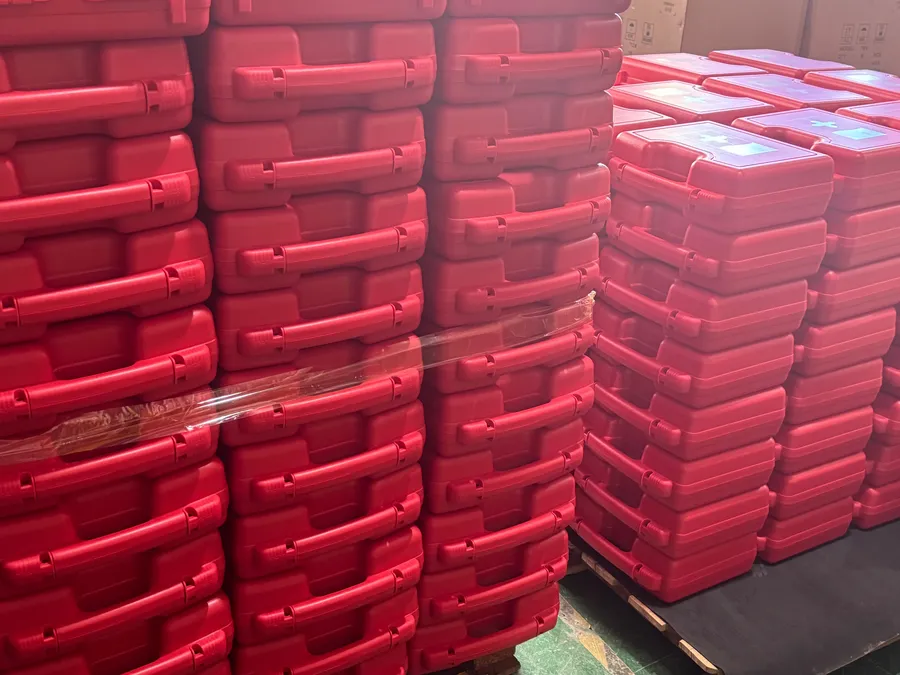
Packaging is where that becomes visible in the data. A carton is published on 64 of 155 listings and a pieces-per-carton figure on 58, running from 1 to 40 units with a median of 10. Nine listings ship a single case per carton - six of them gasketed models including KX-96127, KX-66232 and KX-97227 - while the two highest packing densities, KX-2005 and KX-2305 at 40 pieces per carton, are both unsealed mini shells. Pallet quantity is calculated from carton footprint against your pallet size and container figures come with the quotation, so a transit-compression question is answered per order rather than read off a catalogue line.
Every seal field in the file, and where it stands
The table below is the whole seal picture in one place: what a field governs, and whether our file actually states it. Take it to any supplier as a comparison sheet - the empty rows are the ones that decide whether a sealed case arrives sealing.
| Field | What It Governs | Where Our File Stands |
|---|---|---|
| Seal present on the shell | Whether there is a continuous sealing line at all | Stated per model: gasket on 124 of 155, none offered on 31 |
| Seal construction | Bead retention, continuity and repeat compression | Recorded as measured on the 124: compressible gasket in a continuous moulded channel |
| Seal compound | Compatibility with the environment the case sees | EPDM or equivalent on all 155 as a manufacturer option, not a measured batch value |
| Cross-section, durometer, compression set | How much load the bead needs and how it recovers | Published on 0 of 155 listings; agreed at configuration stage |
| Wall thickness behind the channel | Stability of the sealing surface | Published on 148 listings, 2.0-6.0 mm; gasket group median 4.2 mm |
| Latch count and spacing | Evenness of compression around the perimeter | Specified per configuration on 155 of 155; no count published |
| Pressure equalisation valve | Whether differential pressure loads the bead | Manufacturer option on 155 of 155, no model published as fitted |
| Ingress result for the closed shell | Any performance statement at all | Not measured on 155 of 155; no IP code stated, accredited testing quoted per configuration |
| Temperature range | Elastomer behaviour hot and cold | Not measured on 155 of 155 listings |
| Service interval or replaceability | Maintenance planning across a fleet | Published on 0 of 155 listings |
Which shells carry no seal, and why that is a design answer
The 31 unsealed listings are not leftovers; they are the thin-wall families where a channel was never designed in. They break down as 11 of the 23 mini 0 Series listings, 5 of the 7 small 1 Series, all 6 of the 7 Series large equipment shells, 4 of the 62 8 Series (KX-84814, KX-84815, KX-84823 and KX-84824, all four also publishing no wall figure), 4 of the 18 9 Series and 1 of the 19 rolling T Series (KX-5126). By contrast all 20 6 Series listings and all 22 ABS-shell listings record a gasket.
The two groups also weigh differently, which tells you what they were built for. Net weight is published on 66 of the 124 gasket listings with a median of 2,035 g and 22 listings at or above 4,000 g, while the unsealed group publishes 27 weights with a median of 630 g and only two above 4,000 g. A light utility shell that lives on a shelf and a 10 kg instrument case that lives on a vehicle floor are different sealing problems, and the catalogue says so per model rather than with a range-wide adjective.
Selection guidance: match the seal to the exposure you actually have
Start from the exposure, not from the adjective. If the risk is shelf storage in a dry building, tools handled indoors and occasional transport in a van, an unsealed shell from the thin-wall group is honest engineering, and the money belongs in the foam. If the risk is road spray, dust at a site gate, aerodrome apron or a boat deck, you want a gasket tool from the 3.0 mm-and-above group, a closure specified for even loading, and a valve considered on the same drawing. If the risk is immersion, stop and write a test requirement, because nothing in our current file speaks for immersion.
For mixed fleets, buy by the exposure that is worst rather than by the average: a batch where 20 percent of journeys are wet is a wet programme. Then decide what evidence you need to hold. We publish construction per model and mark every unmeasured field as unmeasured; if your tender needs a stated ingress result for a specific configuration, we quote accredited third-party testing as a separate work package with the method and the sample state agreed in advance, so the number in your report can be traced to the build it came from.
Customising a seal: designed channel, configuration change, or new tool
Three changes look similar in an email and are nothing alike commercially. Selecting a gasketed model from the 124 listings that already record a channel is a configuration choice, quoted on an existing mould at 45 days to first sample from a minimum of 300 pieces, the same line as custom logo and custom colour. Adding a moulded channel to a shell tooled without one, or moving an existing channel to a new perimeter, is new mould work: 125 days and a minimum of 3,000 pieces per component. Changing hardware that loads the bead differently sits in the first category, provided it uses existing bosses.
Custom hardware and custom foam are both recorded as available on all 155 listings, so the useful question at enquiry stage is not can you do it but which drawing the answer requires. Send the model number you are buying, the perimeter you expect to seal and the closure you plan to load it with, and the reply states which of the two routes the change takes and what it does to the fields already agreed.
Procurement notes and the claims this page does not make
Four lines belong in the order text for any sealed purchase: the model number and its recorded seal field copied verbatim; the latch count, spacing and closing sequence for that model; a statement of which fields are measured, which are manufacturer options and which are not measured; and, where a performance figure is required, the test method and who performs it. Those four lines close out almost every dispute we have ever had about a closed lid, and they cost nothing to write.
To be explicit about the rest: no ingress result, no IP code, no temperature range and no service interval is claimed here for any model, and the corrosion note that appears as measured on all 155 listings describes the thermoplastic shell having no ferrous corrosion path - it is not a statement about hardware finish or about a bead. We work wholesale and OEM or ODM only, quoted EXW or FOB, with no retail orders, no DDP terms and no overseas warehouse; payment is a 30 percent deposit with the balance after your inspection, and third-party factory inspection is welcome. Fred Zhao, KeXin Sales Team, WhatsApp +86 135 3588 0002. Written by KeXin New Materials (Guangdong) Co., Ltd.
Customisation
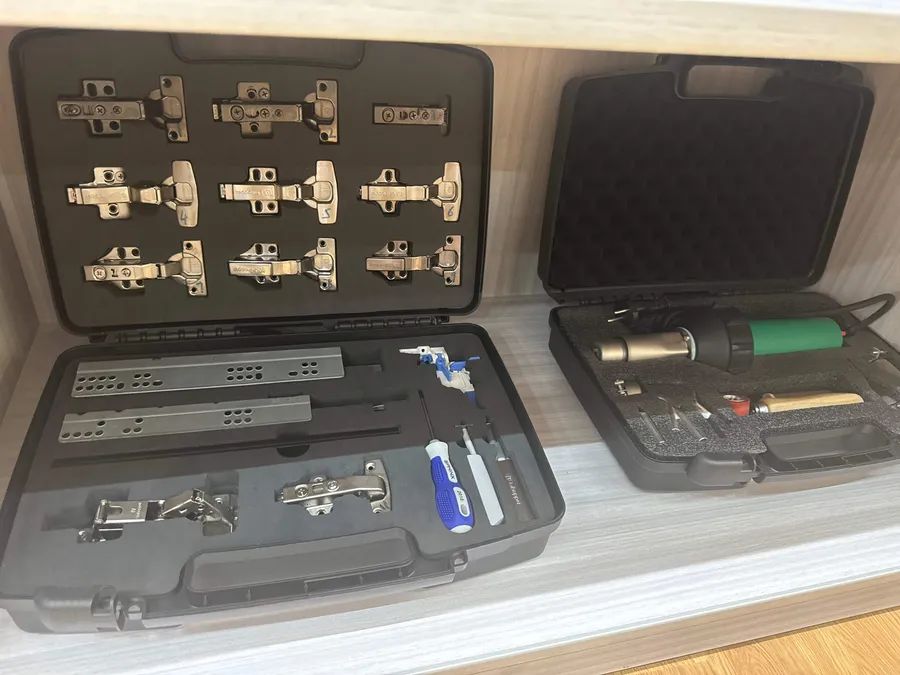
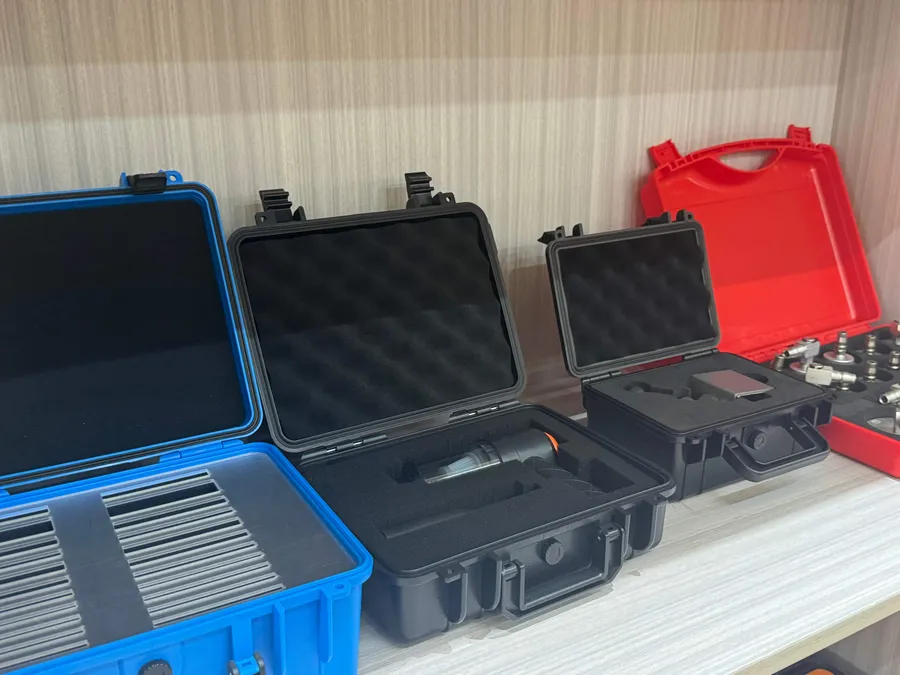
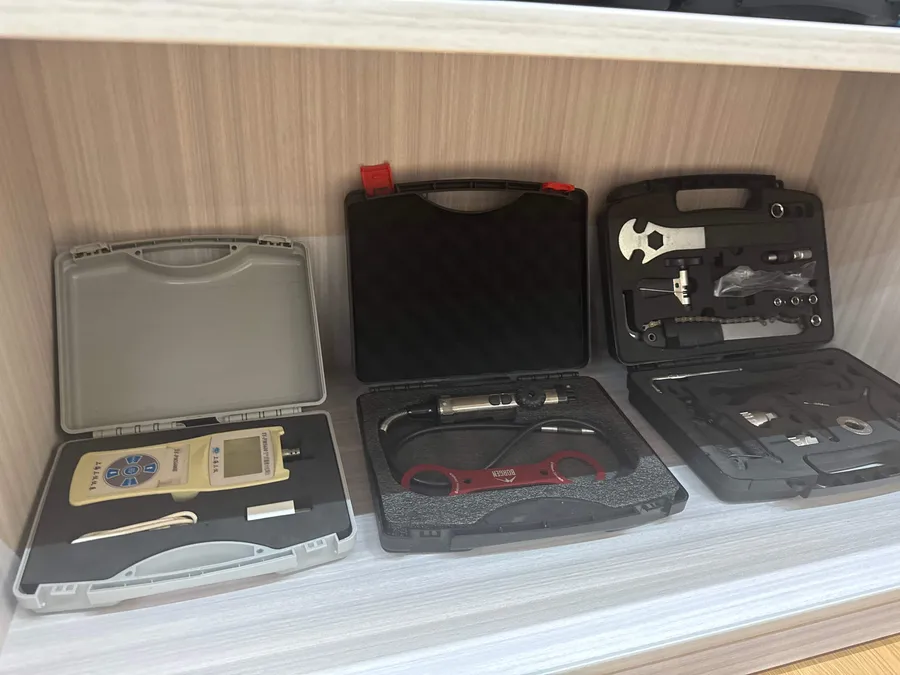
Everything described above is configurable on a standard shell: interior layout (pick-and-pluck, die-cut or CNC-cut), foam grade and thickness, colour, logo method, latch and lock count, pressure-equalisation valve, cable ports, document holder and identification plate. A bespoke exterior geometry requires a new mould — 125 days, from 3,000 units per moulded component.
Procurement considerations
| Question | What to send us |
|---|---|
| Which shell fits? | Equipment L × W × H as packed, plus required clearance per axis |
| What does it cost? | Order quantity and estimated annual quantity — the two drive different answers |
| Is tooling needed? | Whether an existing shell clears the envelope with usable foam depth |
| Lead time? | Your required delivery date, not just the order date |
| Certification? | The exact standard your tender names — we will say whether we can test to it |
| Freight? | Destination and preferred terms; carton and pallet data supplied with the quotation |
Comparison and selection guide
The tables on this page exist because a protective case is chosen by comparing three things: the envelope, the environment and the handling chain. Where no table applies, the rule below is.
| Situation | What To Do |
|---|---|
| Occasional splash | A close-fitting rim without a gasket is cheaper and easier to maintain. |
| Rain and washdown | Sealed configuration, four or more latches, stainless hardware. |
| Immersion or pressure change | Sealed configuration plus a pressure-equalisation valve, and a documented test. |
- Size on internal dimensions plus clearance, never on a product name.
- Choose the carrying method before the shell: it changes the series, not just the price.
- Specify the interior last, and decide up front whether the end user will reconfigure it.
What affects case seals for a hard-shell equipment case? relates to Waterproof & Dustproof Guide. Related families: Waterproof Cases / Custom Protective Cases / Electronics Cases / Equipment Transport Cases / Military Protective Cases / Field Equipment Cases / Outdoor Protective Cases / Ammunition Storage & Transport Boxes. Related sectors: field and industrial equipment. Continue in the Waterproof & Dustproof Guide cluster.
This page is written from our own production data. If your requirement differs, send the dimensions and we will tell you which of the 155 models fits, or whether a custom route is needed.


