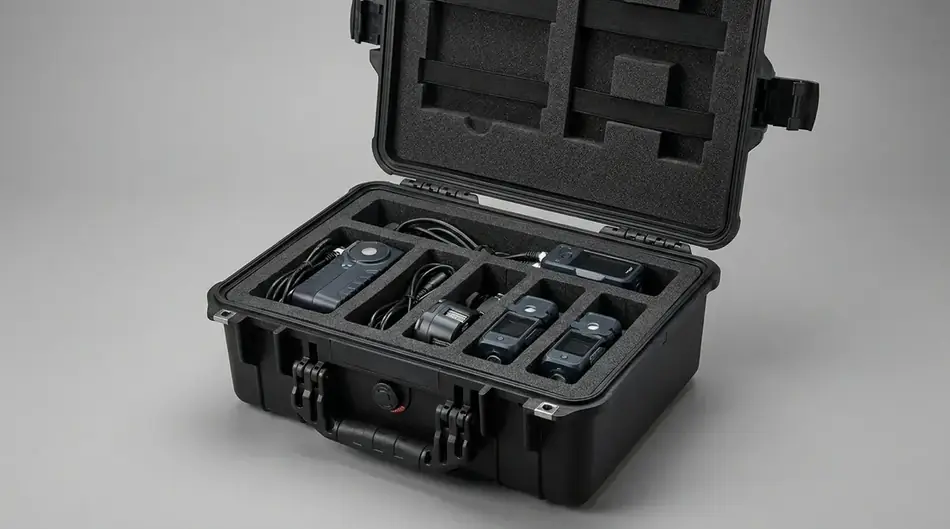
What environmental factors should be considered for electronic equipment transport?
Six environmental factors decide whether electronic gear arrives working: moisture and condensation, temperature extremes and cycling, dust and abrasive particles, mechanical shock from drops and knocks, sustained vibration from road, rail and air movement, and pressure change that pulls air and vapour through a sealed lid. A hard shell alone handles none of them well. Moisture is managed with a compressible gasket in a moulded channel plus a desiccant plan; dust by an uninterrupted sealing face and closed hardware; shock and vibration by foam chosen for stopping distance and restraint; temperature and pressure by a shell material and wall thickness that stay stable and an equalisation path that relieves a vacuum without letting water in. The right answer is a system: sealed shell, graded interior, and a pressure and condensation strategy that matches the actual route the case travels, not the worst story anyone can imagine.
Key points
- Plan against six transport factors: moisture, temperature swing, dust, shock, vibration and pressure change; a rigid shell on its own answers none of them fully.
- Condensation, not rain, is the usual cause of corrosion inside a case; a gasket slows ingress but a desiccant and a drain routine control the humidity already trapped inside.
- Dust protection depends on a continuous sealing face and covered hardware more than on wall thickness, because particles enter through the lid line and latch gaps.
- Shock and vibration are foam problems, not shell problems; choose interior thickness for the stopping distance your heaviest item needs, then restrain every item separately.
- Temperature mainly changes material behaviour: PP and engineering PP shells stiffen when cold and soften when hot, so confirm the wall thickness published for the model you order.
- Pressure swings during air movement pull vapour through a sealed lid; an equalisation valve relieves the load while keeping the sealing face intact.
- Match the case to the real route: a vehicle-boot daily, an air-cargo leg and a static warehouse shelf each stress a different one of the six factors.
- We publish measured values per model where a test record exists and mark the rest as unmeasured, so specify from the datasheet rather than a generic rating.
The six factors that actually damage electronics in transit
Electronic equipment almost never fails because a box was squeezed; it fails because something in the environment found a way in or delivered energy to a board, connector or solder joint. There are six recurring culprits, and every transport route mixes them in different proportions. Moisture arrives as rain, spray, or the condensation that forms when a cold case moves somewhere warm. Temperature swings stiffen and soften plastics and drive that condensation. Dust abrades, insulates, and clogs connectors and fans. Shock is the short high-force event of a drop or a knock. Vibration is the long, steady shaking of a vehicle floor or an airframe. Pressure change is the sneaky one: a sealed case that rises or falls in altitude develops a differential across its lid that pumps air and vapour through the seal and strains the walls. A protective case is not bought for one of these; it is a system assembled to survive the combination that the specific route presents.
Moisture and condensation: the gasket plus a humidity plan
Water gets in as a liquid, but it does more damage as vapour. A compressible gasket set in a continuous moulded channel, which is what 124 of our 155 published models list as a measured feature, closes the lid line against splashing and spray. That is the first layer. The second layer is the moisture already trapped inside when you closed the lid: warm humid air condenses on cold metal shields and boards overnight, and that film is what corrodes contacts. A gasket slows exchange with the outside but does not remove interior humidity, so a desiccant pack sized to the internal volume and a habit of closing the case indoors matter. Store and ship with the case sealed, leave the lid cracked open in dry conditioned space between uses to let interior humidity fall, and inspect the gasket face for grit and compression set because a distorted seal leaks regardless of its material.
Dust and abrasion: continuity of the sealing face
Fine dust does not need a hole; it passes any gap wider than itself and it accumulates in threads, latch hooks and handle pivots. The defence is continuity: a single uninterrupted sealing face around the lid, hardware that does not create its own gap, and avoiding leaving ports or cut-outs uncovered. Wall thickness is largely irrelevant to dust; a thick wall with a broken seal line will still let particles through, while a modest wall with a clean continuous gasket will not. Where equipment has to be accessed in dusty conditions, plan the work so the lid is open for the shortest possible time and so no cable or accessory is left to hold the lid apart. A gasket compressed by debris is worse than no gasket, because you assume protection you no longer have. When you request a quote for dusty service, say so; we can configure a covered hardware arrangement and point out which published models carry the measured moulded-channel seal.
Shock and vibration: interior depth is the real budget
A drop is a stopping-distance problem. The peak force an item feels depends on how far it decelerates, so protection comes from giving it compressible thickness, not from making the shell harder. A 1.4-kilogram instrument dropped onto a tailgate is stopped by a firm carrier layer under a softer contact layer spread over that distance, while a firmer restraint layer stops it ringing in its pocket under vibration. Vibration is the opposite load: steady, low amplitude, and effective at working fasteners loose and fatiguing joints. It is beaten by snug restraint that prevents relative motion rather than by extra soft thickness. This is why usable interior depth is the number to budget first. A shallow lid cannot hold enough foam to protect a heavy device, no matter what grade is specified. Pick the internal height that leaves room for the cushion your heaviest item needs, then cut fixed separated pockets so nothing strikes anything else.
Temperature and pressure: material behaviour and lid load
Temperature rarely breaks electronics through the case wall; it breaks protection by changing the materials. Polypropylene and engineering polypropylene shells stiffen in the cold and soften in heat, which changes how a latch seats and how a gasket recovers, and ABS behaves differently again. That is why we publish shell material and nominal wall thickness per model and do not generalise one figure across the range: 2.0 to 6.0 millimetres of wall is not one number. Pressure is the other factor. A sealed case carried as air cargo or driven over mountain passes develops an internal-to-external differential that flexes the lid, strains the seam, and pumps air and vapour through the seal. A pressure equalisation valve relieves that differential while keeping the sealing face intact; it is a configuration option we supply on request, and it is what stops a vacuum from making a case impossible to open or forcing moisture in as the pressure reverses.
Environmental factor mapped to case design
| Factor | Primary Defence | Secondary | Published Basis |
|---|---|---|---|
| Moisture and condensation | Compressible gasket in moulded channel | Desiccant, indoor closure, gasket inspection | Measured feature on 124 of 155 models |
| Dust and abrasion | Continuous sealing face, covered hardware | Short open-lid time, no debris on gasket | Seal type listed per model |
| Shock from drops and knocks | Graded foam for stopping distance | Firm carrier plus soft contact layer | Interior depth per model |
| Sustained vibration | Snug restraint, fixed pockets | Separate each item, lid layer to press down | Foam structure options |
| Temperature extremes and cycling | Correct shell material and wall thickness | Confirm latch seating when cold or hot | Material and wall published per model |
| Pressure change in air movement | Pressure equalisation valve option | Avoid treating vacuum as a fault | Manufacturer option, on request |
Matching the case to the route, not the worst story
The mistake that wastes budget is specifying every factor at maximum because someone can imagine a disaster. Decide the dominant stressors of the real route. A technician driving between sites each day lives in vehicle vibration, boot-temperature swings, and repeated lid openings that invite dust; moisture is splash at the door, not immersion, so a moulded-channel gasket, covered hardware and well-restrained foam carry the load. A unit that flies is dominated by pressure change and rough cargo handling, so an equalisation valve and generous stopping distance are worth more than a heavier wall. Equipment that sits in a warehouse between deployments is a condensation and static-load problem, so interior humidity control and stack discipline matter more than impact rating. Choose the model size from the internal depth your cushioning needs, then specify the environmental features against the two or three factors that route actually imposes.
Applications where environmental choice decides reliability
Field and deployment use mixes every factor at once: weather, vehicle vibration, hard handling and dust, which is where a sealed shell with a graded cut interior is most clearly justified. Communications and electronics work adds antenna ports, cable entries and displays that each create a potential weak point in the sealing line, so the cover plan for every opening counts as much as the gasket. Optical and instrument payloads are the least forgiving to shock, so interior depth and restraint come before shell thickness. For industrial and telecommunications spares held in stock, condensation during storage is the quiet killer, and a humidity plan and a stable stack protect the board. For drone and camera kits that move between climates, pressure change and temperature cycling dominate. Pick the application, read off its dominant factors, and configure to those. You can browse sealed shell options across our military protective and electronics case ranges.
Customising a case for a specific environment
Environmental configuration is standard OEM work for us. On an existing shell we can fit a pressure equalisation valve, change the gasket or hardware arrangement, add a desiccant pocket, and cut CNC or die-cut foam to a drawing, a photograph of the packed kit, or a physical sample. Custom foam is available from a single unit; a custom colour, logo or packaging starts around 300 units; a brand-new mould is a longer programme, roughly 125 days with MOQ from 3,000 per component, while OEM work on an existing mould runs about 45 days to first sample on a 30 percent deposit. We work wholesale and OEM on EXW or FOB terms and do not sell retail, ship DDP, or hold overseas warehouse stock. Tell us the route and the dominant factors and we will map them to published per-model values rather than a generic promise.
Notes before you order
Read the datasheet as a list of what was measured, not as marketing. Where we have a production or incoming-material record we publish the figure; where a test does not exist we mark it unmeasured and say so, and accredited testing can be commissioned as a separate work package if a specification genuinely requires it. Do not let anyone transfer one model's result onto a whole range. Confirm shell material and wall thickness for the exact SKU, confirm the internal depth against the cushion your heaviest item needs, and confirm the seal type is the moulded-channel gasket if moisture or dust is in play. Ask for a sample on your real equipment, packed the way it travels, before committing to a mould. Buy for the factors you can name, and leave headroom in the interior budget for the ones you cannot fully predict.
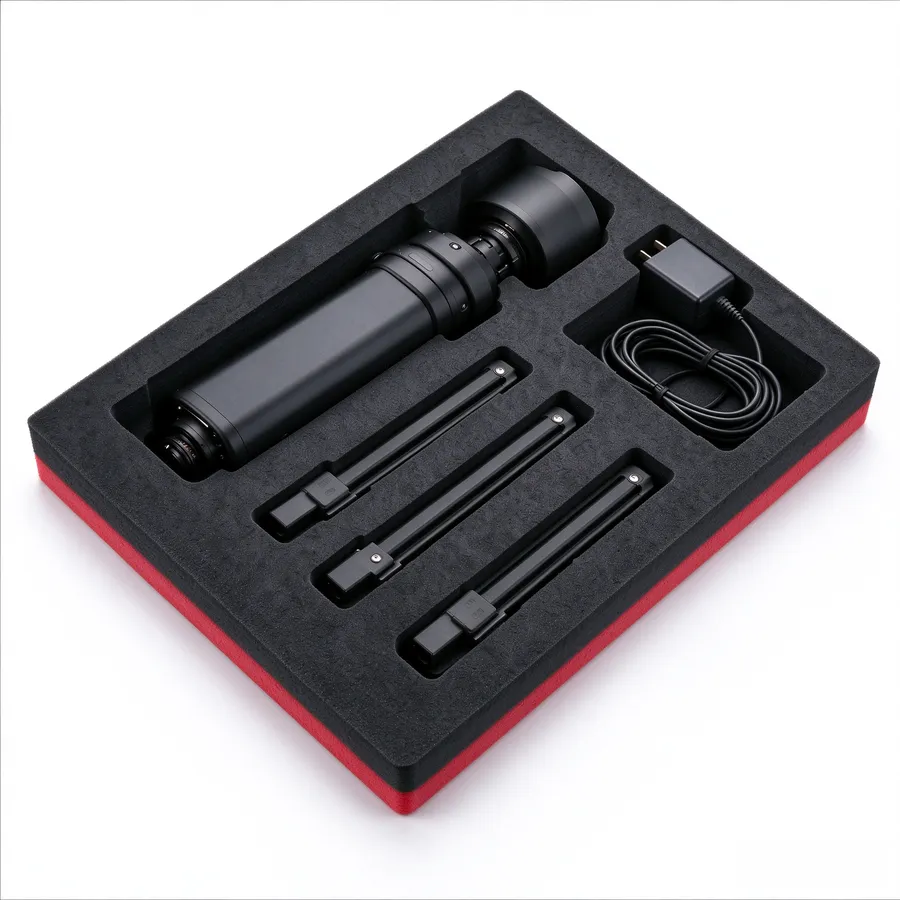
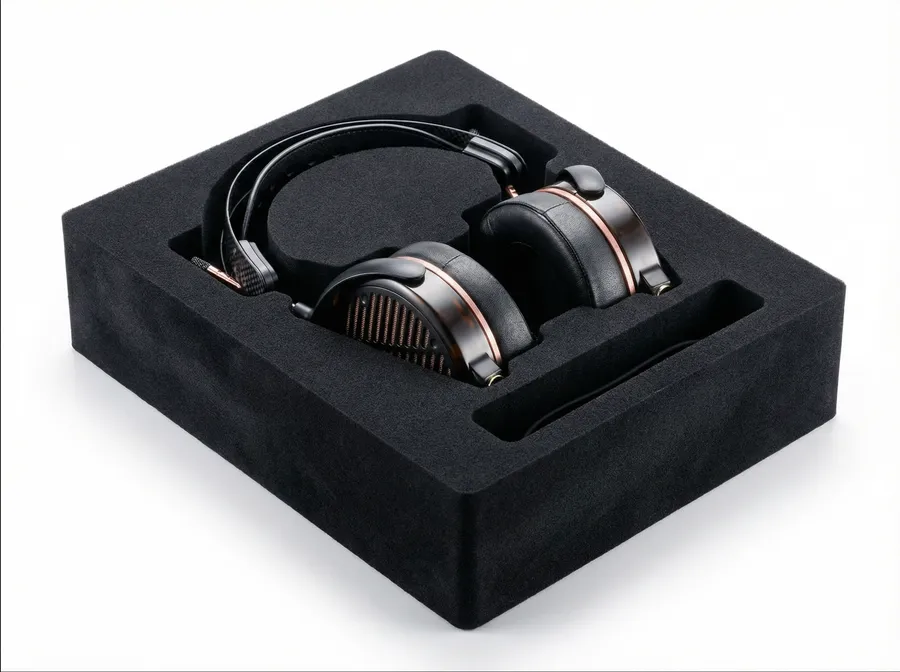
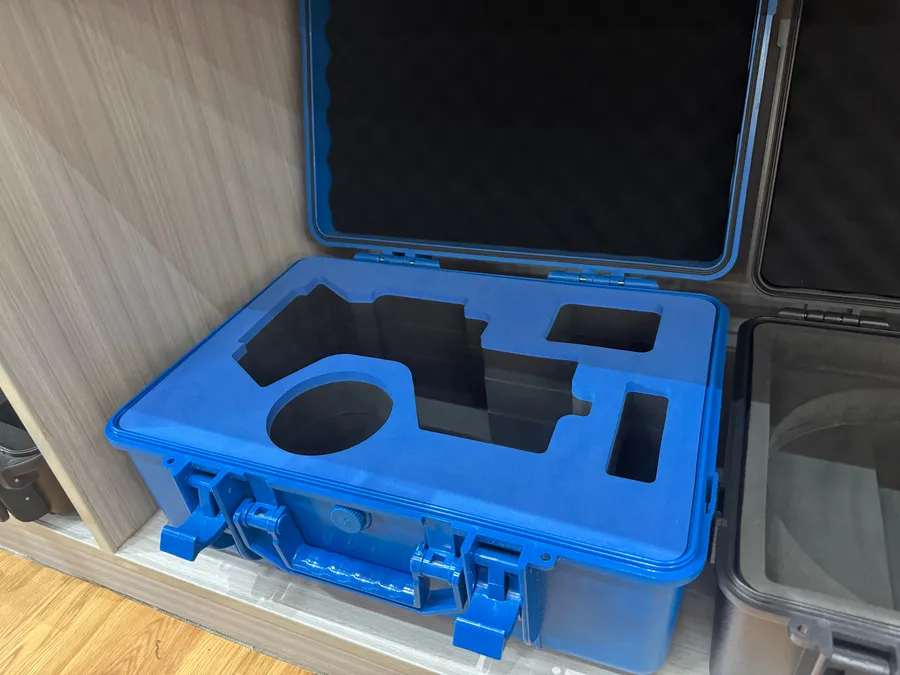
Customisation
Everything described above is configurable on a standard shell: interior layout (pick-and-pluck, die-cut or CNC-cut), foam grade and thickness, colour, logo method, latch and lock count, pressure-equalisation valve, cable ports, document holder and identification plate. A bespoke exterior geometry requires a new mould — 125 days, from 3,000 units per moulded component.
Procurement considerations
| Question | What to send us |
|---|---|
| Which shell fits? | Equipment L × W × H as packed, plus required clearance per axis |
| What does it cost? | Order quantity and estimated annual quantity — the two drive different answers |
| Is tooling needed? | Whether an existing shell clears the envelope with usable foam depth |
| Lead time? | Your required delivery date, not just the order date |
| Certification? | The exact standard your tender names — we will say whether we can test to it |
| Freight? | Destination and preferred terms; carton and pallet data supplied with the quotation |
Comparison and selection guide
The tables on this page exist because a protective case is chosen by comparing three things: the envelope, the environment and the handling chain. Where no table applies, the rule below is.
| Situation | What To Do |
|---|---|
| Shock | Base layer thickness and grade sized to the packed mass. |
| ESD | Anti-static PE, specified by surface resistivity range. |
| Dust | Sealed configuration with a continuous rim. |
- Size on internal dimensions plus clearance, never on a product name.
- Choose the carrying method before the shell: it changes the series, not just the price.
- Specify the interior last, and decide up front whether the end user will reconfigure it.
What environmental factors should be considered for electronic equipment transport? relates to Waterproof & Dustproof Guide. Related families: Electronics Cases / Military Protective Cases / Communication Equipment Cases / Waterproof Cases / Optical Equipment Cases / Custom Protective Cases. Related sectors: field and industrial equipment. Continue in the Waterproof & Dustproof Guide cluster.
This page is written from our own production data. If your requirement differs, send the dimensions and we will tell you which of the 155 models fits, or whether a custom route is needed.