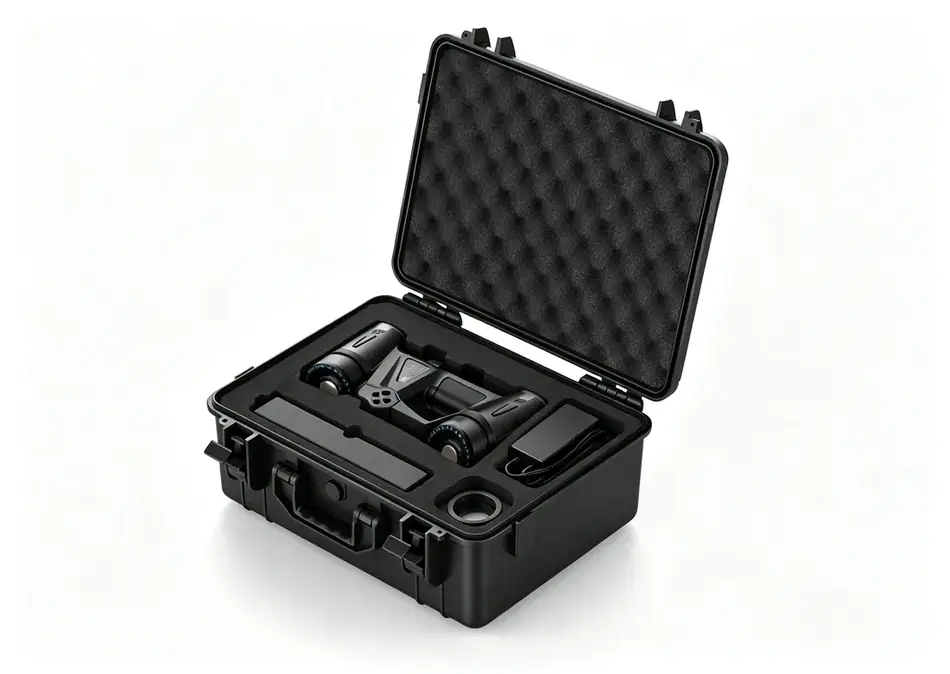
How should sensitive equipment be secured inside a case?
Sensitive equipment is secured inside a case by geometry, not by padding: the item is held in a pocket whose walls stop it sliding, supported along its length so it cannot tip, covered by a top layer that stops it bouncing, and kept clear of the sealing rim and the shell walls. In practice that means sizing on published internal dimensions rather than external ones, checking the lid and base depth split against the parting line, cutting the pocket to a controlled clearance instead of a loose fit, building the interior in layers - firm base, close-cut middle, soft cover - and then verifying the packed sample by lift, tilt and re-check after real travel. Across our 155 published models we give internal and external size, wall thickness on 148, lid and base depth on 100, the narrowest internal width on 36 and empty mass on 93. Ingress protection, drop height, stack load and temperature range are recorded as not measured, so the hold comes from an interior you can inspect, not from a rating word.
Key points
- Hold the item by geometry: a pocket wall against sliding, a full-length bed against tipping, a cover layer against bouncing.
- Check the lid and base depth split before cutting: WL1905 has a 40 mm internal height made of 25 mm lid and 15 mm base.
- Size to the narrowest internal width, not the nominal one: WL4610 is 338 mm across but 302 mm at the pinch.
- Stop the interior short of the gasket channel: foam pressing the rim holds the lid off flat and defeats the seal it sits in.
- Build the interior in layers - firm base, close-cut middle, soft cover - and cut it from a drawing, a packed-kit photo or a sample.
- Verify before the run: custom foam starts at one unit, so pack a pilot, lift it, tilt it, and re-check it after real travel.
Decide which movement you are preventing before you choose an interior
Secured means the item cannot move, not that it sits in something soft. Sensitive equipment fails in transit for three separable reasons: it slides across the base, it tips about an edge, or it bounces and re-applies the same load to the same spot. Each is fixed by a different feature. Sliding is stopped by a pocket wall. Tipping is stopped by a supporting bed that carries the length of the item plus a cover that holds it down. Bouncing is a question of foam thickness against the mass of the item and the depth available. So the first step is not choosing a foam, it is writing down the item mass, its six face dimensions, where the centre of gravity sits, and which faces are fragile - a lens cell, a glass scale, a connector, a moulded handle, a calibrated zero. The interior layout follows from that list, and a supplier who quotes an interior without it is guessing.
Cut to the parting line, not just to the depth
Internal height is two numbers, not one. Where we publish the split, lid depth plus base depth equals the internal height: WL1905 is 180 x 160 x 40 mm inside with 25 mm of lid over 15 mm of base; WL2405 is 220 x 162 x 49 mm with 18 mm of lid over 31 mm of base; WL4822 is 460 x 330 x 210 mm with 165 mm of lid over a 45 mm base; WL5321 is the mirror image, 43 mm of lid over 149 mm of base on a 5.8 mm wall. That parting line decides what the interior can do. A tall item that must sit low and be supported along its body belongs in a deep-base shell such as WL5321. A kit that is built up in the base and closed under a thick protective cover suits a deep-lid shell such as WL4822. Lid and base depth are published on 100 of our 155 models; where the split is not published, ask for it before an interior is quoted, because a pocket cut against the wrong half wastes the whole build.
Support the body of the item, not two points under it
A bed that carries an item at two ends turns the case into a lever: the middle deflects, and every handling event is concentrated at the two contact points. Support should be continuous under the length of the item, with mass spread over as much area as the geometry allows and the fragile element taken out of the load path. The published numbers tell you how much room that leaves. Empty shell mass is published on 93 of 155 models and runs from 100 g on WL1204 to 15,320 g on the WL8-8442 trolley, and usable interior volume across the range is between 43.9 and 75.0 percent of the external volume. Read together, those figures say how much of the box is structure, how much is air, and therefore how thick a real supporting bed can be. A 2,710 g WL4822 with 27.4 L usable interior can carry a heavy instrument on a full-length bed; a 100 g WL1204 with 0.3 L usable interior can only hold a small module in a close-cut pocket.
Keep everything off the sealing rim and away from the walls
Two surfaces have to stay free: the sealing rim and the inside of the walls. Where a gasket is offered - 124 of our 155 models list a compressible gasket in a continuous moulded channel - the interior must stop short of that channel, because foam or a hard item pressing on the rim holds the lid off flat and turns a sealed shell into a leak path. The second trap is the nominal width. Thirty-six models publish a narrowest internal width measured at the pinch, and it is smaller than the flat internal width: WL1204 lists 78 mm across the middle but 70 mm at the narrowest; WL3207 lists 230 mm across but 205 mm at the pinch; WL4610 lists 338 mm across but 302 mm at the pinch. Anything with a stiff connector, a coiled cable or a moulded grip must clear the narrow figure, not the wide one. Cut the pocket against the pinch dimension and leave about one wall thickness of material between the item and every shell wall.
Securing geometry on published models
The table below is assembled from the figures we publish model by model, which is the correct basis for an interior decision. Fields we have not measured stay blank rather than being filled in with a range figure, because generalising one shell's wall or mass across a catalogue is how a cut pocket ends up half a millimetre wrong.
| Model | Internal (Mm) | Lid / Base (Mm) | Narrowest Internal (Mm) | Wall (Mm) | Empty Mass (G) | Gasket Offered |
|---|---|---|---|---|---|---|
| WL1204 | 115 x 78 x 32 | 16 / 16 | 70 | 2.6 | 100 | No |
| WL1905 | 180 x 160 x 40 | 25 / 15 | 130 | 3.0 | 250 | Yes |
| WL2405 | 220 x 162 x 49 | 18 / 31 | 132 | 2.0 | 293 | No |
| WL3207 | 308 x 230 x 64 | 32 / 32 | 205 | 3.0 | 570 | Yes |
| WL4610 | 455 x 338 x 84 | 42 / 42 | 302 | 3.0 | 1,115 | Yes |
| WL4822 | 460 x 330 x 210 | 165 / 45 | not published | 3.3 | 2,710 | Yes |
| WL5321 | 481 x 373 x 192 | 43 / 149 | not published | 5.8 | 4,810 | Yes |
| WL8-8442 Trolley | 740 x 518 x 364 | 320 / 44 | not published | 5.0 | 15,320 | Yes |
Layer the interior: base, close-cut middle, cover
Interiors are built from layers, and naming the layer in an enquiry changes both the price and the result. The constructions published for our shells are pick-and-pluck, die-cut and CNC-cut foam in EVA, PE and EPE, arranged as base foam, top foam, egg-crate or convoluted sheet, custom cut or layered stacks. A working layout for delicate gear is usually three layers: a firm base that carries the mass without creeping, a close-cut middle that removes play around the body, and a softer top cover that presses the item down and keeps small parts away from the rim. Pick-and-pluck is the right pilot because it can be re-cut as the kit changes; a machined cut is what you want once the kit list is fixed, because a CNC pocket can repeat an outline that a hand-plucked bed cannot. To cut either one we need a drawing, a photograph of the packed kit, or a physical sample.
Handle the accessories, and pack the way the case is opened
Securing the main item is one job; keeping the rest of the kit off it is another. Anything with a stiff connector - leads, handsets, spare cells, a charger block - needs its own pocket, because a loose accessory is a hammer that arrives repeatedly when the case is lifted by the handle and set down. Published hardware is part of the same decision: handle type, hinge, feet, a latch count specified per configuration, latch bodies published as accepting a standard padlock, and per-model options recorded for a shoulder strap and a pressure-equalisation valve. Orientation matters for the same reason. Pack the item the way it is opened at the far end, so that lifting the lid does not drop cover-layer pieces onto an open connector, and keep the heaviest element over the base wall, where the shell is stiffest, rather than under the parting line.
For waterproof sensitive equipment secured inside a sealed shell, check both jobs separately
Buyers searching for waterproof sensitive equipment secured inside a case are asking two questions at once, and they have separate answers. The interior stops the item moving; the rim, gasket and clamp stop water. A sound gasket cannot compensate for an item that shifts and strikes the lid, and a perfect interior cannot compensate for a rim held open by foam. We also do not merge the two claims on paper: waterproof, dust resistance, UV, temperature range, stack load and load capacity are recorded as not measured across the range, so we describe construction instead - a compressible gasket in a continuous moulded channel on 124 of 155 models, a pressure-equalisation valve recorded as a configuration option, and shock protection recorded as dependent on a specified foam layout, because the shell alone is not a shock rating. Where a project genuinely needs a number, that number has to come from a commissioned test of the exact build, not from a brochure line.
Verify the packed sample before you commit to a run
Verification is cheap when it happens before production. Pack a sample with the real kit, close it, lift it by the handle, set it down, and tilt it through the angles it will see in a vehicle bed. The item should not shift, the cover layer should not lift off the item, and nothing should be visible at the rim. Then check the same sample again after it has actually travelled, because a first fit relaxes: pick-and-pluck crumbles at the edges, EVA takes a set, and a pocket cut on a cold morning can gain half a millimetre by afternoon in a hot truck. A stock shell with custom foam starts at one unit on our terms, which is what makes that pilot possible before a brand commits to a run. Where a tender requires figures, we commission accredited third-party testing of the build you order and let the report carry them.
Terms for an engineered interior
Terms follow from the fact that an interior is engineered, not stocked. We supply wholesale and OEM only, on EXW or FOB Guangdong: no retail sales, no DDP quotations and no overseas warehouse, so inland haulage and destination clearance stay with the buyer. A standard shell has no minimum beyond one unit and custom foam also starts at one unit; a custom logo or custom colour is typically 300 units; OEM on existing tooling runs about 45 days to first sample; a new mould is about 125 days with an MOQ from 3,000 per component, and a 30 percent deposit starts either. Send the item dimensions and mass, the full kit list, photographs of how it is packed today, the environment it travels in and the quantity, and we return the shell, the layer-by-layer interior, the clearance we cut to, and a written lead time.
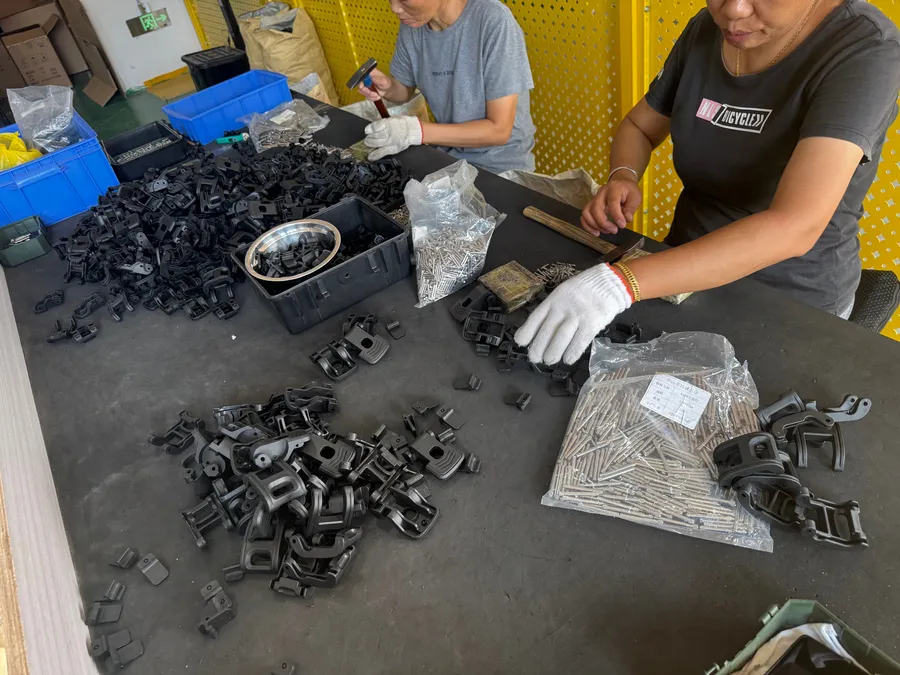
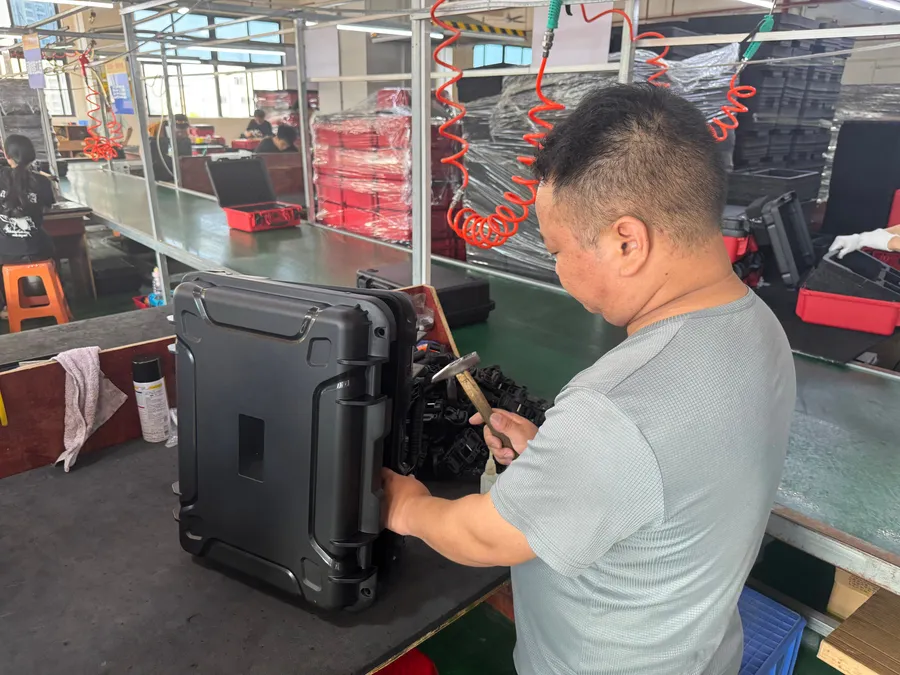
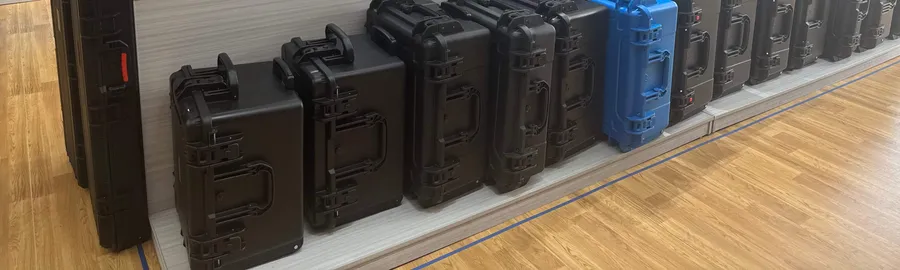
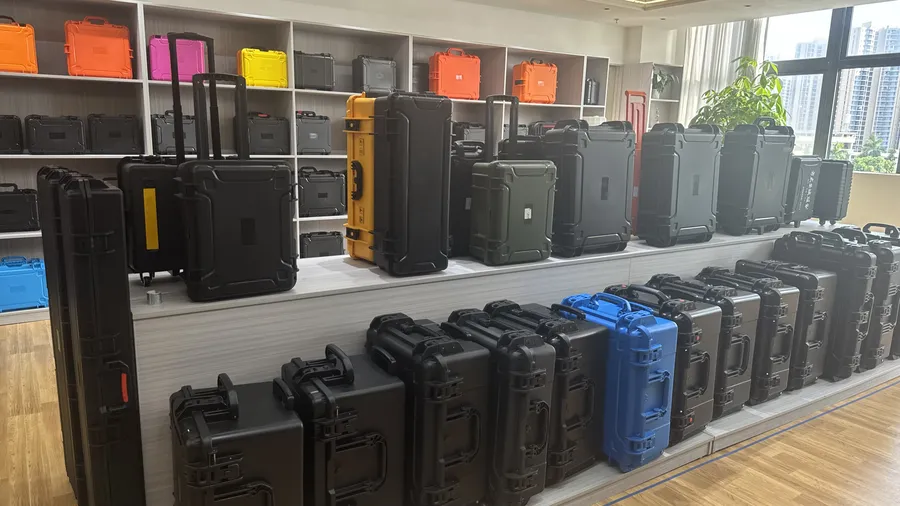
Customisation
Everything described above is configurable on a standard shell: interior layout (pick-and-pluck, die-cut or CNC-cut), foam grade and thickness, colour, logo method, latch and lock count, pressure-equalisation valve, cable ports, document holder and identification plate. A bespoke exterior geometry requires a new mould — 125 days, from 3,000 units per moulded component.
Procurement considerations
| Question | What to send us |
|---|---|
| Which shell fits? | Equipment L × W × H as packed, plus required clearance per axis |
| What does it cost? | Order quantity and estimated annual quantity — the two drive different answers |
| Is tooling needed? | Whether an existing shell clears the envelope with usable foam depth |
| Lead time? | Your required delivery date, not just the order date |
| Certification? | The exact standard your tender names — we will say whether we can test to it |
| Freight? | Destination and preferred terms; carton and pallet data supplied with the quotation |
Comparison and selection guide
The tables on this page exist because a protective case is chosen by comparing three things: the envelope, the environment and the handling chain. Where no table applies, the rule below is.
| Situation | What To Do |
|---|---|
| Occasional splash | A close-fitting rim without a gasket is cheaper and easier to maintain. |
| Rain and washdown | Sealed configuration, four or more latches, stainless hardware. |
| Immersion or pressure change | Sealed configuration plus a pressure-equalisation valve, and a documented test. |
- Size on internal dimensions plus clearance, never on a product name.
- Choose the carrying method before the shell: it changes the series, not just the price.
- Specify the interior last, and decide up front whether the end user will reconfigure it.
How should sensitive equipment be secured inside a case? relates to Waterproof & Dustproof Guide. Related families: Waterproof Cases / Instrument & Equipment Cases / Optical Equipment Cases / Camera & Photography Cases / Electronics Cases. Related sectors: field and industrial equipment. Continue in the Waterproof & Dustproof Guide cluster.
This page is written from our own production data. If your requirement differs, send the dimensions and we will tell you which of the 155 models fits, or whether a custom route is needed.