What affects the impact protection of a case?
What affects the impact protection of a case is not one property but four families of variables, and they are not equally important. First is the stopping distance the item gets: the thickness, grade and compression behaviour of the liner between the item and the shell, which is the single largest lever because it sets how long the deceleration takes. Second is the item itself - its mass, its stiffness, and where its own weak element sits, because a heavier or softer item changes the answer more than any change to the shell. Third is the shell: wall thickness, rib geometry, material, the lid-to-base split, and whether the closure and hinges hold the lid shut through the event. Fourth is the input - the height, the surface, whether the arrival is flat, edge-first or corner-first, and whether it happens once or on every shift for three years. On our sheet wall thickness is published on 148 of 155 models between 2.0 mm and 6.0 mm, lid and base depth on 100 models, net mass on 93 and internal volume on all 155, while impact and shock resistance are recorded as a manufacturer construction option on all 155 and no drop height is stated for any configuration we have not had tested.
Key points
- Stopping distance is the dominant factor: doubling the liner thickness available to an item matters more than doubling shell wall thickness.
- The item's own mass and stiffness decide the input it receives; a 2 kg body at the same arrival speed carries ten times the energy of a 200 g one.
- Free height inside the case is a hidden variable - an item that can move 40 mm takes its own drop inside a shell that never cracked.
- The shell contributes geometry, not a rating: wall thickness is published on 148 of 155 models from 2.0 mm to 6.0 mm, with ribs and corner radius doing the rest.
- A lid that springs open on a corner hit gives no protection at all, so latch count, latch position and hinge restraint are impact variables too.
- Sealed and unsealed builds differ in impact behaviour mainly through wall gauge and rim design, and a distorted rim costs you the seal even when the item is fine.
- We state structure rather than results: no drop height, shock grade or ingress code is published for any model, and accredited testing can be commissioned per configuration.
The four families of factors, ranked
Impact protection is an outcome of a system, and the reason buyers struggle with the question is that most supplier pages answer it with one variable - usually the shell - as though a case were a bumper. It is not. The energy that reaches an instrument is decided in this order. The liner decides the stopping distance, which is the time and travel over which the item's velocity is destroyed; the same energy absorbed over twice the distance produces roughly half the peak. The item decides how much energy is in play and how sharply it can be damaged - a rigid block with a glass element inside behaves completely differently from a compliant one. The shell decides whether the input is spread or concentrated, whether it rebounds or deforms, and whether the lid stays closed. The input decides everything else: height, surface, orientation, and how often.
That ranking has a practical consequence for procurement. If a budget has to be moved somewhere, move it to the interior first and to the closure second, and treat the shell as a geometry problem you solve last. A thick-walled shell with a paper-thin liner around a loose item is one of the most common and most expensive mistakes we see in enquiry files, and it looks protective in a photograph.
What buyers ask, answered as it is phrased
Two searches arrive at this subject constantly: 'affects impact protection case' and 'waterproof affects impact protection case'. The first asks which variables to control when a specification has to survive being dropped, knocked or stacked into a vehicle bed. The second asks a narrower and more interesting question - whether choosing a sealed build changes the shock answer, and in which direction. Both are answered on this page rather than in a single sentence, because the honest reply is a ranking rather than a figure. We can tell you what our data publishes on each factor: internal and external dimensions, wall thickness, lid and base depth, net mass, internal volume, material and gasket availability. We cannot tell you that any model survives a stated height, because we record no such result.
Where a purchaser needs a number attached to a case, the route is a defined test of the configuration they intend to order, carried out by an accredited laboratory and paid for as its own work package. That is a normal thing to commission and we quote for it, but it is not the same transaction as buying shells, and no page on this site should be read as a substitute for it.
Factor one - the stopping distance the item is given
Every drop ends the same way: the item has to lose its velocity. The only question is over how far and how long that happens. A liner that crushes progressively over 25 mm turns a very short, very high-amplitude input into a longer, lower one, and it also dissipates part of the energy as internal friction in the cell structure instead of returning it into the item. This is why foam thickness is specified before foam type on any serious brief, and why our interior pages talk about a depth budget: the internal height of the shell minus the packed height of the item is the raw material of the whole protection scheme, and once it is spent there is nothing the shell can do about it.
Three sub-variables live inside this factor. Thickness, because the distance has to exist. Grade and density, because a soft liner that bottoms out behaves like no liner at all once it is fully compressed, while an over-firm one transmits instead of absorbing. And recovery, because a liner that has taken a permanent set from years of carrying a heavy item no longer gives the distance it was cut with. Our data records lid depth and base depth on 100 of 155 models, from 16 mm to 320 mm of lid and 15 mm to 168 mm of base, which is what you have to work with before any foam is added.
Factor two - what is inside, and how it is held
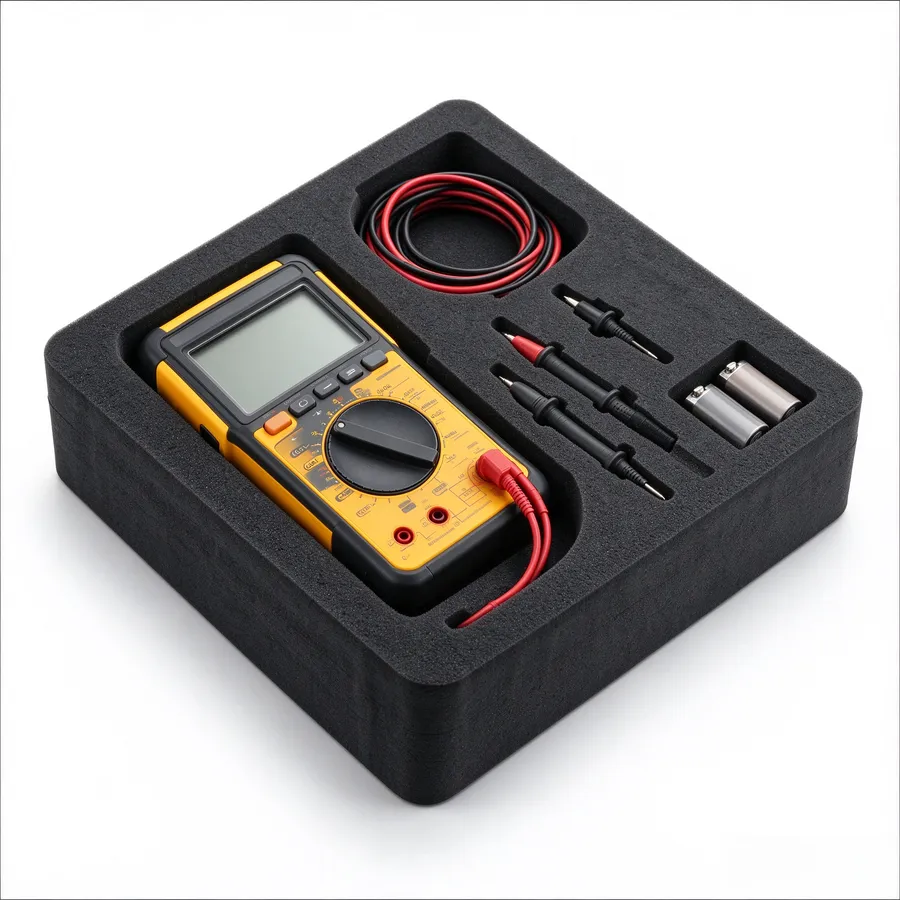
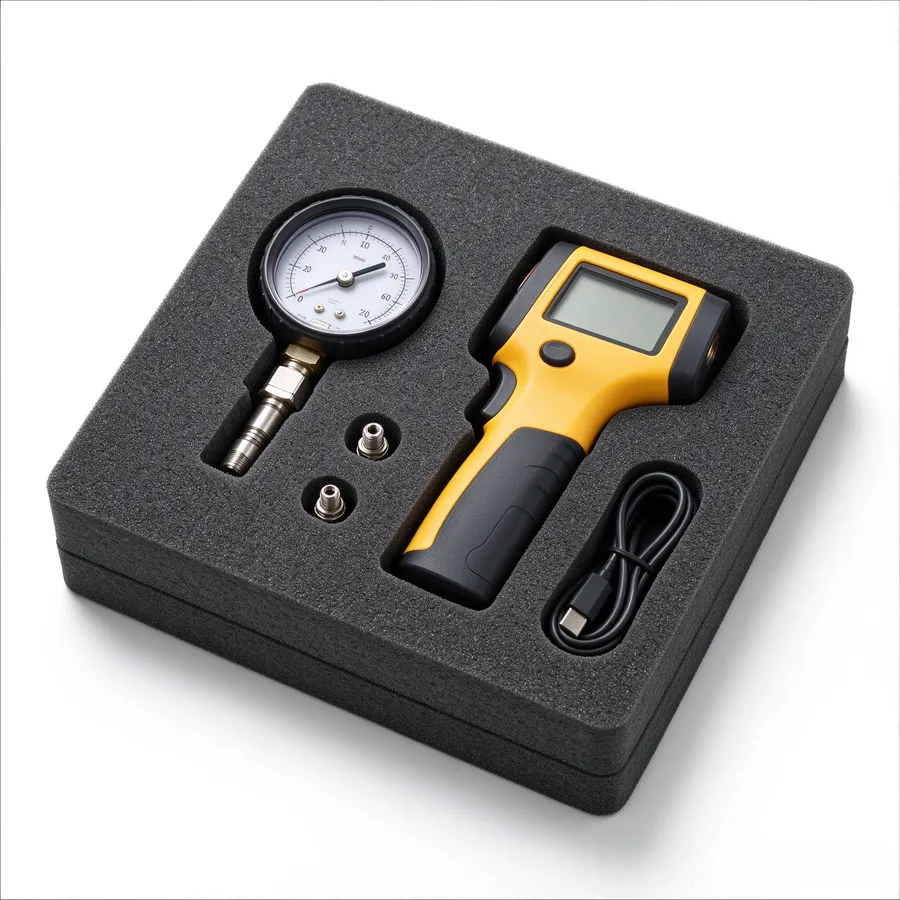
The item contributes two numbers that most specifications never state: its mass and its free travel. Mass is straightforward - the energy at arrival grows with it, so a 2 kg instrument and a 200 g instrument landing at the same speed are not in the same conversation, and the liner has to be designed for the former if both travel together. Free travel is the sneaky one. If an item can move 40 mm inside its pocket before touching something, it takes its own 40 mm drop inside a shell that never cracked, and the case gets the credit for a protection it did not provide. Restraint - a lid face pressing the item down, defined pocket walls, a strap where the layout demands one - is what converts a liner from a cushion into a system.
Stiffness and internal weak points belong here too. A rigid housing with a bonded optical element, a calibrated moving part or a glass face has its own internal resonance and its own failure threshold, and that threshold - not the shell's strength - is what the whole exercise is trying not to cross. This is the point at which the honest answer to 'what case protects my instrument' stops being a case question and becomes an instrument question, and why we ask for the item's own shock limits when a brief is genuinely demanding.
Factor three - the shell: wall, geometry, material
The shell does three jobs in an impact. It spreads a concentrated input across a wider area instead of letting it punch through, it decides whether the energy is absorbed by deformation or returned as a rebound, and it protects the liner from being punctured, split or crushed locally. Wall thickness is the number buyers reach for first and it is the least decisive of the three, because a thin wall with good rib geometry and a generous corner radius routinely outperforms a thick wall with flat unsupported faces. Our published wall figures run from 2.0 mm to 6.0 mm across 148 of 155 models, and the rest of the answer is carried by moulding details that a specification line does not capture.
Material belongs here as a behaviour question rather than a brand one. 94 of our models are moulded in PP, 38 in an engineering PP grade, 22 in ABS and one in a PP and ABS combination, and the practical difference between them in an impact is how they take energy - some grades deform and recover, others stiffen and return it, and cold conditions shift that behaviour. We record no temperature range for any model, so if the duty includes storage in a cold vehicle overnight, that is a question to put to us for the specific configuration rather than something to infer from a data sheet.
Factor four - the closure and the lid-to-base split
An impact that throws the lid open is an impact with no case at all, and this is the most frequently under-specified factor in the whole list. What holds a lid down is latch count and latch position relative to the geometry of the shell, the stiffness of the rim the latches pull against, and the hinge that transfers the load into the base instead of tearing out of it. Latch bodies on our models are recorded as accepting a standard padlock and hinges as measured, but latch count is recorded as specified per configuration - so on a wide, shallow lid the number and position of closures is a line you write on the order, not a feature you assume from a picture.
The lid-to-base split changes where the parting line sits relative to the item, and the parting line is the weakest structural line of any two-piece moulding. A deep-lid shell keeps the rim away from the item and lets a corner hit be taken by the base wall; a shallow-lid shell on a tall item puts the item directly behind the seam. KX-64618 publishes 140 mm of lid over a 25 mm base, which suits a tall instrument; KX-97227 publishes 42 mm of lid over a 168 mm base, which puts the seam far above a low, flat load. Same category of product, completely different impact behaviour, and the number is on the sheet before anybody buys.
Factor five - the input itself
The same case and the same item produce three different answers depending on how the arrival happens. A flat landing spreads the input across a face; an edge or corner landing concentrates it into a small area and a short stopping distance, which is why corners and not faces are where shells crack and where items get hurt. The surface matters as much as the geometry: a concrete yard is not a rubber mat, and a shell with feet behaves differently from one landed on its own wall.
Height enters through velocity, and the arithmetic is worth doing by hand rather than trusting a slogan. A free fall of one metre gives an arrival speed of roughly 4.4 metres per second, since v equals the square root of twice gravity times height; a 0.2 kg item at that speed carries just under two joules, a 2 kg item about twenty. Halving the stopping distance doubles the peak. None of this is a claim about a product - it is the reason a specified height without a specified liner, mass and orientation is not a test anybody can be held to, and it is why we push back when a brief says 'must survive 1.2 m' with no other numbers in it.
Factor six - repetition, temperature and the damage that accumulates
Almost nothing in the field is a single event. A case that goes into the back of a vehicle every day takes hundreds of small inputs a year, and those inputs age the assembly rather than breaking it: liner foam loses its recovery, a gasket takes a set, rivets work loose, a latch strike wears, and a hairline in a corner opens by degrees. The factor that affects protection most in this regime is not peak strength but whether the parts can be inspected and replaced - which is why an interior cut as separate layers outlasts one glued to the shell, and why hardware fixed with standard fasteners is serviceable while a bonded assembly is not.
Stacking is the other accumulated load, and it works against impact rather than with it. A shell in a stack is carrying someone else's weight through its corners, and a corner that has already been deformed by a knock carries that deformation into every subsequent lift. 136 of our 155 models are recorded as stackable and 19 as wheeled with a telescopic handle, but stack load is recorded as not measured for every model because the figure depends on the pallet, the load and the number of levels - so it is a calculation done with your stacking pattern, not a number copied off a page.
The factors side by side
| Factor | What It Decides | On Our Sheet | What It Does Not Give You |
|---|---|---|---|
| Liner thickness | How long the deceleration takes and how much energy is dissipated internally | Internal height per model; lid and base depth on 100 models | Any peak-G figure for an item |
| Liner grade and recovery | Whether the distance is still there after a year of use | Six foam types and five structural builds on all 155 | A compression-set figure we have not measured |
| Item mass | How much energy the interior has to destroy | Net mass of the empty shell on 93 models, 100 g to 15,320 g | Your packed mass, which only you know |
| Free travel inside | Whether the item takes its own drop inside an intact shell | Internal versus external dimensions on all 155 | A layout, which is drawn from your item list |
| Wall thickness | Local resistance to puncture and crushing of the liner | Published on 148 models, 2.0 mm to 6.0 mm | A protection rating, which is not a wall measurement |
| Ribs, radius and parting line | Whether an input is spread or concentrated at the seam | Moulding geometry per model; lid-to-base split on 100 | A stiffness value without a test |
| Latch count and hinge | Whether the lid stays closed through the event | Hinge and padlockable latch recorded as measured; count per configuration | An assumed closure for a wide shallow lid |
| Surface and orientation | Contact area and stopping distance at the moment of arrival | Feet and stacking recorded per model, 136 stackable | Any site condition we have not been told |
Published structure for the models named here
Use these as geometry, not as a performance ladder. Internal dimensions are the envelope before foam; lid and base depth is the budget you can spend on stopping distance; wall thickness is a structural figure; net mass is the shell on its own, so add your item and your liner to reach a carry weight. Where a model shows no lid or base figure, that pair is published on 100 of the 155 models only and we will supply the measurement with the quotation.
| Model | Internal Mm | Lid / Base Mm | Wall Mm | Net G | Material |
|---|---|---|---|---|---|
| KX-1204 | 115 x 78 x 32 | 16 / 16 | 2.6 | 100 | PP |
| KX-2005 | 190 x 135 x 40 | 20 / 20 | 2.0 | 175 | PP |
| KX-3218 | 308 x 230 x 172 | 86 / 86 | 3.0 | 900 | PP |
| KX-4312 | 420 x 260 x 104 | 52 / 52 | 3.5 | 1170 | PP |
| KX-62810 | 253 x 182 x 86 | not published | 4.0 | 900 | ABS |
| KX-64618 | 430 x 290 x 165 | 140 / 25 | 4.7 | 2775 | ABS |
| KX-65522 | 507 x 385 x 190 | not published | 5.3 | 4860 | ABS |
| KX-83917 | 355 x 240 x 155 | not published | 5.0 | not published | PP |
| KX-85835 | 500 x 400 x 305 | 260 / 45 | 5.0 | 8520 | PP |
| KX-6621 | 587 x 434 x 192 | 43 / 149 | 6.0 | 6420 | Engineering PP |
| KX-88442 | 740 x 518 x 364 | 320 / 44 | 5.0 | 15320 | PP |
Does a waterproof build affect impact protection differently?
That phrasing hides two separate questions, and they have different answers. The first is whether adding a seal makes a shell better or worse in an impact. A gasket is a compliant bead sitting in a channel at the parting line, and by itself it contributes almost nothing to how an impact is taken - the material that matters is the wall behind it. What does change is that the sealed builds in our catalogue tend to be the heavier-gauge, ribbed, deep-lid mouldings, because that is how a shell strong enough to keep a rim under even compression is moulded. So the correlation you can observe on our sheet - 124 of 155 models publish a gasket channel, and all 22 ABS shells plus every one of the 56 models with a published wall of 4.5 mm or more sit inside that group - is a design consequence rather than proof that sealing adds shock resistance.
The second question runs the other way and is the one that costs people money: an impact can destroy the seal even when it does nothing to the item. A rim that has been knocked out of true, a channel that has split, a gasket that has been pinched or displaced, or a lid that no longer pulls square all leave a shell that still closes and no longer seals. The inspection routine after a hard knock is therefore not optional on a sealed build: check the rim face, check the channel continuity, check that the lid meets the base evenly at the corners, and only then put the instrument back in.
How to weigh the factors for your own duty
Work through the list in order and you will find where your budget goes. Start with the item: packed mass, packed height, and the location of the element that actually fails - the lens, the calibration, the glass. Then choose the depth budget: internal height minus packed height is what you can spend on stopping distance, and we would rather see that number split into a base layer under the item, a face layer against it and a lid layer pressing down, than one thick slab. Then close the loop on restraint and the parting line: state the latch count for the lid geometry you have chosen, and avoid putting the item behind the seam.
Only after those three do the shell variables earn attention, and by then the choice is usually made for you - the volume needed, the carry weight tolerable, the wall gauge appropriate to the stacking. If the brief genuinely requires a pass criterion, attach the mass, the orientation and the surface to the height, and commission the test on the configuration you intend to order. A requirement written that way can be quoted; a requirement written as a bare height cannot be met or measured by anybody.
Terms, lead times and what this page deliberately does not claim
KeXin New Materials (Guangdong) Co., Ltd. supplies on wholesale and OEM or ODM terms only, with quotations on EXW or FOB. There is no retail channel, no delivered-duty-paid price and no overseas warehouse stock, so freight and import handling stay with the buyer or their forwarder. First OEM articles on existing tooling run about 45 days; a dedicated new mould runs about 125 days from approved drawings with a minimum from 3,000 pieces per component, while colour, logo and hardware changes start around 300 pieces and stock shells with custom foam go from a single piece. Payment is a 30% deposit with the balance after inspection before shipment, and third-party inspection of a finished order is welcome. Send the packed dimensions, the mass, the item list and how it travels, and we will return a nominated model with published figures.
What we do not state is recorded on our data sheet as deliberately as what we do. Impact and shock resistance are carried on all 155 models as a manufacturer construction option, because they depend on the foam layout specified rather than the shell alone; no drop height, peak acceleration or shock grade is published for any model, and dust, water, ingress code, stack load and temperature range are recorded as not measured. Read this page as an engineering framework for a specification conversation, not as a results table - and for enquiries, Fred Zhao or the KeXin Sales Team, WhatsApp +86 135 3588 0002.
Customisation
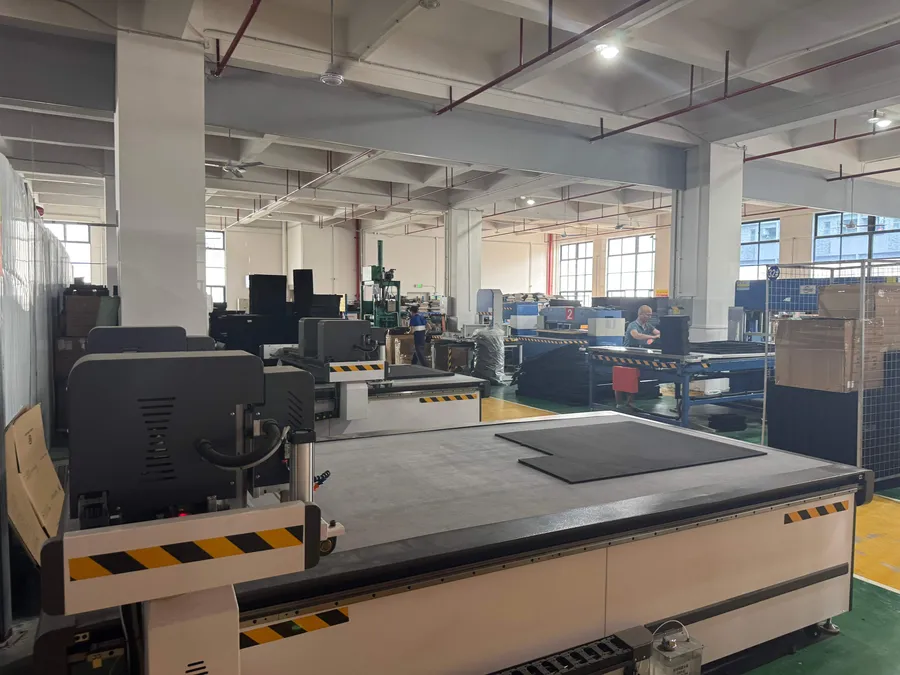
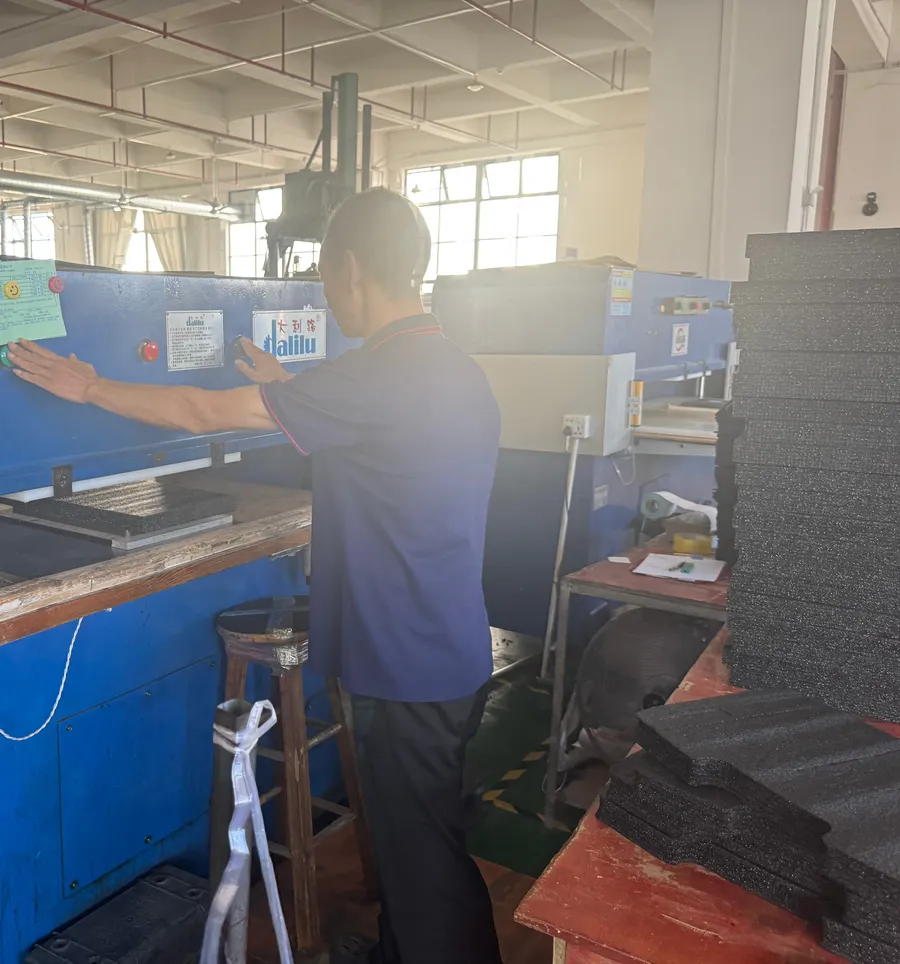
Everything described above is configurable on a standard shell: interior layout (pick-and-pluck, die-cut or CNC-cut), foam grade and thickness, colour, logo method, latch and lock count, pressure-equalisation valve, cable ports, document holder and identification plate. A bespoke exterior geometry requires a new mould — 125 days, from 3,000 units per moulded component.
Procurement considerations
| Question | What to send us |
|---|---|
| Which shell fits? | Equipment L × W × H as packed, plus required clearance per axis |
| What does it cost? | Order quantity and estimated annual quantity — the two drive different answers |
| Is tooling needed? | Whether an existing shell clears the envelope with usable foam depth |
| Lead time? | Your required delivery date, not just the order date |
| Certification? | The exact standard your tender names — we will say whether we can test to it |
| Freight? | Destination and preferred terms; carton and pallet data supplied with the quotation |
Comparison and selection guide
The tables on this page exist because a protective case is chosen by comparing three things: the envelope, the environment and the handling chain. Where no table applies, the rule below is.
| Situation | What To Do |
|---|---|
| Occasional splash | A close-fitting rim without a gasket is cheaper and easier to maintain. |
| Rain and washdown | Sealed configuration, four or more latches, stainless hardware. |
| Immersion or pressure change | Sealed configuration plus a pressure-equalisation valve, and a documented test. |
- Size on internal dimensions plus clearance, never on a product name.
- Choose the carrying method before the shell: it changes the series, not just the price.
- Specify the interior last, and decide up front whether the end user will reconfigure it.
What affects the impact protection of a case? relates to Waterproof & Dustproof Guide. Related families: Waterproof Cases / Outdoor Protective Cases / Instrument & Equipment Cases / Electronics Cases / Camera & Photography Cases / Military Protective Cases / Custom Protective Cases / Medical Equipment Cases / Field Equipment Cases. Related sectors: field and industrial equipment. Continue in the Waterproof & Dustproof Guide cluster.
This page is written from our own production data. If your requirement differs, send the dimensions and we will tell you which of the 155 models fits, or whether a custom route is needed.


