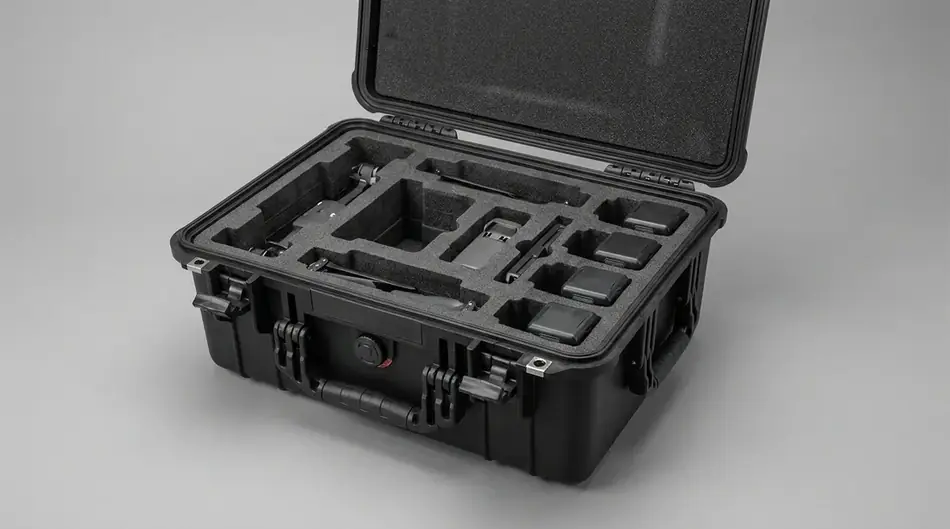
How do temperature changes affect equipment cases?
Temperature changes affect equipment cases through six separate mechanisms, and a specification that answers only one of them is the reason kit arrives damp, loose or with a lid that no longer sits flat. The shell expands and contracts with its own thermoplastic behaviour, which moves the rim the gasket seats into; the gasket itself is an elastomer, so cold makes it stiffer exactly when the shell has shrunk away from it; the air sealed inside a closed shell changes pressure with temperature and equalises through whatever path the rim offers; moisture already in that air condenses on the coldest surface when the case moves from a cool store into warm humid air; the liner foam firms up in the cold and softens in heat, so the same thickness behaves differently; and long storage in a hot depot keeps the gasket compressed, which is how a seal is destroyed without anything being dropped. What our own data publishes for all 155 active models is geometry rather than thermal performance: external and internal dimensions, wall thickness on 148 models from 2.0 mm to 6.0 mm, lid and base depth on 100 models, internal volume from 0.3 L to 139.5 L, and seal type on 124 shells recorded as a compressible gasket in a continuous moulded channel. The field temperature_range_c is recorded as not measured on every model, so no service temperature range, no hot or cold limit and no ingress code is stated here or anywhere else on this site; accredited testing of a defined configuration can be commissioned as a separate work package.
Key points
- Treat a temperature swing as six mechanisms - shell movement, gasket behaviour, internal air, condensation, liner stiffness and storage - not as one rating.
- Cold stiffens an elastomer gasket at the same moment the thermoplastic rim it seats into has moved, which is why the latch count is part of the thermal answer.
- Our data publishes geometry for every model and thermal performance for none: temperature_range_c is recorded as not measured across all 155 shells.
- Most wet electronics in a dry case are condensation after a move from cool storage into warm humid air, not rain that got past the seal.
- A sealed shell holds the humidity that was inside it, so dry the case before closing and store it open or with the latches released.
- The free height left after your item is packed is the budget for liner depth; foam that behaves differently at temperature is the reason to leave some spare.
- Where a thermal figure is required for acceptance, commission accredited testing of the exact configuration being ordered, and keep the report.
What a temperature change actually does to the system
A case is not one part, and a temperature change does not hit one part. It hits a moulded thermoplastic shell, an elastomer gasket pressed into a channel on that shell, a set of metal or polymer latches and hinges that decide how hard the gasket is pressed, a volume of air trapped between all of that and your equipment, and a foam layout whose stiffness is itself temperature dependent. When the temperature moves, each of those responds on a different clock and to a different degree, and the outcome the buyer notices is whichever one responded worst.
That is why the useful answer to "how do temperature changes affect equipment cases" is a list of mechanisms rather than a number. A number would have to be a service range, and we publish none: temperature_range_c is recorded as not measured for all 155 models in our product data. Mechanisms, on the other hand, can be reasoned about honestly, they map onto lines on a purchase order, and they tell a purchaser which questions to put to an accredited laboratory when an application genuinely needs a thermal limit in writing.
What buyers search for, answered as it is phrased
Two fragments arrive at this subject from our keyword library. The first, "temperature changes affect equipment", is the short form of the page question - a buyer wants to know what physically happens to a case and its contents when the temperature moves, and whether the case they are about to order is the right answer to that. The second, "waterproof temperature changes affect equipment", is again two intents joined: it asks whether choosing a sealed build changes the thermal answer. It does, and the change runs in both directions, which is exactly the part most specification sheets leave out.
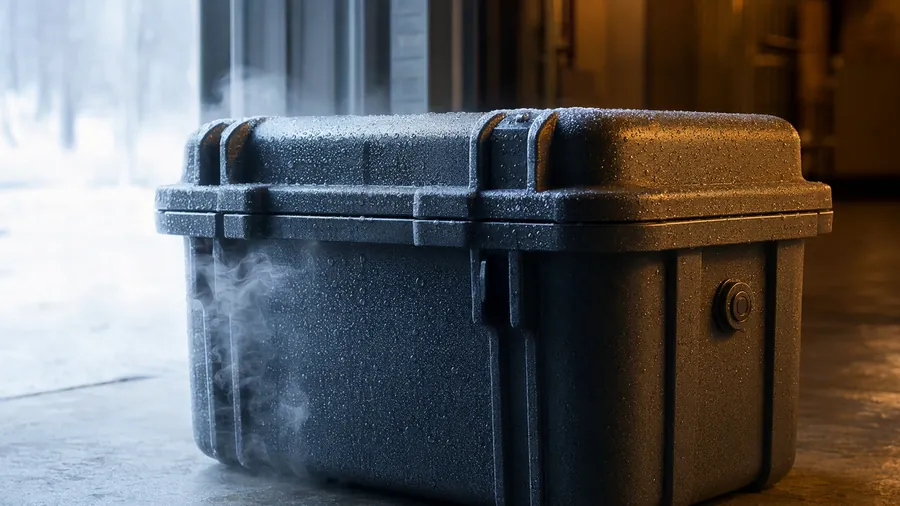
The sealed half is simple to state. A compressible gasket in a continuous moulded channel - recorded on 124 of our 155 shells - keeps outside air from exchanging freely with the interior, so it slows the case from equalising with whatever weather it is standing in. That is a benefit against rain, spray and dust, and it is also a cost: the humidity trapped inside at assembly or during a wet close now stays there and condenses on the coldest surface each time the case is moved from cool to warm. A shell that offers no gasket at all, which 31 of our models record, behaves the other way round. Neither build is the correct answer to a thermal brief on its own; the answer depends on whether the moisture risk or the outside weather is the larger problem at the site.
Mechanism one: the shell moves, and the rim is what matters
Thermoplastic walls expand and contract with temperature, and for a buyer the practical consequence is not the wall itself but the rim: the flat machined line where the lid meets the base and where the gasket has to keep seating. A long lid has more absolute movement than a short one because movement scales with the distance measured, and a rim that goes out of flat anywhere along its length gives the gasket somewhere to fail.
The published geometry tells you which shells are exposed. External dimensions on our range run from 120 mm to 1,356 mm in length and 90 mm to 610 mm in width, and wall thickness is published on 148 of 155 models from 2.0 mm to 6.0 mm, with engineering PP reaching the top of that band at 5.8 mm on KX-5321 and 6.0 mm on KX-6621, and ABS published between 3.0 mm and 5.3 mm across its 22 models. Gauge is what keeps a rim stiff between the latches, so on a long lid in a place with real day-to-night swing, the wall and the latch count are a single decision rather than two.
Mechanism two: the gasket is the only part made of elastomer
Everything else in the assembly is moulded plastic or metal; the seal is the one component whose function depends on being soft. Our data records the gasket as EPDM or equivalent compressible gasket by configuration, which is a family chosen for outdoor exposure, and it records seal type as measured on 124 models with the wording "Compressible gasket in continuous moulded channel". What it does not record, on any model, is a low-temperature brittleness figure, a heat-ageing figure or a compression-set figure.
The mechanism still has a name and a direction. Cold makes an elastomer stiffer at the moment when the shell rim it must follow has contracted, and heat makes it softer while the same rim expands. Latch count is specified per configuration rather than fixed, and that is the honest lever: compression is what holds the seal across both states, and a rim that flexes between latches loses the middle first. Over-tightening to compensate is the classic mistake, because excess compression is precisely what accelerates the permanent set that ends the seal later.
Mechanism three: the air inside the case has its own opinion
A closed shell contains a volume of air, and we publish that volume for every model: internal volume runs from 0.3 L on the smallest box, KX-1204, to 139.5 L on KX-88442. Air in a sealed volume changes pressure with temperature, and a case that travels from a cold dock into a warm warehouse is briefly a pressurised container. It relieves that difference through whatever the rim offers - past the gasket, through a valve if one is fitted, or by flexing the lid.
The observable effects are familiar to anyone who has opened a case that had been sitting in the sun: a lid that resists, a case that is hard to unlatch, and then a faint inrush as equalisation happens. A pressure-equalisation valve is a configuration we quote on request and it is recorded as an option rather than as a fitted feature on any model in our data, so it is a line to ask for rather than something to assume. It is also worth saying plainly that a valve equalises pressure and does not, by itself, stop water.
Mechanism four: condensation, the water that arrives without rain
Warm air holds more vapour than cool air, so a case moved from a cool container, hold or night store into a warm humid morning has an interior whose moisture is now above what the space can hold at the new temperature. The surplus leaves as liquid on the coldest surface available, and in a packed case the coldest surface is usually the equipment itself, sometimes its metal chassis, rather than the wall.
This mechanism is where buyers most often blame the seal. A gasketed shell does not create the moisture; it slows its escape. The counter-measures are all specified rather than hoped for: the foam family chosen by zone - cross-linked PE, EVA or EPS in our configurations, where closed-cell structures take up far less than open ones; the item packaging left on genuinely moisture-sensitive boards; a desiccant allowance placed in the lid space rather than draped over the item; and drying the case fully before closing it after a wet journey. Published lid depth on 100 models runs from 16 mm to 320 mm, which is the space you are actually working with when you decide where that goes.
Mechanism five: the liner behaves differently from the shell
Foam is the softest component in the case and therefore the most temperature-sensitive. A liner that absorbs well in a 30-degree workshop is firmer at dawn on a hard-standing, and the practical effect is a change in stopping distance for the same thickness. Then the other direction: heat softens, and a liner that was already carrying a heavy item can take a permanent set in a hot depot that it would never have taken in a shaded one.
The defence is a thickness that is not fully spent at room temperature. Our data publishes lid depth and base depth on 100 models - from 16 mm to 320 mm of lid and 15 mm to 168 mm of base - which combined with published internal dimensions gives the raw space, and the item packed height, which only you know, subtracts from it. A brief that says the kit travels between a cold store and a hot vehicle cab should buy that difference as liner depth rather than as a stronger shell, and the note in our own protection fields already says why: shock protection requires a specified foam layout, because the shell alone is not a shock rating.
Mechanism six: storage at temperature is a different problem from use
The most common way a fleet loses its seals is that nothing was ever done to them. Cases stored closed and latched for a season hold the gasket at full compression for months, and that is when permanent set accumulates; cases stored in a hot yard or against a south wall do it faster than cases stored in a shaded rack. Nothing in our data supports a storage temperature limit, but the routine is not a matter of measuring: store open or with the latches released, keep the rim clean and dry before closing, rotate stock rather than leaving the bottom of the stack for two years.
Stacking is the second storage question, and it is where an assumption costs money. Stackability is recorded as a per-model attribute on 136 of 155 models and is not recorded for the rest - the largest sealed shells, KX-88442 and KX-87336 among them, are not listed as stackable. What is not published on any model is a stack load: stack_load_kg and load_capacity_kg are both recorded as not measured, so a pallet or rack height has to come from your own handling plan and the published carton, which 58 models state.
Six temperature situations, mapped to mechanism and spec line
| Temperature Situation | Mechanism That Dominates | What The Buyer Sees On Return | What To Specify Instead Of A Rating |
|---|---|---|---|
| Day to night swing outdoors | Shell and rim movement, with the gasket stiffening at the cold end | A lid that springs back, a case that sealed at noon and wept at dawn | Published wall gauge for the model, latch count by configuration, and a lid short enough to stay flat |
| Cool store into warm humid air | Condensation inside the case after the move | Damp boards or a misted lens in a case that never met rain | Closed-cell foam by zone, desiccant space in the lid depth, and a dry-before-close routine |
| Hot depot or a vehicle cab in summer | Gasket compression set and liner softening over months | A seal that no longer recovers, and foam that has taken the shape of the item | Open or unlatched storage, a liner thickness with margin left in it, stock rotation |
| Cold dock and cold handling | Elastomer stiffening and reduced foam absorption | A lid that needs more force to seat and kit that arrives looser in its cut-out | A model that publishes a gasket record, even compression across the longest edge, generous liner depth |
| Sea or air freight in a container | A large temperature move with trapped air and trapped moisture | Pressure difference on opening, and corrosion on whatever metal is exposed | Thermoplastic shell with no ferrous path, hardware material by configuration, an optional equalisation valve |
| Long storage between deployments | Slow compression set plus stacking assumptions nobody published | Cases that fail their own inspection before ever being issued | A pallet plan built on the published carton, per-model stackability, and no assumed stack load |
The geometry a thermal brief has to work inside
| Model | Published External And Internal Size | Rim And Wall Take-Up | Sealing Record Relevant To This Brief |
|---|---|---|---|
| KX-1204 (PP, 0 Series) | 120 x 90 x 40 mm external, 115 x 78 x 32 mm internal, 0.3 L, 100 g, 2.6 mm wall, lid 16 mm plus base 16 mm | 5 mm, 12 mm and 8 mm between the two envelopes | No gasket offered on this shell, so it exchanges air rather than holding it |
| KX-1905 (PP, 0 Series) | 190 x 190 x 45 mm external, 180 x 160 x 40 mm internal, 1.2 L, 250 g, 3.0 mm wall, lid 25 mm plus base 15 mm | 10 mm, 30 mm and 5 mm between the two envelopes | Compressible gasket in a continuous moulded channel, recorded as measured |
| KX-63413 (ABS, 6 Series) | 339 x 310 x 125 mm external, 310 x 255 x 106 mm internal, 8.4 L, 1,680 g, 4.8 mm wall | 29 mm, 55 mm and 19 mm of rim and wall section | Sealed shell with the thickest published ABS wall in this group |
| KX-5321 (engineering PP, 9 Series) | 525 x 434 x 214 mm external, 481 x 373 x 192 mm internal, 34.4 L, 4,810 g, 5.8 mm wall, lid 43 mm plus base 149 mm | 44 mm, 61 mm and 22 mm of section, most of the depth in the base | Sealed, recorded as stackable, 3 pieces per carton |
| KX-6621 (engineering PP, 9 Series) | 662 x 495 x 210 mm external, 587 x 434 x 192 mm internal, 48.9 L, 6,420 g, 6.0 mm wall, lid 43 mm plus base 149 mm | 75 mm, 61 mm and 18 mm of section at the published maximum wall gauge | Sealed and stackable; a long lid where compression spacing decides the seal |
| KX-88442 (PP, T Series) | 843 x 592 x 415 mm external, 740 x 518 x 364 mm internal, 139.5 L, 15,320 g, 5.0 mm wall, lid 320 mm plus base 44 mm | 103 mm, 74 mm and 51 mm of section, and the largest air volume we publish | Sealed but not recorded as stackable; a deep lid that gives real desiccant space |
How to specify for a temperature swing
Write the brief as a movement rather than as a climate. State where the case is stored, how long it sits there, how it is moved, and how fast the air changes on arrival - that is the information that decides sealed versus unsealed, wall gauge, liner margin and the storage routine. Then check each decision against a published figure on the model sheet rather than against a general claim: internal dimensions and volume for the space you have, wall thickness and lid and base depth for the rim and the liner, the seal-type record for whether that shell even carries a gasket, and net mass for who lifts it once the kit is inside.
Where the application needs a thermal limit in writing, ask for it as a test programme on the configuration you intend to order, quoted separately, with the report in your name. That is a normal purchase and we will quote it. What we will not do is print a range we have not measured, and if another supplier answers the same brief with a number and no report behind it, the number is the thing to question before the tooling decision is made.
Customising, and what the tooling clock means for a thermal brief
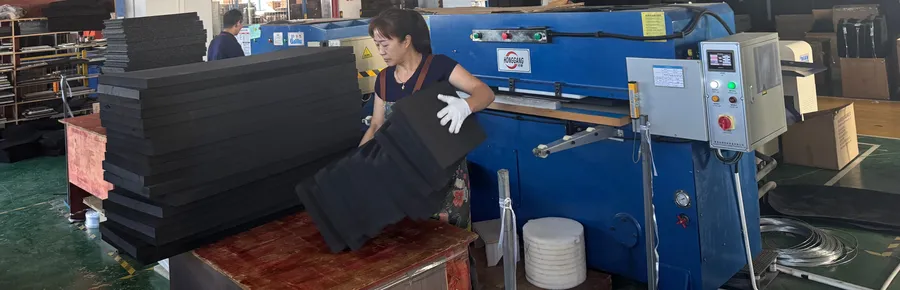
Configuration options that a thermal brief usually touches are all on the standard list: custom foam and interior zones from a single piece, custom colour and logo from 300 pieces, hardware and gasket selection by configuration, an optional pressure-equalisation valve quoted on request, and private-label work. OEM on an existing mould runs about 45 days to first sample; a new mould is about 125 days with a minimum from 3,000 pieces per component, on EXW or FOB terms. We work wholesale and OEM or ODM only - no retail, no delivered-duty-paid shipments, no overseas warehouse stock - with a 30 percent deposit and the balance after inspection, and third-party inspection at our facility is welcome.
The clock matters for a thermal brief specifically, because the cheapest way to find out that a gasket or a liner does not behave is to run one season of the real route with a sample rather than 400 pieces. Build the test into the 45 days, not into the container. Enquiries go to Fred Zhao or the KeXin Sales Team, WhatsApp +86 135 3588 0002.
What we do not claim about temperature
Our product data carries three kinds of record and we label them accordingly. Measured means it came from our own production or incoming-material data, which is how seal type on 124 shells and corrosion resistance on all 155 are recorded. Manufacturer option means a construction we can supply, where the figure depends on the configuration ordered - that is how gasket material, latch count, shock and impact protection are recorded. Not measured means no test record exists and no value will be stated, and that is the status of temperature_range_c, uv_resistance, waterproof, dust_resistant, protection_rating, stack_load_kg and load_capacity_kg on every one of the 155 models.
So this page states mechanisms, geometry and routines, and no temperature figure. We cite no test result, no laboratory report, no customer name, no order and no position in the market. If your acceptance criteria require a thermal figure, we will quote accredited testing against the configuration you order and we will not substitute a claim for it.
Customisation
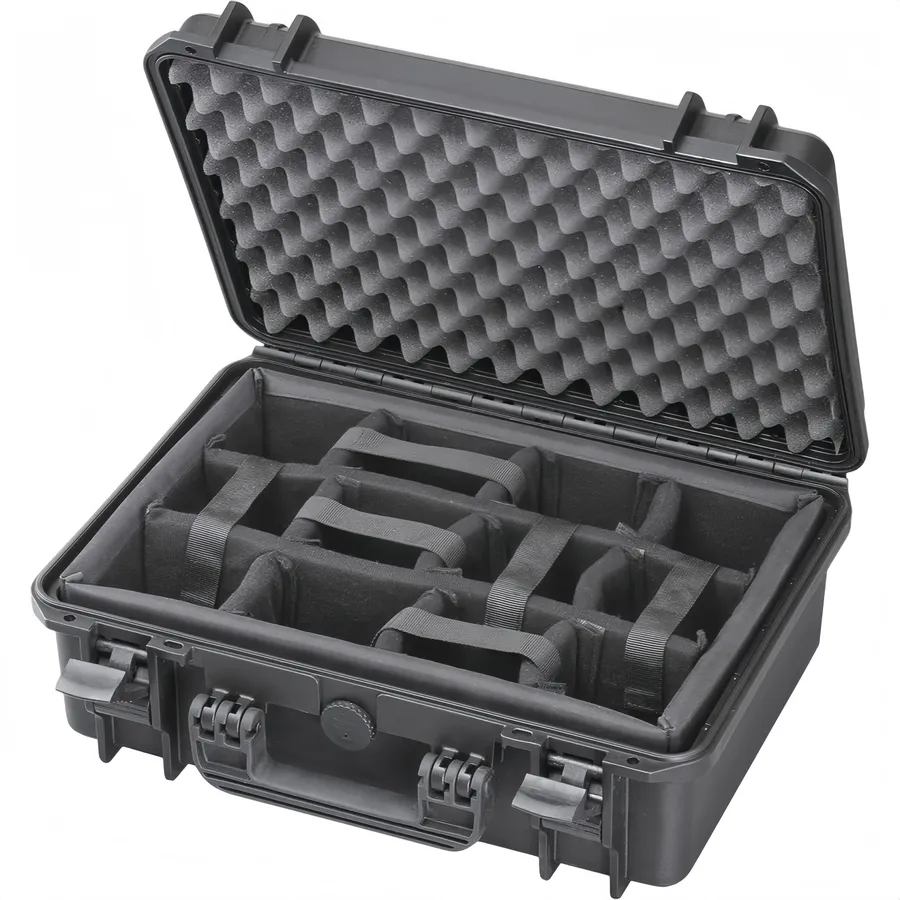
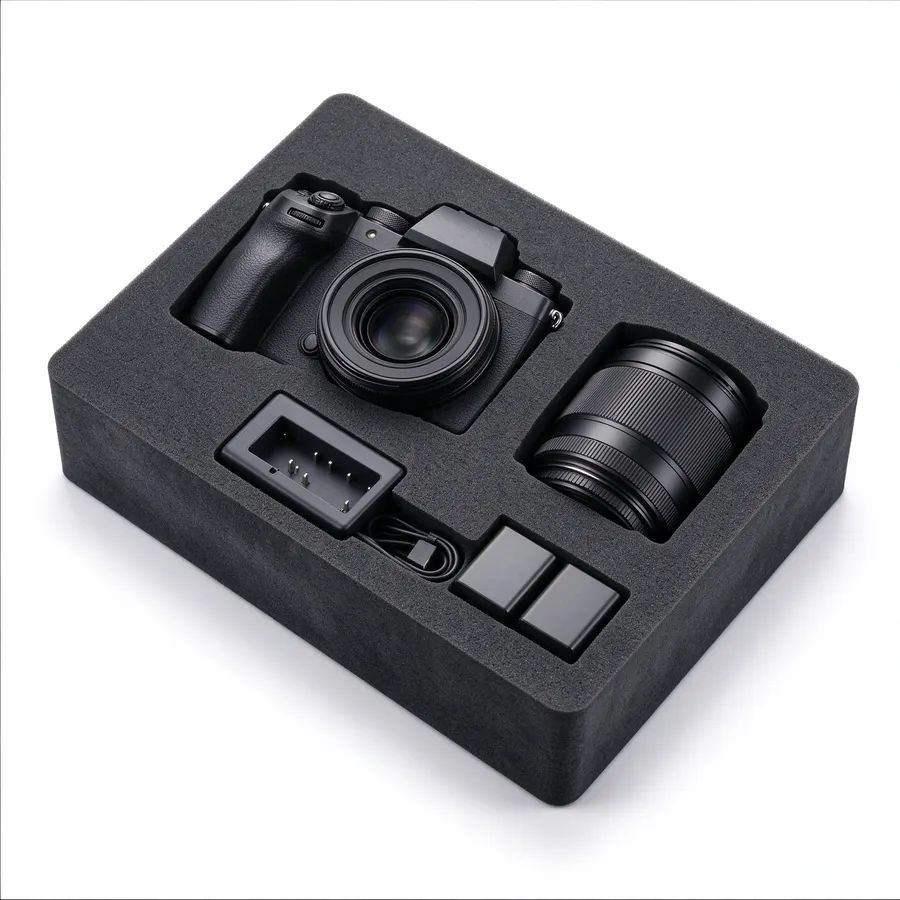
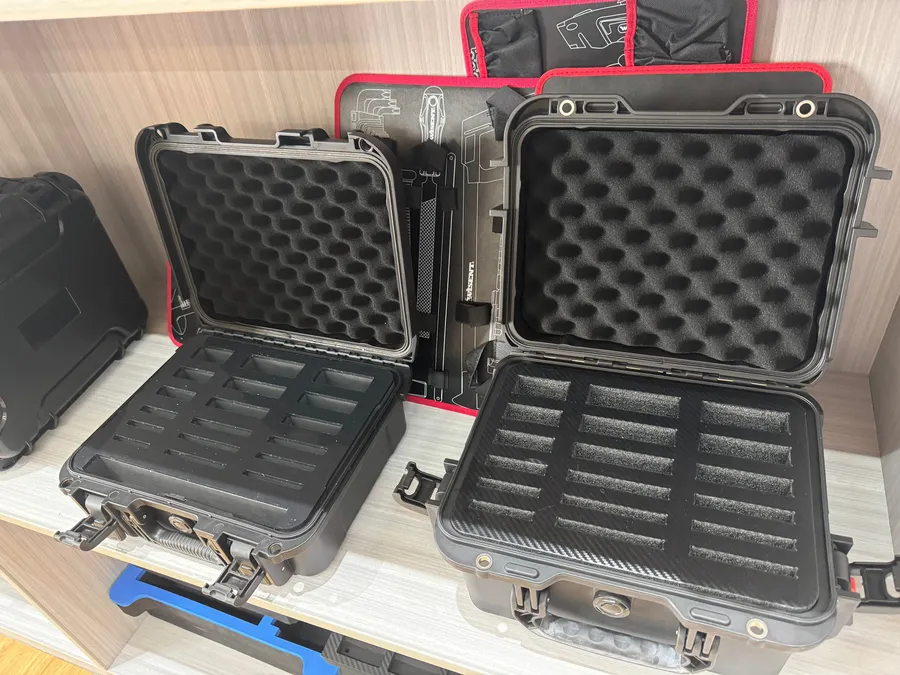
Everything described above is configurable on a standard shell: interior layout (pick-and-pluck, die-cut or CNC-cut), foam grade and thickness, colour, logo method, latch and lock count, pressure-equalisation valve, cable ports, document holder and identification plate. A bespoke exterior geometry requires a new mould — 125 days, from 3,000 units per moulded component.
Procurement considerations
| Question | What to send us |
|---|---|
| Which shell fits? | Equipment L × W × H as packed, plus required clearance per axis |
| What does it cost? | Order quantity and estimated annual quantity — the two drive different answers |
| Is tooling needed? | Whether an existing shell clears the envelope with usable foam depth |
| Lead time? | Your required delivery date, not just the order date |
| Certification? | The exact standard your tender names — we will say whether we can test to it |
| Freight? | Destination and preferred terms; carton and pallet data supplied with the quotation |
Comparison and selection guide
The tables on this page exist because a protective case is chosen by comparing three things: the envelope, the environment and the handling chain. Where no table applies, the rule below is.
| Situation | What To Do |
|---|---|
| Occasional splash | A close-fitting rim without a gasket is cheaper and easier to maintain. |
| Rain and washdown | Sealed configuration, four or more latches, stainless hardware. |
| Immersion or pressure change | Sealed configuration plus a pressure-equalisation valve, and a documented test. |
- Size on internal dimensions plus clearance, never on a product name.
- Choose the carrying method before the shell: it changes the series, not just the price.
- Specify the interior last, and decide up front whether the end user will reconfigure it.
How do temperature changes affect equipment cases? relates to Waterproof & Dustproof Guide. Related families: Waterproof Cases / Outdoor Protective Cases / Equipment Transport Cases / Military Protective Cases / Custom Protective Cases / Instrument & Equipment Cases. Related sectors: field and industrial equipment. Continue in the Waterproof & Dustproof Guide cluster.
This page is written from our own production data. If your requirement differs, send the dimensions and we will tell you which of the 155 models fits, or whether a custom route is needed.