How are protective cases tested?
In six separate activities, run by four different parties, on six different kinds of specimen - not by one test that produces one word for a catalogue. Incoming material is checked against resin lot records. Moulded geometry is checked on the part, which is how dimensions, wall thickness and lid-to-base split get published. A first article is approved against your packed load. Assembly on the line is verified as conditions rather than as figures. Finished goods are inspected before shipment, by your inspector or ours. And a documented performance result is produced only by qualification testing at a laboratory, on the exact model, closure, interior and load you intend to buy. The distinction that saves buyers the most money is between the first five, which a factory performs as part of production and can show you, and the sixth, which is a commissioned work package that belongs to one configuration. In our own published data the first five are represented: geometry and volumes on all 155 models, wall thickness on 148, sealing construction on 124. The sixth is not represented anywhere, because water, dust, ultraviolet, service temperature, stack load, load capacity and any protection class are recorded as unmeasured on every model we list.
Key points
- There is no single test for a protective case: six activities at six stages answer six different procurement questions.
- Ask how waterproof protective cases tested against a named method are evidenced and the answer is a laboratory report for one frozen configuration.
- A factory performs material, dimensional, first-article, assembly and pre-shipment checks as part of production; it does not own performance figures.
- Our published data is strong on geometry and construction and silent on performance, which is the honest shape of a moulding factory's own records.
- Freeze the specimen before booking any test: model, wall, latch count, gasket lot, valve decision and foam layout.
- A report describes the article in the chamber. Change a grade, a pocket, a latch count or a fitted mass and it no longer describes yours.
- Put test scope, sample size, acceptance criteria and report ownership in the request for quotation, not after delivery.
- Terms of business never move: wholesale and OEM only, EXW or FOB, no retail, no delivered-duty-paid and no overseas warehouse stock.
The short answer: six stages and four owners
There is no single honest reply to how protective cases tested in a real supply chain are judged, because the word covers six different activities with different owners, different specimens and different uses. Stages one to five are production activities: material incoming checks, moulded dimensional control, first-article approval, in-line assembly verification and pre-shipment inspection. A factory performs them continuously, they cost nothing extra as a separate service, and their output is what makes a specification sheet readable. Stage six is qualification testing: a laboratory procedure on a named article under a named method, producing a report. It is commissioned, priced, scheduled and owned, and its result belongs to one configuration rather than to a product family.
Most buyer confusion sits exactly on the seam between five and six. A supplier who answers a performance question with a production record is describing how the case is built; a supplier who answers a build question with a laboratory report is describing one article at one moment. Both documents are useful and neither substitutes for the other. The rest of this page walks the six stages, names what each one can and cannot prove, and shows where our own published catalogue sits on that line.
Stage 1: incoming material, where a resin lot is the specimen
Before anything is moulded, the material is checked against its lot: which resin family, which compound, which colourant, and what the supplier's certificate for that delivery says. Our published catalogue records the shell family per model - polypropylene on 94 models, engineering polypropylene on 38, ABS on 22 and one PP/ABS combination - and it records corrosion resistance on all 155 as a measured property of that choice, in the words of the data itself: a thermoplastic shell with no ferrous corrosion path. Read that as a material route removed from a failure list. It is not a salt-spray exposure figure, and a buyer who needs one needs stage six.
Hardware arrives the same way and is described the same way. Metal or polymer hardware is recorded as a configuration choice, the gasket compound as an order option described as EPDM or equivalent compressible gasket, and the foam grades - cross-linked polyethylene, EVA and EPE - are selected per zone rather than per case. The useful document at this stage is the lot record and the certificate of analysis, not a test report, and the audit question is traceability: can the batch you received be tied back to the material it was moulded from. Ask that of any supplier and you will learn quickly which of them actually controls its own inputs.
Stage 2: moulded geometry, the numbers that end up on the model page
This is the stage that produces the figures a buyer can verify with a calliper on the delivered part, and it is where our catalogue is densest. External and internal dimensions are published on all 155 models, together with nominal and usable interior volume; wall thickness appears on 148 models, running from 2.0 mm to 6.0 mm with a median of 3.90 mm; the lid-to-base split is published on 100 models, lid depth from 16 mm to 320 mm and base depth from 15 mm to 168 mm; a narrow internal width appears on the 36 tapered bodies, from 70 mm to 308 mm; net mass is published on 93 models, from 100 g to 15,320 g with a median of 1,480 g; carton dimensions on 64 models and pieces per carton on 58, from 1 to 40 with a median of 10.
It is equally important to state the gaps, because they are what a method question catches. Seven models publish no wall figure at all - KX-84814, KX-84815, KX-84823, KX-84824, KX-95419, KX-6922 and the rolling KX-5126 - and we do not estimate a value for them. Gross weight is published on none, which matters because a forwarder bills the packed figure and that depends on the packing agreed for your order. Nineteen models carry wheels and a telescopic handle but only eleven publish the extended height. CAD data is recorded as not available on all 155. A specification sheet with holes in it is not a weakness; a sheet whose every cell is reassuring is the one to distrust.
Stage 3: the first article you actually approve
The first article is the bridge between our production data and your requirement, and it is a physical thing: a case moulded on production tooling, with the interior cut to your layout, carrying your packed load. On an existing moulding it is planned at 45 days, with a 30 per cent deposit opening production and the balance paid after your inspection. A cut foam layout is made from a drawing, a photograph of the packed kit or a physical sample and starts at a single set, which is what allows fit to be proven before a fleet is committed. Colour, printed logo and OEM production on an existing tooling start at 300 pieces. A genuinely new shell geometry is a mould project: about 125 days and from 3,000 pieces per moulded component.
What a first-article review legitimately covers: whether the packed load sits in the cavity with the clearance the layout intended, whether the lid closes and every latch locates, whether the sealing line is continuous and unobstructed, whether the case stands, stacks or rolls as its published configuration says, and whether identification, marking and packing match the order. What it does not cover: any performance figure. Approving an article is approving a build, not earning a rating, and a buyer who treats a signed sample as evidence of ingress or drop behaviour has skipped stage six and will find that out in an audit rather than in the workshop.
Stage 4: in-line assembly checks, written as conditions
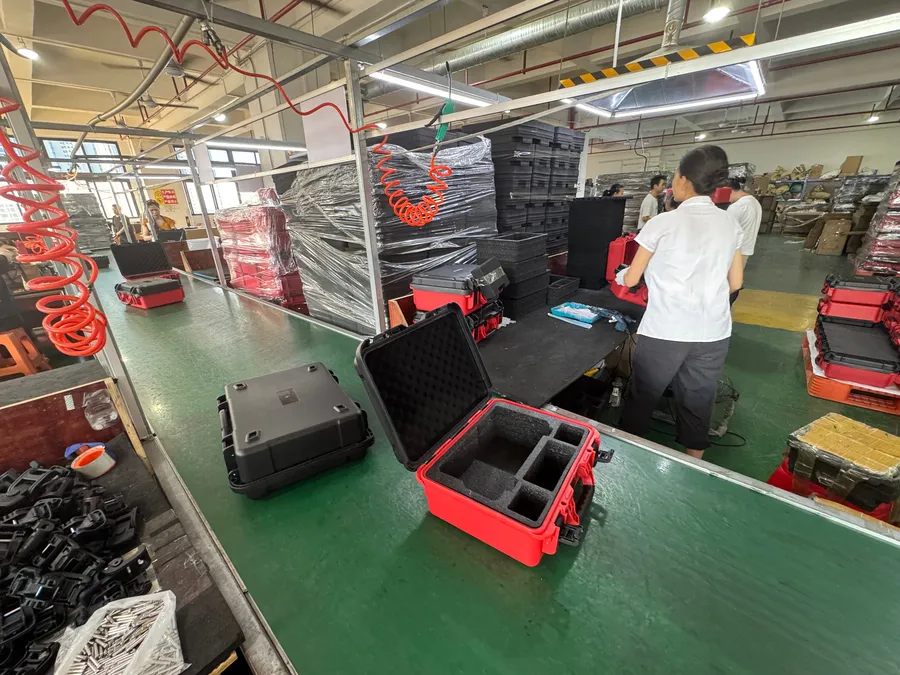
Sealed cases are verified on the line as a set of conditions rather than as a number, because that is what an assembly check can honestly produce. The conditions we work to are: the gasket fully seated in a continuous moulded channel with no twist and no lift at the join; closure uniform across every latch, checked by feel and by gap rather than with a torque figure; the channel free of trim tailings, adhesive and fingerprint grit at the moment the lid is closed for packing; and hinge, feet and latch body present and functioning, which our data records as measured on all 155 models, alongside the note that the latch body accepts a standard padlock.
A factory may also run an air-based leak check on the assembly line: the closed shell is pressurised or evacuated, a pressure change is watched for and outliers rejected. Say plainly what that proves and what it does not. It catches gross assembly defects - a gasket that was never seated, a missing latch, a rim that will not close. It does not demonstrate behaviour at depth or under a hose, and no responsible supplier offers it as if it did. On our catalogue the sealing construction is published per model, 124 listings stating a compressible gasket in a continuous moulded channel and 31 stating that no seal is offered on that shell; the water and dust fields read unmeasured for every one of the 155.
Stage 5: pre-shipment inspection of finished goods
This stage belongs to the buyer's quality plan more than to the factory's, and third-party inspection of our finished goods and of the factory itself is welcome at any time. The documents an inspector needs are produced from stage two and stage four: the packing list against the agreed carton, carton dimensions on the 64 models that publish them, pieces per carton on 58, the closure and gasket conditions the line worked to, and the approved first article as the visual reference. Sampling plan, acceptable quality level and what happens to a rejected carton are your side of the arrangement, and they should be written into the purchase order rather than discovered on the dock.
Freight arithmetic is the one place where our published numbers are deliberately incomplete. Pallet quantity is recorded as calculated from the carton footprint against your pallet size rather than measured, and 20GP, 40GP and 40HQ loading is supplied with the quotation, because a load figure that depends on your pallet and your mix cannot honestly be printed against a shell. Commercial terms are fixed at this stage too: wholesale and OEM volume only, quoted EXW or FOB from the factory, with no retail channel, no delivered-duty-paid arrangement and no overseas warehouse stock, so the freight leg and any import step belong to your own forwarder and your own planning.
Stage 6: qualification testing, where the specimen has to be frozen first
A qualification result is produced by a laboratory on an article whose definition was fixed before the specimen was built. Six families come up repeatedly in enquiries, and they stress different parts of the same case. Drop and impact procedures ask what the contents experienced. Ingress procedures ask whether water or dust crossed the rim under a stated exposure. Vibration asks whether a heavy item travelled and a connector worked loose over hours rather than once. Compression and stacking ask what a column of loaded cases does to the lid of the bottom one. Environmental procedures ask what sunlight, cold soak or a service temperature does to a resin and an elastomer. And a small set of specialist categories - electrostatic discharge behaviour, equipment categories for flammable atmospheres, and air-drop or carriage qualification - ask questions that are entirely outside the shell's own construction.
Two rules govern this stage and are worth repeating until they are boring. First, the specimen is an assembly, not a shell: model, wall, gasket compound and lot, latch count and positions, valve fitted or blanked, any buyer-added penetration, interior layout revision, and the mass and its position. Second, the result is bound to that assembly. Our own listings follow both rules by refusing to state a figure where no record exists: impact resistance is recorded on all 155 models as a construction option whose note cites the wall thickness and states that no drop height is claimed without a test, and shock protection is recorded the same way with the condition that a specified foam layout is required, because the shell alone is not a rating.
| Test Family | What It Answers | What Must Be Frozen First | What Our Data Currently Says |
|---|---|---|---|
| Drop and impact | What the contents felt, and whether the closure stayed shut | Model, wall, latch count, interior revision, mass and centre of gravity, orientation sequence | Construction option on 155 models; no height figure on any |
| Water and dust ingress | Whether anything crossed the rim under a stated duty | Gasket compound and lot, channel condition, latch count, valve or blank, orientation, loaded or empty | Sealing construction on 124, none offered on 31; water and dust unmeasured on 155 |
| Vibration | Whether an item travels, grinds or loosens a connector over hours | Restraint method, pocket geometry, carrier layer, mount faces | No vibration record on any model; layout is designed from the packed load |
| Stack and compression | What a column of loaded cases does to a lid | Stack height, per-case mass, pallet, and whether the shell is one of the 136 published stackable | Stack load and load capacity unmeasured on all 155; 19 wheeled models published non-stackable |
| Environmental exposure | What sunlight, cold soak or heat does to resin and elastomer | Resin family and colourant lot, gasket compound, exposure duration and cycle | Ultraviolet and service temperature unmeasured on all 155; corrosion stated as a material fact |
| Specialist categories | Electrostatic discharge, flammable-atmosphere and air-drop qualification | The standard and revision your programme is being assessed against, and who assesses it | No record held; the method is quoted as its own work package on your configuration |
How waterproof protective cases tested against a named method differ from the rest
Buyers who arrive asking specifically about waterproof protective cases tested for a tender are asking about one family in stage six, and it has the strictest specimen rules of the six. Water does not test a material; it finds the boundary between two parts and waits there. So the article has to be the closed assembly exactly as it will ship - shell, gasket compound and lot, latch count and positions, valve fitted or blanked, any port or gland added later, interior as delivered - and the exposure has to be written as physical duty: depth and duration for immersion, flow and standoff for spray or hose, cycle count for humidity, orientation during the exposure, and the temperature differential between case and water, because that differential is what pumps the joint. A metre of water adds roughly ten kilopascals to every square centimetre of the rim, which is why a shallow tank and a deep one are different questions and a splash is not a submersion.
The acceptance evidence has to be agreed before the case gets wet, not after: indicator tape in the corners, a weighed absorbent pad, a visual check of the foam, a functional test of the contents. Sample size decides whether the report describes a batch or a photograph, and a failed unit normally goes to a destructive check to find the cause rather than to a summary line. This is also where three different test purposes get confused: a type test characterises a design once; a routine or production test asks whether the units in your shipment were assembled correctly; and a destructive check explains a failure. Accepting a type report when your programme needed a routine result is the most expensive and most common mistake in this category.
Where our own catalogue sits in the three claim states
Our published product data labels every performance field with one of three states, and it is worth reading them as a template to hold any supplier to. Measured means recorded from our own production or incoming-material data. Manufacturer option means a construction we can supply where the figure depends on the configuration you order. Not measured means no test record exists for that model and configuration, we state no value, and accredited testing can be commissioned as a separate work package. The distribution across 155 models is asymmetric in a way that tells you what a moulding factory genuinely knows about its own product.
| Field | State Across Our 155 Models | What A Buyer Can Rely On It For |
|---|---|---|
| External and internal dimensions, nominal and usable volume | Measured and published on all 155, from production data | Fit against your packed load, with clearance on every face and usable volume read against nominal |
| Wall thickness; lid and base depth; narrow internal width | 148 publish a wall, 100 the split, 36 the narrow width | Rim stiffness behind a closure and where cavity depth lives, per model rather than per series |
| Net mass; carton dimensions; pieces per carton | 93 publish net mass, 64 a carton, 58 a pieces-per-carton figure, none a gross weight | Handling and freight planning once the packing for your order is confirmed |
| Sealing construction and compound | 124 record a gasket in a continuous moulded channel; 31 record none offered; compound is an option | Closure design and a maintenance routine, not an ingress result |
| Impact and shock entries | Construction options; each note cites the model wall and states no drop height is claimed without a test | Choosing shell and foam, then commissioning a test if a figure is required |
| Water, dust, ultraviolet, service temperature, stack load, load capacity, protection class | Recorded as unmeasured on all 155, with accredited testing quoted per configuration | Nothing yet - which is the point, and the reason a commissioned report is worth its price |
What we say when a tender names a class or a standard
Plainly, and in this order. First, whether we hold a record for the article you are describing: usually we do not, because a catalogue of 155 shells in seven series has never been through a laboratory programme as a range, and no result from one neighbouring size travels to another. Second, what we can show you instead, which is the construction and the production data above, all of it verifiable on the delivered part. Third, what it would take to produce the number your specification asks for: the configuration frozen, the article built on production tooling, and accredited testing against the method and revision your reviewer named, quoted as its own work package with cost and duration stated before it starts.
We do not print a protection class, a standard number or a laboratory name we have not been to, and we do not attach an existing result to a different configuration to make a quotation look better. That position costs us the occasional order to a supplier who will simply write the figure, and it is the reason our buyers stop asking us for catalogue claims and start sending us their test scope instead. If you are screening suppliers, the fastest filter in this category is to ask which of the three states each figure sits in and to ask for the gaps to be listed. A supplier who can do that in one email is comparable against the next bid; a supplier whose answer is a single reassuring sentence is not comparable at all.
Reading a report: the eight lines that make it usable
Start at the identity block and check that the article described is the article you intend to buy: model and moulding batch, shell family and wall, closure with latch count and positions, gasket compound and lot, valve fitted or blanked, buyer-added penetrations, interior layout by drawing revision, and the mass with its position and restraint. Then the method: the standard or procedure and its revision, the apparatus, the conditioning before and after exposure, and the ambient temperatures of case, contents and environment. A report missing either block is a description of an event rather than a result you can design against.
Then the outcome lines, which a surprising number of reports leave vague: the acceptance criterion expressed as observable evidence rather than as the word pass; the sample size and how many articles were tested; what happened to anything that failed; the transmitted measurement at the contents if the question was about the payload rather than the box; who performed the test and whether that body is accredited for that method; and the date, with the production window the specimen came from. Write your own acceptance clause so that a changed parting line, a substituted foam grade, a revised latch position or a different gasket compound triggers a notification rather than a surprise, because a two-year-old report is only as good as the change control around it.
Matching the question you are asking to the stage that answers it
Fit questions are answered at stages two and three, and cheaply: check published internal dimensions against the packed load plus clearance, read usable volume against nominal - our ratio runs from 0.797 to 1.000 with a median of 0.850 - and approve a physical first article with your equipment in it. That single step catches bridging, relieved edges and internal travel, which are the three complaints most often misfiled as case failures. Durability and handling questions are answered at stages four and five: closure conditions on the line, sealing line continuity, hardware present and functioning, packing against the agreed carton.
Performance questions are only answered at stage six, and the honest triage is to buy the one or two documented results your programme genuinely needs rather than a catalogue full of unverified claims. The situations that usually justify it are a tender reviewer who will demand the record behind a claim, a warranty or safety exposure on a calibrated or medical payload, a route with repeated real drops such as drone and field service kits, and a contractual specification that names a method. Everywhere else, published geometry plus a proven interior plus a maintained rim gets most of the protection for a fraction of the cost - and sometimes an unsealed shell from the same series, since a gasket you never need is a gasket you still have to replace.
| Question You Are Asking | Answered At | What To Ask For |
|---|---|---|
| Will my equipment fit and stay where I put it | Stages 2 and 3 | Published internal and narrow dimensions, usable volume, lid-to-base split, and a first article with your load packed |
| Was this shipment built correctly | Stages 4 and 5 | Assembly conditions worked to, closure and gasket seating checks, packing list against agreed carton, and your own inspection |
| How are protective cases tested against water or dust | Stage 6 | A frozen configuration, a named method and revision, defined acceptance evidence, and a report naming the tested article |
| What will the contents feel in a drop | Stage 6 | Instrumented measurement at the payload, orientation sequence, mass and restraint, and repeat count on one article |
| Can a column of loaded cases be stacked in my store | Stages 2 and 6 | Published stackable status per model, 136 of ours stackable and 19 wheeled non-stackable, then a compression test if a figure is needed |
| What does this cost and when does it arrive | Commercial terms | EXW or FOB quotation, 45-day first article on existing tooling, 125 days for a new mould, carton and pallet plan |
Customising a case that is going to be tested
Order the test before you order the changes, because every one of them alters the specimen. Wall thickness, rib layout, the lid-to-base split and the parting line are moulding decisions and cannot be tuned per order; a new exterior geometry is a mould at about 125 days and from 3,000 pieces per moulded component. Everything else can move on existing tooling and is therefore a configuration decision you take with the test scope in hand: latch count and positions, gasket compound, colour and printed logo from 300 pieces, padlockable latch arrangement, a pressure-equalisation valve, document pocket, and the interior in pick-and-pluck, die-cut or CNC-cut form in PE, EVA or EPE, cut from a drawing, a photograph of the packed kit or a physical sample and available from one set.
The sequence that does not waste money is short: freeze shell, wall, closure, compound, valve decision and foam layout; build and approve the first article on production tooling; then commission testing on units from that build, with cost, duration, sample size and report ownership agreed in writing at the same time as the scope. We arrange the making and shipping of test articles and quote the test outside the case price, because a test bundled into a unit price is usually the test nobody paid for. Third-party inspection of ordinary finished goods remains separately welcome at any time.
Procurement notes before you sign
Put the test scope in the request for quotation rather than in a follow-up. Ask each supplier to label every figure as a production measurement, a configuration-dependent option or a laboratory result, to list what is not available, and to name the report holder and the sample size behind anything you intend to rely on. Ask for the model page geometry and closure statement, the latch positions, the gasket compound and the foam drawing revision, and put a change-control clause in the order so a substituted grade or a moved latch tells you before it invalidates a document. Keep your own specification in two columns: geometry and construction in one, evidenced performance in the other, with the second column empty until a report exists.
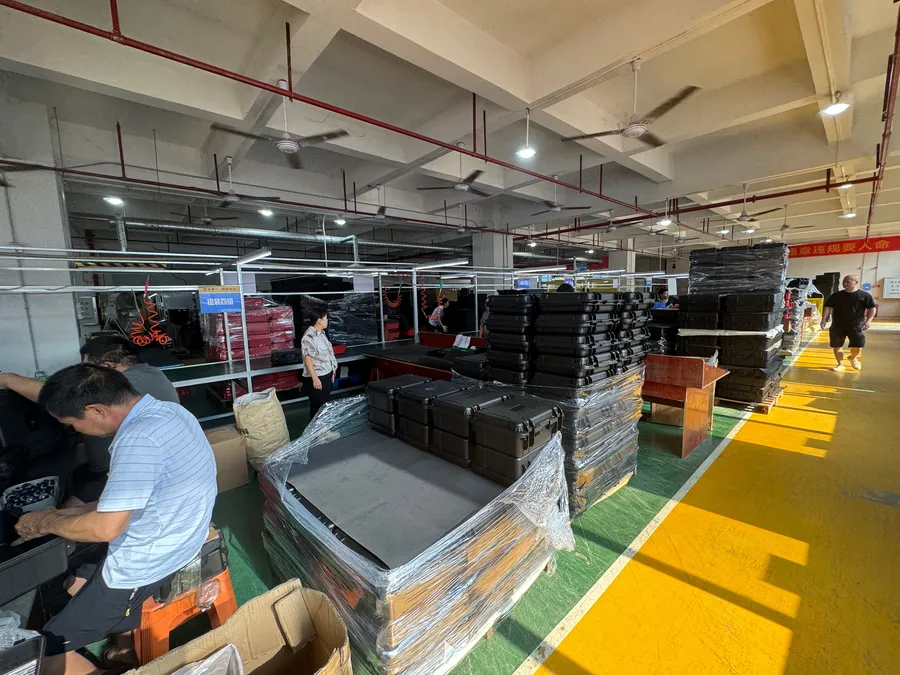
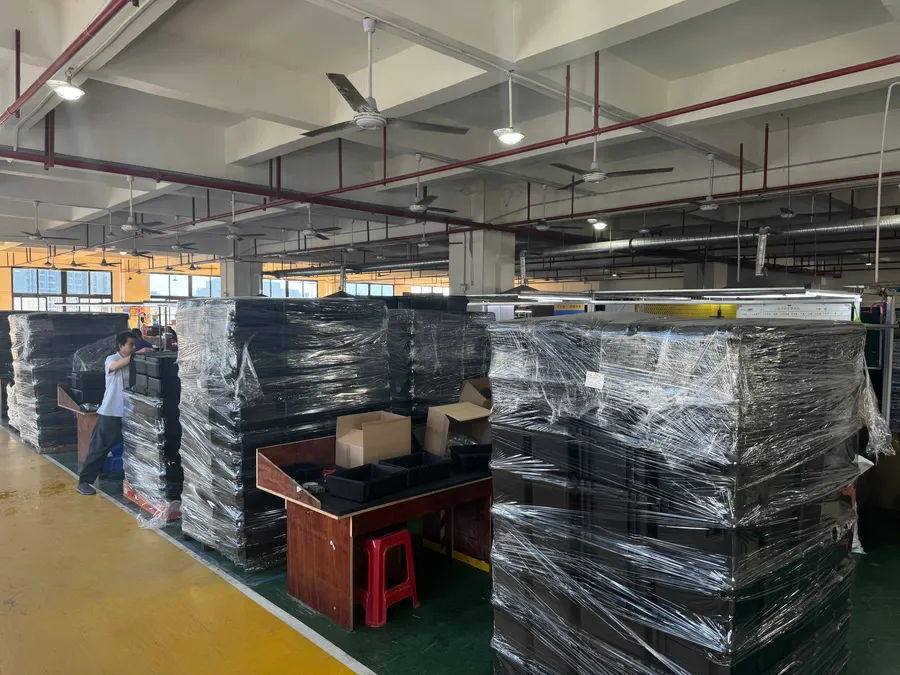
KeXin New Materials (Guangdong) Co., Ltd. manufactures for wholesale and OEM buyers on EXW or FOB terms only, with no retail channel, no delivered-duty-paid quotation and no overseas warehouse stock. Send the packed dimensions and mass of the load, the exposure or the tender clause you are working to, the quantity per delivery and the destination, and we return candidate models with their published dimensions, wall thickness where recorded, sealing construction, closure and hardware configuration, net mass where recorded and carton data - together with a plain statement of which figures we hold, which we can build but have not tested, and which need a laboratory. Fred Zhao, KeXin Sales Team, WhatsApp +86 135 3588 0002.
Customisation
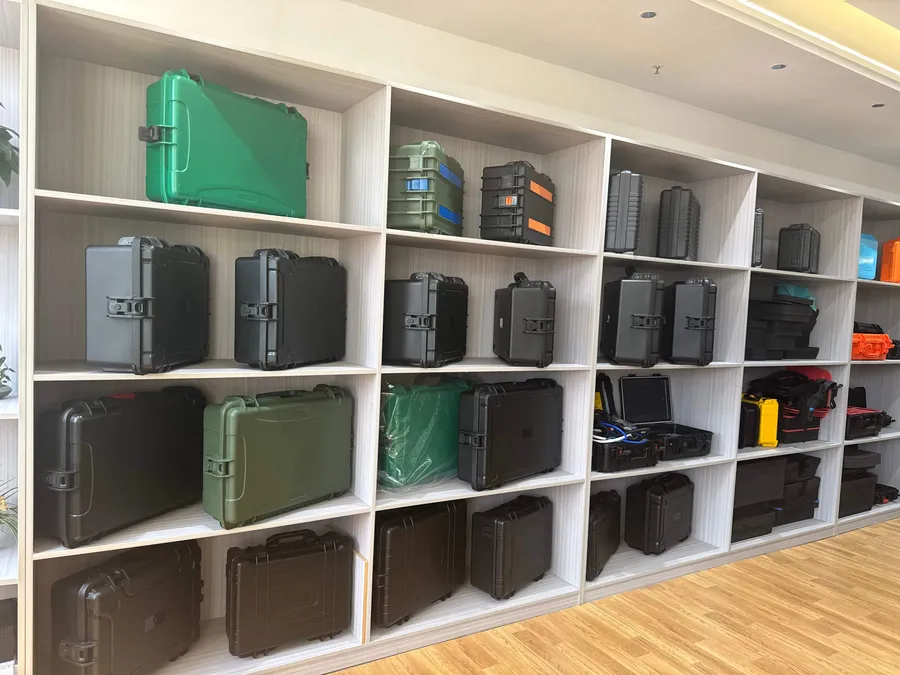
Everything described above is configurable on a standard shell: interior layout (pick-and-pluck, die-cut or CNC-cut), foam grade and thickness, colour, logo method, latch and lock count, pressure-equalisation valve, cable ports, document holder and identification plate. A bespoke exterior geometry requires a new mould — 125 days, from 3,000 units per moulded component.
Procurement considerations
| Question | What to send us |
|---|---|
| Which shell fits? | Equipment L × W × H as packed, plus required clearance per axis |
| What does it cost? | Order quantity and estimated annual quantity — the two drive different answers |
| Is tooling needed? | Whether an existing shell clears the envelope with usable foam depth |
| Lead time? | Your required delivery date, not just the order date |
| Certification? | The exact standard your tender names — we will say whether we can test to it |
| Freight? | Destination and preferred terms; carton and pallet data supplied with the quotation |
Comparison and selection guide
The tables on this page exist because a protective case is chosen by comparing three things: the envelope, the environment and the handling chain. Where no table applies, the rule below is.
| Situation | What To Do |
|---|---|
| Occasional splash | A close-fitting rim without a gasket is cheaper and easier to maintain. |
| Rain and washdown | Sealed configuration, four or more latches, stainless hardware. |
| Immersion or pressure change | Sealed configuration plus a pressure-equalisation valve, and a documented test. |
- Size on internal dimensions plus clearance, never on a product name.
- Choose the carrying method before the shell: it changes the series, not just the price.
- Specify the interior last, and decide up front whether the end user will reconfigure it.
How are protective cases tested? relates to Waterproof & Dustproof Guide. Related families: Waterproof Cases / Military Protective Cases / Instrument & Equipment Cases / Electronics Cases / Outdoor Protective Cases / Custom Protective Cases / Medical Equipment Cases / Drone & UAV Cases / Rolling Cases / Tool Cases. Related sectors: field and industrial equipment. Continue in the Waterproof & Dustproof Guide cluster.
This page is written from our own production data. If your requirement differs, send the dimensions and we will tell you which of the 155 models fits, or whether a custom route is needed.


