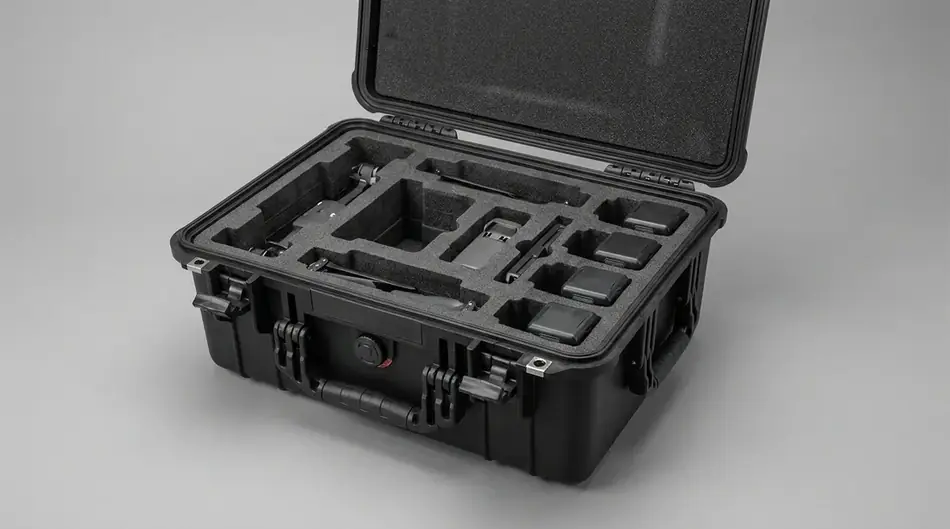
What should buyers check before purchasing a waterproof case?
Before purchasing a waterproof case, check seven things in order: the sealing surface (a continuous moulded rim that a compressible gasket sits in), the gasket material, how many latches clamp that rim and whether the load is spread evenly, whether the shell has a pressure-equalisation vent for altitude or temperature swings, the real internal dimensions against your gear rather than the external number, the wall thickness at the corners, and the supplier terms. Ingress protection is a measured result, not a material property: a case only keeps water out if the rim, gasket and clamping are all correct together. On this site we publish internal and external size, wall thickness, net weight and internal volume per model, we list a compressible EPDM-or-equivalent gasket as a construction option, and we do not print an ingress code or a depth rating unless accredited testing of the exact shell and interior you buy is commissioned and reported.
Key points
- Check the sealing surface first: a waterproof case lives or dies on a continuous rim that a compressible gasket sits in, not on the shell material alone.
- Count the latches and where they sit: water gets in where the lid is not clamped, so the load path must ring the whole rim evenly.
- Size on internal dimensions, not external: a case can be labelled waterproof yet too shallow for a lens hood or a connector.
- Ask about a pressure-equalisation vent if the kit flies, dives, or moves between hot and cold, or the seal will breathe water inward.
- Treat an ingress code as a test result: we publish size and construction per model and commission accredited testing only when a rating is genuinely required.
- Confirm terms before ordering: wholesale and OEM only, EXW or FOB Guangdong, and a gasket is a construction option whose result depends on the build you buy.
Start at the sealing surface, not the shell material
The first thing buyers check before purchasing a waterproof case is the sealing surface, because that is where the water either stops or gets in. A rigid polypropylene or engineering-PP shell on its own is not a seal; the seal is a continuous rim machined or moulded into the lid or base, into which a compressible gasket sits and is squeezed flat when the lid closes. Across our 155 published models a compressible EPDM-or-equivalent gasket is listed as a construction option, which means we can supply it, but the way it performs in the field depends on the exact rim, gasket and clamp you order. Ask the supplier to show you the rim, not just a photo of a closed lid, and ask whether the gasket is captured in a channel or simply bonded on, because a bonded strip lifts at a corner after a few hundred open-and-close cycles.
Count the latches and trace the load path around the rim
A gasket only seals where something presses it down. Buyers should check how many latches a case has and where they sit relative to the sealing rim. A four-latch lid can still leak in the middle of each long side if the clamping force stops short of those points, so look for a latch count and position that rings the rim evenly, plus a hinge side that does not twist the lid out of flat when it is carried. Compression stops on the corners are just as important: they set how far the lid can close, so the gasket is squeezed to its design thickness instead of over-crushed at the latches and under-crushed between them. If a datasheet lists a latch type but never says how many or where, that is a gap worth asking about before a purchase order, not after.
Match the real internal size to your gear, not the external box
The most common expensive mistake is buying on external dimensions. A case can seal perfectly and still be useless because a mounted lens, a top handle, a field monitor or a connector is taller than the interior. Always check internal length, width and height, and the split between lid depth and base depth, against the tallest item you pack. For reference, our compact WL1204 gives an internal 115 x 78 x 32 mm at 100 g net, the WL1905 gives an internal 180 x 160 x 40 mm at 250 g, and a WL4616 gives an internal 455 x 338 x 148 mm at 1395 g with an even 74 mm lid-and-base split. Leave at least one wall thickness of clearance on every side so the gasket rim is never loaded by the gear itself.
Check wall thickness at the corners, not just the label
Wall thickness decides whether the shell holds the rim flat under load. A thin shell can flex at the corners, opening a hairline gap in the seal exactly where a stack or a drop would exploit it. Published wall values across our models run from about 2.0 mm on light compact shells to about 6.0 mm on thick-wall series used for stacked transport; the WL9-2817, for instance, is a 5.0 mm engineering-PP wall, and the WL5321 is a 5.8 mm engineering-PP wall. Do not generalise one model's wall to a whole range: read the wall thickness for the specific model and configuration you are buying, and check that the corners and latch bosses are where the thickness is, because that is where the seal is loaded.
Sealed versus unsealed shells, on published figures
| Model | Internal (Mm) | Wall (Mm) | Net Weight (G) | Sealing Published |
|---|---|---|---|---|
| WL1204 | 115 x 78 x 32 | 2.6 | 100 | Gasket offered as a construction option |
| WL1905 | 180 x 160 x 40 | 3.0 | 250 | Gasket offered as a construction option |
| WL2808 | 272 x 193 x 76 | 2.2 | 527 | Gasket offered as a construction option |
| WL4616 | 455 x 338 x 148 | 3.0 | 1395 | Gasket in a continuous moulded rim |
| WL9-2817 | 253 x 180 x 152 | 5.0 | 940 | Thick-wall shell, gasket on request |
| WL5321 | 481 x 373 x 192 | 5.8 | 4810 | Thick-wall shell, gasket on request |
Ask about a pressure-equalisation vent for altitude and temperature swings
A sealed case that is flown, driven over mountains, or moved between an air-conditioned store and a hot vehicle develops a pressure difference across the gasket. As the outside pressure drops the air inside pushes the lid up and can breathe moisture inward through the only path available, the rim. Buyers who pack gear that travels by air or works across temperature ranges should check whether the shell has a pressure-equalisation vent, and if not, whether one can be added as an option. This is not decoration: on the wrong trip profile a case with an otherwise sound seal will still draw water in, so the vent question belongs on the same checklist as the gasket and the latch count.
Understand what a waterproof rating is and what it is not
A waterproof rating is a result of a specific test done to a specific shell under specific conditions, not an adjective a manufacturer can attach to a material. It is exactly why buyers check before purchasing should treat a code on a datasheet as a claim to trace back to a test report. We do not print an ingress code, a drop height or a submersion depth as if it were a built-in property, because for our models that data is recorded as not measured; what we publish per model is internal and external size, wall thickness, net weight and internal volume. If a production insurer, a tender or a client genuinely needs a rating, we commission accredited testing of the exact shell and interior you buy and let the test report carry the number rather than the marketing page.
Confirm the commercial terms before you order
The last item on the checklist is the purchase itself. We supply wholesale and OEM only, on EXW or FOB Guangdong terms; we do not sell retail, we do not quote DDP, and we keep no overseas warehouse, so landed logistics are the buyer's side. A stock shell with custom foam starts at one unit, which lets a fleet or rental house pilot a cut before committing; a custom colour or logo is typically a three-hundred-unit order. OEM on existing tooling runs about forty-five days to first sample and a new mould about one hundred and twenty-five days, with a thirty percent deposit. Send the gear dimensions, the environment, the quantity and whether a test report is required, and we will return the model, the sealing and vent configuration and a written lead time.
Customisation
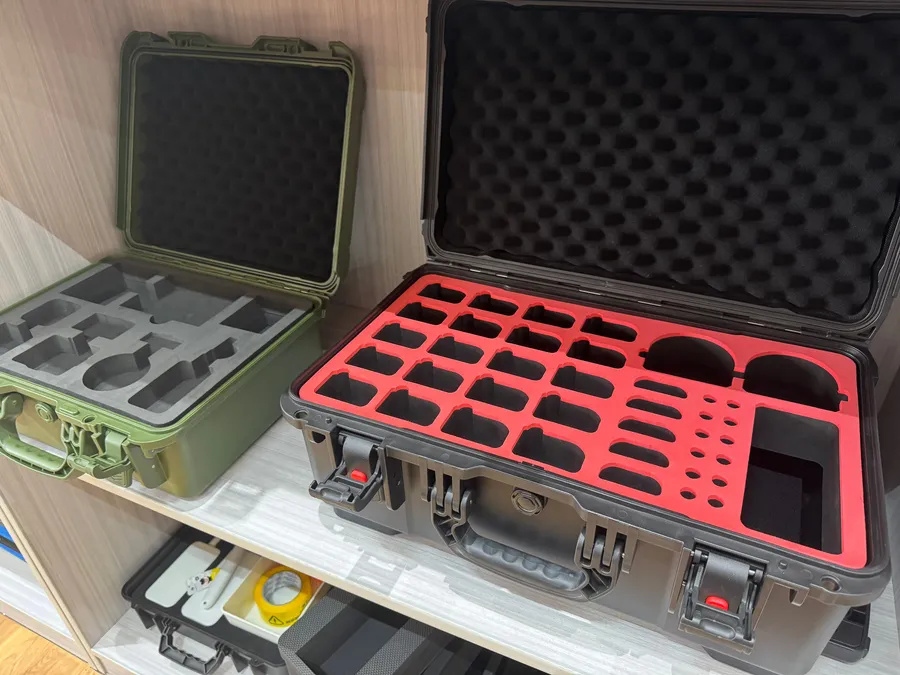
Everything described above is configurable on a standard shell: interior layout (pick-and-pluck, die-cut or CNC-cut), foam grade and thickness, colour, logo method, latch and lock count, pressure-equalisation valve, cable ports, document holder and identification plate. A bespoke exterior geometry requires a new mould — 125 days, from 3,000 units per moulded component.
Procurement considerations
| Question | What to send us |
|---|---|
| Which shell fits? | Equipment L × W × H as packed, plus required clearance per axis |
| What does it cost? | Order quantity and estimated annual quantity — the two drive different answers |
| Is tooling needed? | Whether an existing shell clears the envelope with usable foam depth |
| Lead time? | Your required delivery date, not just the order date |
| Certification? | The exact standard your tender names — we will say whether we can test to it |
| Freight? | Destination and preferred terms; carton and pallet data supplied with the quotation |
Comparison and selection guide
The tables on this page exist because a protective case is chosen by comparing three things: the envelope, the environment and the handling chain. Where no table applies, the rule below is.
| Situation | What To Do |
|---|---|
| Occasional splash | A close-fitting rim without a gasket is cheaper and easier to maintain. |
| Rain and washdown | Sealed configuration, four or more latches, stainless hardware. |
| Immersion or pressure change | Sealed configuration plus a pressure-equalisation valve, and a documented test. |
- Size on internal dimensions plus clearance, never on a product name.
- Choose the carrying method before the shell: it changes the series, not just the price.
- Specify the interior last, and decide up front whether the end user will reconfigure it.
What should buyers check before purchasing a waterproof case? relates to Waterproof & Dustproof Guide. Related families: Waterproof Cases / Outdoor Protective Cases. Related sectors: field and industrial equipment. Continue in the Waterproof & Dustproof Guide cluster.
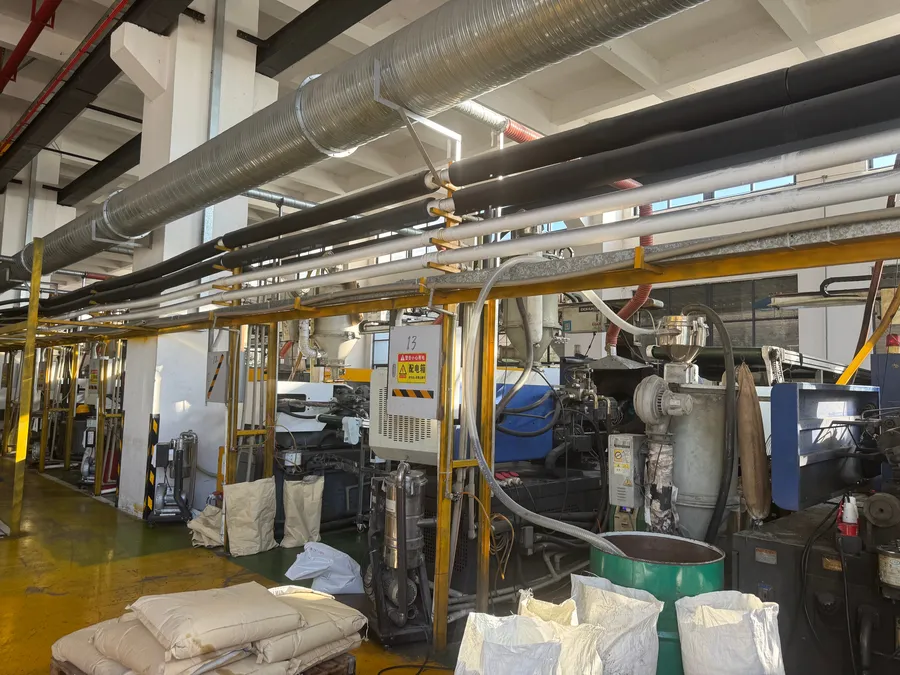
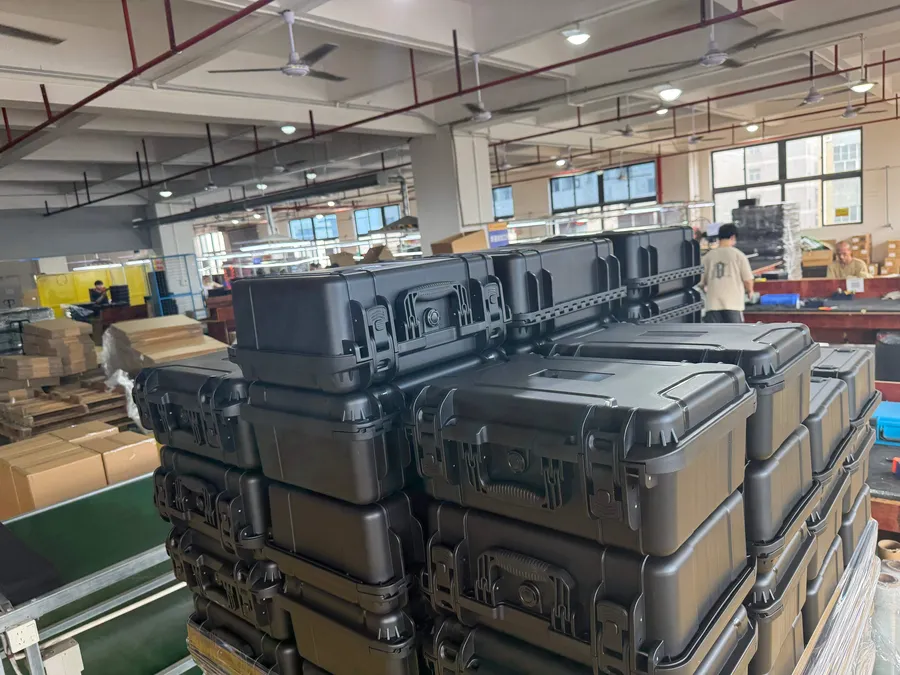
This page is written from our own production data. If your requirement differs, send the dimensions and we will tell you which of the 155 models fits, or whether a custom route is needed.