Kayak/surfboard Sealed Waterproof Dry Case: Size First, Seal Second
No case we mould carries a published ingress rating, an immersion depth or an immersion time, and that includes anything built for paddleside use. What we publish for each of our 155 active shell models is the internal and external size, the wall thickness, the net weight, whether a compressible gasket is offered, and the foam layout you specify. For a Kayak/surfboard sealed waterproof dry case the first filter is size, not seal: the longest internal cavity in the catalogue is 1,280 mm, and the longest model tagged for outdoor use is 880 mm, so a 1.8 m to 2.4 m board or hull never fits one shell and the load has to be split across paddle, fins, wetsuit and camera cases. Of 145 outdoor-tagged models, 114 publish a gasket in a continuous moulded channel and 31 publish none; water and dust performance is recorded as not measured on all 155, and no two-digit ingress code is printed on any datasheet or product page.
Key points
- Measure the longest rigid item before anything else: our published internal lengths stop at 1,280 mm, so a board or hull is split load, not one-case load.
- A gasket is a construction option, not a result: 114 of 145 outdoor-tagged shells list a compressible gasket in a moulded channel; 31 list none.
- Water, dust, UV, temperature range, stack load and working load are recorded as not measured on all 155 models, so no ingress code exists to quote.
- For a camera payload, specify lid depth and internal height from the published split, because the packing decides whether the lens survives, not a code.
- Wall thickness is the mechanical number we do publish: 2.0 mm to 6.0 mm on outdoor-tagged shells, recorded on 138 of the 145.
- A charging dock inside a closed gasketed shell is a heat question we do not answer: no ventilation or thermal figure is published for any model.
Kayak/surfboard sealed waterproof dry case: what the question is really asking
Buyers write Kayak/surfboard sealed waterproof dry case when they want one box for everything that gets wet, and the honest answer is that our catalogue is a rigids catalogue: 155 active moulded shells published with internal and external dimensions, wall thickness, net weight and a seal option, designed around cameras, instruments, radios and field gear rather than around watercraft. A 2.1 m touring kayak or a 2.4 m surfboard is longer than the biggest cavity we publish, so on this page size is the first filter and the seal is the second.
What a gasket does on our shells is close a continuous moulded channel around the lid interface so that splash, spray, rain, spray from a wake and shed wash-down do not travel straight into the interior. What we do not publish for any model is a water result, a dust result, an immersion depth, an immersion time or a two-digit ingress code, and we publish no buoyancy figure either. If your specification needs those numbers, they come from a test you commission on a sample, not from this datasheet, and we would rather say that in advance than let a tender assume it.
Size first: published internal lengths against board, paddle and wetsuit
Read the internal column and ignore the marketing name. Across the 155 models the maximum internal length is 1,280 mm on KX-814641 (1,280 x 350 x 140 mm inside, 50.2 litres usable, 5.0 mm wall, gasket offered, 100 mm lid and 40 mm base), and the longest shell tagged for outdoor use is KX-89616 at 880 x 350 x 140 mm inside and 34.5 litres. Everything that has to travel with a board therefore becomes a split load, with the hull or board strapped to a roof rack or a trailer and the case carrying the accessories.
| What You Want To Pack | Longest Published Internal Cavity | Our Answer |
|---|---|---|
| Surfboard or kayak hull, 1.8 m to 2.4 m | 1,280 mm on KX-814641; 880 mm on KX-89616, the longest outdoor-tagged model | No single shell we make takes a whole board or hull, and we do not quote one. |
| Two-piece paddle, about 230 cm broken into two halves | 1,280 x 350 x 140 mm on KX-814641, with 50.2 litres and a 5.0 mm wall | Two 115 cm sections fit the length; the decision is whether the blades come off, which is your paddle's design, not ours. |
| Fins, mask, snorkel, leash and a repair kit | 455 x 338 x 148 mm inside on KX-4616, 19.6 litres, 1.395 kg net, 3.0 mm wall, gasket offered | Fin rake drives the 148 mm internal height; cut the foam to the fins instead of stacking them loose against a wall. |
| Wetsuit, booties, rash vest and gloves for a season | 650 x 430 x 210 mm inside on KX-87323, 47.0 litres, 5.0 mm wall, gasket offered | Neoprene is a volume question and we publish litres; we publish no fits-one-wetsuit statement. |
| Safety smalls: knife, strobe, flares, locator beacon | 253 x 180 x 98 mm inside on KX-2811, 3.6 litres, 890 g net at a 5.0 mm wall | Small, thick-walled and shallow in the lid, cut item by item so nothing rattles against an optical face. |
What the seal on our shells is, and what the datasheet leaves blank
Of the 145 models tagged for outdoor use, 114 publish a seal type of compressible gasket in a continuous moulded channel and 31 publish none offered on the shell. That is a construction fact we can put in front of you, and it is the only seal fact we hold. On all 155 models the waterproof, dust, UV, temperature-range, stack-load, working-load and protection-rating fields are recorded as not measured with no value entered, which is exactly why this page offers no ingress code and why our own product pages leave the field empty rather than filling it with a neighbour's number.
| Datasheet Field | What Our Data Records | How To Read It |
|---|---|---|
| seal_type | Gasket in a continuous moulded channel on 114 of 145 outdoor-tagged shells; none offered on 31 | A construction option you order, described by what it is rather than by a result it has never been given |
| waterproof and dust_resistant | not measured, no value, on all 155 models | Any supplier number for these two fields should arrive as a test report you can inspect |
| protection_rating | not measured on all 155; we do not print an IP code on any datasheet or product page | A tender that demands a code needs a protocol, a sample and a laboratory work package, in that order |
| pressure equalisation valve | configurable on all 155 models, not fitted as standard | It moves air pressure across the seal; it is not ventilation, and it is not a water path either |
| impact_resistance | wall thickness per model, 2.0 mm to 6.0 mm across the outdoor-tagged group, published on 138 of 145; no drop height claimed without a test | Shell thickness is a design input you choose, not a drop result you can cite |
Outdoor drone aerial camera waterproof case: what to specify instead of a rating
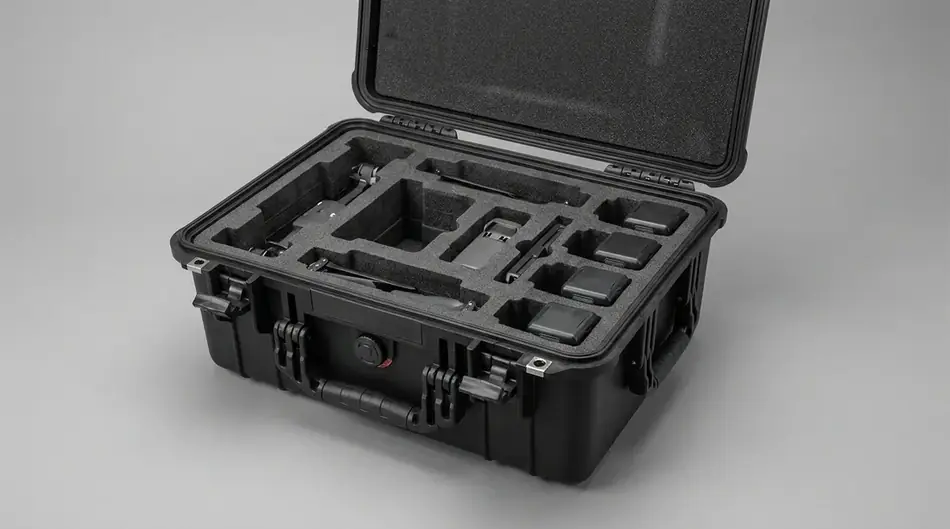
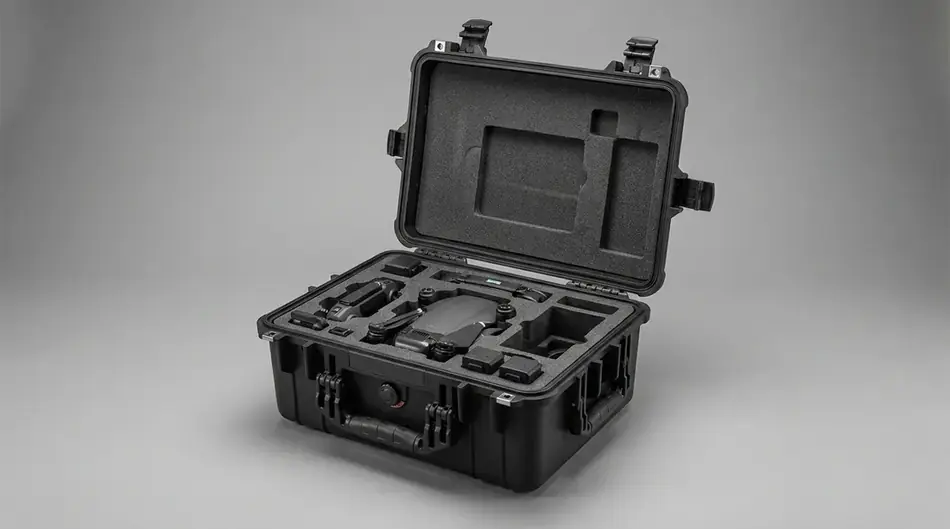
Someone searching Outdoor drone aerial camera waterproof case is usually protecting a gimbal camera or a payload between sessions, and the useful specification list is longer than the seal. 59 models are tagged for drone use and 85 for camera equipment. KX-64618 gives 430 x 290 x 165 mm inside, split into a 140 mm lid and a 25 mm base, with 16.5 litres usable, 2.775 kg net and a 4.7 mm ABS wall plus a gasket. KX-64819 steps up to 454 x 325 x 173 mm inside, 21.9 litres and 2.8 kg at a 3.5 mm wall, and KX-64120 is 378 x 307 x 187 mm inside, 17.4 litres and 2.64 kg at a 4.0 mm ABS wall.
Deciding what the case is actually keeping out
Salt spray and lake spray are not the same problem. A gasket resists the entry path, but the residue a wet trip leaves behind is a rinsing and drying instruction, and condensation forming inside a closed shell after a cold carry is a temperature and humidity event for which we publish no figure and offer no recovery claim. Our practical advice is to pocket the payload in cut foam with the lens facing up off the base, let the unit reach shed temperature before the lid closes, and treat any water number in a tender as a scope item for an accredited laboratory rather than a line copied from a brochure.
Outdoor ski goggles & accessories hard case: lens cavities and lid depth
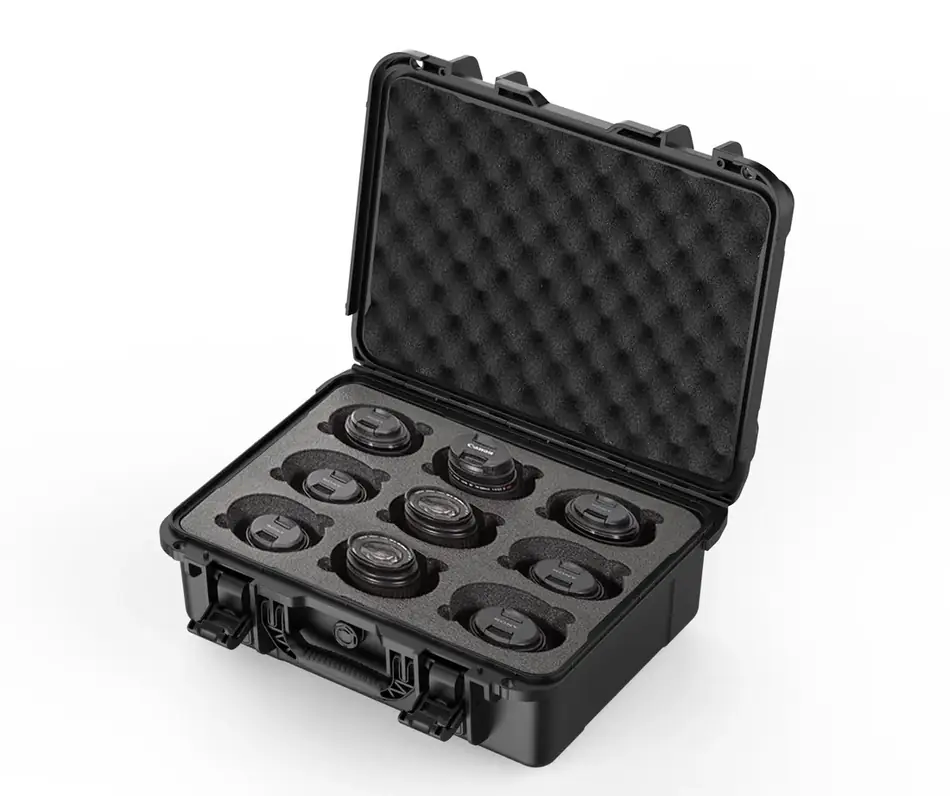
Outdoor ski goggles & accessories hard case is a foam question before it is a shell question. A goggle lens marks against a buckle or against a second lens, so the cavity is cut around each unit and the lid depth is what protects a spherical face. KX-3218 gives 308 x 230 x 172 mm inside with 86 mm of lid and 86 mm of base, 10.5 litres, 900 g net and a 3.0 mm wall with the gasket option. KX-2811 is smaller at 253 x 180 x 98 mm inside, 3.6 litres and 890 g on a 5.0 mm wall. Where a helmet rides alongside the goggles, KX-4616 offers 455 x 338 x 148 mm inside and 19.6 litres.
Cutting the foam around goggles, filters and straps
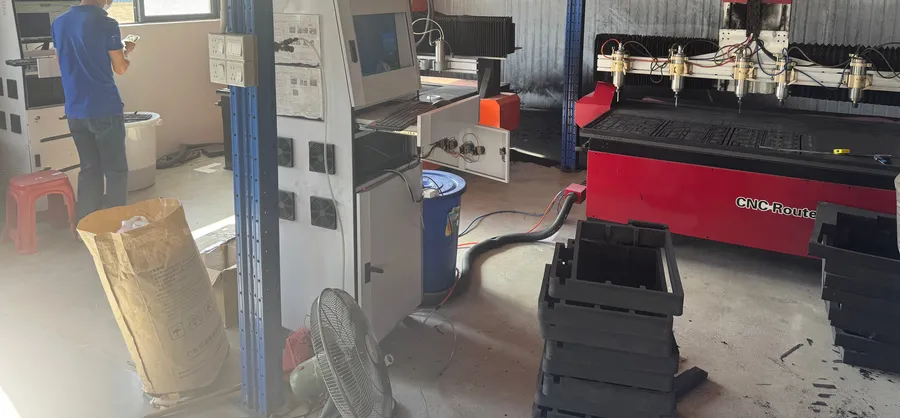
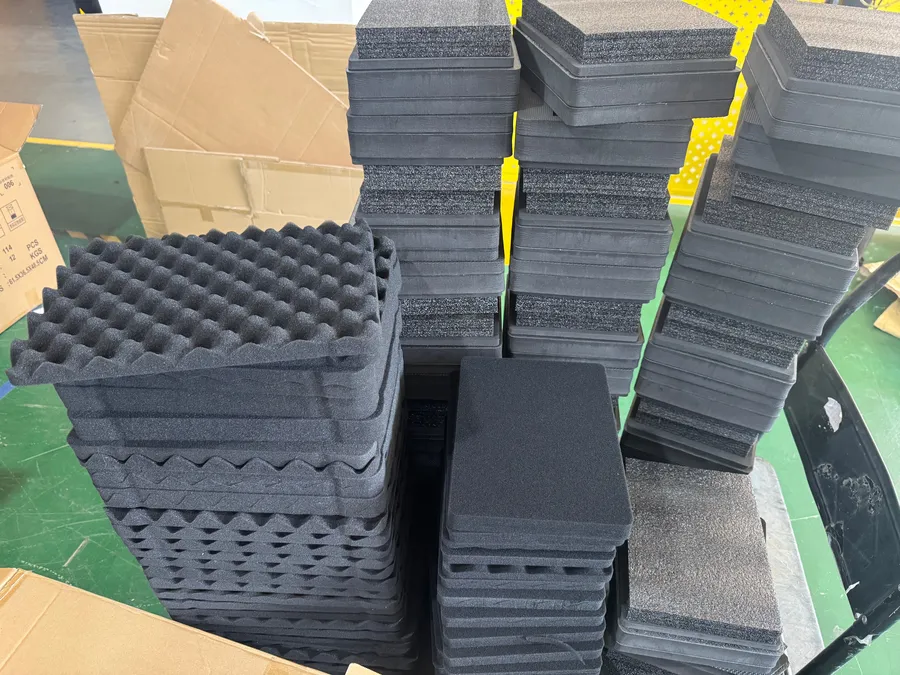
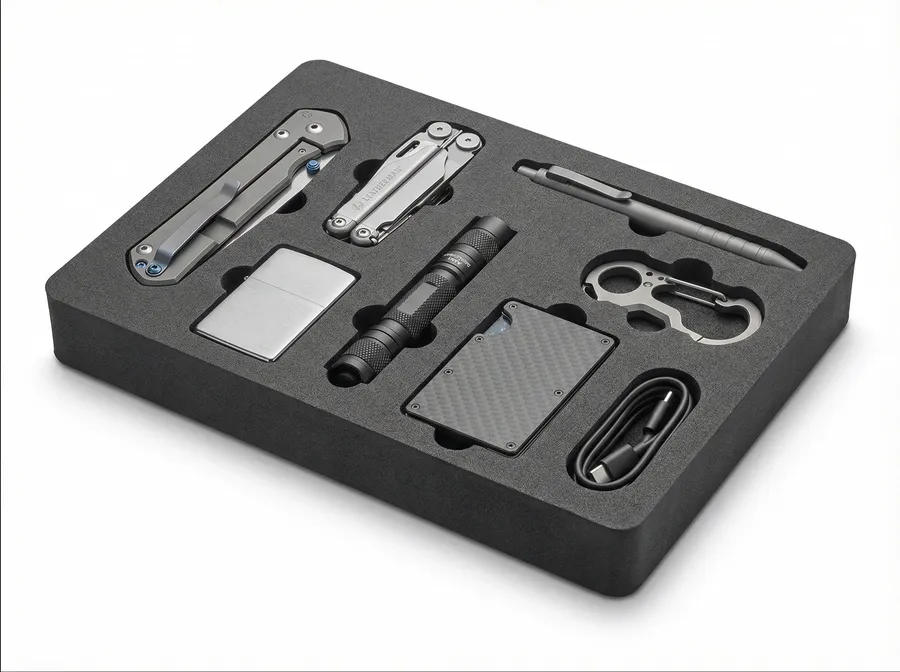
Our foam menu is published identically across the catalogue: pick-and-pluck, die-cut, CNC-cut, EVA, PE and EPE, in top, base, egg-crate, layered and custom-cut structures, with custom thickness and custom shape available. What we ask for before cutting is a drawing, a photograph of the packed kit or a physical sample, because a goggle case that ships and a goggle case that arrives with a marbled lens are usually separated by which of those three the buyer sent us. For the strap and clip pile, leave a closed-cell ridge between each unit rather than a common cavity, and keep the lid cut shallow enough that a buckle never bears on a lens when the latches close.
Outdoor walkie-talkie multi-charging station case: headroom, leads and heat
An Outdoor walkie-talkie multi-charging station case has to solve three problems at once: the vertical height of radios standing on a dock, the cable tail leaving the dock, and the heat the dock produces while the lid is shut. 99 models are tagged for communication equipment, and the trolley shells give the headroom. KX-85726 is 520 x 296 x 210 mm inside with a 155 mm lid and a 55 mm base, 25.8 litres, 5.6 kg net and a 4.2 mm wall. KX-96027 is 502 x 337 x 214 mm inside, 29.0 litres, 6.11 kg and a 5.0 mm wall. KX-97227 is 590 x 435 x 210 mm inside, 43.1 litres, 10 kg net and a 6.0 mm wall, the thickest figure we publish.
Why we do not describe a charging case by its seal
Read the heat question from the charger, not from us. A gasketed shell publishes no ventilation rate and no thermal figure for any model, and we do not state that a multi-bay dock may run with the lid closed; batteries on a charging rack warm up, and the dock maker's instructions and your site's battery rules decide whether that is acceptable. The valve option equalises pressure across the seal and is not a fan. Where a site is classified for an explosive atmosphere, that regime applies to the electrical equipment and the working procedure, not to a moulded shell, and we do not present any case as making a charging setup suitable for such an area.
Four search phrases, four different buying problems
The titles buyers use for this cluster look alike and are not the same purchase. The table answers each phrase with the field on our datasheet that actually decides the specification, and with the numbers we can publish against it. Where the honest answer is that a field is empty on our data, the row says so instead of borrowing a neighbour's result.
| Search Phrase As Buyers Write It | What It Really Asks | What Our Data Supports |
|---|---|---|
| Kayak/surfboard sealed waterproof dry case | Will one shell swallow a watercraft and keep it dry | Internal length stops at 1,280 mm; a gasket is offered on 114 of 145 outdoor-tagged models; water performance is not measured |
| Outdoor drone aerial camera waterproof case | Will the payload survive a wet transfer between flights | 59 drone-tagged models; lid and base splits published on 100 of 155; the seal is a construction option and no water value exists |
| Outdoor ski goggles & accessories hard case | Will the lenses arrive unscratched | Cavity depth and cut foam decide it: KX-3218 has 86 mm of lid; six foam types and five structures are published for every model |
| Outdoor walkie-talkie multi-charging station case | Can radios stand on a dock inside the case and travel | Internal heights to 364 mm on wheeled shells; no ventilation or thermal figure is published, so the lid stays open unless the dock maker says otherwise |
Wall thickness, shell material and what sun and cold do to either
Across the 155 models the shell material is recorded as PP on 94, engineering PP on 38, ABS on 22 and one PP plus ABS combination. On the outdoor-tagged group, wall thickness is published on 138 of 145 models and runs from 2.0 mm to 6.0 mm. Thickness is a stiffness and impact-path input you choose against how the case is actually moved: a 2.0 mm utility box that rides loose in a backpack is a different object from a 5.0 mm shell loaded onto a rack and dropped from a tailgate. UV exposure and low-temperature behaviour, however, are recorded as not measured on all 155, so a case that will live on a sun deck or sit on a ski field in January is a material conversation and a test scope, not a sentence we can copy into your specification.
Wholesale and OEM: packing, minimums, lead times and terms
We work on wholesale and OEM or ODM orders only, quoted EXW or FOB. We do not sell retail, we do not ship DDP and we hold no overseas warehouse stock, so freight and clearance belong in your own plan. Published minimums on every model are 1 piece for a standard shell and for custom foam, 300 pieces for a logo, a colour or an OEM order, and 3,000 pieces per component for a new mould. Lead time is 45 days for OEM work on an existing mould and 125 days for a new mould. Terms are a 30 percent deposit with the balance paid after inspection, and third-party factory audits are welcome.
Packing is the other half of a wholesale decision, and our data is uneven there on purpose. 58 of the 155 models publish a carton size and a pieces-per-carton figure; 91 do not, and we do not fill those blanks with an estimate. Pallet loading is recorded as not measured because it is calculated from the carton footprint against your pallet size, and 20GP, 40GP and 40HQ container figures are supplied with the quotation rather than printed on a datasheet.
| Model | Internal | Usable Volume | Net Weight | Carton Record |
|---|---|---|---|---|
| KX-1905 | 180 x 160 x 40 mm | 1.0 L | 250 g | no carton figure published |
| KX-2005 | 190 x 135 x 40 mm | 0.9 L | 175 g | 40 pieces in 410 x 360 x 495 mm |
| KX-62205 | 200 x 98 x 41 mm | 0.7 L | 310 g | 20 pieces in 475 x 285 x 320 mm |
| KX-3207 | 308 x 230 x 64 mm | 3.9 L | 570 g | 24 pieces in 645 x 530 x 430 mm |
| KX-62810 | 253 x 182 x 86 mm | 3.2 L | 900 g | 10 pieces in 480 x 293 x 550 mm |
What this page does not claim
So that a buyer can check us line by line: nothing here states an ingress code, an immersion depth, an immersion time, a drop height, a stack load, a UV or temperature result, a buoyancy figure, a test result, a customer name, an order history or an industry ranking. Those fields are either recorded as not measured in our product data or they are not ours to publish at all. The numbers above come from the specification sheet of the model named against them, and a figure taken from one shell should never be read as a property of the range.
Customisation
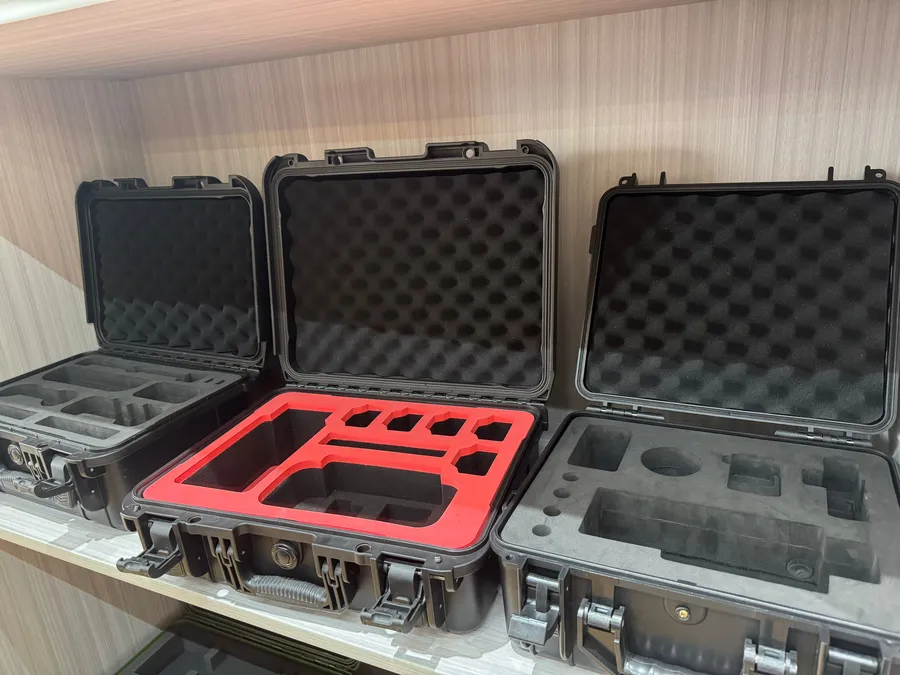
Everything described above is configurable on a standard shell: interior layout (pick-and-pluck, die-cut or CNC-cut), foam grade and thickness, colour, logo method, latch and lock count, pressure-equalisation valve, cable ports, document holder and identification plate. A bespoke exterior geometry requires a new mould — 125 days, from 3,000 units per moulded component.
Procurement considerations
| Question | What to send us |
|---|---|
| Which shell fits? | Equipment L × W × H as packed, plus required clearance per axis |
| What does it cost? | Order quantity and estimated annual quantity — the two drive different answers |
| Is tooling needed? | Whether an existing shell clears the envelope with usable foam depth |
| Lead time? | Your required delivery date, not just the order date |
| Certification? | The exact standard your tender names — we will say whether we can test to it |
| Freight? | Destination and preferred terms; carton and pallet data supplied with the quotation |
Comparison and selection guide
The tables on this page exist because a protective case is chosen by comparing three things: the envelope, the environment and the handling chain. Where no table applies, the rule below is.
| Situation | What To Do |
|---|---|
| Marine or wet | Sealed configuration with a drain-friendly interior and stainless hardware. |
| Dry and dusty | A close-fitting rim and a lid that can be opened one-handed without spilling contents. |
| Carried far | Under 10 kg packed, with a padded handle or shoulder webbing. |
- Size on internal dimensions plus clearance, never on a product name.
- Choose the carrying method before the shell: it changes the series, not just the price.
- Specify the interior last, and decide up front whether the end user will reconfigure it.
Kayak/surfboard Sealed Waterproof Dry Case: Size First, Seal Second relates to Waterproof & Dustproof Guide. Related families: Outdoor Protective Cases / Drone & UAV Cases / Camera & Photography Cases / Communication Equipment Cases / Custom Protective Cases / Long Equipment Cases / Rolling Cases. Related sectors: field and industrial equipment. Continue in the Waterproof & Dustproof Guide cluster.
This page is written from our own production data. If your requirement differs, send the dimensions and we will tell you which of the 155 models fits, or whether a custom route is needed.