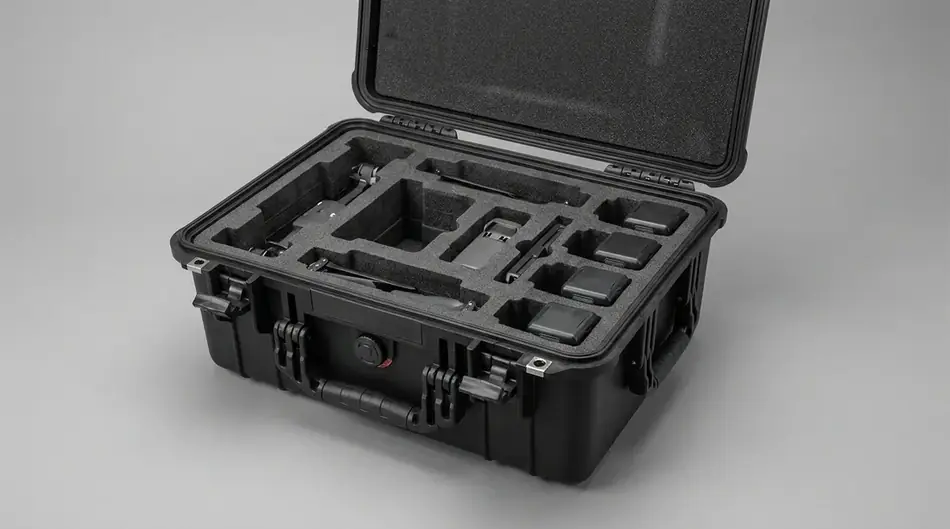
How should a small outdoor hard case be sealed?
Seal it as a complete closing path, not as a strip of rubber. A small outdoor case stays dry only where the lid mating face, the gasket, the latch pressure and every penetration are handled together: a compressible gasket - our material record lists EPDM or equivalent on all 155 catalogue models as a supplyable option - seated in a channel that runs continuously around the closing face, compressed evenly by enough latches at the right pitch, with any cable entry, hinge cut, handle boss or breather treated as part of the same loop. On our outdoor-tagged listings 114 of 145 models carry the seal flag, and among the twelve smallest bodies (3 litres or less) only four are listed with it: KX-1905, KX-62205, KX-62209 and KX-62109. Choose one of those four when a small shell must shed rain and dust, then specify the gasket, the latch count and the vent on the drawing. What we do not do is publish an ingress grade: the protection field on these models is recorded as not measured, so we state the construction we supply and, where a procedure needs a stated grade, we quote accredited laboratory testing on the finished configuration you order.
Key points
- Treat the seal as a loop: gasket, channel, mating-face flatness, latch pressure and every penetration are one system.
- 114 of our 145 outdoor-tagged models carry the seal flag; among bodies of 3 litres or less only KX-1905, KX-62205, KX-62209 and KX-62109 list one.
- The material record for all 155 models lists EPDM or equivalent compressible gasket as a supplyable option, which is a construction choice rather than a rating.
- Compression needs support: two latches on a 300 mm lid leave the middle of the loop lifted, so latch count is specified per configuration in our hardware record.
- Every cut for a cable, hinge or handle breaks the loop locally, so penetrations should be routed, plugged or re-seated rather than trimmed around.
- Protection grades on these listings are recorded as not measured; accredited testing against a chosen standard can be commissioned on the finished case.
Sealing Is A Loop, Not A Strip Of Rubber
The most common mistake in small outdoor hard case sealing is to buy the gasket and stop there. Water and dust do not diffuse through a moulded polypropylene shell; they arrive through the line where lid meets body, through any opening made for hardware, and through the air that moves in and out as the case changes altitude and temperature. A sealing plan therefore has to describe a continuous loop: a channel that holds the gasket, a closing face that is flat enough for that gasket to compress against, enough fasteners spaced closely enough to press the whole loop at once, and a treatment for each place the loop is interrupted.
Small cases are harder to seal than large ones, not easier. A 200 x 98 mm lid has very little room for a channel, so the bend radius at the corners is tight and the gasket has to be compressed against a short straight run between two latch centres. Wall thickness also works against you: our outdoor listings publish moulded walls from 2.0 to 6.0 mm, and a thin shell flexes more under a latch, which opens the loop on the far side of the lid. When buyers compare two shells of similar footprint, the sealed difference is usually channel design and latch pitch.
What Our Model Records Actually Say About Seals
Two different fields describe sealing in our catalogue and they answer different questions. The per-model seal flag says whether that listing is supplied with a gasketed closing face; the material record says what the gasket is made of when one is fitted, and it lists EPDM or an equivalent compressible gasket as a manufacturer option on all 155 entries. That is why we describe a seal as a construction we can supply rather than a property the whole range shares, and why a specification should name the model, the option and the quantity rather than the material alone.
| Model | Interior (Mm) | Volume | Wall | Net Weight | Seal Flag | Lid/Base Depth | Good For |
|---|---|---|---|---|---|---|---|
| KX-1905 | 180 x 160 x 40 | 1.2 L | 3.0 mm | 250 g | listed | 25 / 15 mm | Phone, meter or handset lying flat |
| KX-62205 | 200 x 98 x 41 | 0.8 L | 3.5 mm | 310 g | listed | not published | Handheld gauge or GPS in a narrow pocket |
| KX-62209 | 200 x 98 x 78 | 1.5 L | 3.5 mm | 410 g | listed | not published | Same footprint with cable and charger stacked |
| KX-62109 | 195 x 128 x 81 | 2.0 L | 3.0 mm | 470 g | listed | not published | Small instrument with a fitted boot |
| KX-1204 | 115 x 78 x 32 | 0.3 L | 2.6 mm | 100 g | not listed | 16 / 16 mm | Dry indoor storage, small accessories |
| KX-2305 | 225 x 150 x 40 | 1.4 L | 2.0 mm | 240 g | not listed | 20 / 20 mm | Shallow kit kept in a rucksack liner |
| KX-2805 | 270 x 190 x 46 | 2.4 L | 2.1 mm | 340 g | not listed | 23 / 23 mm | Larger flat kit, dust cover rather than rain |
| KX-3207 | 308 x 230 x 64 | 4.5 L | 3.0 mm | 570 g | listed | 32 / 32 mm | Compact camera or instrument kit in the rain |
Where A Small Case Actually Lets Things In
Four places account for nearly every complaint we hear about a leaky small case, and none of them is the shell itself. The first is the corner of the lid, where a gasket either has to be moulded with a radius or is cut and butt-joined; a straight join under a curved corner is the classic path. The second is under the latches: fastener pressure is local, so a lid held down at two points lifts along the run between them when the case is carried, stacked or knocked. The third is every hardware penetration - hinge barrels, handle bosses, padlock hasps, document-holder fittings and the valve hole - because each one is a hole through the boundary rather than a seal.
The fourth is what people forget entirely: the air. A sealed box that is packed at a warm low altitude and then carried up a hill or loaded into an aircraft hold ends up at a different internal pressure, and that difference either pulls dusty air in through the easiest gap on the way down or pushes damp air out on the way up. When the case then cools, the remaining vapour condenses on the coldest surface inside, which is usually the metal of a connector or the inside face of the lid. That is why an enquiry about outdoor hard box dust protection is often really an enquiry about condensation, venting and how the kit is stowed between uses.
Compression, Latch Pitch And The Mating Face
A gasket works by being squeezed to a defined fraction of its free height across its whole length, which means the closing face has to be supported underneath at regular intervals. Our hardware record lists latch count as specified per configuration rather than as a fixed number, and it records on all 155 models that the latch body accepts a standard padlock - two facts worth knowing, because they mean the fastener pattern is something you set when ordering rather than something inherited from the mould. On a small lid, moving from two latches to three or four is normally the cheapest single improvement available: it shortens the unsupported span, which reduces the flex that opens the loop. Ask what else the case carries and how it is stowed, because a 0.8 litre body packed beside a tent peg behaves very differently from the same body sitting flat on a shelf.
The other half is flatness. A hinge pin taken out of service, a shell that has been loaded in a pack against a rigid object, or a case stored with a strap cranked tight for months can distort the closing face enough that gasket compression is uneven even when nothing is visibly broken. That is why we ask how the case is carried and stored before quoting a sealed small model: the shape of the load around it decides whether an evenly compressed loop stays compressed.
Vents, Desiccant And The Things Buyers Specify Too Late
A pressure-equalisation valve is listed in our hardware record as a manufacturer option with no value preset on any model, which is the honest way to describe it: it is something we can add, and the spec depends on whether you need to equalise pressure while excluding liquid. If the case lives in a vehicle, a boat or an aircraft hold where altitude changes are routine, a valve is usually worth more than a thicker gasket. If it is carried on foot in the rain and then stored in a warm room, the better answer is often a desiccant pocket and a habit of opening the case to dry it out, because a valve cannot remove vapour that is already inside.
Three details are commonly decided after the tool has been committed and should be decided before. Lids that carry a document pocket compress the gasket differently from a plain lid. A foam inlay that swells after being compressed pushes the lid open, so the lining in the sealing zone should be sized, not simply over-stuffed - our material record lists cross-linked PE, EVA or EPS by zone as an option, and the inlay height in the closing region is what needs agreeing. And a carry strap or shoulder webbing that pulls the lid sideways changes the load path on the latch, which is why the strap is recorded as a configuration option rather than a given.
Choosing The Construction: A Comparison
The table below compares sealing approaches by what a buyer controls, what it costs in tooling or assembly and where it fails. It is a specification aid rather than a performance ranking, and the last column is deliberately about what has to be measured rather than assumed.
| Approach | What You Control | Cost Driver | Where It Fails |
|---|---|---|---|
| Gasketed closing face, moulded channel | Model and seal flag, gasket compound | Included in the model option; no new tooling on existing moulds | Corner joins and unsupported spans between latches |
| More latches, closer pitch | Fastener count and spacing per configuration | Hardware and assembly time, not moulding | Distorted faces still leak at the corners |
| Pressure-equalisation valve | Whether a valve is fitted and its type | Added component and a penetration to manage | Do not expect it to stop condensation |
| Desiccant pocket plus drying routine | Pocket position and service interval | Consumables and a small internal detail | Useless if the kit is packed damp |
| Sealed inner bag around the equipment | Inner packaging, not the shell | Low; packaging only | No protection for connectors or the lid pocket |
What We Do Not Publish, And Why
For the models in this range the protection field in our product data is recorded as not measured. That means we publish the seal flag, the gasket compound we supply as an option, the interior and exterior dimensions, the wall thickness, the lid and base depth where recorded, and the net weight where recorded - and we do not print a submersion depth, a spray test outcome or a protection grade. The reason is procedural rather than evasive: a grade belongs to a specific shell in a specific configuration, and once a lid is routed for a cable, a handle or a valve, the closing loop that was measured is no longer the loop you received.
If your purchasing process needs a documented grade, treat it as a separate line item. Tell us the standard and the test method your procedure names, and we will quote accredited laboratory testing against the finished, cut configuration with the report referenced on the order. In the meantime the practical control on a site is much cheaper: keep the channel clean, do not over-stuff the inlay, open the case to dry when it comes in wet, and check that the latch hardware still pulls the lid down evenly.
A Sealing Specification Checklist
Send these points with an enquiry and the quotation comes back with a real configuration rather than a generic model number. The same list is what we work from internally when a distributor brings us an outdoor range to support.
Terms, Lead Times And Contact
KeXin New Materials (Guangdong) Co., Ltd. supplies this range wholesale and on an OEM or ODM basis, quoted EXW or FOB. We do not sell retail, we do not offer DDP and we do not hold overseas stock. Published thresholds are uniform across the catalogue: one piece for a standard model or a custom foam set, 300 pieces for a logo or colour change, 300 for OEM and 3,000 for a dedicated mould, which our record describes as available at 125 days and from 3,000 pieces per component. First articles on an existing mould run 45 days, terms are a 30 percent deposit with the balance after inspection, and third-party factory audits are welcome.
Enquiries about sealing a small outdoor case should go to Fred Zhao or the KeXin Sales Team, or to WhatsApp +86 135 3588 0002, with the model number and the penetration list attached. Because most sealing problems are decided by hardware and assembly rather than by the shell, we would rather look at your drawing than guess from a catalogue page.
Customisation
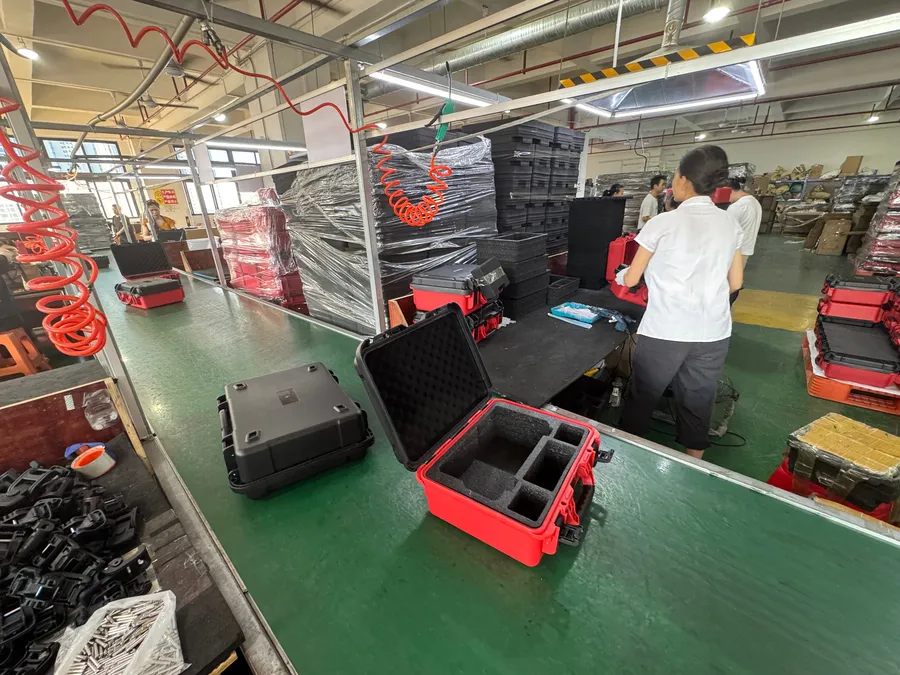
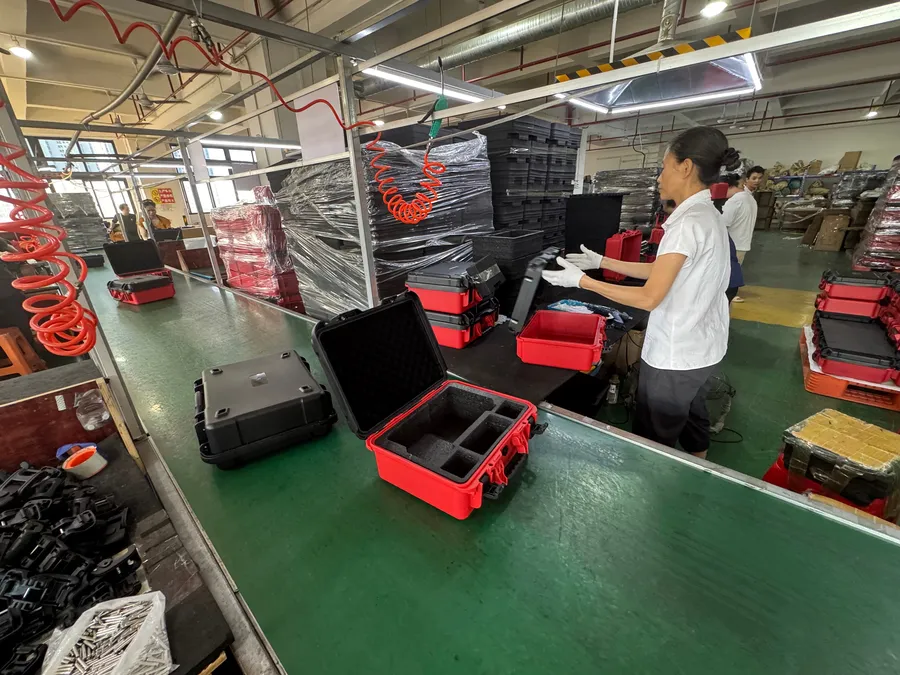
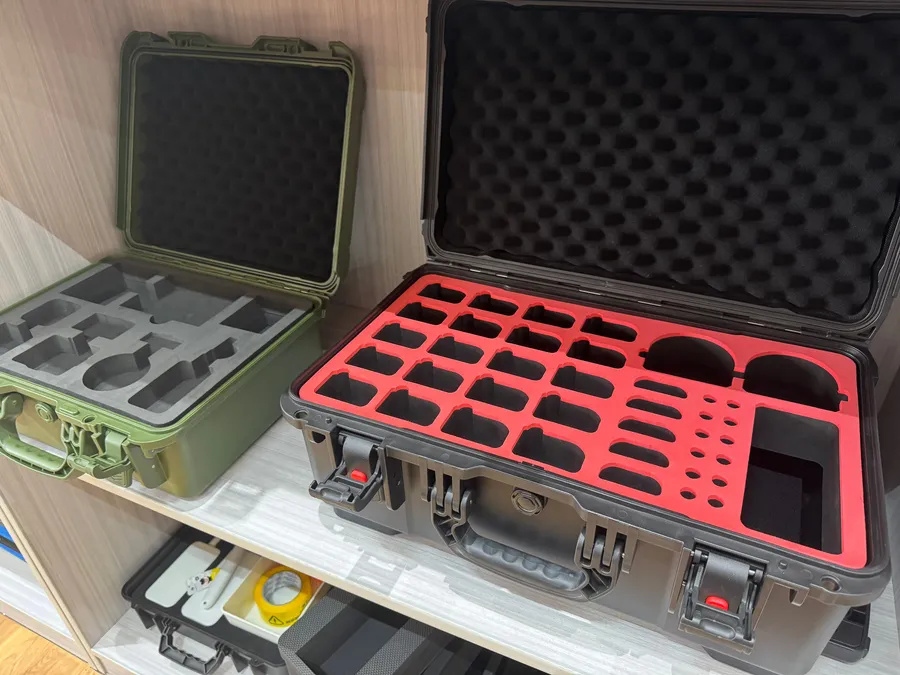
Everything described above is configurable on a standard shell: interior layout (pick-and-pluck, die-cut or CNC-cut), foam grade and thickness, colour, logo method, latch and lock count, pressure-equalisation valve, cable ports, document holder and identification plate. A bespoke exterior geometry requires a new mould — 125 days, from 3,000 units per moulded component.
Procurement considerations
| Question | What to send us |
|---|---|
| Which shell fits? | Equipment L × W × H as packed, plus required clearance per axis |
| What does it cost? | Order quantity and estimated annual quantity — the two drive different answers |
| Is tooling needed? | Whether an existing shell clears the envelope with usable foam depth |
| Lead time? | Your required delivery date, not just the order date |
| Certification? | The exact standard your tender names — we will say whether we can test to it |
| Freight? | Destination and preferred terms; carton and pallet data supplied with the quotation |
Comparison and selection guide
The tables on this page exist because a protective case is chosen by comparing three things: the envelope, the environment and the handling chain. Where no table applies, the rule below is.
| Situation | What To Do |
|---|---|
| Marine or wet | Sealed configuration with a drain-friendly interior and stainless hardware. |
| Dry and dusty | A close-fitting rim and a lid that can be opened one-handed without spilling contents. |
| Carried far | Under 10 kg packed, with a padded handle or shoulder webbing. |
- Size on internal dimensions plus clearance, never on a product name.
- Choose the carrying method before the shell: it changes the series, not just the price.
- Specify the interior last, and decide up front whether the end user will reconfigure it.
How should a small outdoor hard case be sealed? relates to Waterproof & Dustproof Guide. Related families: Outdoor Protective Cases / Waterproof Cases / Electronics Cases / Custom Protective Cases / Instrument & Equipment Cases. Related sectors: field and industrial equipment. Continue in the Waterproof & Dustproof Guide cluster.
This page is written from our own production data. If your requirement differs, send the dimensions and we will tell you which of the 155 models fits, or whether a custom route is needed.