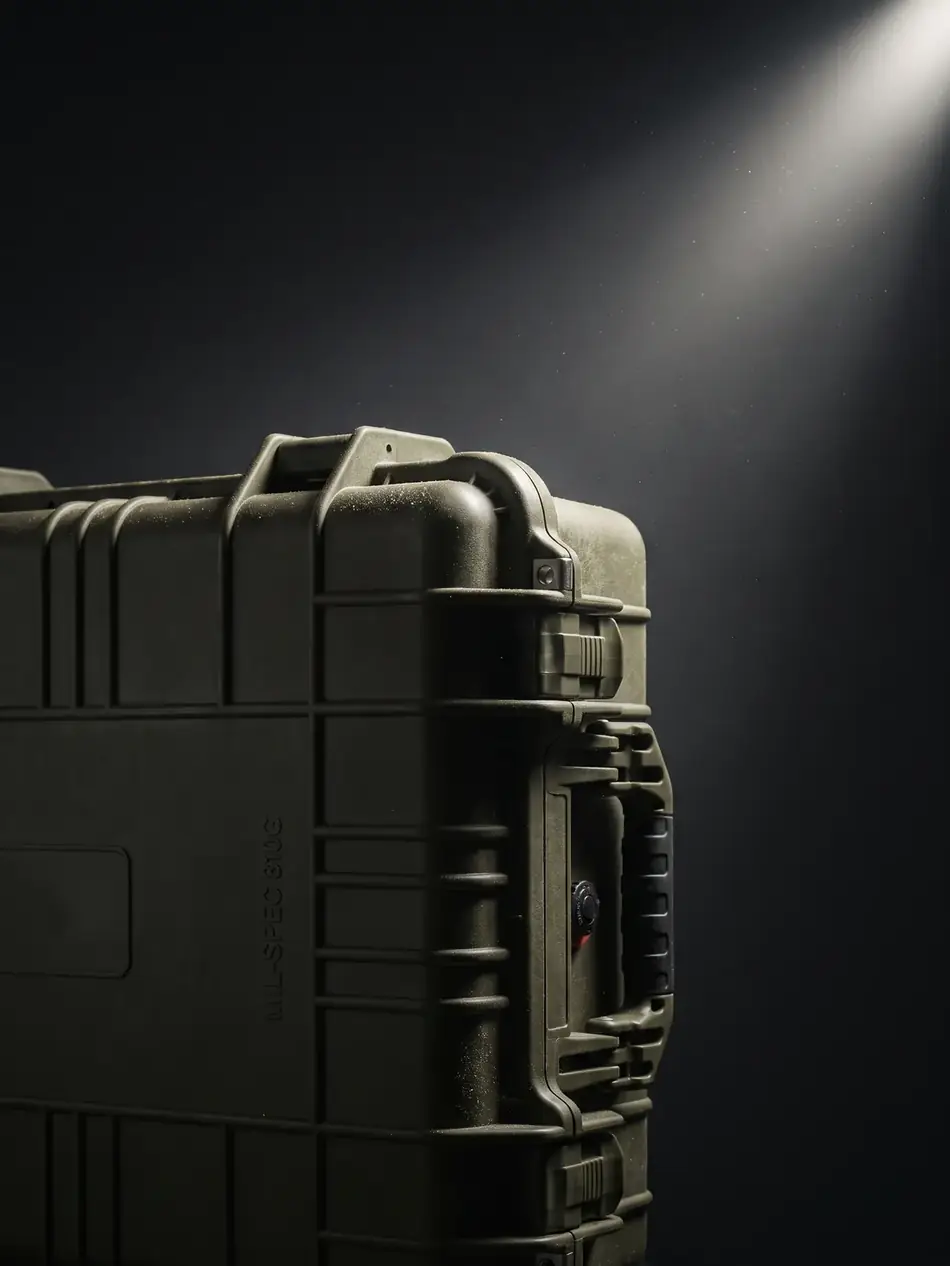
How should dust and water protection be specified?
Specify dust and water protection in three moves: name the exposure events the case will actually meet, pick the model by its published gasket flag, and put any number you need contractually behind a test report instead of a code. On the first move, stationary rain, wash-down, immersion risk, dust-laden wind and transit humidity are different problems, and a requirement that does not separate them cannot be quoted honestly. On the second move, the flag is per model, not per family: 100 of the 113 models in the military-protective-cases family publish seal availability as true, and 13 publish it as false, including the WL705#, WL706# and WL707# utility shells. On the third move, our catalogue file records water and dust performance as not measured and prints no ingress-protection code for any of the 155 models; where a tender or an integration needs a documented figure, we quote accredited third-party testing against the exact model, gasket configuration and packed load state as a separate work package, with the report issued to you. Treat any supplier sentence of the form just trust the rating as a question, not an answer. Sealing is a property of the lid engagement, the gasket channel and the latch line; foam is the shock layout and does not seal anything. Terms are wholesale and OEM only, EXW or FOB, no retail, no delivered-duty-paid shipments and no overseas warehouse stock.
Key points
- Specify exposure as events with duration - stationary rain, wash-down, immersion risk, dust-laden wind - not as an adjective the supplier must interpret.
- The gasket flag is per model: 100 of 113 military family models publish seal availability as true, 13 publish it as false.
- No ingress-protection code is printed for any of the 155 models; water and dust are recorded as not measured in the catalogue file.
- Foam is the shock layout, not a seal: a full foam kit does not substitute for the gasket flag when you specify case sealing.
- Lid engagement is publishable geometry: 69 family models publish the base and lid depth split, 86 / 86 mm on the WL3218.
- For contract figures, quote accredited third-party testing against the exact model, gasket configuration and packed load state; the report is issued to you.
- Terms stay wholesale and OEM: EXW or FOB, 45 days on an existing mould, 125 days for a new one, 30% deposit, no retail channel.
Name the exposure before naming the case
Dust and water protection for transit cases is usually requested as one word - sealed, weatherproof, rugged - and that word cannot be engineered against. A case that keeps driving rain off a radio during a stationary downpour is not thereby a case that survives a wash-down hose, and neither is a case that can be briefly submerged. Dust-laden wind on a convoy route attacks the latch line and the lid channel in a way that a laboratory dust chamber does not quite reproduce, and humidity inside a closed case during a sea crossing condenses on whatever is coldest. Each of those is a distinct event with a duration, a direction and a consequence, and the requirement becomes specifiable the moment it is written that way.
Writing the exposure as events also changes what you can demand from a supplier. If your annex says the case will meet stationary rain for 30 minutes, wash-down once per maintenance cycle and dust-laden wind in transit, then a manufacturer can answer three ways: this is published per model, this is not measured, or this can be measured by a third party against your stated events. That is a conversation with evidence at the end of it, instead of a trade in adjectives where nobody can later prove what was meant.
The published lines that carry a sealing decision
Our catalogue file publishes the geometry and the flags a sealing decision needs, per model rather than per family. The gasket flag is the first of them: 100 of the 113 military family models publish seal availability as true, and the 13 others publish it as false, so a buyer filtering for a gasketed shell can filter the catalogue instead of guessing. Wall thickness is recorded on 106 of 113 models, from 2.1 mm to 6.0 mm, because the wall schedule and the lid channel belong to the same moulding decision. The base and lid depth split is published on 69 models - the WL3218 publishes 86 mm in the base and 86 mm in the lid - which is the geometry the gasket sits between. Shell material is stated per model as polypropylene, engineering polypropylene, ABS or PP/ABS.
What the file deliberately does not publish is a performance code. Water, dust, UV, temperature and load performance are recorded as not measured, and no ingress-protection code is printed for any of the 155 models in the library, gasketed or not. A gasket flag says a compressible gasket seated in a moulded channel is part of the published design; it does not say a number was measured against that design. Keeping those two statements separate is what makes the catalogue honest, and it is also what makes a tender document defensible when an evaluator asks what each figure means.
Gasketed and plain shells side by side
The four models below are chosen to show that the gasket flag travels independently of material, wall schedule and size: two of them publish seal availability as true, two as false, and the reason is the mould, not the tier. Every cell is quoted from the model's own catalogue record.
| Specification Line | Wl3218 | Wl6-4621 | Wl9-5419 | Wl-5126 Trolley |
|---|---|---|---|---|
| Gasket flag (seal available) | yes | yes | no | no |
| Wall thickness | 3.0 mm | 4.7 mm | not published on this model | not published on this model |
| Shell material | PP | ABS | PP / ABS | PP |
| Base / lid depth split | 86 / 86 mm | not published on this model | not published on this model | not published on this model |
| External dimensions, L × W × H | 315 × 260 × 180 mm | 456 × 340 × 210 mm | 540 × 445 × 190 mm | 510 × 395 × 257 mm |
| Catalogue page | /products/military-protective-cases/kx-3218/ | /products/military-protective-cases/kx-64621/ | /products/military-protective-cases/kx-95419/ | /products/military-protective-cases/kx-5126/ |
How to specify case sealing line by line
How to specify case sealing is best answered with a short list that a supplier can answer per model without interpretation. The lines below are ordered so that each one can be checked off against a published field or a documented action.
Plain shells: which models, and why the flag is explicit
The 13 family models that publish seal availability as false are: WL-5126 Trolley, WL-6922, WL4710, WL4713, WL4716, WL705#, WL706#, WL707#, WL8-4814, WL8-4815, WL8-4823, WL8-4824, WL9-5419. Several of them are thin-shell utility models - the WL705#, WL706# and WL707# line - and one is the WL-5126 Trolley. The flag is explicit because assuming it is how mistakes happen: a buyer picks by size and price, the case ships, and the lid line was never designed to carry a gasket. If your environment statement includes any water or dust event, filter the catalogue on the gasket flag first and let size and material come second.
The flag is also independent of the rest of the record, which the comparison table shows: the WL6-4621 is an ABS shell with a 4.7 mm wall and a gasket, while the WL9-5419 is a PP/ABS shell of similar internal volume with none. Neither is better in the abstract; they are different answers, and the catalogue publishes enough per-model geometry for your engineer to see which answer fits the load and the exposure events you named.
What we do not claim, and the testing route instead
The stance in our file is plain: water, dust, shock and load performance are recorded as not measured, we state no free-fall figure, and we do not attach a rating the product has not been measured against. We advise buyers to read any supplier sentence that offers a protection code without a test document as a question - which model, which configuration, which load state, which laboratory - rather than an answer. That habit costs nothing at specification time and saves a programme from building on a brochure sentence.
Where the exposure events carry contractual thresholds, the workable route is documented testing: we quote accredited third-party testing against the exact model, the gasket configuration and the packed load state as a separate work package, and the report is issued to you. The report then means what an evaluator needs it to mean, because it names its own model and configuration. Ask for the quotation alongside the case quotation so the two can be compared as one package rather than sequenced after award.
Where this matters in defense and field use
The deployment patterns on our defense and field equipment pages are the ones where the gasket flag earns its line: equipment that alternates between vehicles and open ground, tool kits that live outdoors between uses, communication modules that travel in the same load as their antennas and cables, and optics that are more sensitive to condensation than to rain. The pages describe the recurring packing decisions - nested versus palletised versus crew-carried - rather than unit-specific claims, because those decisions are what a specification can actually govern. For each pattern the catalogue answers with published geometry: internal dimensions against the packed load, the depth split against how items stand, and the gasket flag against the exposure events.
Customisation: gasketed variants and programme terms
Seal availability is a design attribute of the mould, so changes to it belong in an OEM conversation rather than an add-on order. The published programme basis is: 45 days lead time for OEM work on an existing mould, 125 days where a new mould must be cut, MOQ 300 units for logo, colour and OEM programmes and 3,000 units for a new custom mould, with a 30% deposit and the balance before shipment. Custom foam inserts carry an MOQ of 1, and the foam approval chain - drawing, photograph of the packed kit, or sample - is separate from the sealing conversation by design.
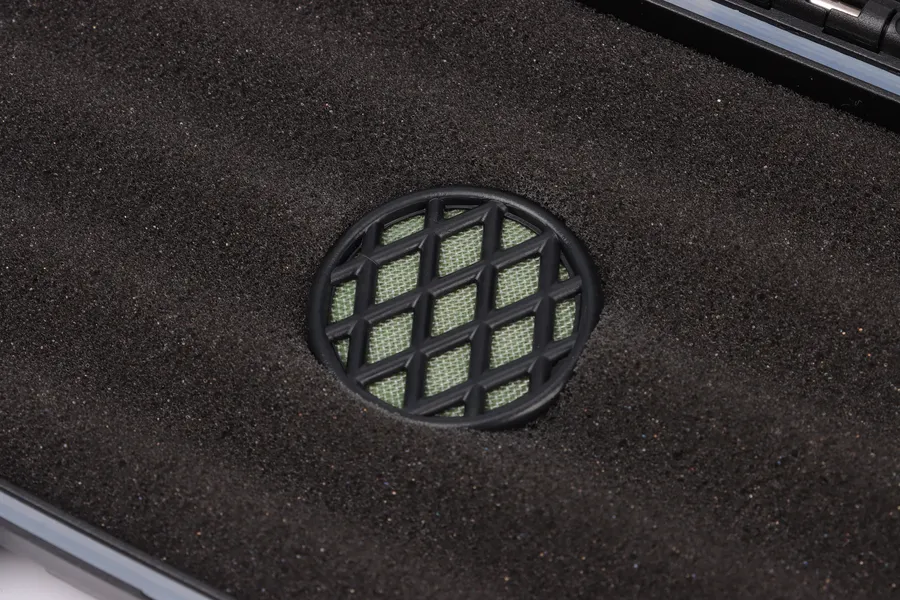
Pressure equalisation sits in the same conversation: where your deployment pattern includes large temperature swings or altitude changes, raise the valve question during the OEM scoping so the lid design is considered once, with the gasket channel, rather than retrofitted. Commercially we work wholesale and OEM only, EXW or FOB from Guangdong, with no retail channel, no delivered-duty-paid shipments and no overseas warehouse stock.
Procurement notes for the environmental annex
An environmental annex that survives evaluation does three things. It lists the exposure events with durations and marks which are contractual. It names the acceptable models by their published flags - gasket flag, wall schedule, depth split - instead of by adjectives. And it states how disputed figures will be settled: by an accredited third-party report against the exact model, gasket configuration and packed load state, issued to the buyer. Each of the three maps to a field we publish or a package we can quote, so the annex can be answered without a clarification round.
Send the annex with the packed load list and the quantities, and the answer comes back on the same structure: published figures per model, the not-measured lines stated as such, and the testing package priced separately where your thresholds need evidence. That structure keeps every later discussion - first article, programme scaling, re-qualification after a design change - anchored to the same documents.
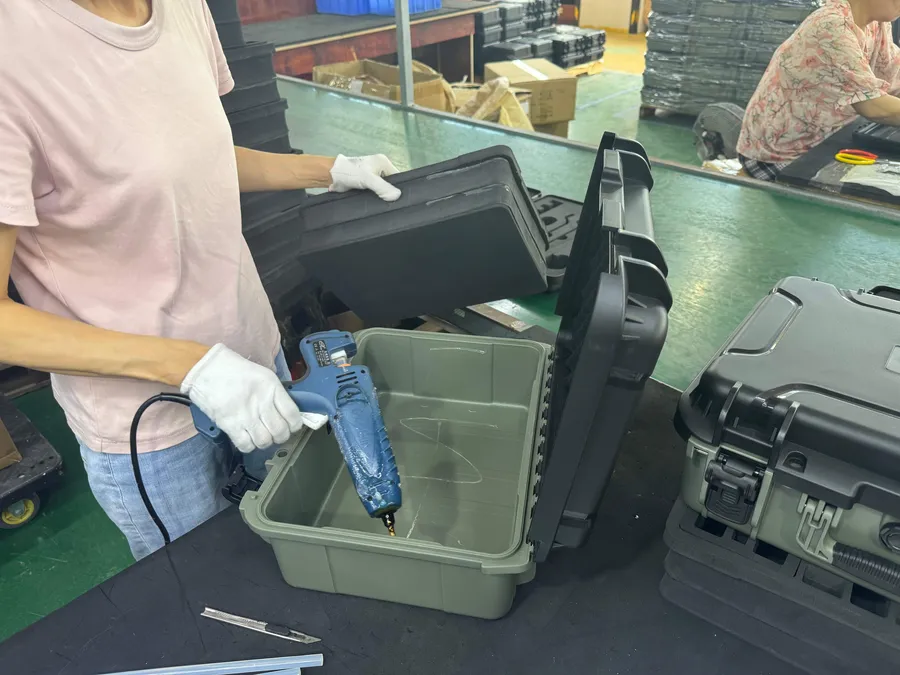
Customisation
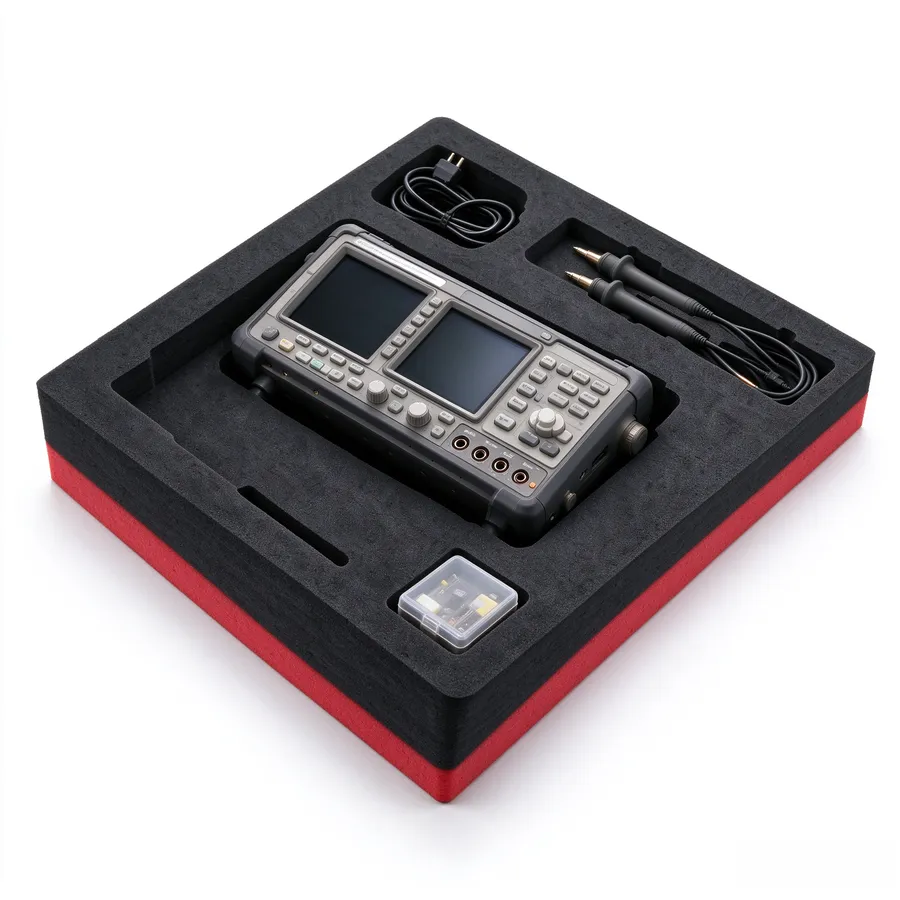
Everything described above is configurable on a standard shell: interior layout (pick-and-pluck, die-cut or CNC-cut), foam grade and thickness, colour, logo method, latch and lock count, pressure-equalisation valve, cable ports, document holder and identification plate. A bespoke exterior geometry requires a new mould — 125 days, from 3,000 units per moulded component.
Procurement considerations
| Question | What to send us |
|---|---|
| Which shell fits? | Equipment L × W × H as packed, plus required clearance per axis |
| What does it cost? | Order quantity and estimated annual quantity — the two drive different answers |
| Is tooling needed? | Whether an existing shell clears the envelope with usable foam depth |
| Lead time? | Your required delivery date, not just the order date |
| Certification? | The exact standard your tender names — we will say whether we can test to it |
| Freight? | Destination and preferred terms; carton and pallet data supplied with the quotation |
Comparison and selection guide
The tables on this page exist because a protective case is chosen by comparing three things: the envelope, the environment and the handling chain. Where no table applies, the rule below is.
| Situation | What To Do |
|---|---|
| Start from the equipment, not the case | Measure the tallest, widest and longest points of the packed equipment including antennas, handles and connectors. Add 20 mm minimum clearance per axis before selecting a shell. |
| Then choose the carrying method | Under 8 kg, a fixed handle is lighter and cheaper. Over 12 kg or any journey over 30 m, specify the T series with telescopic handle and wheels. |
| Then decide the interior | Pick-and-pluck for kits that change. Die-cut or CNC-cut for fixed layouts that must be auditable at a glance. |
- Size on internal dimensions plus clearance, never on a product name.
- Choose the carrying method before the shell: it changes the series, not just the price.
- Specify the interior last, and decide up front whether the end user will reconfigure it.
How should dust and water protection be specified? relates to Waterproof & Dustproof Guide. Related families: Military Protective Cases / Waterproof Cases / Defense Equipment Cases. Related sectors: field and industrial equipment. Continue in the Waterproof & Dustproof Guide cluster.
This page is written from our own production data. If your requirement differs, send the dimensions and we will tell you which of the 155 models fits, or whether a custom route is needed.