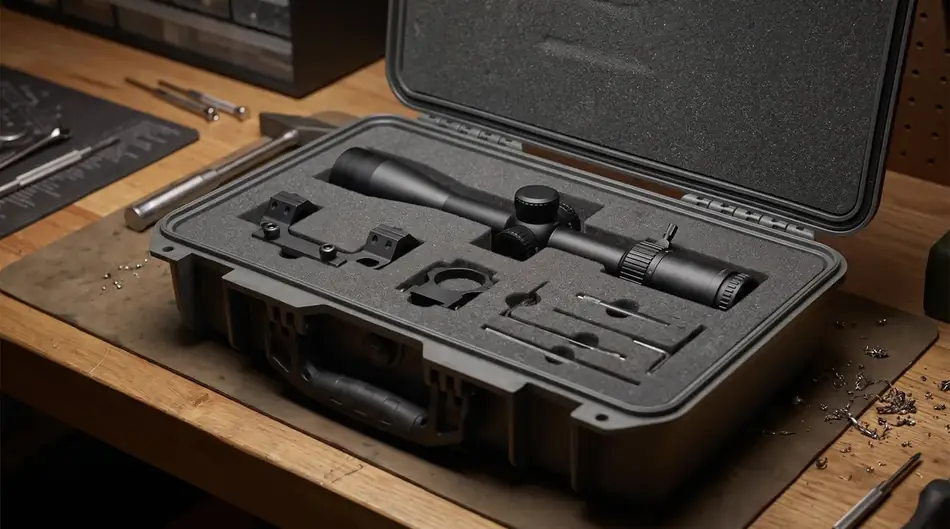
Automotive Equipment Transport Packaging Solutions?
Short answer: automotive equipment transport packaging is decided by four published figures on one named shell - internal dimensions against the packed equipment, wall thickness against the stack it will sit under, the lid-to-base split against whatever stands proud of the chassis, and empty mass against the people who carry it. KeXin publishes internal and external dimensions for all 155 moulded shells, wall thickness between 2.0 and 6.0 mm on 148 of them, lid and base depth separately on 100, empty mass on 93, and a compressible gasket in a continuous moulded channel on 124 with 31 shells recorded without one. No model publishes an ingress code, a free-fall height or a shock figure, so protection is specified as shell construction plus a cut interior, with accredited third-party testing of the exact ordered build available as a quoted work package. Supply is wholesale and OEM or ODM on EXW or FOB terms only.
Key points
- Measure the packed state, not the catalogue item: footprint first, then the tallest standing dimension, then convert to internal sizes with about 20 mm of cut clearance.
- Read lid depth and base depth separately on the 100 models that publish them; a 230/45 mm split and a 43/149 mm split are different machines for the same total height.
- Wall thickness is the stacking lever: the 2.5 mm KX-4716 records no gasket channel, while the 5.8 mm KX-5321 and 6.0 mm KX-6621 carry heavy bench loads.
- All 19 wheeled shells are recorded as non-stackable and eleven publish telescopic heights between 240 and 485 mm - buy wheels for distance, stacking for pallets.
- Long automotive parts need length, not volume: KX-814641 publishes 1,280 x 350 x 140 mm of internal space with 50.2 usable litres.
- Carton size and pieces per carton are published on 64 of 155 models; pallet and container figures are supplied with the quotation per model, not printed on a datasheet.
- No ingress code, free-fall height or shock figure is published for any model; we state that plainly and quote accredited testing of the exact build when a number is required.
What Transport Packaging Means For Automotive Equipment
Transport packaging for automotive equipment is a system of four decisions, not a single box: the moulded shell, the interior that positions the load, the closure hardware that keeps the rim sealed and locked, and the carton-and-pallet plan that gets a fleet of cases through a warehouse without damage. Three damage mechanisms account for nearly everything that goes wrong between a workshop bench and a dealer store. The first is repeated handling and road vibration, which works on connectors, jig pins, sensor cables and torque tools that were never immobilised in the first place. The second is stacking load, which turns a thin wall into the weak point the first time cases are palletised or a carton goes under two others in a truck. The third is the single event - a rim strike on a doorway, a corner landing on concrete - and the honest answer to it is wall thickness, corner geometry and a cut interior that keeps clearance around the vulnerable face, not an adjective on a datasheet. Because KeXin moulds and finishes these shells in-house and supplies wholesale and OEM buyers, each of those four decisions is quoted on a named model with published figures, and the numbers in this article are taken from the published product library only.
The Published Figures That Decide An Automotive Case
The product library publishes internal and external dimensions for all 155 shells, wall thickness between 2.0 and 6.0 mm on 148 of them, lid and base depth separately on 100, empty mass on 93, and a gasket channel on 124 of them with 31 recorded without one. Within the equipment-transport tag - 71 shells - usable interior volume runs from 16.5 to 111.6 litres and published empty mass from 1,360 to 15,320 g, so the same category spans a hand-carried tray and a two-person trolley. A benchtop diagnostic unit with its cable loom is the everyday example: KX-64120 gives 378 x 307 x 187 mm internal on a 4.0 mm wall at about 2,640 g and 17.4 usable litres, and the same plan is available taller as KX-84120 at 385 x 313 x 180 mm and KX-84122 at 385 x 313 x 205 mm on a 3.7 mm wall when the unit travels with a cage or a mounting frame. Where connectors and display heads stand above the chassis, the lid does the work: KX-84430 publishes 395 x 295 x 275 mm internal with a 230 mm lid over a 45 mm base and 25.6 usable litres, and KX-64618 gives 430 x 290 x 165 mm with a 140/25 mm split at about 2,775 g on a 4.7 mm wall. For a torque-tool set presented as a tray, KX-4616 at 455 x 338 x 148 mm with a 74/74 mm split, 3.0 mm wall, about 1,395 g and 19.6 litres is the natural format - and it records a gasket channel, where the thinner 2.5 mm KX-4716 series records none.
Automotive Scenarios And The Published Figure That Decides Them
The table below maps the six scenarios automotive buyers bring to us most often onto the published figure that actually decides the order, with named examples from the product library. Every figure is a specification of the named model and nothing else; none of them is a performance rating, and the comparison is valid only against the packed envelope measured on your own equipment.
| Automotive Scenario | Deciding Published Figure | Published Example |
|---|---|---|
| Diagnostic tester or benchtop unit with connectors on top | Lid depth over the standing connector block, then internal plan | KX-84430: 395 x 295 x 275 mm internal, 230/45 mm lid/base, 4.2 mm wall, 25.6 usable litres; KX-64618: 430 x 290 x 165 mm, 140/25 mm, about 2,775 g |
| Tool set, torque kit and socket inventory as a working tray | Base-loaded 74/74 mm split with a gasket channel recorded | KX-4616: 455 x 338 x 148 mm internal, 3.0 mm wall, about 1,395 g, 19.6 usable litres, gasket recorded; KX-4716: same family at 2.5 mm, no gasket recorded |
| Heavy bench instrument, jig plates or a fixture body | Deep base split and the thickest published walls | KX-5321: 481 x 373 x 192 mm, 5.8 mm wall, 43/149 mm split, about 4,810 g; KX-6621: 587 x 434 x 192 mm, 6.0 mm wall, about 6,420 g, 39.1 litres |
| Jig plates, fixture sets and gauge bodies in a fleet store | Broad plan with a 145 mm lid and pallet-friendly height | KX-88421: 740 x 518 x 189 mm internal, 145/44 mm split, 5.0 mm wall, 57.9 usable litres; KX-65522: 507 x 385 x 190 mm, 5.3 mm wall, about 4,860 g |
| Rails, shafts, busbars and extrusions | Internal length with one channel per member | KX-88015: 725 x 350 x 140 mm, 5.0 mm wall, 28.4 litres; KX-89616: 880 mm internal; KX-814641: 1,280 x 350 x 140 mm, 50.2 usable litres |
| Fleet trolley for mixed service kit on a workshop floor | Telescopic height and the loss of the stacking face | KX-85827: 500 x 400 x 220 mm, 295 mm handle, about 7,800 g; KX-97227: 590 x 435 x 210 mm, 6.0 mm wall, 485 mm handle, about 10,000 g |
| Pallet programme for dealer networks and training fleets | Carton arithmetic and pieces per carton | Carton data published on 64 of 155 models; KX-65522 ships 3 per 565 x 450 x 665 mm carton; KX-707 ships 8 per 735 x 480 x 595 mm carton; trolleys record 1 per carton |
Selection Guidance: From Equipment Envelope To Purchase Order
Work from the packed state outward, in this order. One: lay the equipment out exactly as it travels - tester with its cage fitted, cables coiled, jig on its plate - and record three numbers: the footprint, the height of the tallest standing item, and the height of anything you refuse to strip before the journey. Two: add roughly 20 mm of working clearance per axis for the cut, and translate that into internal dimensions, not external ones; the library publishes both, and the difference between them is wall plus hardware, which is where a cross-supplier comparison usually goes wrong. Three: choose the lid-to-base split so the standing item sits in the deeper half and the closure line crosses only empty relief - read on the 100 models that publish the two figures separately. Four: set wall thickness by the stack plan, because a case that palletises under others wants the 4.7 to 6.0 mm end of the published range, while a hand-carried tray can sit at 2.5 to 3.3 mm. Five: decide the carry format honestly - a carried shell, a long shell or a wheeled trolley - and remember that every wheeled shell in the library is recorded as non-stackable. Six: read carton size and pieces per carton on the 64 models that publish them before you quote freight, and ask for pallet and container figures with the quotation, since those are supplied per model rather than printed. Seven: write down which documents your purchaser requires, because a workshop purchase and a written into a tender are two different briefs.
Long Parts: Rails, Shafts, Busbars And Extrusions
Electric-vehicle service and research programmes move long members - camshafts and crankshafts on engine benches, drive and lay shafts, aluminium extrusions, structural test coupons, and on EV platforms the busbar and rail assemblies that must not kink. These are length problems, and the library answers them with length: KX-86216 gives 582 x 300 x 130 mm internal on a 3.3 mm wall with a 100/30 mm split and 19.5 usable litres for a short assembly; KX-88015 gives 725 x 350 x 140 mm on a 5.0 mm wall with a 100/40 mm split and 28.4 litres; KX-89616 extends the same section to 880 mm and 34.5 litres; and KX-814641 publishes 1,280 x 350 x 140 mm with 50.2 usable litres, the longest cavity in the library. Where the part travels with a head, a bracket or a coupling fitted, the taller KX-87926 at 737 x 257 x 240 mm with a 175 mm lid over a 65 mm base and 36.4 litres takes the assembly standing. Three construction rules do more than any adjective: one channel per member so nothing rolls against a collar, a base plank firm enough that a collar does not dig into soft pluck foam, and nothing stacked on top of a long shell in transit - which is a loading instruction we print, not a rating we claim. If a safety document requires a documented free-fall or load figure for the packed assembly, that is quoted as accredited testing of the exact build, because no model publishes one.
Fleet, Workshop And Warehouse Logistics: Wheels, Stacking, Cartons
The logistics layer is where automotive buyers most often overpay, so the published records deserve a close read. Nineteen of the 155 shells publish wheels, every one of them sits in the equipment-transport tag, and every one of them is recorded as non-stackable - that is the real cost of a trolley, because it gives up the pallet face. Eleven of the wheeled shells publish a fixed telescopic handle height between 240 and 485 mm: 240 mm on KX-88337 and KX-87336, 295 mm on the KX-85827, KX-86136, KX-85835 and the 740 mm KX-88434 and KX-88442, 310 mm on KX-86836, 385 mm on KX-85726 and 485 mm on KX-97227. Empty masses on the trolleys run from about 4,912 g on the KX-85021 to 15,320 g on the KX-88442, before equipment. By contrast, 136 of the 155 shells are recorded as stackable, and that is the property a dealer-network or training-fleet programme actually palletises on. Carton data is published on 64 models, 19 of them inside the transport tag: KX-65522 ships 3 per carton of 565 x 450 x 665 mm, KX-707 ships 8 per 735 x 480 x 595 mm carton, and the trolleys record one per carton, which is the honest way to build a container plan. Pallet and container figures themselves are supplied with the quotation per model, calculated from the carton footprint against your pallet size, because a printed 20-foot number is meaningless without knowing which pallet you run.
Where Automotive Teams Use These Cases
The buyers are wider than one workshop. Service networks and dealer groups standardise tool, torque and diagnostic cases so a technician who moves between sites finds the same layout every time, and they care most about the carton arithmetic and the gasket record. Research and development programmes pack data loggers, sensor sets, instrumentation and jig hardware that travel between a test cell and a proving ground, and they buy on internal dimensions and the lid-to-base split rather than on volume. Motorsport and rally support teams kit spares per event, so the interior drawing - outlines printed or routed so a missing part is visible the moment the lid opens - matters more than shell colour. Electric-vehicle programmes carry inverters, on-board chargers, busbar samples and battery test fixtures as equipment envelopes, which we size like any other load; what we do not do is attach a rating to that load, because the product library records no free-fall, shock or ingress figure for any model. Fleet workshops and driving academies buy trolleys for the workshop floor and carried shells for the vehicles, and training organisations keep one fixed outline per curriculum so an instructor can audit a kit at a glance. All of them draw on the same published shells and differ only in cut, wall, carry format and marking.
Customisation: Foam Layouts, Colour, Logo And OEM Hardware
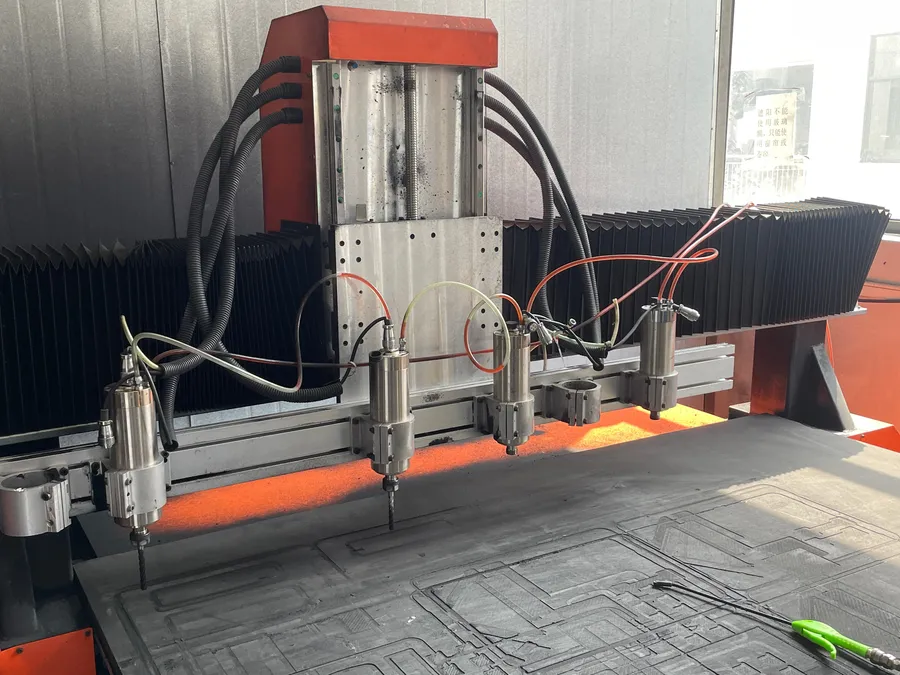
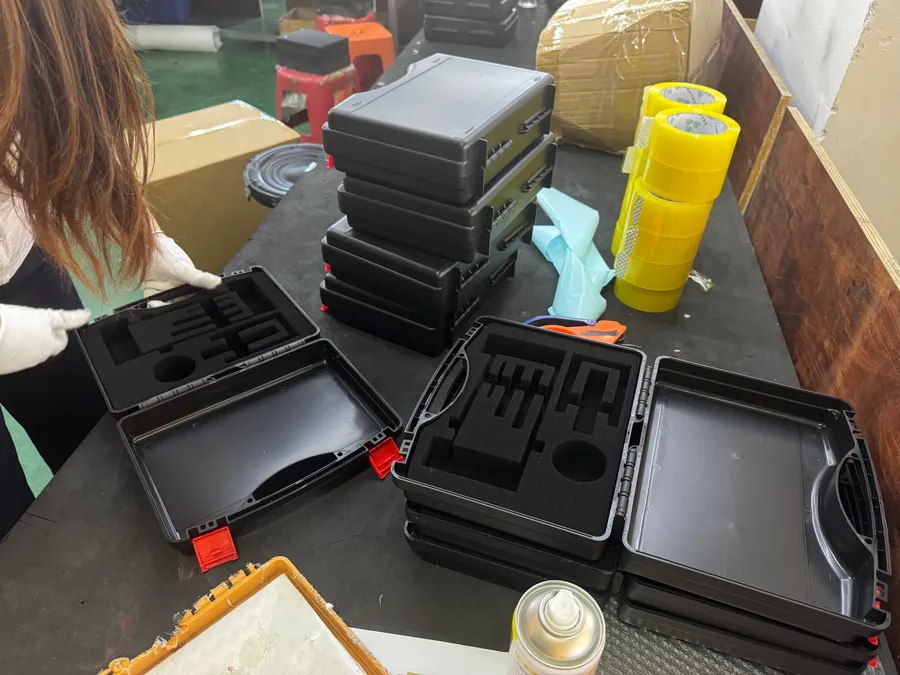
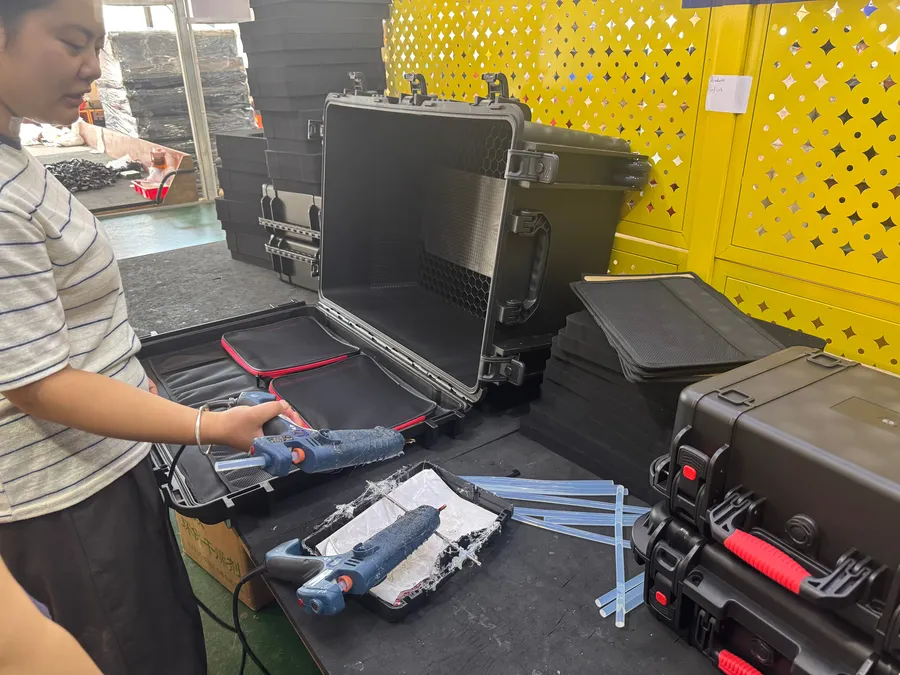
Custom work divides into three tiers with published thresholds. A cut interior starts at one unit on an existing shell with no new tooling: die-cut where a department repeats one layout across many units, CNC-cut where a pocket wall must hold tolerance around a connector or a sensor, and layered builds with a firmer carrier under mass and a softer face against a finished body; a drawing, a scale photograph of the packed kit or the items themselves is enough to start. Colour, logo and OEM hardware begin near 300 units, and buyer-branded packaging is quoted in the same band. A change to the shell itself - a new cavity, a dedicated plan, an original height - needs a mould at near 3,000 units per component and about 125 days from approved drawings, while an OEM first sample on approved existing tooling takes about 45 days. Two boundaries are worth stating because buyers assume otherwise: a colour change does not alter the published wall thickness, and it does not add or remove a gasket channel - the 31 shells recorded without one stay without one in any colour. Hardware is specified per configuration rather than inherited from a series: latch count, handle type, a document holder and a latch body that accepts a standard padlock are configuration items quoted on the named model.
Procurement Notes: Wholesale Terms, Verification And What We Do Not Claim
KeXin New Materials (Guangdong) Co., Ltd. moulds and finishes these shells and supplies wholesale and OEM or ODM buyers on EXW or FOB terms only. There is no retail channel, no delivered-duty-paid quotation and no overseas warehouse stock, so a landed cost is an FOB or EXW figure plus your own freight and clearance - which is exactly why the carton arithmetic above is published rather than promised. Minimum order is one unit on a stock shell and one unit on a custom foam layout, near 300 units for colour, logo or OEM hardware, and near 3,000 units per component for a dedicated mould. Payment is a 30 per cent deposit with the balance after inspection, and a third-party factory inspection before shipment is welcome. Then apply the same three questions to us that you would apply to any packaging supplier: which accredited report produced this figure, what method and conditions were used, and does it cover the exact shell, gasket, latch and foam build being bought. Any field our library records as not measured - ingress, free-fall height, shock, temperature range, stack load - is the answer we will give you in writing, and we would rather a fleet programme heard that before a tender response than after one. Enquiries go to Fred Zhao or the KeXin Sales Team, WhatsApp +86 135 3588 0002.
Customisation
Everything described above is configurable on a standard shell: interior layout (pick-and-pluck, die-cut or CNC-cut), foam grade and thickness, colour, logo method, latch and lock count, pressure-equalisation valve, cable ports, document holder and identification plate. A bespoke exterior geometry requires a new mould — 125 days, from 3,000 units per moulded component.
Procurement considerations
| Question | What to send us |
|---|---|
| Which shell fits? | Equipment L × W × H as packed, plus required clearance per axis |
| What does it cost? | Order quantity and estimated annual quantity — the two drive different answers |
| Is tooling needed? | Whether an existing shell clears the envelope with usable foam depth |
| Lead time? | Your required delivery date, not just the order date |
| Certification? | The exact standard your tender names — we will say whether we can test to it |
| Freight? | Destination and preferred terms; carton and pallet data supplied with the quotation |
Comparison and selection guide
The tables on this page exist because a protective case is chosen by comparing three things: the envelope, the environment and the handling chain. Where no table applies, the rule below is.
| Situation | What To Do |
|---|---|
| Sea freight | Sealed configuration plus desiccant; salt spray is a handling issue, not a material issue. |
| Air freight | Mass and external dimensions drive cost more than volume. |
| Repeated movement | Replaceable latches, hinges and gaskets; keep a spares kit with the first order. |
- Size on internal dimensions plus clearance, never on a product name.
- Choose the carrying method before the shell: it changes the series, not just the price.
- Specify the interior last, and decide up front whether the end user will reconfigure it.
Automotive Equipment Transport Packaging Solutions? relates to Logistics & Packing Guide. Related families: Equipment Transport Cases / Tool Cases / Instrument & Equipment Cases / Electronics Cases / Long Equipment Cases / Rolling Cases / Custom Protective Cases / Communication Equipment Cases. Related sectors: field and industrial equipment. Continue in the Logistics & Packing Guide cluster.
This page is written from our own production data. If your requirement differs, send the dimensions and we will tell you which of the 155 models fits, or whether a custom route is needed.