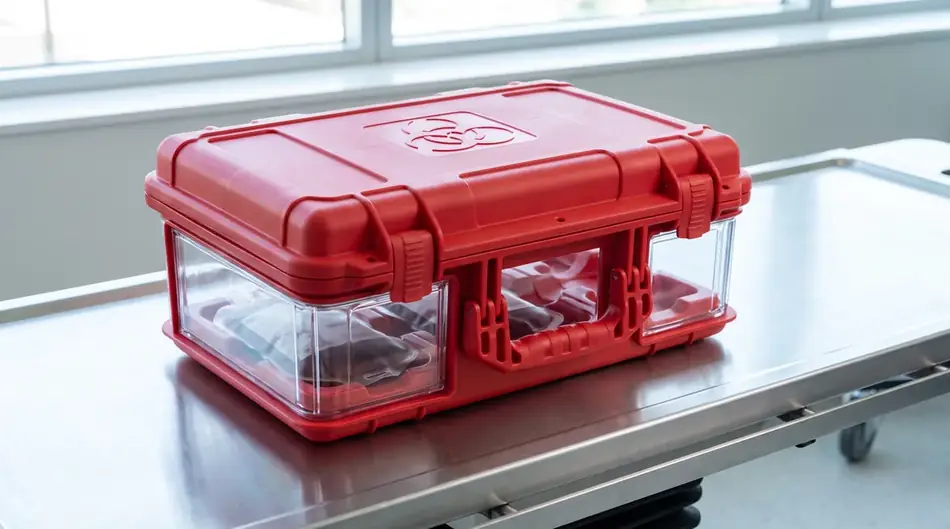
Cold chain equipment case?
A cold chain equipment case is a rigid shell that protects a temperature-sensitive load mechanically; it does not create or hold a temperature. Cooling capacity, hold time and excursion reporting belong to the validated shipper, the phase-change material and the data logger, while our published file decides whether the load physically fits and survives handling. Of the 155 active models we publish, 71 appear in the medical equipment category with usable interiors from 16.5 L to 111.6 L and internal lengths from 378 mm to 1,280 mm; 64 of those 71 list a compressible gasket and 7 list no seal at all; a temperature operating range is recorded as not measured on all 155 models. So buy the case on geometry, wall thickness, seal configuration and foam layout, and buy the cold chain performance from a packaging validation record, not from a shell.
Key points
- The case protects the load mechanically; temperature and hold time come from the shipper, the coolant and the logger.
- 71 medical-category models publish usable interiors of 16.5 L to 111.6 L and internal lengths from 378 mm to 1,280 mm.
- 64 of those 71 list a compressible gasket in a continuous moulded channel; the other 7 list no seal at all.
- A temperature range is recorded as not measured on all 155 published models, so no hold time is quoted here.
- Wall thickness is published on 66 of the 71 medical models and runs from 2.5 mm to 6.0 mm, per model.
- Custom foam carries an MOQ of 1 unit, so a layout can be tried in a cold room before any tooling spend.
The short answer: the case protects, the shipper holds temperature
Two products are being discussed whenever a buyer says cold chain equipment case, and mixing them up is the single most expensive mistake in this category. The first is the packaging system that controls temperature: an insulated shippers, phase-change material sized to the payload and duration, and a logger that records what actually happened between the sampling point and the laboratory. The second is the hard shell: a moulded thermoplastic case with a gasket channel, foam cut around the instrument or the specimen racks, latches, a handle and feet. We manufacture the second one. Our published file contains dimensions, wall thickness, weights, seal availability, foam options and hardware options; it contains no insulation figure, because none of the 155 active models has been measured for one.
That division is not a hedge, it is how the specification is written. A shell with a 4.0 mm wall and a compressible gasket slows heat movement a little and stops splashing, dust and cleaning fluids reaching the load. It cannot be counted on for a two-hour or a twenty-four-hour hold, and no responsible buyer should treat it as the control that keeps a specimen within range. What the shell does determine is whether the load survives the physical part of the journey: being lifted, stacked, tilted, loaded into a vehicle, and opened in a room that is a different temperature from the one it came from. Those are the failure modes we can talk about with published numbers.
What we publish, and what we deliberately leave blank
Every model in our file carries the same field set. Physical fields are filled in from production and incoming-material data: external and internal dimensions in millimetres, the narrow internal width where a taper exists, lid and base depth, wall thickness, net weight, internal and usable volume, shell material, whether a seal is offered, whether the shell stacks, whether it has wheels, and the packing data where a carton has been specified. Hardware fields say what a latch, handle, hinge, foot, padlock provision, pressure equalisation valve, shoulder strap and document holder are on that model, and whether they are standard or a configuration we build on request.
The performance fields are where the blanks live, and the blanks are deliberate. On all 155 models the temperature operating range is recorded as not measured, ultraviolet resistance is recorded as not measured, stack load and load capacity are recorded as not measured, and no protection rating of any kind is stated for any model; accredited testing can be commissioned against a named configuration as a separate work package. Shock protection and impact resistance are recorded as manufacturer options, with the file stating plainly that a specified foam layout is required and that the shell on its own is not a shock rating, and that no drop height is claimed without a test.
Cold Chain Equipment Case: the four loads buyers actually quote
Buyers arrive with one of four loads, and each of them lands in a different part of our published range. The table below is the mapping we use at quotation stage. It is written as geometry plus the question you still have to answer from your own protocol, because those two columns are the whole difference between a case that fits and a case that protects. The middle column is only ever a count or a dimension from the 155-model file; where our file has nothing to say, the table says so rather than inventing a figure.
The row worth reading twice is the specimen-transport row. Secondary containment for tubes, a rack that cannot tip when the lid is opened one-handed, and a foam layout that keeps absorbent material away from the instrument's optics are all case decisions. Temperature is not one of them, and a hold-time requirement written against a shell specification is the reason a shipment is condemned after the fact rather than saved.
| Load | Published Models In Our File | Published Interior | What The Case Must Do | What You Must Supply |
|---|---|---|---|---|
| Benchtop analyser, haematology or chemistry unit | 71 medical-category models, usable 16.5 L to 111.6 L | Internal lengths 378 mm to 1,280 mm; example 378 x 307 x 187 mm | Carry 1.4 kg to 15.3 kg of published shell mass plus the instrument, stack without point loading, open on a bench | Instrument mass, footprint, cable and feet clearance, and the validated temperature control |
| Reagent, cassette and consumable kit | 19 models across the file publish under 5 L usable, 9 under 2 L | From 115 x 78 x 32 mm on a 0.3 L example | Keep small boxes separated, survive being opened repeatedly at a bench, accept a padlock hasp | Kit list with box sizes, and the refrigerated storage rule for each reagent |
| Specimen transport with secondary tubes | Seal offered on 64 of the 71 medical-category models | Typical 430 x 288 x 166 mm to 500 x 400 x 220 mm on mid-band models | Contain a leak inside the case, keep racks upright, clean without wetting the gasket seat | Rack count and tube diameter, absorbent volume, and your regulatory packaging requirement |
| Cold room or clinic trolley load | 19 models in the file are wheeled; 136 are marked stackable | Up to 740 x 518 x 364 mm on the largest published trolley model | Roll over a threshold, brake, and stack into a vehicle without crushing the lid | Aisle and lift dimensions, and the load you actually carry per trip |
Blood Testing Instrument Case: matching an analyser to a published shell
Sizing a blood testing instrument case is arithmetic before it is a preference. Measure the instrument at its widest fixed point, not at the display, then add the height of the feet and the bend radius of the power lead. Compare that against the internal dimension of a model, and treat the internal length as the controlling number: on our medical-category models the published internal length runs from 378 mm to 1,280 mm, and the published internal height is often the tighter constraint because a benchtop analyser is taller than it looks. Three real examples from the file show how different the envelopes are: one model publishes 455 x 338 x 148 mm internal with a 3.0 mm wall, 1,395 g net weight and 19.6 L usable volume; another publishes 378 x 307 x 187 mm internal with a 4.0 mm wall, 2,640 g net and 17.4 L usable; a third publishes 465 x 310 x 140 mm internal, 1,360 g net and 17.4 L usable, and lists no seal option at all.
The second decision is depth, because it decides how the instrument is packed. Lid and base depth are published separately, and a shallow base with a deep lid puts the instrument's mass in the lid when the case is carried open side up, which is exactly the orientation you do not want for an optical reading bay or a fluidics module. A case that matches on length but not on depth ends up with the instrument resting against the gasket, and a gasket compressed by a hard shell corner is a maintenance problem, not a protection feature.
The third decision is the foam, and it is where the blood-testing context actually changes the build. Reagent probes, aspirate tubing and the optical bay want their own cavities with a wall of material between them, consumables want a separate layer so they are not carried against the instrument, and absorbent material for a spill should sit in a pocket that can be removed and replaced. Our file publishes six foam types, from pick and pluck through die-cut and CNC-cut to EVA, PE and EPE, in five structures including top, base, egg-crate, custom cut and layered. What the foam does is stop movement; it does not moderate temperature, and the file says so.
Three published shells compared on real numbers
The table below takes three models out of the file and puts them side by side, because the useful comparison in a medical enquiry is never a category name. The first is a mid-band sealed shell that suits a benchtop unit with consumables. The second is a thicker-walled ABS shell with a deeper lid, quoted often for analysers with an exposed reading bay. The third is the largest published trolley model, specified by mobile sampling teams that move a full day's kit in one trip and care about thresholds and lifts more than about weight.
| Model | Published External | Published Internal | Wall | Net Weight | Usable Volume | Seal | Stackable | Packing |
|---|---|---|---|---|---|---|---|---|
| KX 4616 | 460 x 367 x 155 mm | 455 x 338 x 148 mm | 3.0 mm | 1,395 g | 19.6 L | Compressible gasket offered | Yes | Carton 755 x 470 x 635 mm, quantity per carton not published |
| KX 64120 | 405 x 362 x 195 mm | 378 x 307 x 187 mm | 4.0 mm | 2,640 g | 17.4 L | Compressible gasket offered | Yes | Carton 750 x 425 x 640 mm, 6 pieces per carton |
| KX 88442 Trolley | 843 x 592 x 415 mm | 740 x 518 x 364 mm | 5.0 mm | 15,320 g | 111.6 L | Compressible gasket offered | No, wheeled build | Carton data not published on this model |
Sealing, condensation and pressure: what a gasket is actually for
Across the whole file, 124 of the 155 models list a compressible gasket seated in a continuous moulded channel, in EPDM or an equivalent, and 31 list no seal offered on the shell. Within the medical category the split is 64 sealed and 7 unsealed out of 71. That is a construction fact about the channel and the gasket, and it is worth having: a continuous channel resists dust, dried spill residue and the splash of a cleaning wipe far better than a shell with a bare joint, and a channel that has been crushed by a mis-cut foam spacer stops being any of those things. What the file does not contain, on any model, is a stated protection rating or a measured ingress result. We will not turn a gasket into a rating, and an accredited test against a named configuration can be quoted instead.
Condensation deserves its own paragraph because it is the failure people do not expect. A case that has stood in a cold room or the back of a vehicle carries cold air inside it, and when it is opened in a warm clinic the moisture in that air lands on the coldest surface available, which is usually the instrument's optical block or a reagent tray. Two configuration options address the mechanics of that: a pressure equalisation valve and a document holder, both recorded in our file as manufacturer options on all 155 models. Neither is a temperature control. They let the internal air exchange in a controlled way and keep the paperwork off a wet lid, and they are specified on the order rather than assumed from a photograph.
Selection guidance: eight steps from protocol to order line
The sequence below is the one we apply to a medical enquiry before we quote anything. Each step should end in a number or a named configuration. If a step ends in an adjective, it has not been completed, and the gap will surface at the sample stage or at the receiving bench. Steps five to eight are commercial, and they are the ones that most often get skipped when a buyer is working to a tender deadline.
Where these cases are used
The loads above map onto real working lives, and the case specification changes with each one. A mobile blood drive opens its cases on a trolley in a corridor, so the lid has to stay open hands-free and the consumables have to be reachable without lifting the analyser. A veterinary field team closes a case in mud and opens it in a car, so the gasket channel and the handle geometry matter more than the interior finish. A clinical trial sampling kit is assembled at midnight by someone who has never seen it before, which is a strong argument for a layered foam layout with one obvious place for each item and a document holder.
A hospital point-of-care programme moves carts between wards on a schedule, and there the wheeled builds in our file answer a logistics question rather than a protection one: 19 models in the file are published with wheels, and 136 are marked stackable, so a ward that nests cases at the end of a shift buys a different model from a ward that rolls them down a corridor. A pharmaceutical quality-control group transferring samples between a manufacturing floor and an analysis laboratory is the most document-heavy of all, and it is also the setting where a buyer most often asks us for a temperature figure we do not hold.
Customisation: foam first, moulds last
Almost everything that makes a medical case fit for purpose is configuration, and the price of that configuration changes by three orders of magnitude. Custom foam carries a minimum order of 1 unit, which means a hospital or a distributor can cut one insert, put it in a stocked shell, run it through a real shift and only then commit. Custom colour and a custom logo both start at 300 units, and an OEM build on an existing mould starts at 300 units with a first article in 45 days from the confirmed drawing and deposit. A new mould starts at 3,000 units per moulded component and runs 125 days.
The line not to cross is between organisation and performance. Foam organises a kit, holds an instrument so it cannot move, and absorbs a knock; it is not insulation and it is not a rating. Our file records shock protection as requiring a specified foam layout and states that the shell alone is not a shock rating, and it records the temperature range as not measured on every model. If a tender document requires a thermal figure, the honest route is a validation performed on your assembled shipper, with our published dimensions used as the geometry input to it.
Procurement notes for wholesale and OEM orders
We work with wholesale and OEM orders only, on EXW or FOB terms. We do not sell retail, we do not quote DDP and we do not hold an overseas warehouse, so the freight and import leg stays with your forwarder and the quotation stays clean. Payment is a 30% deposit with the balance settled after inspection and before shipment. Third-party inspection is welcome and an on-site factory audit by appointment is welcome, which suits a product where the gasket channel, the foam cut and the latch plan are all inspected on the sample rather than guessed from a catalogue image. Orders are placed against a drawing package, and the quotation is issued by KeXin New Materials (Guangdong) Co., Ltd., contact Fred Zhao or the KeXin Sales Team, WhatsApp +86 135 3588 0002.
Two practical warnings close the loop. The first is freight arithmetic: 64 of the 155 models publish carton data and 58 publish a quantity per carton, from 1 to 40 pieces, while pallet quantity is left for calculation from the carton footprint against your pallet size and the 20GP, 40GP and 40HQ figures are supplied with the quotation. Do not build a landed cost on a guessed pallet count. The second is the one that matters most in this category: nothing in this page should be used as the cold chain evidence in a validation file. Ask us for geometry, wall, seal configuration, foam and hardware. Ask your packaging supplier for the hold time, and keep the two records separate.
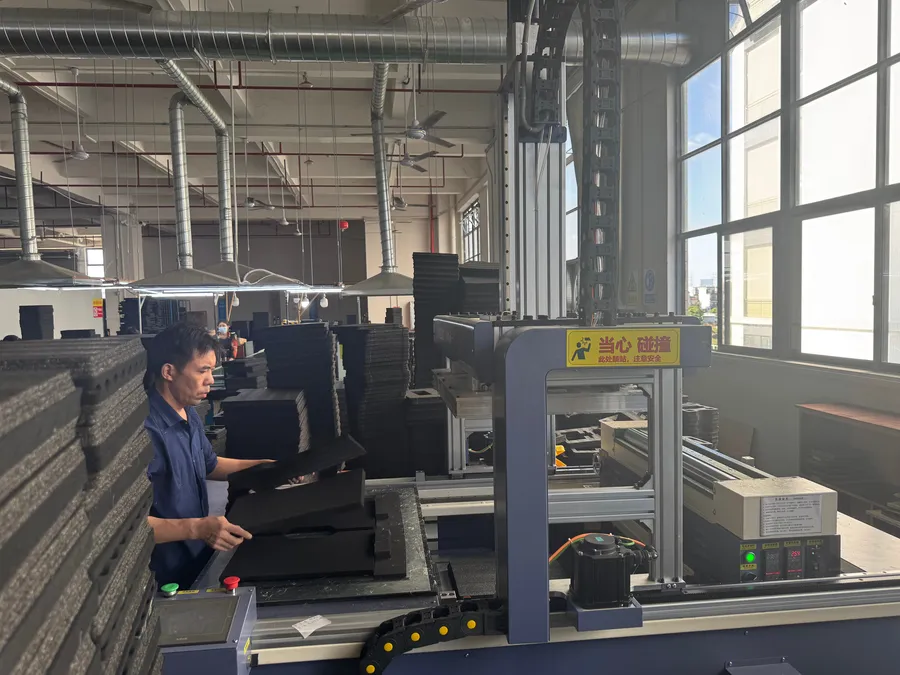
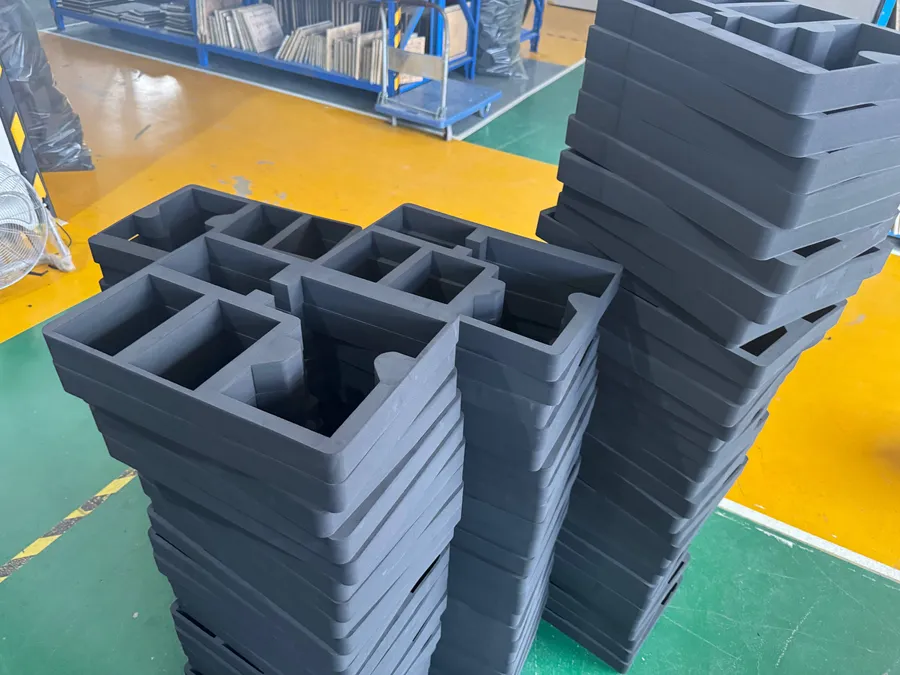
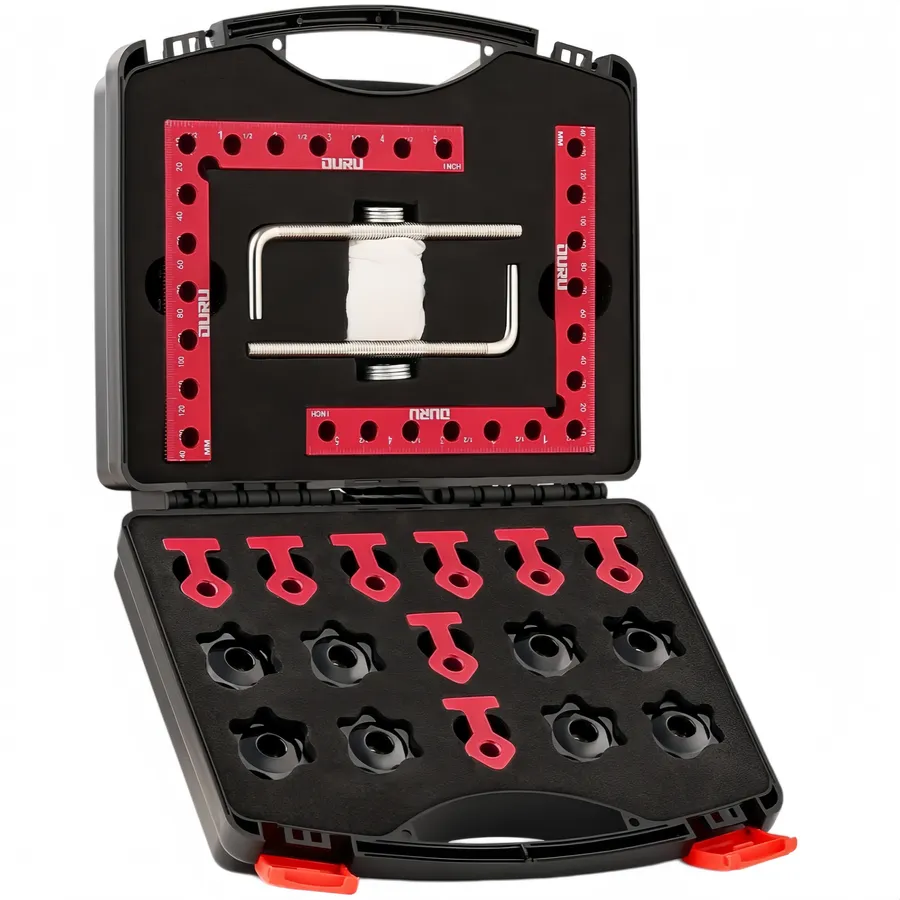
Customisation
Everything described above is configurable on a standard shell: interior layout (pick-and-pluck, die-cut or CNC-cut), foam grade and thickness, colour, logo method, latch and lock count, pressure-equalisation valve, cable ports, document holder and identification plate. A bespoke exterior geometry requires a new mould — 125 days, from 3,000 units per moulded component.
Procurement considerations
| Question | What to send us |
|---|---|
| Which shell fits? | Equipment L × W × H as packed, plus required clearance per axis |
| What does it cost? | Order quantity and estimated annual quantity — the two drive different answers |
| Is tooling needed? | Whether an existing shell clears the envelope with usable foam depth |
| Lead time? | Your required delivery date, not just the order date |
| Certification? | The exact standard your tender names — we will say whether we can test to it |
| Freight? | Destination and preferred terms; carton and pallet data supplied with the quotation |
Comparison and selection guide
The tables on this page exist because a protective case is chosen by comparing three things: the envelope, the environment and the handling chain. Where no table applies, the rule below is.
| Situation | What To Do |
|---|---|
| Clinical environment | Closed-cell foam or a wipeable tray; no open-cell pluck foam. |
| Emergency use | Latches that open with one hand and a lid that stays up unaided. |
| High-value device | Deeper base foam, a separate transducer zone, and a documented drop test if required. |
- Size on internal dimensions plus clearance, never on a product name.
- Choose the carrying method before the shell: it changes the series, not just the price.
- Specify the interior last, and decide up front whether the end user will reconfigure it.
Cold chain equipment case? relates to Logistics & Packing Guide. Related families: Medical Equipment Cases / Instrument & Equipment Cases / Equipment Transport Cases / Rolling Cases / Custom Protective Cases. Related sectors: field and industrial equipment. Continue in the Logistics & Packing Guide cluster.
This page is written from our own production data. If your requirement differs, send the dimensions and we will tell you which of the 155 models fits, or whether a custom route is needed.