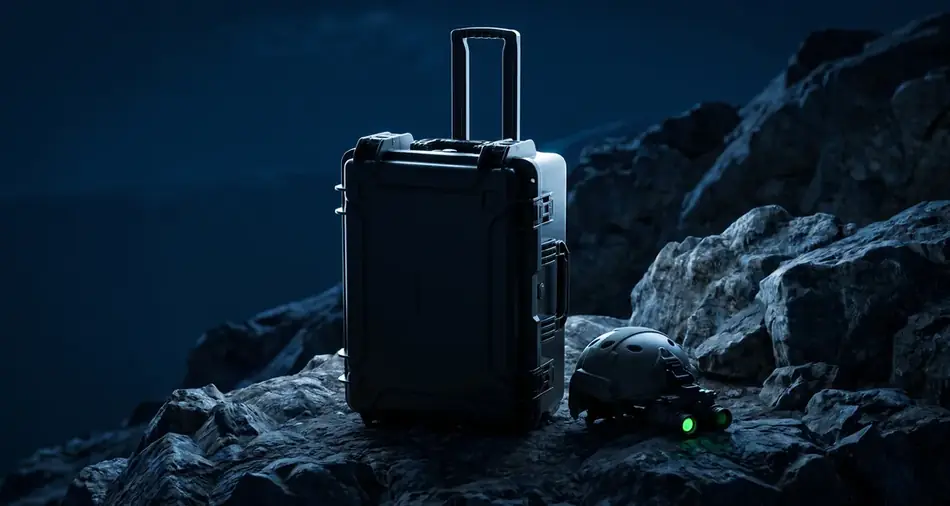
How should case wheels be specified in a protective case RFQ?
Write case wheels into the RFQ as a numbered hardware block, not as an adjective. State the wheel count and layout, whether the fixing is a serviceable bolt-on part or a moulded boss, the wheel diameter and material you require, the bearing and brake you need, the telescopic pull height your operators will use, the stacking consequence you accept, and the spares you want with the production batch. Then require the supplier to answer each line with a measured figure or with the words not published. In our own file, 19 of 155 models carry wheels, each with a telescopic pull, each recorded as not stackable, and none publishes a wheel diameter, a wheel material, a bearing type or a per-wheel load rating.
Key points
- Write wheel count, layout and fixing as three separate RFQ lines; a photograph cannot be inspected against at receiving.
- Ask for measured wheel diameter, width and compound per model, and accept not published as a valid answer only if it is followed by a measurement on the quoted configuration.
- Pull height is an operator fit, not a size-proportional number: our 19 rolling models publish 240 mm to 485 mm, while the longest shell in that group carries one of the shortest pulls.
- Treat wheels and stacking as one decision: all 19 wheeled models in our file are recorded as not stackable against 136 wheel-free models recorded as stackable.
- Order a spares kit on the purchase order, because wheels, stanchions and grip covers wear before the shell does.
- Do not accept a per-wheel load rating as a number without the method behind it; we publish none, and a rating without a method cannot be checked at receiving.
Why case wheels arrive under-specified
Wheels are the one part of a protective case that a buyer usually chooses from a photograph. The shell is discussed in millimetres, the foam in density and thickness, the latches by count and the seals by material, but the wheels are described with a word such as rugged, heavy duty or smooth running. That works until the first batch lands, and then the questions begin: which wheel is on the drawing, whether it can be replaced without returning the case, and why the pallet plan that worked for the previous model no longer stacks.
The underlying reason is that a wheel is a bought-in component fitted to a moulded base, so it sits between the tooling and the hardware catalogue. A supplier who has not measured it has nothing to quote except an adjective, and a buyer who has not specified it has nothing to inspect except a shape. The fix is the same one used for dimensions: convert the preference into numbered lines, give each line a unit, and make the supplier answer every line in writing before the sample is approved.
It is worth being precise about what a wheel buys. It converts a two-person lift into a one-person pull, but only on ground that is continuous, hard and flat, and only while the operator is willing to keep the shell tilted. The moment the route includes a kerb, a stair, a soft shoulder or a vehicle tailboard, the empty mass of the shell is what someone carries. That is why the specification below includes the mass line and the fixed handle line alongside the wheel itself.
The wheel block: eight lines to write
Put this block near the dimension block and keep the order fixed, so that every supplier answers the same question in the same place. Lines one to three describe the wheel, lines four and five describe how it is carried and parked, and the last three describe the consequences that reach your warehouse rather than your operator.
Ask for the answer to be written as a figure with a unit, or as the words not published followed by the method used to settle it. A line that comes back blank is not a neutral answer; it means the value will be decided later by whoever builds the batch, and it will be decided at the lowest cost consistent with the drawing.
| Line | Write | Why |
|---|---|---|
| 1. Wheel count and layout | Two wheels in a tilt-and-drag layout, or four in a push layout, stated as a number | The count predicts tipping angle, doorway behaviour and whether the case can stand parked |
| 2. Wheel diameter, width and compound | Measured millimetres and the polymer, or an explicit acceptance of an unstated figure | Diameter governs kerb and threshold behaviour; compound governs noise and floor marking |
| 3. Bearing, axle and fixing | Bolt-on serviceable part or moulded boss, plus the spare part reference | A serviceable wheel is a maintenance item; a moulded one is a return |
| 4. Brake and caster type | Trailing or swivel, brake or none, stated per model | A ramp or a sloped apron changes the answer, and a brake is not retrofittable on every base |
| 5. Telescopic pull height | Retracted and extended height in millimetres, and the operator heights it serves | Pull height sets the drag angle and therefore the load on the wrist and the base |
| 6. Fixed handle alongside the pull | Confirm a fixed folding handle is present for a two-person lift | A case with only a telescopic grip cannot be lifted into a vehicle by a second person |
| 7. Stacking consequence | Stackable yes or no for the wheeled build, in writing | This is the line that changes your pallet and rack plan |
| 8. Packing and spares | Carton footprint, pieces per carton, and the spares kit per quantity band | The carton is what your freight is priced on; the spares kit is what keeps a fleet running |
What our published data already answers
We can answer five of those eight lines from our own model file, at least in part, which is useful because it shows what a real answer looks like. Of 155 active models, 19 carry wheels and a telescopic handle, all of them in the T series; the other 136 are listed with a fixed folding handle and no wheels. Every one of the 19 records two wheels and none records four, so the layout is a property of the mould rather than an option line on the order.
The mass line is published on all 19, from 4,912 g on KX-85021 to 15,320 g on KX-88442, with a median of 8,500 g. Wall thickness is published on 18 of the 19, from 4.2 mm to 6.0 mm, and a compressible gasket in a moulded channel on 18 of the 19; KX-5126 is the exception on both fields and is quoted without a gasket. What is not published is equally consistent: no wheel diameter, no wheel width, no compound, no bearing, no brake, no caster type and no per-wheel load rating appears anywhere in the 155 records, and gross shipping mass is empty on every one. Those blanks are the lines your RFQ has to force.
| Model | External | Internal | Empty Mass | Wall | Pull Height | Carton |
|---|---|---|---|---|---|---|
| KX-85022 | 463 x 370 x 230 | 437 x 308 x 180 | 5,012 g | 4.5 mm | not published | 495 x 375 x 245, 1 per carton |
| KX-85827 | 588 x 475 x 267 | 500 x 400 x 220 | 7,800 g | 5.0 mm | 295 mm | not published |
| KX-85835 | 588 x 475 x 353 | 500 x 400 x 305 | 8,520 g | 5.0 mm | 295 mm | not published |
| KX-86830 | 677 x 535 x 304 | 595 x 460 x 255 | 10,160 g | 4.8 mm | 310 mm | not published |
| KX-88337 | 830 x 445 x 374 | 723 x 368 x 329 | 10,866 g | 5.0 mm | 240 mm | not published |
| KX-97227 | 720 x 500 x 270 | 590 x 435 x 210 | 10,000 g | 6.0 mm | 485 mm | 715 x 515 x 280, 1 per carton |
Wheels change the stack, the carton and the pallet plan
This is the part of the wheel decision that is usually left out of the RFQ and always noticed by the warehouse. In our file the stacking field separates the range perfectly: all 19 wheeled models are recorded as not stackable, and all 136 wheel-free models are recorded as stackable. The reason is moulding rather than policy. The base that carries the wheel mounts is not the base that locates into the shell below it, so a rolling case travels in a single layer, and the void above it is paid for in freight.
The carton data shows the same thing from the packing side. Only six of the 19 wheeled models publish a carton, and all six record one case per carton: KX-85022 at 495 by 375 by 245 mm, KX-5126 at 520 by 405 by 270 mm, KX-96027 at 580 by 250 by 415 mm, KX-66232 at 620 by 465 by 355 mm, KX-96127 at 640 by 625 by 280 mm and KX-97227 at 715 by 515 by 280 mm. Every other model in the group has its packing confirmed per order rather than copied from a sibling, which is the honest position when a carton and a pallet plan are built around a configuration.
The practical instruction is to put lines seven and eight of the block on the same page as the wheel lines, so that nobody can order wheels and inherit a stacking claim at the same time. A quotation that offers both is describing a base that does not exist, and it is cheaper to discover that during the tender than after a container is booked.
Matching pull height to the operator and the route
Pull height is the field buyers most often treat as decorative, and it is the one that decides whether a wheeled case is used as intended. Of our 19 rolling models, 11 publish an extended travel height: 240 mm on KX-87336 and KX-88337, 295 mm on five models including KX-85827, KX-85835 and KX-88442, 310 mm on KX-86830 and KX-86836, 385 mm on KX-85726 and 485 mm on KX-97227. The median is 295 mm, and the spread is the point.
Two rows in that list make the case better than any argument. KX-88337 is 830 mm long externally and publishes a 240 mm pull, while KX-97227 is 720 mm long and publishes 485 mm. A taller operator dragging the longer shell gets a shallower angle and more load through the wrist than a shorter operator gets on the shorter shell. So write the operator population into the RFQ, not just the case: state the range of user heights, the surfaces the case will cross, and whether the case will be pulled or pushed. A pull that is too short is not a defect that can be fixed at receiving, and a pull that is too long can foul a vehicle tailboard.
The route matters for the same reason. Wheels earn their place on a corridor, an apron, a hangar floor or a loading bay. They stop earning it at the first stair, kerb or gravel shoulder, and the empty mass in the table above is what is then handled. Where the route has more than one interruption, price the case as a lift and treat the wheels as a convenience, because a fleet that buys wheels for a route with stairs usually ends up carrying the case anyway.
Spares, service and the receiving inspection
A wheeled case is a serviceable assembly, and the RFQ should say so. Wheels, stanchion assemblies, grip covers and the telescopic stages are the parts that wear first, and a spares kit ordered with the production batch costs a fraction of a case that is grounded waiting for a replacement. Put the kit on the purchase order as a line with a quantity per band, and ask for the part reference against each item so that a reorder two years later reaches the same component.
At receiving, check a sample rather than the whole shipment. Spin each wheel for bearing drag and side play, confirm that the telescopic stages latch cleanly at every published height, verify that the folded handle seats flat and does not foul the latches, and stand the case parked on its wheels, feet and handle to see whether it is stable on a slightly inclined floor. Then measure the external envelope with the hardware fitted, because that is the number your rack and your pallet plan are built around, and it is the number most likely to differ from a nominal box size.
Customisation, minimum order and the tooling route
Some wheel changes are configuration work and some are tooling work, and the RFQ should say which one it is asking for. Configuration work is anything that does not cut a new boss or cross the sealing rim: an equivalent bought-in wheel on the same fixing, a change of hardware colour, a bolt-on fitting to existing moulded inserts, and the choice between a wheeled and a wheel-free build that we already run. Custom hardware is recorded as available on all 155 models, and an OEM build on an existing mould is quoted at 45 days to first sample, with a minimum of 300 pieces where a logo, a colour or an OEM specification is involved.
Tooling work is adding a wheel boss where the mould has none, moving a boss outside the gasket line, or converting a two-wheel base into a four-wheel one. That last change also removes the stacking rim, which is why it is a freight decision as much as a hardware decision. A new mould runs 125 days, from 3,000 pieces per moulded component, with a 30 percent deposit opening the tooling slot. We work wholesale and OEM only, on EXW or FOB terms: no retail channel, no DDP and no overseas warehouse, so the freight leg stays with you or your forwarder.
What we do not claim about wheels
Nothing in this page is a rating. The waterproof, dust, ultraviolet, temperature range, stack load and load capacity fields are recorded as not measured on all 155 models, and no ingress code is printed anywhere in our catalogue. Shock protection is recorded as a manufacturer option that depends on a specified foam layout, and impact is recorded as that model's wall thickness with no drop height claimed without a test. A wheeled configuration inherits neither a rating nor a promise from the hardware it carries.
On the wheels themselves, four absences are deliberate. We publish no wheel diameter, no wheel material, no bearing type and no per-wheel load rating, because none of those values is measured per model in our data. If your specification needs one of them, we will measure the configuration being quoted and put the figure in the drawing pack, so it is auditable at receiving instead of inherited from a catalogue page. If your tender needs a test report behind it, accredited third-party work is quoted per configuration as a separate package, with the method named in advance.
Customisation
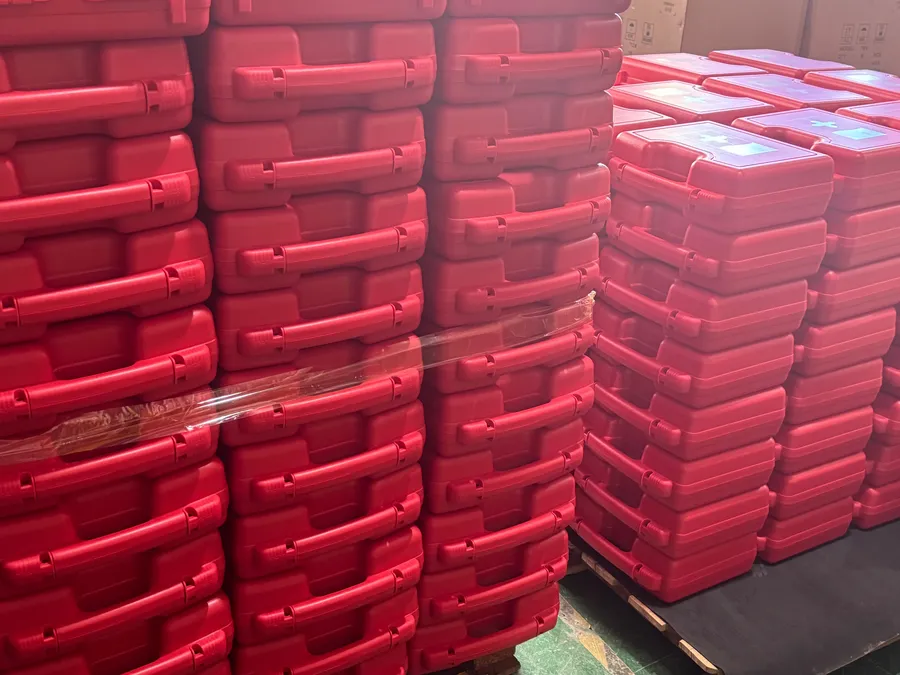
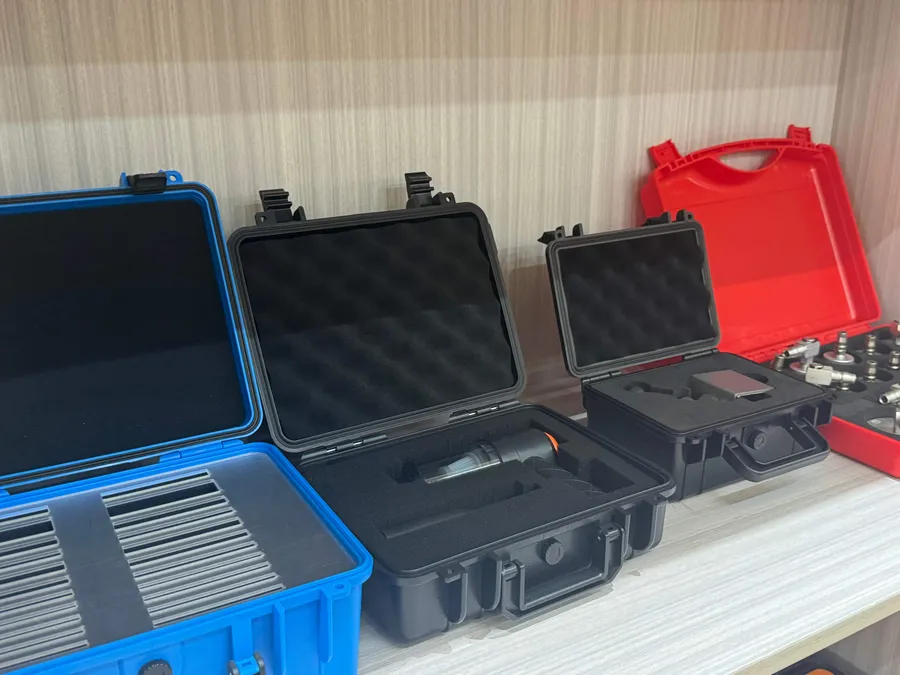
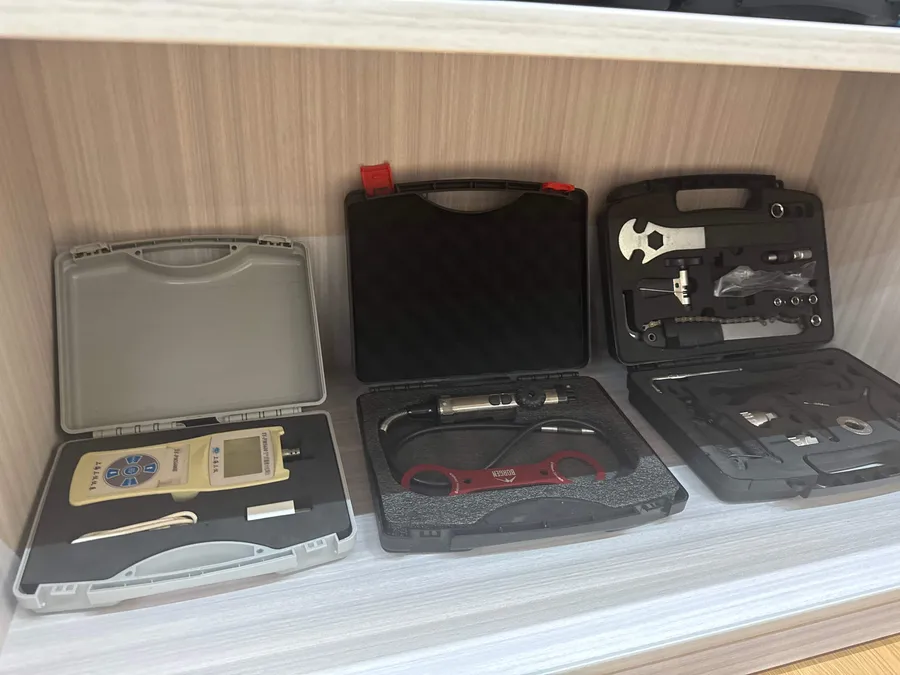
Everything described above is configurable on a standard shell: interior layout (pick-and-pluck, die-cut or CNC-cut), foam grade and thickness, colour, logo method, latch and lock count, pressure-equalisation valve, cable ports, document holder and identification plate. A bespoke exterior geometry requires a new mould — 125 days, from 3,000 units per moulded component.
Procurement considerations
| Question | What to send us |
|---|---|
| Which shell fits? | Equipment L × W × H as packed, plus required clearance per axis |
| What does it cost? | Order quantity and estimated annual quantity — the two drive different answers |
| Is tooling needed? | Whether an existing shell clears the envelope with usable foam depth |
| Lead time? | Your required delivery date, not just the order date |
| Certification? | The exact standard your tender names — we will say whether we can test to it |
| Freight? | Destination and preferred terms; carton and pallet data supplied with the quotation |
Comparison and selection guide
The tables on this page exist because a protective case is chosen by comparing three things: the envelope, the environment and the handling chain. Where no table applies, the rule below is.
| Situation | What To Do |
|---|---|
| Airport and road transfer | Check the external dimensions against cabin and boot constraints, not just the internal volume. |
| Rough ground | Larger wheels and a wider track matter more than shell volume. |
| Stored upright | Confirm the case can stand on its base with the handle retracted in your racking. |
- Size on internal dimensions plus clearance, never on a product name.
- Choose the carrying method before the shell: it changes the series, not just the price.
- Specify the interior last, and decide up front whether the end user will reconfigure it.
How should case wheels be specified in a protective case RFQ? relates to Logistics & Packing Guide. Related families: Rolling Cases / Military Protective Cases / Equipment Transport Cases / Custom Protective Cases. Related sectors: field and industrial equipment. Continue in the Logistics & Packing Guide cluster.
This page is written from our own production data. If your requirement differs, send the dimensions and we will tell you which of the 155 models fits, or whether a custom route is needed.