How should equipment cases be palletized?
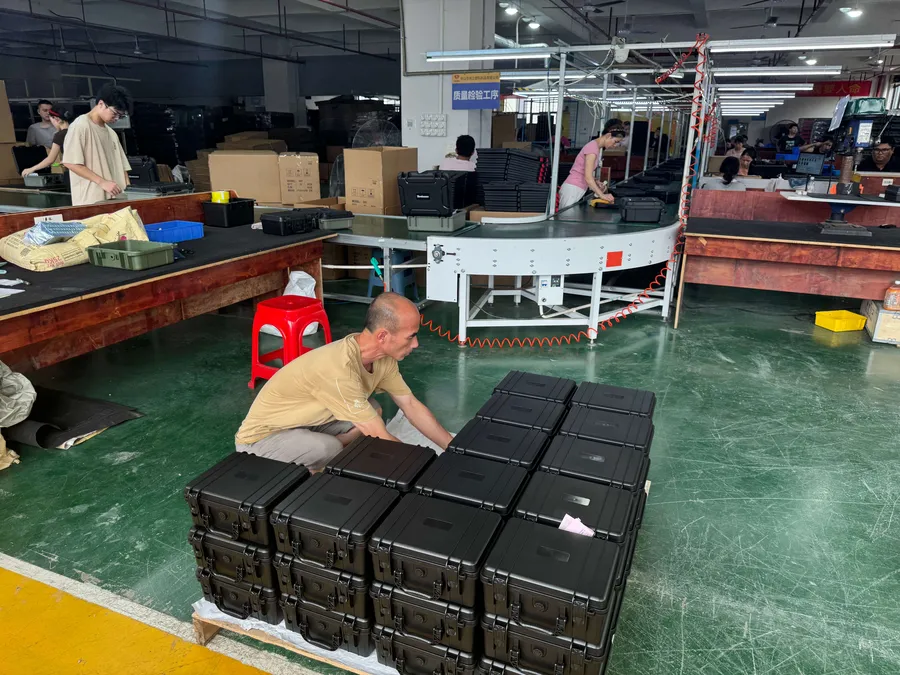
Palletize equipment cases from the outside in: take the carton footprint and the pieces-per-carton figure for every model on the order, lay a grid on the deck you actually use, keep all units inside the deck edge, then build the load in level courses with a tie course on top and restrain it with stretch film and corner boards. Pallet quantity is a property of the carton against your deck, not a property of the case, which is why no model in our 155-model catalogue publishes a fixed pallet figure. Sixty-four models publish carton dimensions and fifty-eight publish pieces per carton, so the build is calculated for each order from those published numbers rather than guessed from a photograph of a single case.
Key points
- Build the grid on the carton, not the case: the outer packing footprint is what the deck sees, and case dimensions only decide how many units sit inside it.
- Sixty-four of our 155 models publish carton dimensions and fifty-eight publish pieces per carton; the remainder are packed to the order and calculated at quotation.
- A 463 x 370 mm case footprint takes six units per course on a 1,200 x 1,000 mm deck, which uses roughly 86 percent of the available deck area.
- Rotate a whole course, never individual units: a mixed orientation layer looks like free capacity and turns into an out-of-square stack by the third course.
- Only the 136 models flagged stackable should carry a column; the 19 T Series trolley shells have wheels and are not, so they travel on their own deck.
- Mark every carton with the order line and model code before the film goes on, because a wrapped pallet cannot be re-counted once it is at sea.
Why the pallet is planned from the packing, not the product
A palletized load is a stack of rectangular packages, and the case is inside one of them. That distinction decides the whole exercise. The deck grid is filled by carton length and width, the course height is set by carton height, the unit count comes from pieces per carton, and the mass per pallet is units times net weight plus the packing. The external dimensions of the bare case matter only in two places: where a model ships without an outer carton, and where you are checking that a finished case will still fit the rack, doorway or vehicle body it goes to after unpacking.
This is also why a catalogue that quotes a single pallet quantity per model is usually guessing. A carton that lands neatly on a 1,200 x 1,000 mm deck can leave a strip of unusable deck on a 1,200 x 800 mm deck and a completely different strip on an 1,100 x 1,100 mm pool deck. We publish the inputs, which are the carton dimensions and the pieces-per-carton count for the models where the packing is fixed, and we calculate the pallet build against the deck you tell us you use. The catalogue field for pallet quantity is deliberately left open with that instruction written against it, rather than filled with an optimistic number.
The grid calculation, worked with published dimensions
Run the arithmetic on a real set of numbers so the method is visible. The KX 8-4818 shell measures 463 x 370 x 181 mm externally. On a 1,200 x 1,000 mm deck, laying the 370 mm side along the long edge gives three units across at 1,110 mm, and the 463 mm side along the short edge gives two units deep at 926 mm, so a course holds six cases and covers about 1.03 of the 1.20 square metres available. Five such courses put the load at 905 mm of product before the deck itself, which is why this footprint families works well: seven models share the same 463 x 370 mm plan with heights from 144 to 245 mm, so courses of different depths still land flat.
Now compare a carton build. The KX 2005 ships forty pieces to a carton measuring 410 x 360 x 495 mm. Three cartons across at 1,080 mm and two deep at 820 mm gives six cartons per course, which is 240 finished cases on one deck, and two courses reach just under a metre. The KX 6-3317 ships eight pieces to a 510 x 350 mm carton footprint, so the same deck takes four cartons and 32 units. Both numbers are honest; the difference is packing density and how much of the deck each carton shape can actually claim.
The last step before you commit is the leftover strip. A carton of 645 x 530 mm, which is the KX 3218 outer size holding twelve cases, fits two to a 1,200 x 1,000 mm deck with 140 mm of width left over at the long edge and 355 mm at the short edge. That leftover cannot take a third carton and is not enough for a mixed unit, so the build is two cartons per course and the question becomes whether the course height you gain is worth the deck you did not use.
What actually controls the pallet capacity
| Factor | What It Controls | How To Check Before Ordering | If Ignored |
|---|---|---|---|
| Carton footprint | How many cartons land on one course and how much deck is wasted at the edge. | Published carton length and width for the model, tested against your own deck size. | A lost column of cartons and a shipment billed on volume it did not use. |
| Pieces per carton | Units per course, and therefore how many purchase-order lines one pallet represents. | Fifty-eight catalogue models publish this figure; the rest are agreed with the packing design. | Recounting at the far end becomes an argument instead of a check. |
| Course height | How many levels fit inside the door height of the container or the rack level. | Carton height per model, multiplied against your clearance target. | The top course is cut, and a part course is the least stable thing on the deck. |
| Stackable geometry | Whether a column of loaded cases can carry the courses above it. | The stackable field is published per model; 136 of 155 are flagged. | Bottom-layer bowing and latch damage written up on arrival. |
| Deck standard | Which grid works at all, and whether the same pallet can be re-used across destinations. | State your deck size in the enquiry, including whether it is a pool pallet. | A build that works on paper at the factory and will not stand in the destination rack. |
Courses, tie layers and mixed-model pallets
Build in level courses and keep each course to one model and one orientation. A pallet that mixes a 405 x 325 mm carton with a 410 x 370 mm carton in the same layer will produce a top surface that is not flat, and everything above that layer inherits the error. Where two models must share a deck, put them in separate courses and note on the marking which band of height belongs to which order line, so the receiving team can break the load down without guessing.
The tie course matters more with hard cases than with cartons, because a moulded shell has a defined locating rim and a defined top face, and only one of those is intended to carry. Finish the load with a flat top board and keep the centre of gravity low: the heaviest and most regular units at the bottom, the lightest on top. The 843 x 592 mm family shows why. A KX 8-8442 shell alone is 15.32 kg net, and two of them rotated across a 1,200 x 1,000 mm deck fills the course, so a pallet built from that family is limited by the mass anyone is willing to lift long before it is limited by deck area. It is also a wheeled trolley shell and is not specified for stacking, so that single course is the whole load.
Stackable, nested, and the wheeled exception
One hundred and thirty-six of the 155 catalogue models are specified stackable, which is what makes a rim-on-rim pallet economic: shells travel at a fraction of their in-service volume when they locate into each other instead of lying flat in a grid. When you palletize empty cases, stack them rim-to-rim on a flat deck and band them as a single unit rather than as individual cases, because a column of empty shells that can walk sideways is the one failure mode a locating rim cannot cover.
The nineteen exceptions are the T Series trolley shells, which carry wheels and a telescopic handle and are not specified for stacking. Where their outer packing is published it is one case to a carton, so each trolley shell contributes its own deck area and its own course height rather than merging into a column. Do not use them as a base course or bury them mid-column: put them on their own deck, or on top of a stack whose height you have already fixed, so no column load ever reaches an axle.
Restraint, deck flatness and the moisture question
Restraint is a specification, not a habit. Stretch film applied in an overlapping spiral, with more wraps at the base than at the top, holds a pallet of moulded cases far better than a few turns around the crown, and corner boards earn their cost wherever a shell's latch bosses or handle mountings stand proud of the carton face. State the film gauge, the number of wraps and the corner-board arrangement on the packing instruction, because those are the details that get dropped when the packing is done by a night shift.
The deck has to be flat and dry before the first course goes down, because a warped pallet gives the bottom layer a starting tilt and everything above it amplifies the error. Deck choice also carries a commercial consequence: a pool pallet sized to one market may not be accepted in another, and a one-way timber deck may need heat treatment or marked fumigation documentation depending on where the shipment is going. That is an import requirement you confirm with your own broker, not something a case supplier can assert for you.
Marking, paperwork and the receiving check
Every carton on the pallet should carry the purchase-order number, the line it satisfies, the model code, the quantity inside and the gross mass, and the pallet itself should carry a summary label with the course map. Where an OEM programme includes a machined foam layout, add the cutting-file or insert reference to the marking scheme at the time of order, because reordering a machined layout two years later is only straightforward when the reference still exists on the drawing and on the box.
Define the receiving check before the load moves, so that a discrepancy is a claim rather than a conversation. Photograph the wrapped pallet and the carton faces before breakdown, reconcile carton counts against the packing list rather than against unit counts, and open one carton per model on the first shipment to verify that the published external and internal dimensions are the dimensions you received. The evidence that settles a dimensional dispute is the drawing or measurement record filed with the order.
Choosing case models with the pallet in mind
Where two candidate models both accept the equipment, prefer the one whose packing grids into your deck without an overhang, whose course height leaves room for a top board inside your rack or container limit, and whose published external footprint belongs to a family with several heights. Sharing a plan across depths means one pallet pattern serves a whole range of kits. The 405 x 325 mm plan, for example, is shared by seven models with heights from 130 to 230 mm, and the 517 x 430 mm plan by four models from 150 to 240 mm.
Work the other direction as well. If a model you already use leaves a strip of dead deck on your standard pallet, ask whether the carton can be revised by a few millimetres rather than accepting the loss on every shipment. That is a packing change, not a tooling change, and it is usually worth more over a reorder cycle than the equivalent negotiation on freight rate. A change to the shell geometry itself is a different matter: a new mould creates a new external footprint, and every carton and pallet figure has to be recalculated against it.
Where palletized case loads are used
Pallet discipline pays first in the flows that move the same models repeatedly. Defence and field-equipment programmes shipping communication kits, optronics, survey instruments and drone-and-battery sets all want the same thing: one deck pattern that survives an inland leg, a sea leg and a warehouse rack without re-work. Ammunition and inventory transport is the same problem with more strictness about count, because a consignment that cannot be verified carton-by-carton at the receiving point becomes a reconciliation exercise.
Distribution and rental fleets have the opposite pressure, where mixed-model pallets are the norm. There the answer is not a better grid but a documented course map, so that whoever breaks the pallet down can put each band of height onto the right shelf without opening cartons. It is also the case where a single shared plan across a range of shell depths reduces the number of pallet patterns your team has to remember.
Customising the packing around your deck
Three things are configurable without touching the shell. Outer carton size and pieces-per-carton can be set to your deck, subject to a handling mass any one person has to lift. Carton printing, labelling and pallet marking can follow your own scheme, which is a common OEM requirement. And the internal foam layout can be arranged so that a carton opens into a presentation that matches the rack at the destination, which removes a re-packing step from the receiving process.
Changing the shell itself is a separate programme. A dedicated new mould runs about one hundred and twenty-five days with a minimum from three thousand pieces per component, and an OEM configuration on an existing mould runs about forty-five days to first article, both with a thirty percent deposit. If the goal is purely a better pallet fit, ask first whether a revised carton achieves it, because the carton route costs nothing in tooling and can be applied to the next production run.
Procurement notes and terms
KeXin New Materials (Guangdong) Co., Ltd. supplies on a wholesale and OEM basis, quoted EXW or FOB from the factory, with a thirty percent deposit and the balance before shipment. There is no retail sale, no DDP delivery and no overseas warehouse, so the pallet and container figures in a quotation are calculated for your stated deck and your stated destination handling, not taken from a fixed table.
What we publish per model is the measurable geometry: external and internal dimensions, narrowest internal width, wall thickness, lid and base depth, net mass where it is recorded, shell material, stackable status and, for the models with fixed packing, the carton size and pieces per carton. What we do not publish is a pallet quantity, a container count or any ingress or impact rating, because those depend either on your deck or on a test that has to be commissioned for the exact configuration you order. A supplier who separates the measured from the calculated is giving you data; a supplier who blends them is giving you a brochure.
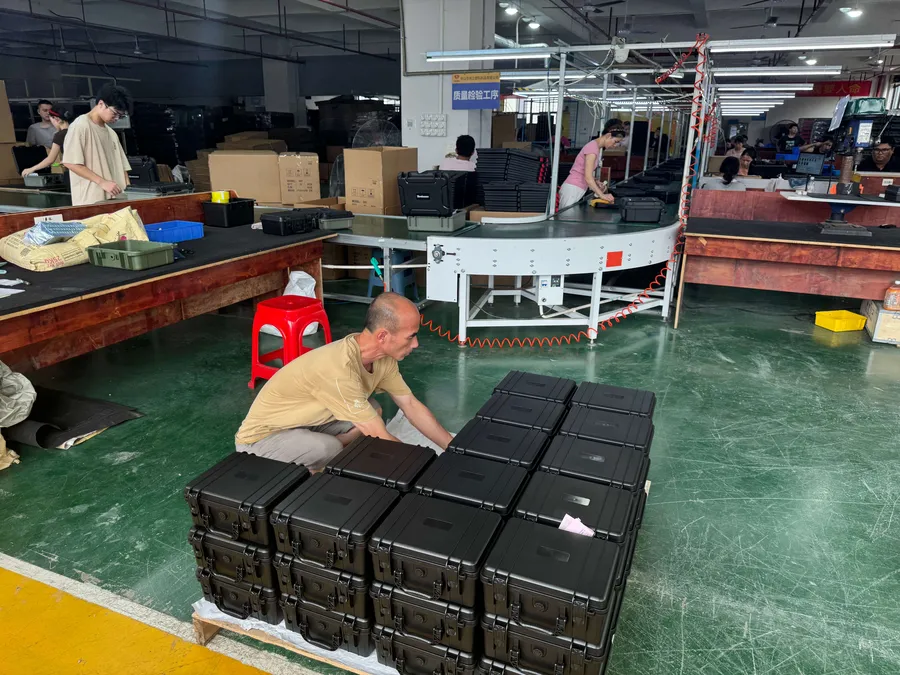
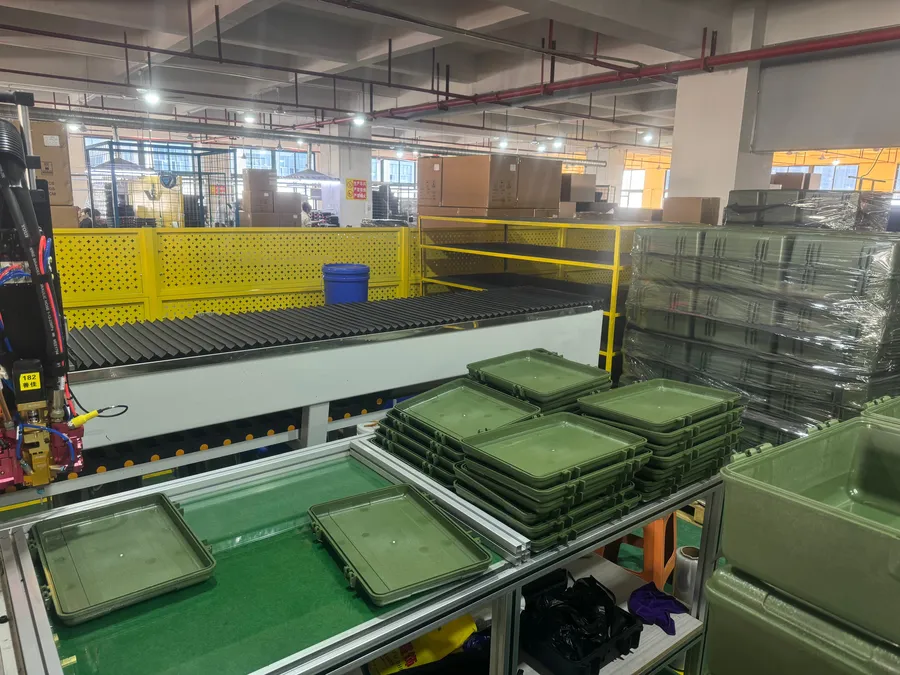
Customisation
Everything described above is configurable on a standard shell: interior layout (pick-and-pluck, die-cut or CNC-cut), foam grade and thickness, colour, logo method, latch and lock count, pressure-equalisation valve, cable ports, document holder and identification plate. A bespoke exterior geometry requires a new mould — 125 days, from 3,000 units per moulded component.
Procurement considerations
| Question | What to send us |
|---|---|
| Which shell fits? | Equipment L × W × H as packed, plus required clearance per axis |
| What does it cost? | Order quantity and estimated annual quantity — the two drive different answers |
| Is tooling needed? | Whether an existing shell clears the envelope with usable foam depth |
| Lead time? | Your required delivery date, not just the order date |
| Certification? | The exact standard your tender names — we will say whether we can test to it |
| Freight? | Destination and preferred terms; carton and pallet data supplied with the quotation |
Comparison and selection guide
The tables on this page exist because a protective case is chosen by comparing three things: the envelope, the environment and the handling chain. Where no table applies, the rule below is.
| Situation | What To Do |
|---|---|
| Free-drop height | With a 50 mm base foam layer, a 15 kg assembly sees a markedly lower peak deceleration than with 20 mm. Where the case is handled by hand off a vehicle, we specify the deeper base. |
| Stacking | A case that will be shipped stacked needs a wall thickness and rim geometry that carries the load through the shell, not through the lid. |
- Size on internal dimensions plus clearance, never on a product name.
- Choose the carrying method before the shell: it changes the series, not just the price.
- Specify the interior last, and decide up front whether the end user will reconfigure it.
How should equipment cases be palletized? relates to Logistics & Packing Guide. Related families: Defense Equipment Cases / Equipment Transport Cases / Military Transport Cases / Ammunition Storage & Transport Boxes. Related sectors: field and industrial equipment. Continue in the Logistics & Packing Guide cluster.
This page is written from our own production data. If your requirement differs, send the dimensions and we will tell you which of the 155 models fits, or whether a custom route is needed.