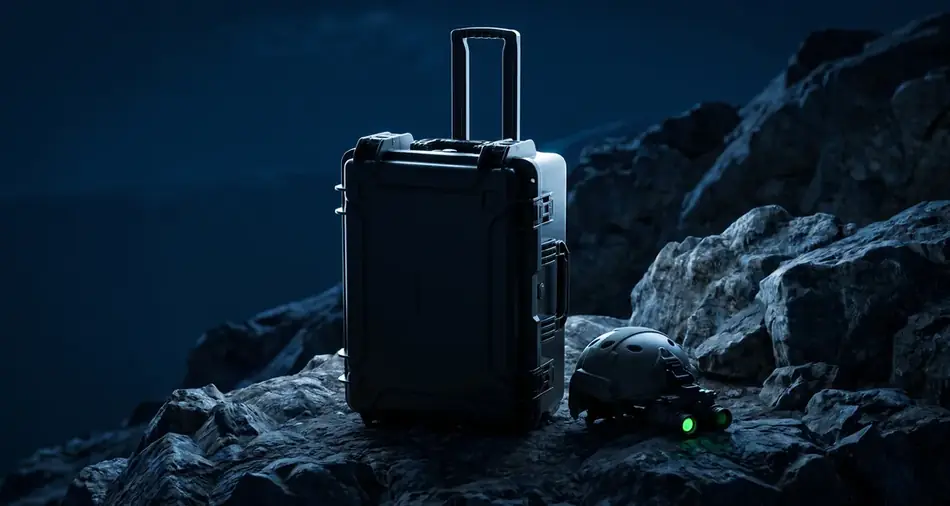
What are the common mistakes in case handles for equipment transport cases?
Six mistakes explain nearly every handle complaint we hear about equipment transport cases: reading a handle type as if it were a handle specification, sizing a grip without the loaded mass, treating a blank telescopic height as either zero or a promise, ordering the rolling handle without accepting its wheels and its stacking loss, forgetting the grip that has to hold a deep loaded lid, and assuming a long shell must roll. Our published 155-model file answers each one with a field. The handle record takes exactly two values - fixed folding on 136 listings and telescopic plus fixed folding on 19 - and a fixed folding handle is present on all 155, while handle count, grip geometry, handle material and any load figure for the handle are stated on none of them. Net weight, the number a grip actually carries, is published on 93 listings from 100 g to 15,320 g with a median of 1,480 g. Extended handle height appears on 11 of the 19 telescopic shells, 240 mm to 485 mm, and on none of the other eight. All 19 telescopic listings carry two wheels and state stackable as false; all 136 wheel-free listings state true. The common mistakes in case handles are therefore substitutions rather than bad luck: in every case an easy number, or a photograph, was used for a decision the published field was recorded to support.
Key points
- A handle type is one field, not a specification: our file states count, grip geometry, material and load rating for the handle on 0 of 155 listings.
- Size the grip from loaded mass, not from the shell in the picture: net weight is published on 93 of 155, median 1,480 g, and 62 listings leave it blank.
- Extended height is published on 11 of the 19 telescopic shells, 240 mm to 485 mm; the other eight are open questions and must be asked, not assumed.
- Telescopic, wheels and lost stacking are one purchase: the same 19 listings carry all three, and all 136 wheel-free listings publish stackable as true.
- Deep lids need their own grip: 11 shells publish a lid of 200 mm or more and three of them - KX-84430, KX-84825, KX-86127 - publish no net mass.
- Length does not predict the handle: 26 of the 43 shells at 500 mm or more on their longest axis are published fixed-folding with zero wheels.
- All six mistakes are prevented by one habit: name the published field and the model behind every handle claim before the sample is approved.
Why handle mistakes repeat across transport programmes
Handle failures follow the same route in electronics, medical, telecommunications and field programmes: a visible number gets used for a job it was never recorded for. The wheel count is visible, so it stands in for the carrying plan. The word folding in a catalogue line stands in for a grip that has to hold eleven kilograms of loaded shell on a loading-bay edge. A handle that appears in a photograph stands in for a position on the rim that nobody has drawn. None of these substitutions are ignorance; they are convenience, and they are all mechanical to prevent once you know which field is supposed to sit behind each claim.
The prevention is a reading discipline rather than specialist knowledge. For every statement you make about how a case will be carried, name the published field that supports it and the model that field belongs to. We use our own file below - 155 listings, every dimension published, and honest about the cells it leaves empty - because a specification written against stated fields survives receiving inspection, while one written against impressions is discovered at the first kerb, on the first rack deck or in the first two-person lift.
Mistake one: reading a handle type as a handle specification
The first mistake is the one everything else grows from. Our handle field takes exactly two values across 155 listings - fixed folding on 136, telescopic plus fixed folding on 19 - and every listing, including all 19 rolling ones, records a fixed folding handle as present. That is genuinely useful and it is also almost all there is. The file states no handle count per shell, no grip length, no standoff between grip and wall, no handle polymer or metal and no load figure for the handle itself. Hardware material is recorded as metal or polymer by configuration rather than per model, and shoulder strap is held as an option with a value on none of the 155. A buyer who reads the type line as a specification has, in effect, been told which moulding family the case belongs to and nothing about whether it can be carried safely.
Mistake two: sizing a grip without the loaded mass
The number a handle lives or dies by is mass, and it is the number our file publishes least evenly. A net weight is stated on 93 of 155 listings, from 100 g on KX-1204 to 15,320 g on KX-88442, with a median of 1,480 g and a mean of about 2,985 g; 62 listings publish dimensions and no weight, and a gross shipping mass is recorded on none. Read those figures as empty shells. Your equipment and your cut foam go on top of every one of them, and 61 models already sit at or above 1,000 g, 36 at or above 2,000 g, 28 at or above 3,000 g and 24 at or above 4,000 g before anything is packed.
The split by handle tells you where the mistake hides. All 19 telescopic listings publish a mass, from 4,912 g to 15,320 g with a median of 8,500 g - a two-person number the moment the wheels stop. The 136 fixed-folding listings publish weights on 74 models with a median of 1,200 g, but their top end reaches 6,420 g on KX-6621, 6,140 g on KX-6922, 4,860 g on KX-65522, 4,810 g on KX-5321 and 4,680 g on KX-5723. A folding-grip shell is therefore not automatically a light shell, and a specification that treats the two as synonyms under-plans the lift.
Mistake three: treating a blank handle height as zero, or as a promise
An extended telescopic height is published on 11 of the 19 rolling listings: five shells at 295 mm, two at 240 mm, two at 310 mm, KX-85726 at 385 mm and KX-97227 at 485 mm - the highest figure in the file - with a median of 295 mm. The other eight rolling models, KX-85021, KX-85022, KX-5126, KX-85424, KX-85427, KX-96027, KX-96127 and KX-66232, record the telescopic handle and no number. Buyers make two opposite errors with that gap. The first reads the blank as zero and plans a rack deck that turns out too low once the grip is pulled up. The second reads the blank as whatever the sibling model publishes, quotes 295 mm, and discovers at receiving that the delivered shell was never measured.
Both errors cost the same to avoid. Ask for the extended figure, the retracted figure and the number of stages, measured on the shell in your order, and put the raised dimension into every shelf pitch, vehicle floor, lift doorway and aisle the route contains. Then check the interaction at sample stage: the stages should latch cleanly at each height, the latch button should clear the lid hinge, and the folded side grip should still seat flat. A height you can specify is a height somebody measured.
Mistake four: ordering the rolling handle without its wheels and its stacking loss
The fourth mistake treats a telescopic grip as an upgrade you can select on its own. In our file it never exists alone: all 19 listings that record a telescopic handle also record two wheels, and no listing records wheels without a telescopic handle. Those same 19 are exactly the listings that state stackable as false, while all 136 wheel-free listings state true. The correspondence is exact because it is a moulding consequence - the base that carries the wheel bosses and the handle channel is not a surface another case can rest on. A quotation that offers a telescopic handle and keeps the stacking sentence from the sibling model is describing a tool that does not exist, and the error surfaces when the pallet plan fails at the forwarder rather than when the sample arrives looking convincing.
Because the coupling is real, the decision belongs in freight before it belongs in comfort. Those 19 shells span 463 mm to 843 mm on their longest external axis and publish empty masses with a median of 8,500 g; a non-stackable shell travels in a single layer and the void above it is paid for on every leg. If your storage and transport model depends on column stacking, the honest answer may be the wheel-free shell of the same footprint rather than a compromise on the handle.
Mistake five: forgetting the grip that has to hold a loaded lid
Most handle conversations are about the base rim, and that is the second thing buyers under-specify. A lid that is deep and full of cut foam swings hard when it is opened one-handed, and the grip that arrests it sits on the cover, not on the shell. Our file publishes a lid depth on 100 listings, from 16 mm to 320 mm with a median of 98 mm, and 11 shells carry a cover of 200 mm or more: KX-88442 at 320 mm, KX-88337 at 280 mm, KX-86836 at 270 mm, KX-87336, KX-85835 and KX-86136 at 260 mm, KX-88434 at 240 mm, KX-84430 at 230 mm, KX-86830 at 210 mm, and KX-84825 and KX-86127 at 200 mm. Three of those eleven are fixed-folding shells with no published net weight at all, so their worst case is a deep loaded cover on a grip with no figure behind either half.
The rim those grips share is busy. A hinge is recorded on all 155 shells, moulded feet on all 155 and a latch body that accepts a standard padlock on all 155, while the latch count itself is specified per configuration rather than per model. Sealing narrows it further: 124 listings record a compressible gasket in a continuous moulded channel and 31 record none offered on the shell, and every boss placed across that channel turns a hardware request into a sealing question. Ask for the marked drawing, not the adjective.
Mistake six: assuming a long case must roll
The sixth mistake is size-driven and it is the easiest to disprove from a datasheet. Across our 155 listings, 43 shells reach or pass 500 mm on their longest external axis; 17 of them are telescopic and 26 are published fixed-folding with zero wheels. Twelve reach or pass 700 mm, and the two longest shells in the file - KX-814641 at 1,356 by 154 by 408 mm and KX-89616 at 956 by 408 by 154 mm - are both long, both fixed-folding and both stackable, with no published mass. A long narrow shell has rim wall running its whole length and no sensible place for a wheel channel; it is a two-person lift at the end grips, and length is the reason rather than an argument for trolley hardware.
The six mistakes and the published check that replaces each one
Run the table below as a pre-order review. Each row pairs one recurring mistake with the field that answers it, so a specification can be settled before the purchase order is raised instead of argued about after the delivery. Where our own file is blank, the row says so: a blank you have identified is worth more than a number you inherited from a similar-looking model.
| The Mistake | What Our Published File Actually States | The Check That Replaces It |
|---|---|---|
| Handle type read as a full handle specification | Two type values across 155 listings; handle count, grip geometry, material and load rating on 0 of 155 | A marked drawing naming every grip, its opening and its distance from the centre of mass |
| Grip sized without the loaded mass | Net weight on 93 of 155, 100 g to 15,320 g, median 1,480 g; gross weight on none | Empty shell weight for the named model plus your packed mass, written down before hardware is chosen |
| A blank telescopic height read as zero or as a promise | Height on 11 of 19 rolling shells, 240 mm to 485 mm, median 295 mm; eight blanks | Extended, retracted and stage count measured on the shells in your own order |
| Rolling handle ordered without its wheels and stacking loss | The same 19 listings carry telescopic, two wheels and stackable as false; 136 wheel-free listings state true | Freight and racking plan priced with the wheel option, on the same line as the handle |
| No grip considered for a deep loaded lid | Lid depth on 100 listings, 16 mm to 320 mm; 11 shells at 200 mm or more, three of them with no published mass | A one-handed open-and-arrest rehearsal at sample stage with your actual foam fitted |
| Length assumed to require trolley hardware | 26 of the 43 shells at 500 mm or more are fixed-folding with zero wheels, including the 1,356 mm shell | Which moulding family the batch is built to, confirmed before hardware preferences are discussed |
What we do not state about handles on any model
So that silence cannot be mistaken for a claim, here is the explicit list. No handle count, grip length, standoff, grip-opening dimension or handle material is published for any of our 155 models, so no ergonomic conclusion is implied on this page. No load rating exists for any handle, and load capacity and stack load are recorded as not measured on all 155 listings. A gross shipping mass is recorded on none, and 62 listings state dimensions without a net weight, so a packed figure for those configurations has to be quoted rather than assumed. A shoulder strap is held as an option with no value published anywhere in the file.
Where each mistake bites hardest, by programme
The six errors are not evenly distributed. Field and deployment fleets meet mistake two most often, because the last stretch of their route is stairs and soft ground and the folding grip ends up carrying the whole loaded number; the deep-body listings that publish 3,430 g on KX-5021 up to 6,420 g on KX-6621 are the ones to ask about grip count, since none of them states one. Workshop and instrument programmes meet mistake three, because cases live in racks and vehicles whose decks were cut from shell dimensions with the handle retracted. Aviation-facing and telecommunications fleets meet mistake four, because a single-layer non-stackable build changes pallet count, container fill and freight cost on every leg.
Correcting a handle specification: configuration change or new tooling
Once a mistake is identified, the remedy splits into two very different commercial paths. Configuration work covers substituting an equivalent bought-in handle on an existing fixing, changing grip or hardware colour, fitting bolt-on parts to moulded inserts, and specifying the grip and latch arrangement shown on your drawing; custom hardware is recorded as available on all 155 listings, and these routes are quoted at about 45 days to first sample from a MOQ of 300 pieces, with custom colour and custom logo also at 300 pieces and standard cases and custom foam at 1. Any change that needs a new boss, a telescopic channel or an anchor across the gasket line is moulding work instead: about 125 days with a MOQ from 3,000 pieces per component.
That split is also the honest answer to the most common retrofit request. A folding-grip shell cannot be given a telescopic system by an accessory purchase, because the same change would cut wheel bosses, breach the sealing channel that 124 of our listings record as a continuous moulded gasket, and forfeit the stacking surface the model publishes as true. We price it as three decisions in one line and say so at quotation stage. The frame around all of it is fixed: wholesale and OEM or ODM only, EXW or FOB, no retail orders, no DDP terms and no overseas warehouse, with a 30 percent deposit and the balance after your inspection; third-party factory inspection is welcome.
Procurement notes: the handle lines to put on the order
A handle requirement is only real when the purchase order carries it. Minimum lines: the handle type string for the named model; which fields are stated and which are explicitly marked unspecified; extended, retracted and stage figures for any telescopic unit; a marked drawing showing every grip relative to the latch line and hinge, including the lid; the stacking status you accepted; and the loaded mass the configuration is expected to reach. At receiving inspection, work the hardware while it is still returnable - open and arrest the cover one-handed, run the telescopic stages through each latch height, confirm the folded grip seats flat, and check grip positions against the drawing rather than against expectations.
Send us the equipment dimensions in its packed configuration, its mass, a written description of the route including every stair, threshold, rack deck and vehicle shelf, and the mass a single operator is permitted to lift. The answer comes back with published figures for named models, the model page link beside each number, and an explicit statement of which values are measured and which our file records as blank. Fred Zhao, KeXin Sales Team, WhatsApp +86 135 3588 0002. Written by KeXin New Materials (Guangdong) Co., Ltd.
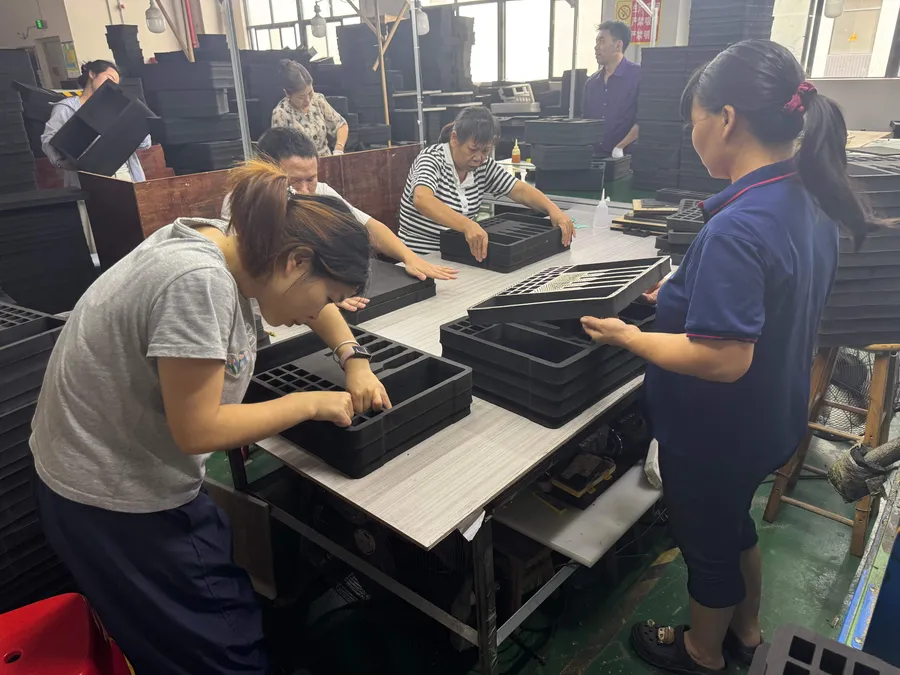
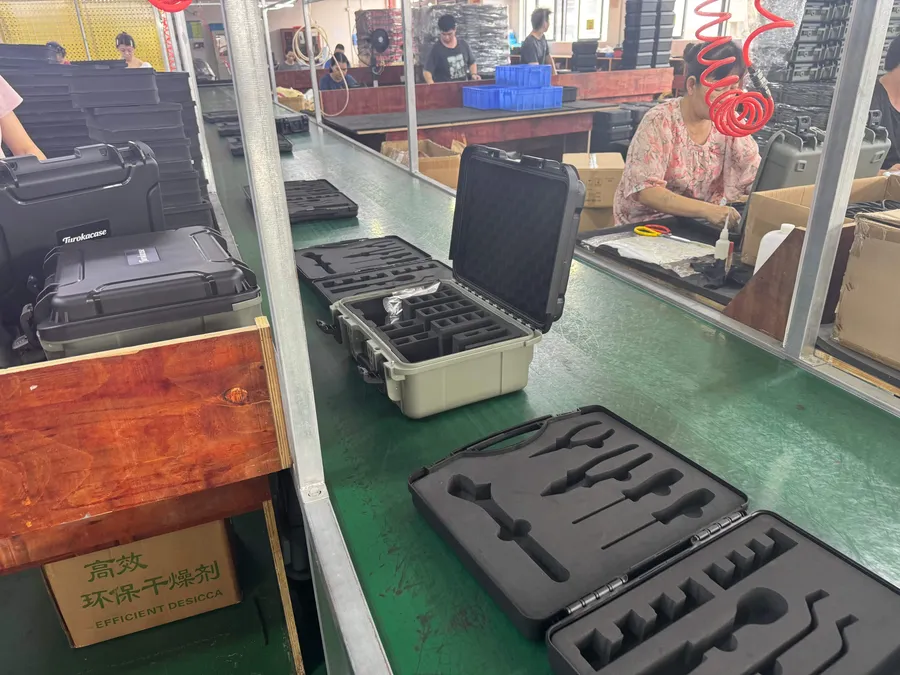
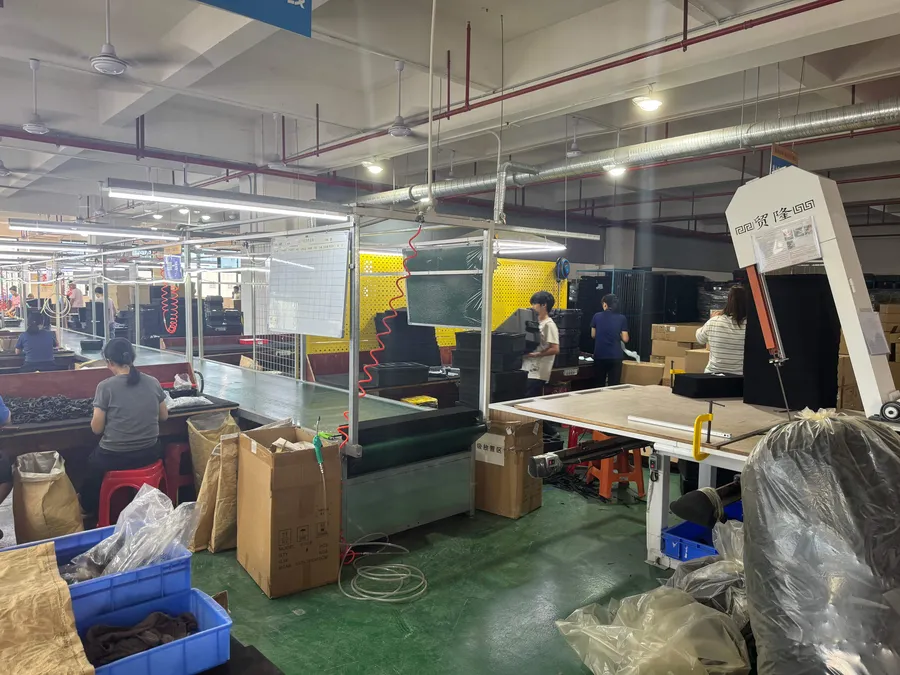
Customisation
Everything described above is configurable on a standard shell: interior layout (pick-and-pluck, die-cut or CNC-cut), foam grade and thickness, colour, logo method, latch and lock count, pressure-equalisation valve, cable ports, document holder and identification plate. A bespoke exterior geometry requires a new mould — 125 days, from 3,000 units per moulded component.
Procurement considerations
| Question | What to send us |
|---|---|
| Which shell fits? | Equipment L × W × H as packed, plus required clearance per axis |
| What does it cost? | Order quantity and estimated annual quantity — the two drive different answers |
| Is tooling needed? | Whether an existing shell clears the envelope with usable foam depth |
| Lead time? | Your required delivery date, not just the order date |
| Certification? | The exact standard your tender names — we will say whether we can test to it |
| Freight? | Destination and preferred terms; carton and pallet data supplied with the quotation |
Comparison and selection guide
The tables on this page exist because a protective case is chosen by comparing three things: the envelope, the environment and the handling chain. Where no table applies, the rule below is.
| Situation | What To Do |
|---|---|
| Sea freight | Sealed configuration plus desiccant; salt spray is a handling issue, not a material issue. |
| Air freight | Mass and external dimensions drive cost more than volume. |
| Repeated movement | Replaceable latches, hinges and gaskets; keep a spares kit with the first order. |
- Size on internal dimensions plus clearance, never on a product name.
- Choose the carrying method before the shell: it changes the series, not just the price.
- Specify the interior last, and decide up front whether the end user will reconfigure it.
What are the common mistakes in case handles for equipment transport cases? relates to Logistics & Packing Guide. Related families: Equipment Transport Cases / Military Protective Cases / Rolling Cases / Custom Protective Cases / Electronics Cases / Field Equipment Cases / Medical Equipment Cases / Tool Cases. Related sectors: field and industrial equipment. Continue in the Logistics & Packing Guide cluster.
This page is written from our own production data. If your requirement differs, send the dimensions and we will tell you which of the 155 models fits, or whether a custom route is needed.