How should internal vs external dimensions be specified in a protective case RFQ?
State both sets of internal vs external dimensions, label each one, and say which of them is the constraint. In a protective case RFQ the internal box is the line that decides whether the supplier can fit your equipment, while the external box is the line that decides whether the shipment fits your freight, so a single unlabelled number forces the seller to guess and usually gets you quoted on the wrong one. On our own catalogue every one of the 155 published models carries an external triple and an internal triple, with a median outer-to-inner difference of 26 mm on length, 57 mm on width and 15 mm on height, so the two sets are never interchangeable. If a model is already selected, quote its published internal and external dimensions by model code; if the equipment drives the choice, send the equipment envelope and the freight ceiling and let us match the two.
Key points
- Put internal and external dimensions on separate, labelled RFQ lines; an unlabelled number is the most common cause of a wrong-model quotation.
- Every one of our 155 published model sheets states both an external and an internal triple, so a named model can be checked without a guess.
- The internal box is the fit constraint and the external box is the freight constraint; the median outer-to-inner gap is 26 x 57 x 15 mm.
- 64 models publish carton dimensions and pieces per carton, which is the number freight forwarders need; pallet quantities are not stated on model sheets.
- Where a sheet states a narrow internal width, that figure governs whether a part enters; it is 8 to 37 mm tighter than the internal width on 36 models.
- For a new mould the sequence is drawing first: 125 days and MOQ from 3,000 per component, against 45 days for a first OEM sample on existing tooling.
Internal vs external dimensions: what one RFQ line has to carry
A dimension line in a protective case RFQ is only usable if the reader knows which box it describes and which axis is which. Write it as an ordered triple, length x width x height, name the unit, and say whether the measurement is taken on the outside faces of the closed shell or on the inside faces of the cavity. Those two answers change the product you are being quoted: the external triple sets how many units go on a pallet and into a container, while the internal triple sets whether the item goes in at all.
The second thing the line has to carry is direction of constraint. If you have already chosen a case, the internal triple is a fact you are asking the supplier to confirm and the external triple is what your freight planner needs. If you have not chosen a case, the numbers you send are your equipment's envelope plus a stated maximum for the outside, and the supplier's job is to find a shell that satisfies both. Mixing these two modes in one email is how buyers end up with a quote for a case that fits the equipment and cannot be shipped economically, or the reverse.
What our published model sheets state, axis by axis
We publish both boxes for all 155 models, and the gap between them is not a constant. Taking each model's own figures, the median external-minus-internal difference is 26 mm on length, 57 mm on width and 15 mm on height; across the range those differences run from 5 to 130 mm on length, up to 80 mm on width and 3 to 268 mm on height. The width gap is larger than two walls can explain because the internal dimension is taken between the moulded ribs and the latch band rather than between the outer faces. Wall thickness is stated for 148 models and runs 2.0 to 6.0 mm, a median 3.9 mm, which is a useful cross-check but not a substitute for the published internal triple.
One caution about arithmetic. On 154 of the 155 models every external value is larger than the internal value on the same axis. On KX-814641 the two published triples are ordered differently from each other, so subtracting one axis from the other on that row produces nonsense. Read each box as an ordered triple, compare model to model rather than deriving one from the other, and if a subtraction looks impossible, check the axis order before you challenge the supplier's data.
Published internal and external data on real model sheets
The rows below are copied from individual model pages, not from a category average. Dimensions are length x width x height in millimetres, volumes are the published litre figures, and the difference column is that model's own external triple minus its own internal triple.
| Model | External Mm | Internal Mm | Difference Mm | Internal Volume L | Usable Interior L | Carton Mm Pieces |
|---|---|---|---|---|---|---|
| KX-2005 | 195 x 170 x 46 | 190 x 135 x 40 | 5 / 35 / 6 | 1.0 | 0.9 | 410 x 360 x 495, 40 pcs |
| KX-2405 | 240 x 200 x 53 | 220 x 162 x 49 | 20 / 38 / 4 | 1.7 | 1.5 | 475 x 415 x 280, 20 pcs |
| KX-2808 | 275 x 230 x 82 | 265 x 190 x 76 | 10 / 40 / 6 | 3.8 | 3.3 | 560 x 445 x 415, 20 pcs |
| KX-4616 | 460 x 367 x 155 | 455 x 338 x 148 | 5 / 29 / 7 | 22.8 | 19.6 | 755 x 470 x 635, quantity on request |
| KX-97227 | 720 x 500 x 270 | 590 x 435 x 210 | 130 / 65 / 60 | 53.9 | 43.1 | 715 x 515 x 280, 1 pc |
| KX-88442 | 843 x 592 x 415 | 740 x 518 x 364 | 103 / 74 / 51 | 139.5 | 111.6 | not stated; shipped as a single unit |
Which number belongs in which part of the RFQ
The table below is the layout we can answer fastest, because each line has one owner in the quotation: the factory answers the fit lines, the freight desk answers the shipping lines. Where a line is left blank, expect the quotation to come back with an assumption in it rather than a question.
| Rfq Field | What To Write | Who Answers It | If It Is Missing |
|---|---|---|---|
| Internal vs external dimensions | Both triples, each labelled, in length x width x height millimetres, and a note on which one is fixed | Factory, from the model sheet you name | The seller picks one for you, usually the one that makes the quote look cheap |
| Model code | KX- codes, one per line, or the series if the range is being compared | Factory, confirms published figures for that code | A substitution is offered without you seeing the dimension change |
| Cavity and insert | Insert type, layer thickness per zone, and the tallest single item | Factory engineering, then foam | Foam is quoted as an accessory instead of as part of the usable interior |
| Carton and quantity | Order quantity, target carton count, destination port | Freight desk, from carton dimensions and pieces per carton | You get a unit price with no idea what it costs to move |
| Commercial terms | EXW or FOB, deposit and balance point, inspection stage | Sales, on our standard terms | The quote is comparable on price and incomparable on risk |
Freight, cartons and the external side of the same line
External dimensions matter commercially only through what they become in a carton. We publish carton data for 64 of the 155 models, giving the carton's own length, width and height plus the number of pieces it holds, for example 410 x 360 x 495 mm holding 40 pieces of KX-2005, or 560 x 445 x 415 mm holding 20 pieces of KX-2808. Those are the figures a forwarder loads against. For the other 91 models the carton is defined with the order rather than on the sheet, which is normal for larger trolley cases: KX-97227 ships one to a carton of 715 x 515 x 280 mm and KX-88442 has no published carton at all.
Two things we do not publish, stated plainly so nobody builds an assumption on them. Model sheets do not carry a pallet quantity; pallet patterns are derived from the carton figures and confirmed on the quotation. Container loading for 20 GP, 40 GP and 40 HQ is recorded on our data as not measured, with the note that the figures are supplied with the quotation. Ask for both in writing if your freight model depends on them, and do not derive them from the external triple yourself.
The five mistakes we see in dimension lines
These are the patterns that cost the most time in a quotation round, in the order we meet them most often. Each is fixable by adding one label to a line you are already writing.
Custom moulds, foam and the tolerance question
When the RFQ is for a new shell rather than an existing model, the dimension lines become drawing lines, and the sequence changes: the internal triple comes from your equipment envelope, the external triple follows from the tool, and the two are agreed on the drawing before steel is cut. On our published terms a new mould runs 125 days with a minimum order from 3,000 per component, while a first OEM sample against existing tooling runs 45 days. Custom foam starts at a single piece, and logo or colour changes start at 300 units, so an insert-only change is a much shorter conversation than a shell change.
On tolerance specifically: we do not publish a numeric dimensional tolerance on the model sheets, and we will not quote one in an email as a general property of the range. For an existing model the published triple is the reference. For new tooling, the tolerance is agreed on the drawing, part by part, before the mould is made, and it is that drawing revision, not a catalogue number, that both sides sign against.
What we do not state about dimensions, and what to ask for
Dimension data is the part of our catalogue that is complete, so it is worth being clear about where the rest of the sheet stops. Water and dust resistance, ultraviolet behaviour, temperature range and stack load are recorded on our model data as not measured. Shock and impact behaviour are recorded as a manufacturer option that depends on the foam layout you specify, and the notes on the sheets say the shell alone is not a shock rating and that no drop height is claimed. Seven models state no wall thickness and 55 state no lid or base depth, so those fields have to be confirmed for the specific code rather than read across the range.
What you can ask for, and will get: the model's own external and internal triples, the usable-interior figure, the narrow internal width where it exists, lid and base depth where published, net weight, shell material, carton dimensions and pieces per carton where published, and the sealing configuration. 124 models are offered with a seal and 136 are stated as stackable, and the material split across the range is 94 PP, 38 engineering PP, 22 ABS and one PP and ABS pairing.
How to send the RFQ, and the terms behind it
Our commercial scope is wholesale and OEM or ODM work on EXW or FOB terms. We do not sell retail, we do not quote delivered-duty-paid, and we hold no overseas warehouse. Payment is a 30 percent deposit with the balance after inspection, and third-party factory audits are welcome on site. Put the model codes in the subject line, the two labelled dimension triples in the body, the quantity and destination port underneath, and the insert you want stated per zone.
Fred Zhao and the KeXin Sales Team take these enquiries, on WhatsApp +86 135 3588 0002. If internal vs external dimensions are the point where your specification is still open, send the equipment envelope and the outside ceiling and we will come back with the models that satisfy both and the model sheets that prove it.

Customisation
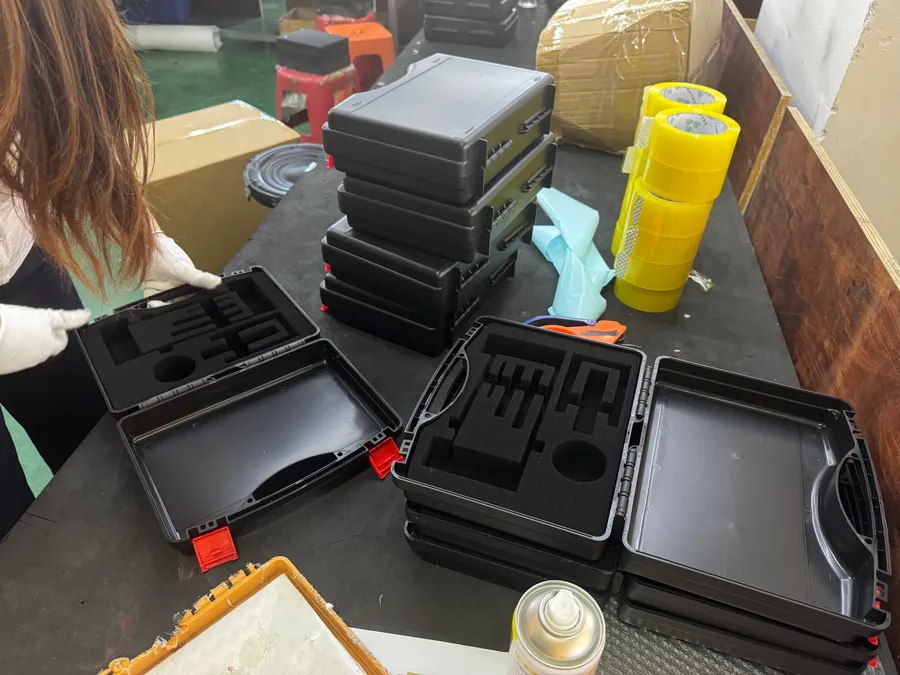
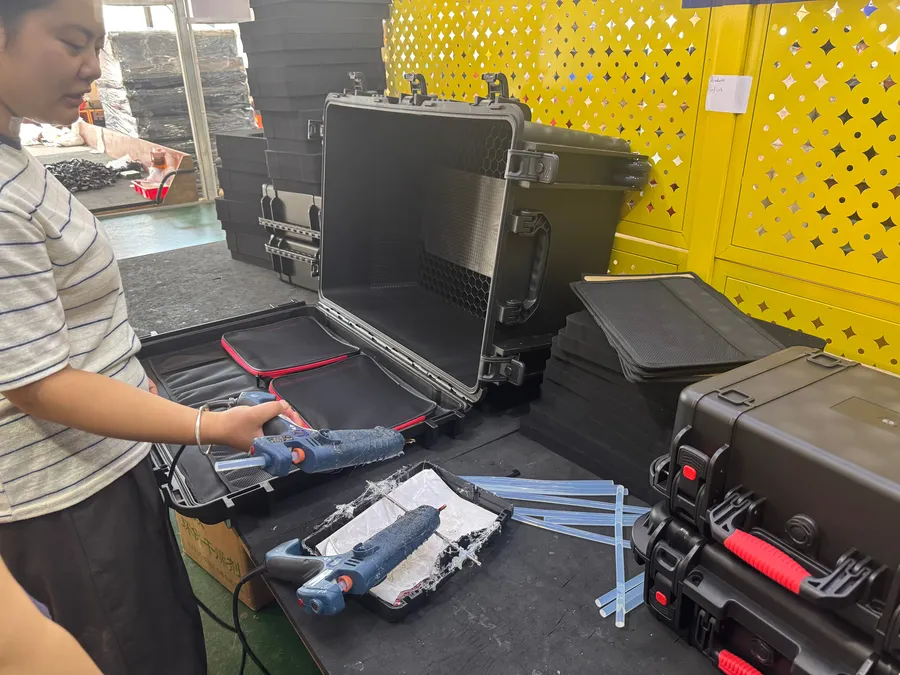
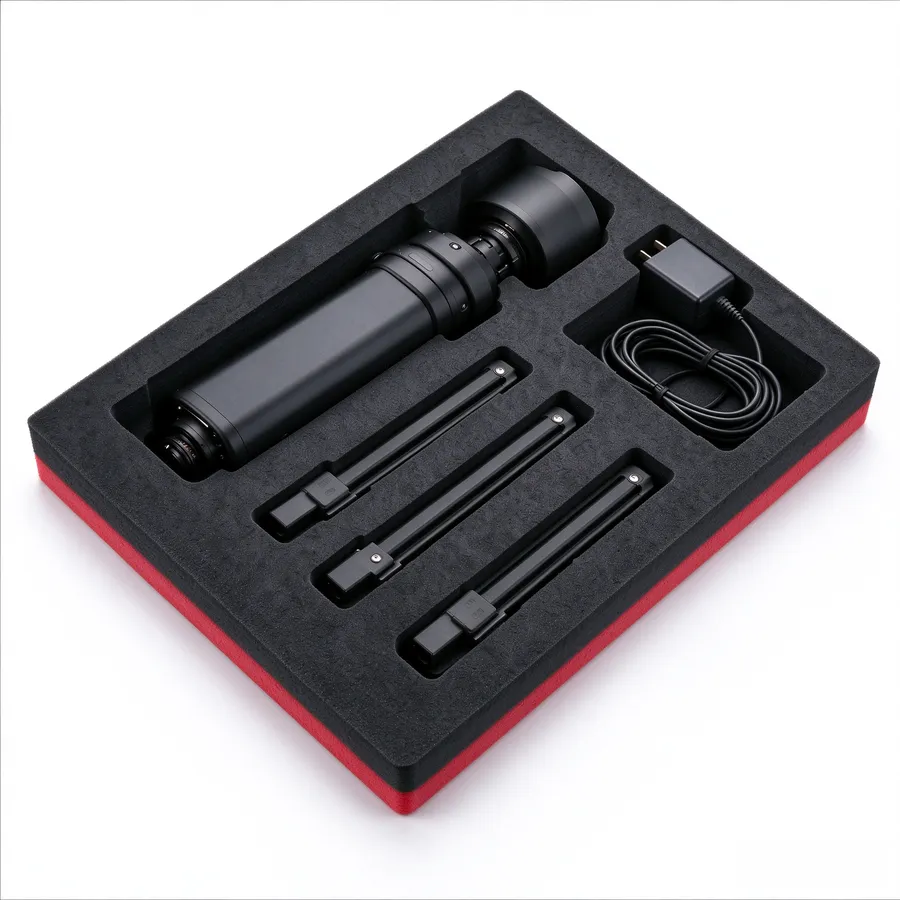
Everything described above is configurable on a standard shell: interior layout (pick-and-pluck, die-cut or CNC-cut), foam grade and thickness, colour, logo method, latch and lock count, pressure-equalisation valve, cable ports, document holder and identification plate. A bespoke exterior geometry requires a new mould — 125 days, from 3,000 units per moulded component.
Procurement considerations
| Question | What to send us |
|---|---|
| Which shell fits? | Equipment L × W × H as packed, plus required clearance per axis |
| What does it cost? | Order quantity and estimated annual quantity — the two drive different answers |
| Is tooling needed? | Whether an existing shell clears the envelope with usable foam depth |
| Lead time? | Your required delivery date, not just the order date |
| Certification? | The exact standard your tender names — we will say whether we can test to it |
| Freight? | Destination and preferred terms; carton and pallet data supplied with the quotation |
Comparison and selection guide
The tables on this page exist because a protective case is chosen by comparing three things: the envelope, the environment and the handling chain. Where no table applies, the rule below is.
| Situation | What To Do |
|---|---|
| Fastest | Standard shell plus CNC foam — typically 45 days from approved drawing. |
| Branded | Standard shell plus custom colour and logo — MOQ applies to the resin colour. |
| Bespoke geometry | New mould — 125 days, MOQ from 3,000 units per component. |
- Size on internal dimensions plus clearance, never on a product name.
- Choose the carrying method before the shell: it changes the series, not just the price.
- Specify the interior last, and decide up front whether the end user will reconfigure it.
How should internal vs external dimensions be specified in a protective case RFQ? relates to Logistics & Packing Guide. Related families: Custom Protective Cases / Equipment Transport Cases / Instrument & Equipment Cases / Electronics Cases. Related sectors: field and industrial equipment. Continue in the Logistics & Packing Guide cluster.
This page is written from our own production data. If your requirement differs, send the dimensions and we will tell you which of the 155 models fits, or whether a custom route is needed.


