What affects case palletization for a hard-shell equipment case?
Four inputs decide the answer, in this order: the published carton footprint, the pieces per carton sitting beside it, the deck height your own rack or truck sets, and whether the shell is recorded as stackable at all. Case palletization is therefore arithmetic on fields a supplier either publishes or does not. In our 155-model file, 64 listings publish carton dimensions, 58 of those publish a quantity per carton, and 91 publish no carton at all - including none of the 62 models in the 8 Series. Pallet quantity is recorded as not measured on 155 of 155 listings, with the file's own note that it is calculated from the carton footprint against your pallet size; container loading for 20GP, 40GP and 40HQ comes with the quotation, and no gross shipping mass is published for any model. So what affects case palletization for a hard-shell equipment case is not a capability claim: it is which numbers you can get in writing before the pallet plan is priced, and how the blanks are handled when a series page does not carry them.
Key points
- Carton dimensions are published on 64 of 155 listings and a quantity on 58, so 91 models cannot be palletised from the file alone - the 8 Series publishes none of its 62.
- Pallet quantity is recorded as not measured on all 155 listings: any cases-per-pallet figure is grid arithmetic against your pallet, not a test result.
- Pieces per carton changes shipped density more than the shell does: 20 pieces on 12 cartons gives KX-62205 240 cases per pallet, while one-per-carton KX-96127 gives 3.
- Twenty of the 64 published cartons leave room for only one position per layer on a 1,200 x 800 mm deck, so the footprint, not the case count, sets the plan.
- Deck height is the other lever: 47 cartons take two layers within a 1,000 mm working height, five take one and four take four.
- Stackability feeds straight into the plan: 136 listings publish stackable true and the 19 wheeled shells publish false, six of which ship one case per carton.
- Mass arithmetic is shell-only in our file: net weight on 93 of 155 listings, no gross shipping mass on any, with a median of 39.7 kg of shells per worked pallet.
What affects case palletization: the four inputs, in order
The first input is the carton footprint, because a pallet is a plan area before it is anything else. Our file records three carton sides on 64 of 155 listings - the two longer published sides are what sits on the deck and the shortest is what stacks upward - and those three numbers alone split the range into groups that behave completely differently: twenty of the 64 leave space for only one position per layer on a 1,200 by 800 mm deck, forty-one take two, one takes three and two take four. Nothing about the shell itself predicts that; the packing does.
The second input is the quantity published beside the carton, the third is the working height you are allowed - a rack beam, a van roof line, a mixed-load ceiling in a container - and the fourth is whether the shell is recorded as stackable, which decides whether cases may form a column without any carton argument at all. Between them these four inputs explain the whole spread of our own file: 240 cases on one pallet for KX-62205 and three for KX-96127, both from published numbers, neither from a measured pallet quantity, which is recorded as not measured on all 155 listings.
What affects case palletization for a hard-shell equipment case, field by field
The table below is a purchasing instrument, not a description of us. Run the same three questions across any catalogue - is the field published for the model I am ordering, is it published as a measured value or as an option, and what does the supplier say about the models where it is blank. On our file the geometry side is honestly recorded: external and internal dimensions on all 155 listings, the stackable flag on all 155, feet on all 155, an empty shell mass on 93. The freight side is where catalogues quietly stop, and ours is no exception.
| Field That Drives The Pallet Plan | What Our Published File States | What To Demand From Any Supplier |
|---|---|---|
| Carton dimensions (three sides) | 64 of 155 listings; 91 models publish no carton, including all 62 models in the 8 Series | The carton triple for the ordered model, not an average from the range page |
| Pieces per carton | 58 of 155 listings; six rows state a carton with no quantity: KX-3607, KX-3608, KX-3609, KX-4610, KX-4613, KX-4616 | A quantity per carton or an explicit statement that packing is per order |
| Pallet quantity per model | Recorded as not measured on 155 of 155 listings, with a note that it is calculated from the carton footprint against your pallet size | The arithmetic they used: pallet size, orientation, overhang rule and deck height |
| Container loading (20GP / 40GP / 40HQ) | Recorded as not measured on all 155; figures supplied with the quotation | A loading sheet for the container you book, dated against the carton triple |
| Mass the pallet carries | Empty shell mass on 93 of 155 listings; gross shipping mass published on none of the 155 | Gross mass per carton, or contents plus shell plus packing stated separately |
| Whether cases stack without cartons | Stackable published on all 155: 136 true, 19 false, and the 19 false are exactly the wheeled shells | The stacking consequence of their wheel option on the same line as the wheel option |
| Drawing or CAD for layout planning | CAD recorded as not measured on all 155 listings; datasheet and catalogue pages exist per series | A dimensioned outline of the packed carton before the rack is built |
Carton footprint against pallet size: the arithmetic, stated as arithmetic
Every number in this section is grid arithmetic on published carton sides, and we label it that way because pallet quantity is not measured in our file. Take a 1,200 by 800 mm deck, one orientation per layer, no overhang, and see what our own listings produce. KX-62205 in a carton of 475 by 320 by 285 mm fits four positions per layer and three layers under a 1,000 mm working height: twelve cartons. KX-2005 at 495 by 410 by 360 mm and KX-2305 at 480 by 470 by 370 mm each fit two per layer and two layers: four cartons. KX-2805 at 570 by 470 by 435 mm gives four cartons; KX-3207 at 645 by 530 by 430 mm gives four; KX-85022 at 495 by 375 by 245 mm gives sixteen.
Then the opposite corner: KX-4321 ships in a carton whose two longer sides are 885 and 650 mm and whose shortest side is 515 mm, so one position per layer and one layer under the same 1,000 mm ceiling - one carton on the whole deck. KX-96127 at 640 by 625 by 280 mm also fits one position per layer but stacks three. KX-3609 at 730 by 630 by 550 mm is one and one. Across the 64 published cartons the distribution is not smooth: positions per layer land at one (20 rows), two (41), three (1) and four (2), and layers within a 1,000 mm deck land at one (5 rows), two (47), three (8) and four (4). That spread is what affects case palletization more than any single case dimension.
Cases per pallet: the same arithmetic carried through to shipped units
Cases per pallet is where pieces per carton does most of the work, and it is the figure buyers quote to freight forwarders without ever asking how it was produced. Worked from our published cartons on the same 1,200 by 800 mm grid: KX-62205 at 20 per carton reaches 240 cases; KX-2005 and KX-2305 at 40 per carton reach 160; KX-2805 at 32 reaches 128; KX-2406 and KX-62209 at 20 per carton over six cartons reach 120; KX-3207 at 24 reaches 96. Against those, the shells that ship one per carton tell the other story: KX-5723 and KX-96027 reach eight cases on a pallet, KX-85022 sixteen, KX-95419 four, KX-96127 three.
The published quantities across our file are 1 (nine listings), 3, 6, 8, 10 (nine listings), 12, 16, 20 (fourteen listings), 24, 32 and 40 (two listings), which is a spread of forty to one in units and far more than the spread in shell size. Two worked pairs make the point better than any advice: KX-5723 and KX-96027 publish the identical carton triple - 580 by 415 by 250 mm - with one piece each, so both reach the same eight positions on the deck arithmetic; yet KX-5723 is a wheel-free shell recorded as stackable and KX-96027 is a T Series rolling shell recorded as not stackable. Same carton, different column behaviour, different freight sheet.
| Model | Published Carton Mm | Pieces Per Carton | Positions Per Layer | Layers Within 1,000 Mm | Cartons Per Pallet | Cases Per Pallet |
|---|---|---|---|---|---|---|
| KX-62205 | 475 x 320 x 285 | 20 | 4 | 3 | 12 | 240 |
| KX-2005 | 495 x 410 x 360 | 40 | 2 | 2 | 4 | 160 |
| KX-2305 | 480 x 470 x 370 | 40 | 2 | 2 | 4 | 160 |
| KX-2805 | 570 x 470 x 435 | 32 | 2 | 2 | 4 | 128 |
| KX-2406 | 490 x 410 x 290 | 20 | 2 | 3 | 6 | 120 |
| KX-3207 | 645 x 530 x 430 | 24 | 2 | 2 | 4 | 96 |
| KX-85022 | 495 x 375 x 245 | 1 | 4 | 4 | 16 | 16 |
| KX-5723 | 580 x 415 x 250 | 1 | 2 | 4 | 8 | 8 |
| KX-95419 | 755 x 550 x 485 | 1 | 2 | 2 | 4 | 4 |
| KX-96127 | 640 x 625 x 280 | 1 | 1 | 3 | 3 | 3 |
| KX-4321 | 885 x 650 x 515 | 12 | 1 | 1 | 1 | 12 |
| KX-3609 | 730 x 630 x 550 | not published | 1 | 1 | 1 | not calculable |
Deck height before deck area: the cartons that allow only one layer
Height is the input buyers discover last and forwarders charge for first. Within a 1,000 mm working deck, five of our 64 published cartons allow a single layer - KX-3213 at 645 by 530 by 520 mm, KX-3218 at 645 by 550 by 530 mm, KX-3609 at 730 by 630 by 550 mm, KX-3113 at 635 by 595 by 540 mm and KX-4321 at 885 by 650 by 515 mm - while four allow four layers: KX-5723, KX-96027, KX-6922 and KX-85022, all of which ship one case per carton in a carton whose shortest side is 250 mm or less. The published shortest sides across the file run from 232 mm to 550 mm with a median of 422.5 mm.
Why a case-packed pallet gets so tall is worth stating plainly, because it is where a hard shell surprises a buyer: the shell is shipped standing in its lid and base, not flat, so the carton stacks on the case height plus rim rather than the case footprint. KX-95419 is the cleanest illustration. Its shell publishes 540 by 445 by 190 mm with a 190 mm internal height, yet the carton recorded for it measures 755 by 550 by 485 mm - two hundred litres of box for forty-five litres of shell, a fill ratio near 0.23 against a file median of 0.91. Nothing is wrong with the shell; the packing rule, not the product, is what sets the deck height.
Stackability is a palletization input, not a warehouse preference
The stackable field is published on all 155 listings and it splits the catalogue cleanly: 136 shells record true and the 19 that record false are exactly the shells that publish two wheels and a telescopic handle. For a pallet plan that means two different loading sheets from one purchase order - shells that form a column on their own base rim, and shells that must travel in a single carton layer with the void above them paid for on every leg. Of those 19, only six publish a carton and all six record one case per carton, which is the honest shape of how a non-stackable shell ships.
The same split explains why a mixed fleet is where palletisation goes wrong in practice. A buyer counting 463 by 370 mm shells will find six stackable listings on that plan - KX-84814, KX-84815, KX-84818, KX-84820, KX-84823 and KX-84824 - and one rolling shell, KX-85022, whose carton of 495 by 375 by 245 mm with one case inside gives sixteen positions on the deck arithmetic above. Ask any supplier to give you the stacking answer per model, because a series page cannot hold both answers at once.
Pallet quantity per model: what our file states and what it refuses to invent
Pallet quantity per model is recorded as not measured on all 155 listings, with the file's own note attached: it is calculated from the carton footprint against your pallet size. That is a deliberate position rather than a gap in diligence. A measured pallet quantity depends on pallet size, orientation rule, overhang tolerance, deck height, whether cartons are interleaved or column-stacked and whether the load is shrink-wrapped - five of those six variables belong to the buyer's warehouse and not to our moulds. Publishing a single number would launder our assumptions into your freight plan.
The same discipline covers container loading, which is recorded as not measured on all 155 listings with 20GP, 40GP and 40HQ figures supplied with the quotation, and CAD outlines, recorded as not measured on all 155. What we do publish is the arithmetic you need to reproduce the number yourself: the carton triple on 64 listings, a quantity on 58 and the case geometry on all 155. If a competitor prints a pallet quantity and a container count without stating the pallet size and the stacking rule behind them, that is a marketing figure, and it will not survive your own rack.
Mass is the field nobody publishes: 93 shell figures, no gross figures
Freight is sold by mass and volume, and on the mass side our file is honest but incomplete. An empty shell mass is published on 93 of 155 listings - from 100 g on the 120 by 90 by 40 mm KX-1204 to 6,420 g on KX-6621 among the stackable shells and 15,320 g on the rolling KX-88442 - while gross shipping mass is published on none of the 155. So a worked pallet mass can only be shell mass: multiplying cases per pallet by the published net figure gives a median of 39.7 kg across the 58 rows where both fields exist, a floor of 14.4 kg and a maximum of 86.4 kg on KX-63416, where forty-eight shells at 1,800 g sit in six cartons.
Two of those worked rows come out heavy for opposite reasons, and both are worth knowing before a mezzanine floor is loaded: KX-85022 reaches 80.2 kg from sixteen cartons of one 5,012 g shell each, while KX-62205 reaches 74.4 kg from 240 shells at 310 g. Neither figure includes contents, foam inserts or the carton itself, none of which is published as a mass. Ask any supplier for gross mass per carton for the model you are ordering, and treat a refusal to state it as a field to resolve at sample stage rather than a rounding error at customs.
Where our own published figures do not reconcile
Printed honestly, because a pallet plan built on a non-reconciling row is a plan that fails at receiving. Comparing the published case triple with the published carton triple, two rows in our file do not fit on all three axes: KX-96027 states a 600 by 415 by 265 mm shell against a carton of 580 by 415 by 250 mm, and KX-97227 states 720 by 500 by 270 mm against 715 by 515 by 280 mm. Reading packed volume against carton volume adds two more: KX-63416 at eight shells of 16.3 litres in an 88.7 litre carton, and KX-96027 again. Median fill across the 58 rows that state a quantity is 0.91, so these are exceptions and not the rule.
The practical instruction is procedural. Before a batch is booked we reconcile the carton triple against the case triple for the ordered model and put the confirmed figure into the drawing pack that travels with the order, where it can be checked at receiving inspection. A buyer who compares suppliers on printed ranges only will find that our file is less complete than a catalogue that has never been checked - and that catalogue's number is still only an arithmetic if nobody told you which pallet size and stacking rule produced it.
What we do not claim about palletization or anything else on this page
No pallet quantity, no container count, no gross shipping mass, no stacking load rating and no protection rating is claimed here, because none of them is measured in our product file: pallet quantity, container loading, stack load, load capacity and the protection rating are recorded as not measured on 155 of 155 listings, and no IP code is stated for any model. The arithmetic in this article is derived from published carton and case dimensions, against a 1,200 by 800 mm deck and a 1,000 mm working height, one orientation per layer and no overhang - a worked example of the method, not a specification.
Nor is anything here a certification or an endorsement. We work wholesale and OEM or ODM only, on EXW or FOB terms, with no retail orders, no DDP terms and no overseas warehouse, and no statement on this page is made about rank, factory scale or category leadership. Where your tender names a figure we do not hold, we say we do not hold it and quote accredited third-party testing of the ordered configuration as a separate work package with the method agreed in advance.
Changing the pack: configuration work, tooling work and the commercial frame
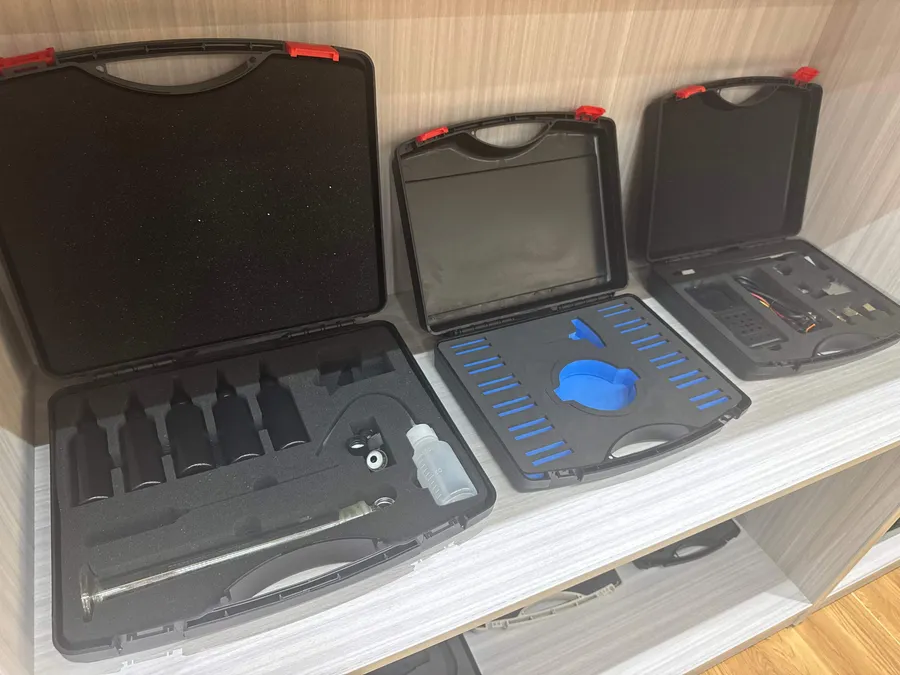
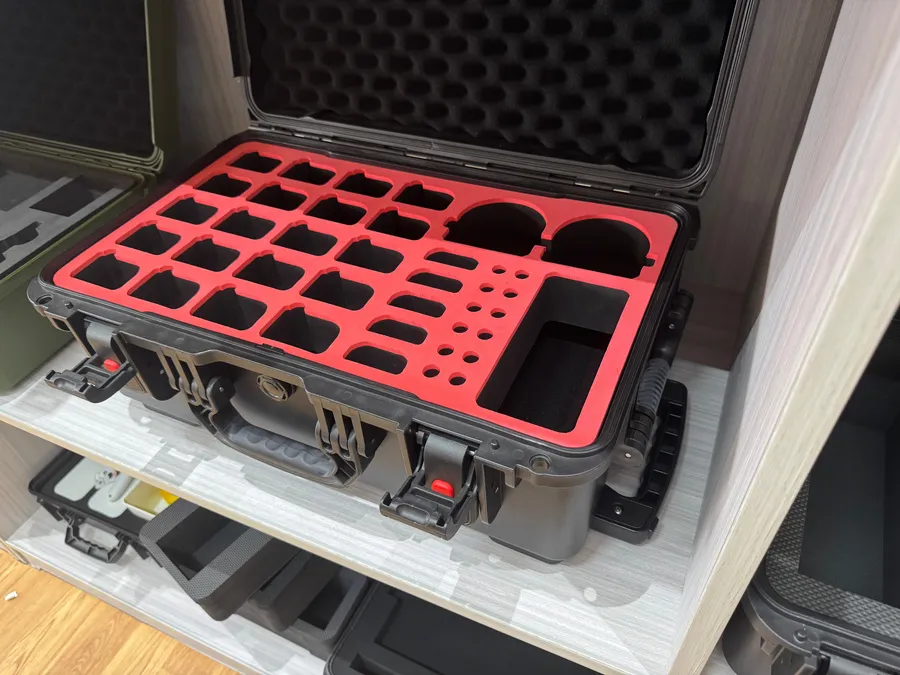
Custom packaging is recorded as available on all 155 listings, along with custom foam, custom logo, custom colour and custom hardware, so the pallet-facing changes that are genuinely configuration work are these: carton grade and print, quantity per carton within an existing carton size, inner boxes and dividers, foam layout that does not change the outer triple, labelling and pallet sheet naming. What is not configuration work is anything that changes the shell geometry a carton is built around - a new case size means a mould.
The commercial frame is fixed. OEM work on an existing mould quotes at 45 days to first sample from a MOQ of 300 pieces, and custom colour or logo sits at the same 300; standard cases and custom foam carry a MOQ of 1. A new mould runs 125 days with a MOQ from 3,000 pieces per component. Payment is a 30 percent deposit with the balance after your inspection, terms are EXW or FOB, wholesale and OEM or ODM only, and third-party factory inspection is welcome on any batch. If your pallet plan is the reason a pack must change, say so on the enquiry and the packing proposal comes back with the arithmetic attached.
Procurement notes: what to send so the pallet plan is right first time
Put the freight inputs on the order line rather than in the email thread: the pallet size you actually use, the maximum deck height your rack or container allows, the orientation and overhang rule your warehouse enforces, whether cartons may be column-stacked or must be interlocked, and whether you are shipping shells empty or packed with your equipment and foam. Then require three written answers - the carton triple for the ordered model, the quantity per carton, and gross mass per carton or an explicit statement that none is held.
For mixed orders, ask for the loading sheet split by stackable and non-stackable SKUs, since the 136 and the 19 in our file produce two different arithmetic sheets from one purchase order. Send us the equipment dimensions, the pallet size and the quantity band, and the reply carries published values for named models, the model page link beside each number, the arithmetic sheet behind the pallet figure and an explicit list of which fields are measured and which are blank. Fred Zhao, KeXin Sales Team, WhatsApp +86 135 3588 0002. Written by KeXin New Materials (Guangdong) Co., Ltd.
Customisation
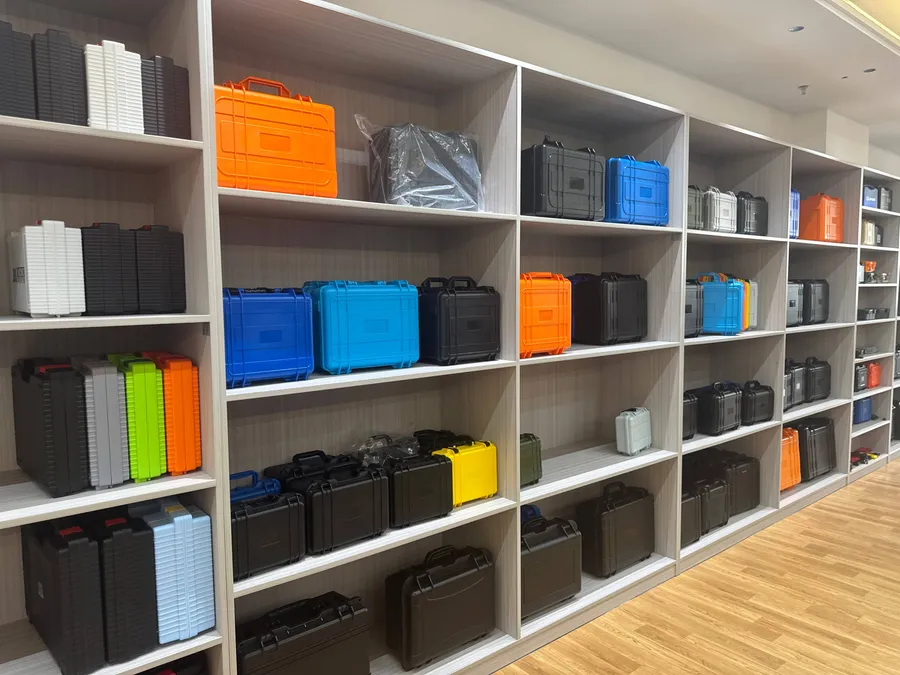
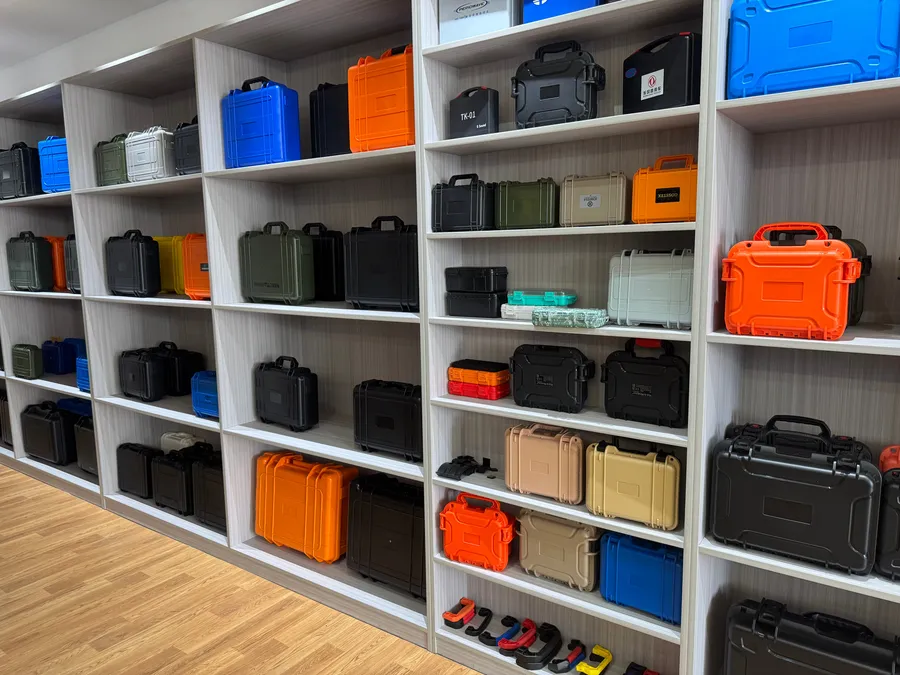
Everything described above is configurable on a standard shell: interior layout (pick-and-pluck, die-cut or CNC-cut), foam grade and thickness, colour, logo method, latch and lock count, pressure-equalisation valve, cable ports, document holder and identification plate. A bespoke exterior geometry requires a new mould — 125 days, from 3,000 units per moulded component.
Procurement considerations
| Question | What to send us |
|---|---|
| Which shell fits? | Equipment L × W × H as packed, plus required clearance per axis |
| What does it cost? | Order quantity and estimated annual quantity — the two drive different answers |
| Is tooling needed? | Whether an existing shell clears the envelope with usable foam depth |
| Lead time? | Your required delivery date, not just the order date |
| Certification? | The exact standard your tender names — we will say whether we can test to it |
| Freight? | Destination and preferred terms; carton and pallet data supplied with the quotation |
Comparison and selection guide
The tables on this page exist because a protective case is chosen by comparing three things: the envelope, the environment and the handling chain. Where no table applies, the rule below is.
| Situation | What To Do |
|---|---|
| Sea freight | Sealed configuration plus desiccant; salt spray is a handling issue, not a material issue. |
| Air freight | Mass and external dimensions drive cost more than volume. |
| Repeated movement | Replaceable latches, hinges and gaskets; keep a spares kit with the first order. |
- Size on internal dimensions plus clearance, never on a product name.
- Choose the carrying method before the shell: it changes the series, not just the price.
- Specify the interior last, and decide up front whether the end user will reconfigure it.
What affects case palletization for a hard-shell equipment case? relates to Logistics & Packing Guide. Related families: Equipment Transport Cases / Custom Protective Cases / Military Protective Cases / Military Transport Cases / Electronics Cases / Medical Equipment Cases / Tool Cases / Rolling Cases. Related sectors: field and industrial equipment. Continue in the Logistics & Packing Guide cluster.
This page is written from our own production data. If your requirement differs, send the dimensions and we will tell you which of the 155 models fits, or whether a custom route is needed.


