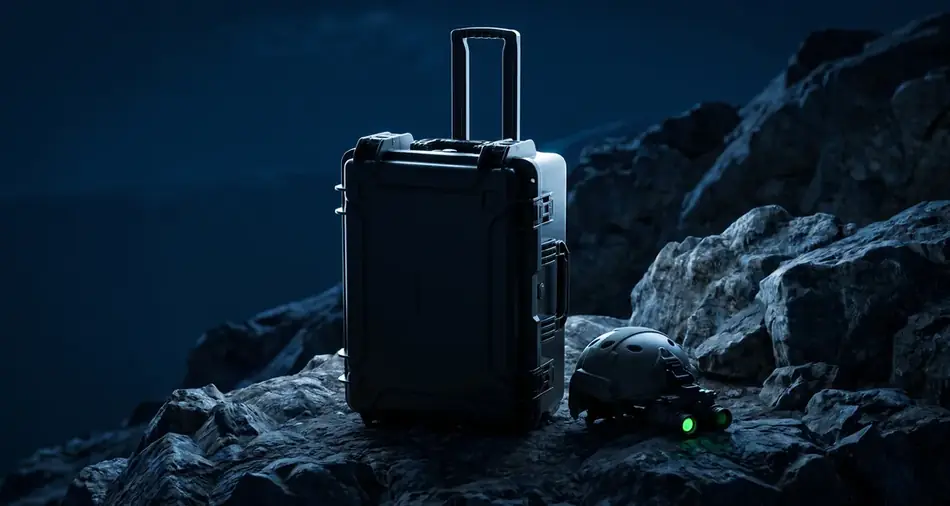
What information should be provided about case wheels before a quotation?
Give the supplier six lines and the quotation becomes answerable: which listing or external envelope you are working from, the mass of the shell with its contents inside, the surface and obstacles the case is pulled across, the height of the person who pulls it, whether the empty case still has to stack or rack, and the order quantity with the delivery term. Case wheels before a quotation are not a bolt-on option in our published file. Wheels, a telescopic handle and the loss of stacking arrive as one moulding decision, so a request missing those six lines can only be answered with a catalogue guess rather than a figure we will put in writing and build to.
Key points
- Our published file records wheels as a count only: zero wheels on 136 of 155 listings and two wheels on 19, with no four-wheel listing anywhere in it.
- The 19 rolling listings are exactly the T Series, exactly the 19 that state a telescopic handle, and exactly the 19 that state stackable as false.
- Case wheel diameter, wheel width, tyre material, bearing type and any case wheel load rating are published on none of our 155 models, so ask for them per order.
- Empty mass across the rolling range runs from 4,912 g to 15,320 g, and seven of those shells are already at or above 10,000 g before your contents go in.
- Telescopic extended height is published on 11 of the 19 rolling models, from 240 mm to 485 mm; the other eight are confirmed against the ordered configuration.
- Adding a wheel channel to a shell that was tooled without one is a new mould at 125 days with MOQ from 3,000 pieces per component, not a fitting change.
The six lines that decide a wheel quotation
Case wheels before a quotation are only quotable when a supplier knows six things: which listing or external envelope you are working from, the mass of the shell with its contents inside, the surface and obstacles the case is pulled across, the height of the person who pulls it, whether the same case has to stack or rack when it is empty, and the order quantity with the delivery term. Those six answers move a request between three different realities in our catalogue: a wheel-free shell with a fixed folding handle, a T Series rolling shell carrying two wheels and a telescopic grip, or a new moulding programme, because cutting a wheel channel into a tool that was designed without those bosses is not a fitting change.
A partial enquiry costs time for a simple reason. The wheel field in our published file records a count and nothing else, so the count alone cannot tell you whether the request is inside the tool we already own. Tell us the count you want and we can say in one line whether it is configuration work on an existing mould or a tooling decision, and that line changes both the price and the calendar of your purchase order.
What our 155-model file actually publishes about case wheels
Every rolling listing in our catalogue is a T Series shell. Across 155 published models the wheel field takes exactly two values, zero wheels on 136 listings and two wheels on 19, and the same 19 listings also state a telescopic plus fixed folding handle where the other 136 state fixed folding only. A fixed folding handle is recorded on all 155, so a rolling shell in our range keeps its side grip for two-person lifts rather than trading it away. Longest external axis across the rolling range runs from 463 mm to 843 mm, empty mass from 4,912 g to 15,320 g with a median of 8,500 g, and published wall thickness from 4.2 mm to 6.0 mm on the 18 rolling listings that state it. Seal availability is stated on 18 of the 19, with WL-5126 Trolley the single listing that does not.
Read the table below as the shape of a real answer rather than a marketing grid. Each row is a published listing with the fields our file states for that model; where the file is blank we leave the cell blank instead of borrowing a sibling number.
| Model As Published | Wheels | Handle Field | Stackable | Net Mass G | Longest External Mm | Telescopic Height Mm |
|---|---|---|---|---|---|---|
| WL8-5021 Trolley | 2 | Telescopic + fixed folding | false | 4912 | 495 | not published |
| WL8-5022 | 2 | Telescopic + fixed folding | false | 5012 | 463 | not published |
| WL-5126 Trolley | 2 | Telescopic + fixed folding | false | 5610 | 510 | not published |
| WL8-5835 Trolley | 2 | Telescopic + fixed folding | false | 8520 | 588 | 295 |
| WL9-7227 Trolley | 2 | Telescopic + fixed folding | false | 10000 | 720 | 485 |
| WL8-7336 | 2 | Telescopic + fixed folding | false | 10660 | 733 | 240 |
| 8-8337 | 2 | Telescopic + fixed folding | false | 10866 | 830 | 240 |
| WL8-8434 Trolley | 2 | Telescopic + fixed folding | false | 14030 | 843 | 295 |
| WL8-8442 Trolley | 2 | Telescopic + fixed folding | false | 15320 | 843 | 295 |
Case wheel diameter, material and load rating: the fields we leave blank
Case wheel diameter is published on none of our 155 listings, and neither are wheel width, tyre material, bearing type or a case wheel load rating. The wheel field records how many are fitted and which configurations carry them. Anything about the component itself sits in the drawing we build to for that order, not in a series-level catalogue line, which is why we treat a request for a diameter as a question to answer during specification rather than a number to print in advance and hope a batch matches.
The same discipline applies to load. Stack load and load capacity are recorded in our file as not measured, and the impact note for a shell gives a wall thickness figure while stating that no drop height is claimed without a test. Where a tender needs a component figure, ask any supplier for three things in the same document: the value, the method used to derive it, and whether it was measured on the shell you are buying or on a component datasheet that shares its name. A figure without a method cannot be checked at receiving, and a figure from a datasheet is a property of the wheel, not of your case.
| Field | Status In Our Published File | What To Request Per Order |
|---|---|---|
| Wheel count | Published: 0 on 136 listings, 2 on 19 | Nothing further; the count is a file value. |
| Case wheel diameter and width | Not published on any listing | Component drawing with diameter, tread width and hub, referenced to the ordered SKU. |
| Wheel material and bearing | Not published; hardware is stated as metal or polymer by configuration | Material designation plus sealed or open bearing, and the floor-marking behaviour you need. |
| Case wheel load rating | Not published; stack load and load capacity recorded as not measured | Value, derivation method, and whether it is a component figure or a finished-case figure. |
| Telescopic extended height | Published on 11 of 19 rolling listings, 240 mm to 485 mm | Confirmation that the height is measured on this shell rather than taken from the series. |
| Stacking after wheels | Published as false on all 19 rolling listings | Written statement of whether the empty case still racks or palletises in layers. |
Two wheels versus four wheels on a case: a tooling answer, not an option line
Two wheels versus four wheels on a case is a moulding decision before it is a handling preference. A two-wheel trolley layout tips the shell back and rolls on two corners plus the handle legs, which keeps the base wall clear and lets the same shell sit flat on a shelf edge. A four-wheel layout needs bosses on the base face and changes how the shell meets a floor seam, so our tool library records only the two-wheel arrangement: 19 listings at two wheels, 136 at zero, and no four-wheel listing at all. If a four-wheel requirement comes from a fleet standard rather than from the route, say so in the enquiry and we will show you which published rolling model comes closest and what would have to change to reach the rest.
Mass is where the two answers diverge fastest. The lightest rolling shell in our file is 4,912 g empty and the heaviest is 15,320 g; seven of the 19 are already at or above 10,000 g before contents go in. A wheel set carries a heavy shell across a smooth floor comfortably and becomes a tip-and-carry problem on a stair run or a soft shoulder, so the route description in your enquiry matters more than the wheel count you happened to specify.
The rolling case stacking loss arrives with the wheels
Rolling case stacking loss is the part of a wheel decision that rarely reaches a purchase order, and in our file it is unambiguous: stackable is stated as false on all 19 listings that carry wheels and as true on all 136 that do not. The catalogue-wide counts are therefore 136 stackable shells and 19 non-stackable shells, and the split is not by size band or by series but by the wheel decision itself. A fleet that stores cases in layers on a rack, or that relies on cases sitting on one another in a vehicle, pays for the rolling convenience in storage volume, and a buyer who quotes only the wheel price never sees that cost.
It also reaches freight planning. Our pallet figures are recorded as not measured and are calculated from the carton footprint against your pallet size, and container loading for 20GP, 40GP and 40HQ is supplied with the quotation rather than printed per listing. A non-stackable shell changes how many cartons you can put in a layer, so tell us the pallet dimension and the destination and we will re-run the load plan for the rolling configuration instead of quoting the wheel-free one and hoping it carries over.
Pull height, operator fit and the route the case travels
Pull height is a fit-to-person number, and our file is honest about how much of it exists. Extended telescopic height is published on 11 of the 19 rolling listings, at 240 mm on two models, 295 mm on five, 310 mm on two, and single listings at 385 mm and 485 mm, with a median of 295 mm. The other eight rolling listings, including WL8-5021 Trolley, WL8-5022, WL-5126 Trolley, WL8-5424 Trolley, WL8-5427 Trolley, WL9-6027 Trolley, WL9-6127 Trolley and WL6-6232 Trolley, carry no published height, because that figure is confirmed against the configuration ordered rather than copied from a sibling model. Send us the operator height, or the range if a crew shares the case, and the handle travel becomes an answer rather than a guess.
Describe the route in metres and obstacles rather than in adjectives. Threshold heights, lift-platform edges, ramp gradient, floor seam spacing and the length of any stair run decide whether a two-wheel shell is an advantage; a case that rolls well along a workshop aisle still has to be lifted at the door, and the empty mass figures in the table above are the numbers a person puts their hands under at that point. Add the mass of the contents and the foam layout you want, and the handling question answers itself.
Information to send a wheeled case supplier, in the order we can use it
Information to send a wheeled case supplier works best as one block at the top of the enquiry. We ask for: the model reference or the external envelope in millimetres, the internal depth budget including lid and base split, the mass of the case with contents, the route description, the operator height band, the stacking and racking requirement, the annual quantity with the first-order quantity, the delivery term and destination, whether spares for wheels and handle need to be quoted as line items, and what has to be evidenced at receiving. Where your procedure demands a documented rating, name the standard and the clause rather than the adjective, and we will tell you plainly which parts of it exist in our published file and which would have to be generated as a separate testing work package on the ordered configuration.
Two of those lines prevent most of the rework. The lid and base split is a real constraint on a rolling shell: lid depth is published on 14 of our 19 rolling listings, from 42 mm to 320 mm with a median of 225 mm, and the deepest lids sit on the heaviest shells, with WL8-8442 Trolley at 320 mm and 15,320 g empty. A loaded lid has to be carried by its own grip, so a handle decision and a foam decision arrive together. The spares line matters because our file records latch count as specified per configuration and gives wheel components as metal or polymer by configuration, so a spares package is quoted from the drawing rather than assumed from the catalogue page.
Quantities, tooling routes and lead times behind a wheel answer
Our commercial frame is wholesale and OEM only, on EXW or FOB terms: we do not retail, we do not quote DDP, and we hold no overseas warehouse. The published minimum order figures are one piece for a standard listing and for custom foam, 300 pieces for logo, colour and OEM work, and 3,000 pieces per component for a custom mould. Lead time follows the same split: first sample on an existing mould in 45 days, a new mould in 125 days, with 30 percent deposit and the balance cleared after inspection. Custom hardware, custom foam, colour, logo, packaging and private label are recorded as available on all 155 listings, so a wheel or handle change that fits an existing insert is configuration work; a change that needs a wheel channel cut into a tool is a 125-day programme and should be planned as one.
Third-party factory audits are welcome and we host them. If your procurement rule requires an independent inspection before shipment, name the agency in the enquiry so the inspection hold is built into the 45-day sample path instead of being added to the calendar afterwards. For the rolling range in particular, the receiving check we would write with you covers wheel count against the drawing, handle travel against the confirmed height, and the absence of scoring on the base wall where the shell is tipped.
What we do not state about wheels on any listing
To keep this page usable as evidence, here is the explicit negative list. We do not publish a case wheel diameter, a wheel width, a tyre material, a bearing specification or a case wheel load rating for any of our 155 models. We do not state a stack load or a load capacity, both of which are recorded in our file as not measured. We do not claim a drop height for any shell, and we do not print handling or protection ratings that would imply a test we have not run on that configuration. What we do state is what is in the file: wheel count, handle type, stackability, external and internal dimensions, net mass where measured, wall thickness where published, and the lead time and quantity terms that follow from whichever of those you change.
Where a specification you must meet calls for a rating we cannot show, we say so in the quotation, and then offer the honest path: accredited third-party testing of the ordered configuration as a separate, priced work package, with the method, the specimen condition and the laboratory agreed before the test rather than chosen after it. That is a slower and more expensive answer than ticking a box on a catalogue page, and it is the only one that survives an audit of the goods you actually received.
Customisation
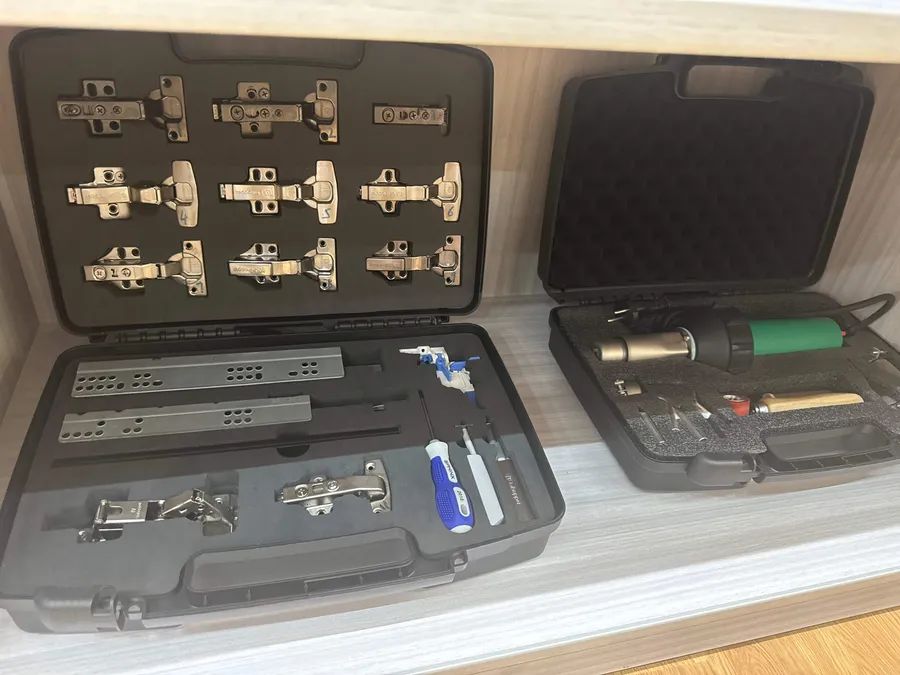
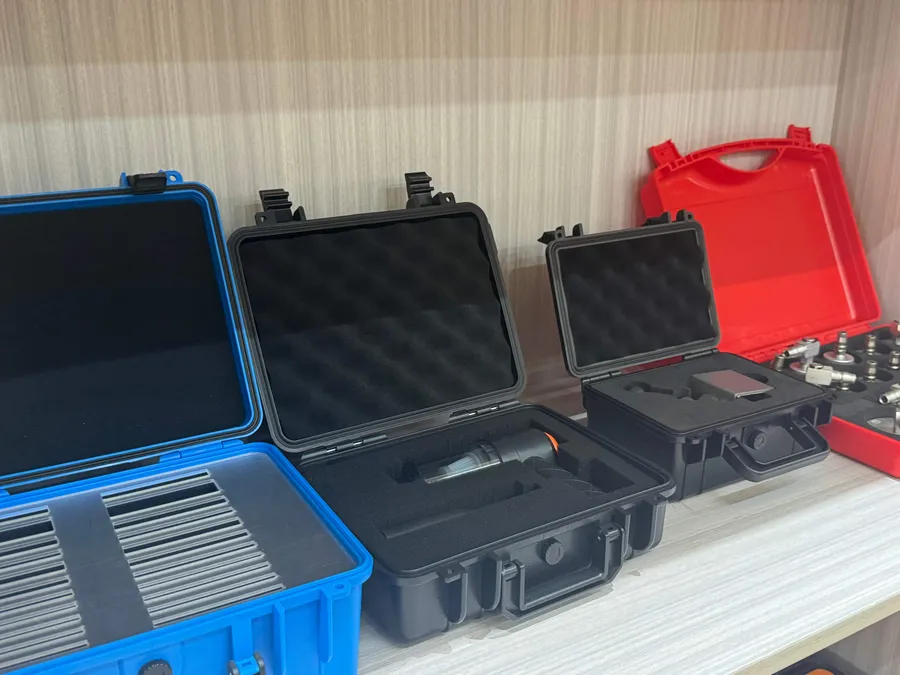
Everything described above is configurable on a standard shell: interior layout (pick-and-pluck, die-cut or CNC-cut), foam grade and thickness, colour, logo method, latch and lock count, pressure-equalisation valve, cable ports, document holder and identification plate. A bespoke exterior geometry requires a new mould — 125 days, from 3,000 units per moulded component.
Procurement considerations
| Question | What to send us |
|---|---|
| Which shell fits? | Equipment L × W × H as packed, plus required clearance per axis |
| What does it cost? | Order quantity and estimated annual quantity — the two drive different answers |
| Is tooling needed? | Whether an existing shell clears the envelope with usable foam depth |
| Lead time? | Your required delivery date, not just the order date |
| Certification? | The exact standard your tender names — we will say whether we can test to it |
| Freight? | Destination and preferred terms; carton and pallet data supplied with the quotation |
Comparison and selection guide
The tables on this page exist because a protective case is chosen by comparing three things: the envelope, the environment and the handling chain. Where no table applies, the rule below is.
| Situation | What To Do |
|---|---|
| Airport and road transfer | Check the external dimensions against cabin and boot constraints, not just the internal volume. |
| Rough ground | Larger wheels and a wider track matter more than shell volume. |
| Stored upright | Confirm the case can stand on its base with the handle retracted in your racking. |
- Size on internal dimensions plus clearance, never on a product name.
- Choose the carrying method before the shell: it changes the series, not just the price.
- Specify the interior last, and decide up front whether the end user will reconfigure it.
What information should be provided about case wheels before a quotation? relates to Logistics & Packing Guide. Related families: Rolling Cases / Military Protective Cases / Equipment Transport Cases / Custom Protective Cases. Related sectors: field and industrial equipment. Continue in the Logistics & Packing Guide cluster.
This page is written from our own production data. If your requirement differs, send the dimensions and we will tell you which of the 155 models fits, or whether a custom route is needed.