What are the common mistakes in case load capacity for equipment transport cases?
The expensive errors around case load capacity are almost all reading errors, not moulding errors, and they share one root cause: treating a published number as a tested limit. On our own file none of the 155 active models carries a stack-load or load-capacity value at all, because both fields are recorded as not measured, yet buyers routinely read six other numbers as if they answered the question. They read wall thickness (2.0 mm to 6.0 mm across 148 models, median 3.9 mm) as a stacking rating. They read net weight (0.10 kg to 15.32 kg across 93 models) as strength. They read the stackable flag (136 models stackable, 19 T-series trolleys non-stackable) as a how-many-kilograms limit. They load the flat lid panel instead of the rim. They borrow a figure from a similar box or a supplier headline. And they expect a pallet or container number to be stamped on the shell, when pallet quantity and container loading are computed per order. The fix is a fixed reading order and one rule: a load capacity is a test result, so if there is no report, there is no number.
Key points
- The common mistakes are reading mistakes: turning a published geometry or weight number into a tested load limit that was never measured.
- On all 155 models the stack-load and load-capacity fields are recorded as not measured, so any kilogram figure you read off our sheet is a misread.
- Wall thickness, net weight and the stackable flag each answer a different question; none of them is a stacking rating on its own.
- A load path runs through the rim and walls, not the flat lid panel, so where you place the case above the stack is a real variable.
- Two of our models both publish 6.0 mm walls in engineering PP, yet one is stackable and one is not, which is why thickness alone is the wrong instrument.
- Pallet quantity and container loading are not stamped on the shell; they are calculated from the carton footprint and your pallet size.
- The correct move when a tender needs a number is accredited third-party testing of the exact configuration, not a brochure figure.
Why the common mistakes in case load capacity are reading mistakes
A transport case rarely fails because the mould was wrong; it fails because someone planned a stack, a pallet or a racking height against a number the datasheet never actually gave. The single clearest fact in our specification file is that none of our 155 active models publishes a stack-load or load-capacity value: both fields are recorded as not measured, and we will not state a limit we have not tested. Everything that goes wrong after that is a substitution, where the buyer quietly swaps a number that is published for the number that is missing. The substitutions are predictable, so they are also preventable, and the rest of this page walks through them one at a time against real published fields.
It helps to name what a load capacity actually is before you read anything: it is the result of putting a known mass on a known configuration for a known time, with the case in a stated state (bare shell, with foam, with contents, with a lid, or lid-free), and it describes only that configuration. Once you hold that definition, a wall thickness stops looking like a rating and starts looking like what it is, a manufacturing measurement you can put a calliper on. The mistakes below are all cases of the second kind of number being asked to do the first kind of job.
Mistake one: reading wall thickness as a load rating
Wall thickness is the most comparable published figure we have, which is exactly why buyers reach for it and why it gets misread. Across the 148 models that list a wall, thickness spans 2.0 mm to 6.0 mm with a median of 3.9 mm, but a millimetre is not a kilogram. Thickness multiplies with the unsupported span between ribs and with the rim geometry, and it behaves differently in polypropylene, engineering polypropylene and ABS at the same value. Treating a 6.0 mm shell as automatically stronger under a stack than a 3.9 mm shell ignores both the footprint it sits in and the material it is moulded from, and it produces the wrong buying decision whenever the thick case is heavier, more expensive to fly, and no more stackable.
Mistake two: treating net weight as carrying strength
The second substitution is mass for capacity. Ninety-three models publish a finished empty-case net weight, from 0.10 kg on KX 1204 to 15.32 kg on KX 88442 with a median of 1.48 kg, and none of those figures says anything about how much load the shell accepts. A heavier case is usually a bigger case, or a case with more hardware, or a denser material; weight is material times volume plus fittings, while a stack limit is a tested behaviour. Buyers who assume the heavier of two boxes is the safer one to pile end up paying for grams they did not need, and buyers who assume a light case is weak overlook that a short, well-ribbed span can carry a column just fine.
Mistake three: assuming the stackable flag is a stack limit
The stackable field is real and useful, but it is a yes-or-no design decision, not a number. We publish 136 models as stackable and 19 as non-stackable, and those 19 are precisely the T-series trolleys, whose wheel housings, frame and telescopic handle give them a base that is not meant to take weight from above. Reading that flag as a rating invites the question it cannot answer, how many kilograms and how many high. Worse, the flag can move independently of the wall, which the matched rows below make obvious: identical published thickness and material, opposite stackability, and still no load figure anywhere in the table.
| Model | Wall | Material | Stackable | Load Limit |
|---|---|---|---|---|
| Model | Published wall | Shell | Stackable flag | Published load limit |
| KX 6621 | 6.0 mm | Engineering PP | Stackable | None - not measured |
| KX 97227 | 6.0 mm | Engineering PP | Non-stackable | None - not measured |
| KX 88421 | 5.0 mm | PP | Stackable | None - not measured |
| KX 88442 | 5.0 mm | PP | Non-stackable | None - not measured |
Mistake four: loading the flat lid panel instead of the rim
A stack does not bear on the middle of a lid; it bears where the geometry tells it to. The load path in a hard-shell case runs through the locating rim and the vertical walls, not through the flat lid panel, and that distinction is one of the most-skipped lines on a transport datasheet. The lid and base split, published on 100 models with lid depths from 16 mm to 320 mm, tells you how the height is divided and therefore where the rim sits and how deep a compressible lid panel is in front of the supported edge. A column planned without checking that split can put the whole weight onto a deep lid on the lower case, which is a stacking geometry error the millimetres of wall never warned you about.
Mistake five: borrowing a figure from a similar model or a supplier headline
When a datasheet has no load number, people fill the gap: from the neighbouring model in the same series, from a box of similar external volume, or from a competitor headline such as a drop height or a stacking claim printed without a report. None of those transfers cleanly. KX 88421 and KX 88442 share an 843 by 592 mm footprint and a 5.0 mm wall yet publish opposite stackability, so a figure lifted between them is wrong at one end. A rating tied to one configuration also does not survive a change of interior, seal or lid, because the tested sample is the configuration, not the series. If a number is not traceable to a named procedure run on the model you are buying, treat it as absent.
Mistake six: expecting a pallet or container number to be stamped on the case
Buyers often plan a column from a pallet quantity or a per-container figure and are surprised to find neither on our model pages. That is deliberate: pallet quantity and container loading are recorded as not measured on all 155 models, because pallet fit is calculated from the carton footprint against your pallet size, and 20GP, 40GP and 40HQ counts are supplied with the quotation rather than stamped on a shell that does not know your pallet. The same caution applies to pack: 58 models publish a pieces-per-carton value ranging from 1 to 40, and that count is about how many cases travel in a carton, not how many cases you may pile in a warehouse. Reading a freight field as a strength field is a category error with a real cost.
Mistake seven: stacking trolleys, deep bodies, or ignoring the weakest layer
Three practical stacking errors sit behind most of the paper mistakes. First, piling onto a trolley: the 19 T-series models are published non-stackable for a structural reason, so planning them into a column is wrong from the base up. Second, reading external height as stack freedom: a case whose outside runs from 40 mm to 415 mm tall changes how many units fit a column, and the published external dimensions, not the interior, set that. Third, treating a stack as strong because its best layer is strong: a column is only as safe as its least stable level, and the published stability of a stack depends on rim, footprint and lid depth matching at every interface, which is why mixed-model pallets are the hard case. An empty shell and a loaded shell also behave differently, so state which one a plan assumes.
Mistake eight: reading an untested waterproof or drop claim as strength
The last substitution reaches in from a different specification line. A protection claim is not a capacity claim. On our file the waterproof and dust-resistance fields are recorded as not measured for every model, and a seal is listed as available on 124 of 155 shells as a construction option, not as proof of an ingress rating; impact resistance is published with the note that a wall figure carries no drop height without a test, and shock protection is a manufacturer option that depends on the foam layout you specify. Only corrosion resistance is a measured material fact, because a thermoplastic shell has no ferrous path to rust. Turning any of those into a stacking or load argument, or into an unmeasured grade, misreads what the field is describing.
A short reading checklist for your comparison sheet
The practical answer to eight mistakes is one fixed order. Read the fields in this sequence and record, for each, whether it is measured, an option, or not measured; then stop, because the missing load figure is missing on purpose. The rows below are the checklist we would use against any datasheet, ours included.
| Step | Check | Our Status |
|---|---|---|
| 1. Rim and footprint | Where the case above lands, plan area | Published external dimensions per model |
| 2. Lid and base split | Depth of compressible lid in front of the rim | Published on 100 models, 16 to 320 mm |
| 3. Wall and material | One input, not a rating | 148 models, 2.0 to 6.0 mm; PP / Eng PP / ABS |
| 4. Stackable flag | Design intent, not kilograms | 136 stackable, 19 trolleys not |
| 5. Net weight | Case mass, not capacity | 93 models, 0.10 to 15.32 kg |
| 6. Pallet and container | Freight field, not strength | Not measured; computed with your quote |
| 7. Load capacity | A test result or nothing | Not measured; accredited test on request |
What we do not claim, and what we will test
We do not print a stack-load figure, a load-capacity rating, a drop height, a water or dust grade, or a standard code for any model, because we do not hold a test record behind it, and we would rather lose the order than put an unmeasured number on a datasheet an inspector later has to reconcile. If a tender requires a specific figure, say which laboratory would run it, against which named procedure and revision, on which configuration in which state (bare shell, with foam, with contents, lid fitted), and whether the report covers the exact model and size being bought. Where we do not have that data, we can quote accredited third-party testing of that configuration as a separate work package, and the result describes that configuration only, not the range.
Buying and customising against a real load requirement
When a load or stacking requirement is genuine, meet it through configuration and, if needed, a test, not through a substitute number. On an existing mould we change the interior layout (pick-and-pluck, die-cut, CNC-cut, EVA, PE or EPE, quoted against your drawing), the hardware and seal set, and colour or logo work; standard and custom foam carry an MOQ of 1 unit, logo, colour and OEM work start at 300 units, and samples run about 45 days. Relocating the rim or thickening the wall is steel, so it ends in new tooling at about 125 days, MOQ from 3,000 units per component, 30 percent deposit with the balance after inspection, EXW or FOB. We are wholesale and OEM or ODM only, with no retail, no delivered-duty-paid terms and no overseas warehouse stock. Send the footprint, the stacked height, the state of the column and the figure a tender asks for, and we reply with the published geometry, a plain statement that the load field is not measured, and a test quote if you need a number. Signature: KeXin New Materials (Guangdong) Co., Ltd.
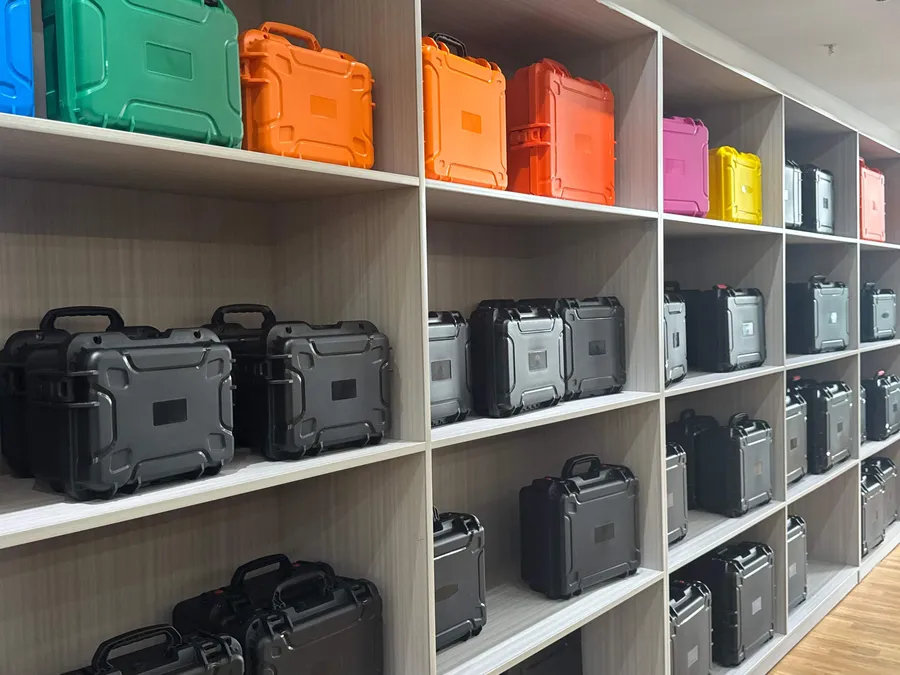
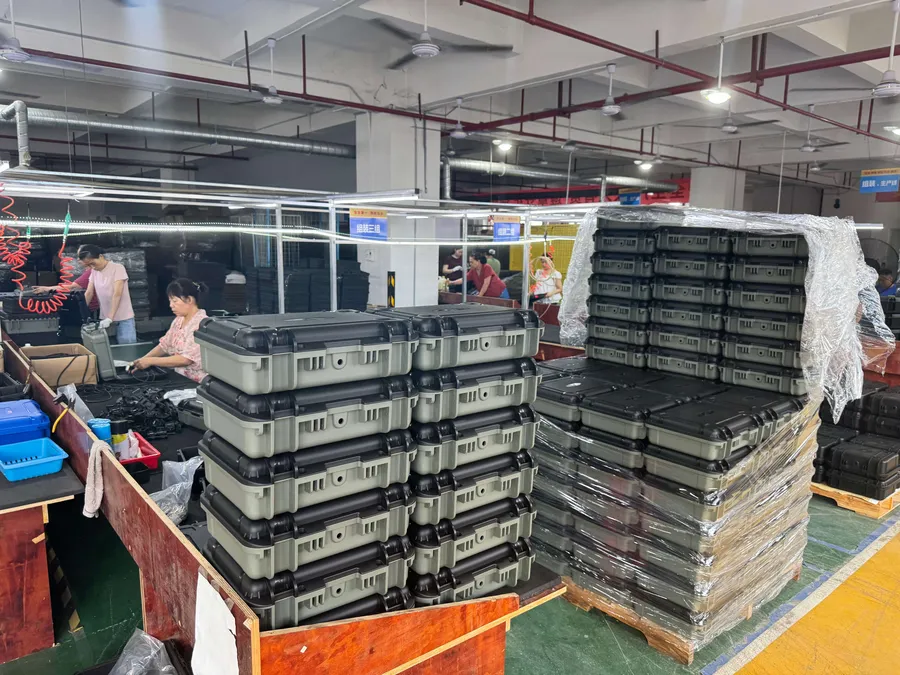
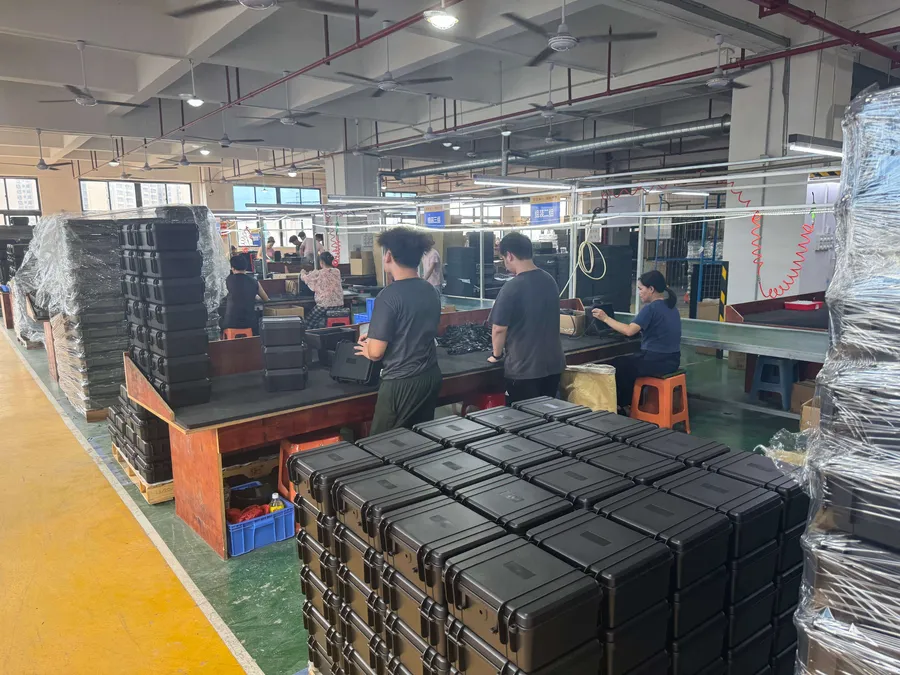
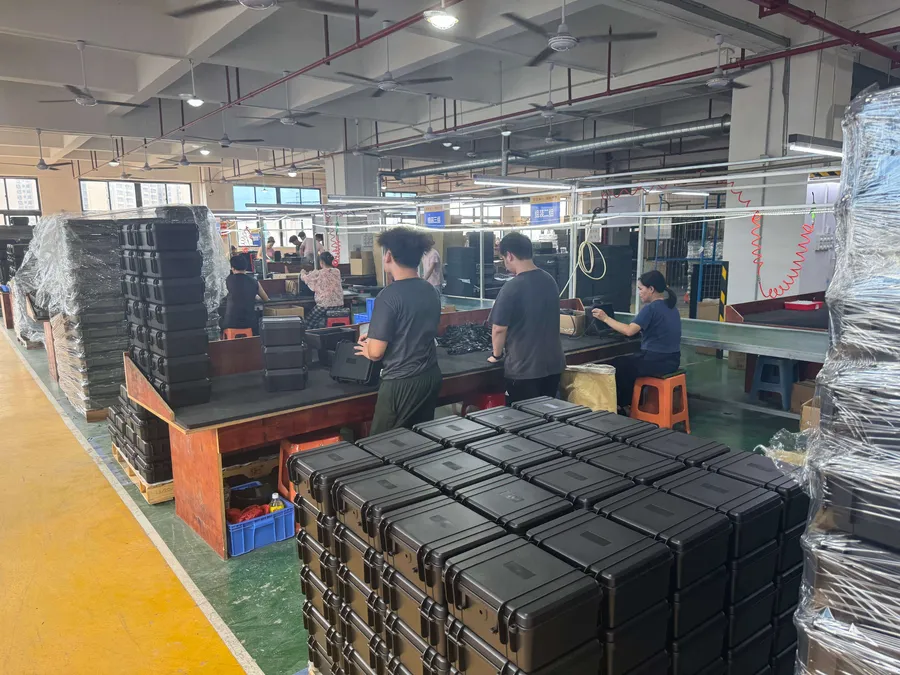
Customisation
Everything described above is configurable on a standard shell: interior layout (pick-and-pluck, die-cut or CNC-cut), foam grade and thickness, colour, logo method, latch and lock count, pressure-equalisation valve, cable ports, document holder and identification plate. A bespoke exterior geometry requires a new mould — 125 days, from 3,000 units per moulded component.
Procurement considerations
| Question | What to send us |
|---|---|
| Which shell fits? | Equipment L × W × H as packed, plus required clearance per axis |
| What does it cost? | Order quantity and estimated annual quantity — the two drive different answers |
| Is tooling needed? | Whether an existing shell clears the envelope with usable foam depth |
| Lead time? | Your required delivery date, not just the order date |
| Certification? | The exact standard your tender names — we will say whether we can test to it |
| Freight? | Destination and preferred terms; carton and pallet data supplied with the quotation |
Comparison and selection guide
The tables on this page exist because a protective case is chosen by comparing three things: the envelope, the environment and the handling chain. Where no table applies, the rule below is.
| Situation | What To Do |
|---|---|
| Fastest | Standard shell plus CNC foam — typically 45 days from approved drawing. |
| Branded | Standard shell plus custom colour and logo — MOQ applies to the resin colour. |
| Bespoke geometry | New mould — 125 days, MOQ from 3,000 units per component. |
- Size on internal dimensions plus clearance, never on a product name.
- Choose the carrying method before the shell: it changes the series, not just the price.
- Specify the interior last, and decide up front whether the end user will reconfigure it.
What are the common mistakes in case load capacity for equipment transport cases? relates to Logistics & Packing Guide. Related families: Custom Protective Cases / Equipment Transport Cases / Military Protective Cases / Rolling Cases / Field Equipment Cases / Electronics Cases / Ammunition Storage & Transport Boxes / Tool Cases. Related sectors: field and industrial equipment. Continue in the Logistics & Packing Guide cluster.
This page is written from our own production data. If your requirement differs, send the dimensions and we will tell you which of the 155 models fits, or whether a custom route is needed.


