What information should be provided about case locks before a quotation?
Before you ask for a quotation, put four facts about case locks in the request: how many locking points each case needs, what will do the locking - your padlock, your seal, or a key-operated lock you supply - the shackle diameter the hasp slot must clear, and whether the whole fleet has to open with the same key. That is the information that turns an estimated price into a firm one. What we can already answer from the catalogue: on all 155 published models the latch body accepts a standard padlock, and that item is recorded as measured in our product data. The number of latches is not a fixed published count; it is specified per configuration, which is exactly why your count belongs in the request. Everything beyond that - hasp material, key plan, seal interaction - is fixed on the drawing the quotation prices, so the more of these details travel with the RFQ, the fewer surprises in the first price.
Key points
- State the locking points per case in the RFQ: latch count is specified per configuration across all 155 published models, so a number in the request buys a firmer price.
- Say what does the locking: on every published model the latch body accepts a standard padlock, so the shackle diameter you use drives the hasp slot on the drawing.
- Give the padlock shackle diameter and say whether the hasp must also take a wire seal; both dimensions belong on the drawing, not in an email thread.
- Decide keyed alike or keyed to differ before quoting; changing the fleet key plan after production starts is rework the quotation will not carry.
- Check the seal line at the same time: 124 of 155 models list a seal as available, and the 31 without one are the thin-wall small cases.
- Put lock requirements on the same drawing as dimensions and foam; a lock added after tooling starts is a new-mould decision on its own 125-day lead time.
What we publish about case locks before any quotation
Our catalogue makes three lock-related statements, and it makes them the same way on all 155 models. First, the lock field is true and flagged measured, with the note that the latch body accepts a standard padlock. Second, latch count is published as 'Count specified per configuration' and flagged as a manufacturer option, not as a fixed number. Third, the seal line is published per model: 124 models list a seal as available, 31 do not. That is the complete published lock picture. It answers 'is there something to lock and to hasp?' - yes, as a measured item - but it deliberately does not answer 'how many, what material, keyed how?', because those are set when a configuration is drawn.
The practical consequence for buyers is simple: the catalogue narrows the conversation to four decisions that only you can make. Those four - count, method, shackle clearance and key plan - are the difference between a quotation that assumes and a quotation that commits, and every one of them can be written in one RFQ line each.
| Published Field | Value On All 155 Models | Claim Status | What It Means For Your Rfq |
|---|---|---|---|
| Latch body accepts a standard padlock | true | measured | Send the shackle diameter your padlock uses; the hasp slot must clear it. |
| Latch count | Count specified per configuration | manufacturer option | State how many locking points you want and where. |
| Seal available | true on 124 models, no on 31 | published per model | Say whether the closure also has to hold a seal. |
The four facts that fix a lock quotation
These are the four facts we ask buyers to state, in the order that matters, and each is a decision only the buyer can make: we cannot guess how many points you want locked, what hardware your security team already runs, or who should hold the keys. Each answered fact removes an assumption from the price, and assumptions are what turn first quotes into second quotes.
None of the four requires engineering language. A sentence per point is enough for us to come back with a configuration drawing, and the drawing is what the quotation prices.
Lock arrangements buyers ask for, and what each changes
Buyer requests arrive as one of four common arrangements. None of them is a published standard feature of the catalogue models - the published statement is that the latch body accepts a standard padlock - so each arrangement below is something we draw into a configuration on request. The table shows what you must state and what each arrangement changes in the quotation. Padlock hasps on protective cases remain the most requested starting point, because they let each buyer keep the locking hardware they already run.
| Arrangement | Buyer Must State | What It Changes |
|---|---|---|
| Padlock hasps only | Number of hasps, shackle diameter, hasp orientation | Hardware count and moulding positions on the drawing |
| Hasps plus wire seals | Seal slot size and who supplies the seals | Adds a sealing point beside the hasp; check the model's seal line |
| Key-operated locks you supply | Lock body size, fixing pattern, keep position | Pocket and fixing holes are moulded in; later changes are tooling changes |
| Mixed fleet: hasps here, seals there | Which sizes get which arrangement | The quotation splits into configurations instead of one line item |
How locking interacts with seals, walls and materials
The published numbers put real limits around lock placement. Wall thickness is published for 148 of 155 models and runs 2.0 to 6.0 mm with a median of 3.9 mm. Shell materials are PP on 94 models, engineering PP on 38, ABS on 22 and one PP/ABS blend. A hasp that must carry a heavy padlock asks more of a 2.0 mm wall than of a 6.0 mm wall, so the wall the drawing uses is part of the lock conversation, not a separate topic.
The seal line matters just as much. 124 of 155 models list a seal as available, and every one of those with a published wall is 3.0 mm or thicker. The 31 models without a seal are 13 military-protective, 10 outdoor-protective and 8 tactical category models; 24 of them publish a wall below 3.0 mm and 7 publish no wall value. If your lock and your seal have to share the same edge, say so in the RFQ - the drawing has to find room for both.
Fleet decisions: keyed alike locks for case fleets
Fleet-level decisions look small and cost the most when missed. Keyed alike means one key opens every case - right for internal fleets that move together, wrong when different teams must not open each other's cases. Keyed to differ is the opposite trade. Then there is the key-holder question: who signs keys out, and how spares are controlled. None of this changes the shell, but all of it changes the closure plan, so it belongs in the RFQ rather than in a phone call after the deposit.
Say also who must be able to open a case at the factory. If a third-party inspection has to open cases before shipment, the closure plan has to allow it, and our payment terms already assume inspection: 30% deposit with the balance after inspection. Third-party factory audits are welcome, and an audit will look at exactly this kind of process question.
What we do not claim about case locks
We publish no forced-entry rating, no latch cycle count and no torque figure, for any model. The measured lock statement in our product data is one line: the latch body accepts a standard padlock. We do not describe any model with a security grade, and we do not present any hardware figure as a resistance rating. If a programme needs a rating of any kind, it has to come from measurements by a third-party laboratory against an agreed procedure; we can build the configuration that such a laboratory evaluates, and the quotation prices the build, not the result.
This is also why we ask for shackle diameters instead of guessing them. A hasp slot that does not fit the padlock that actually arrives is a field failure no rating would have prevented, and it is avoidable with one number on the drawing.
Commercial terms for lock and hardware customisation
Customisation runs through our OEM/ODM route. First samples against an existing mould take 45 days; a new mould takes 125 days. Payment is 30% deposit with the balance after inspection. We quote EXW or FOB. We sell wholesale and OEM/ODM only - no retail, no DDP, no overseas warehouse - and third-party factory audits are welcome before you commit. Logo and colour options carry their own minimum quantities, which we confirm with the quotation.
KeXin New Materials (Guangdong) Co., Ltd. answers lock and hardware questions through Fred Zhao and the KeXin sales team on WhatsApp +86 135 3588 0002. Send the four facts from the section above with your model shortlist, and the reply will be a configuration drawing and a price, not another round of questions.
Customisation
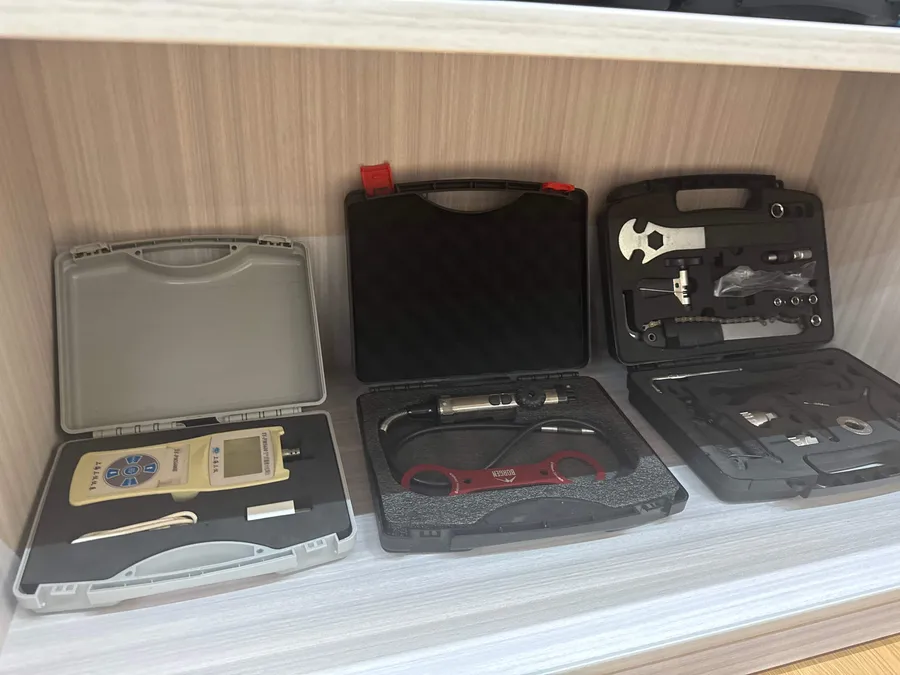
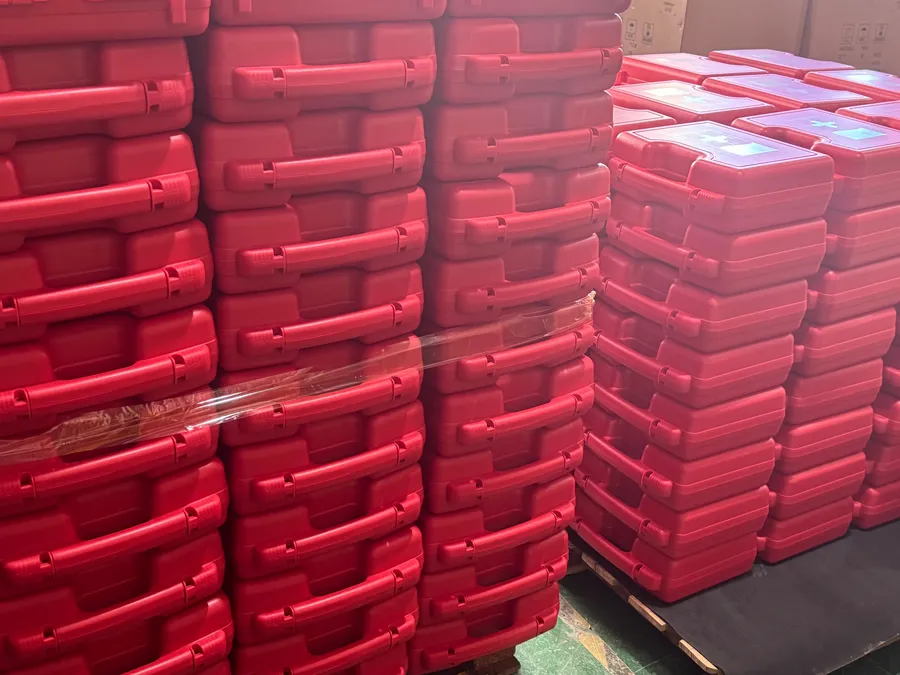
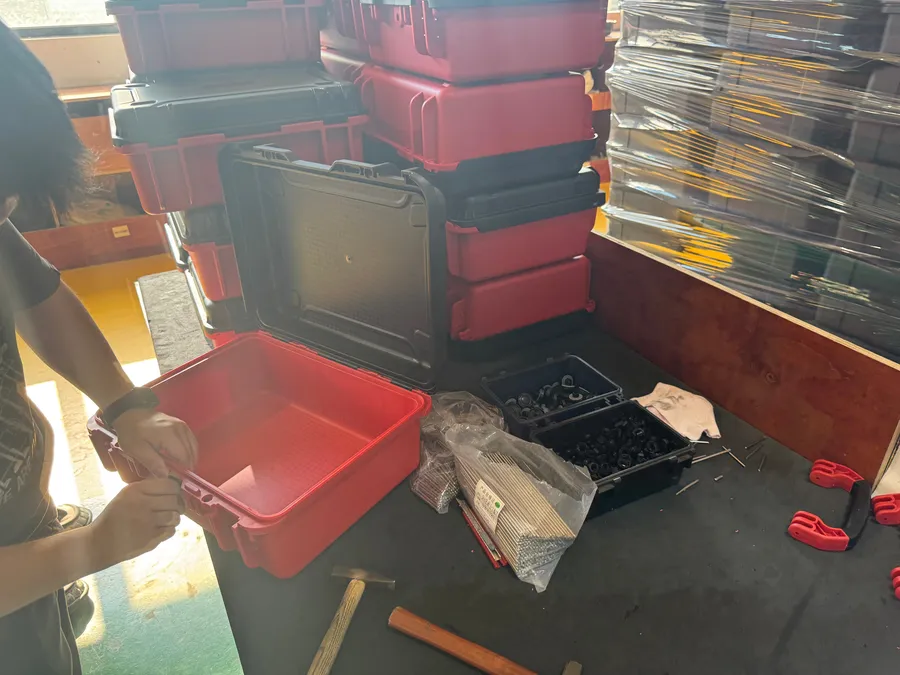
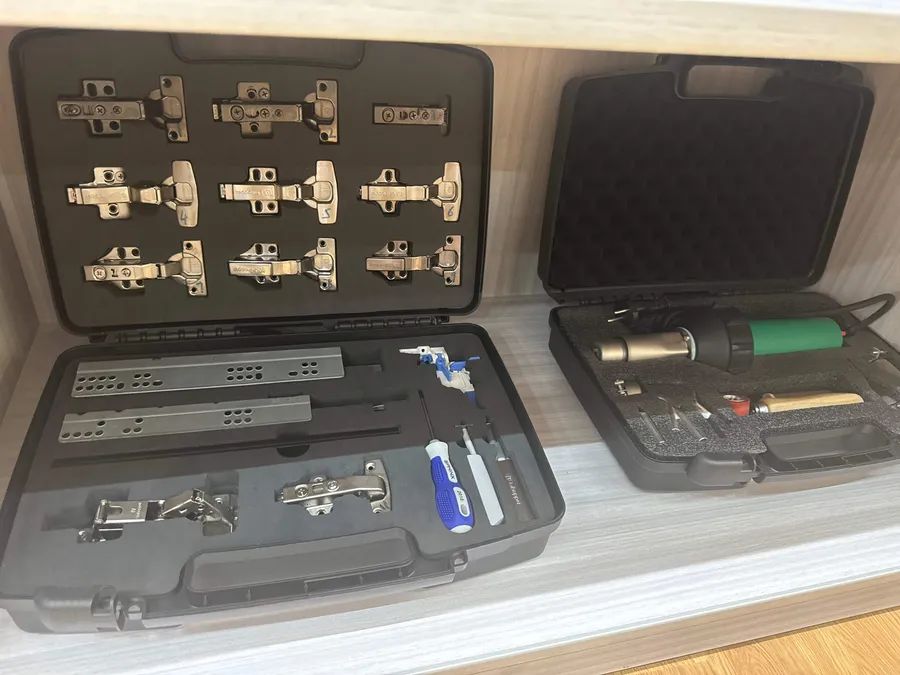
Everything described above is configurable on a standard shell: interior layout (pick-and-pluck, die-cut or CNC-cut), foam grade and thickness, colour, logo method, latch and lock count, pressure-equalisation valve, cable ports, document holder and identification plate. A bespoke exterior geometry requires a new mould — 125 days, from 3,000 units per moulded component.
Procurement considerations
| Question | What to send us |
|---|---|
| Which shell fits? | Equipment L × W × H as packed, plus required clearance per axis |
| What does it cost? | Order quantity and estimated annual quantity — the two drive different answers |
| Is tooling needed? | Whether an existing shell clears the envelope with usable foam depth |
| Lead time? | Your required delivery date, not just the order date |
| Certification? | The exact standard your tender names — we will say whether we can test to it |
| Freight? | Destination and preferred terms; carton and pallet data supplied with the quotation |
Comparison and selection guide
The tables on this page exist because a protective case is chosen by comparing three things: the envelope, the environment and the handling chain. Where no table applies, the rule below is.
| Situation | What To Do |
|---|---|
| Fastest | Standard shell plus CNC foam — typically 45 days from approved drawing. |
| Branded | Standard shell plus custom colour and logo — MOQ applies to the resin colour. |
| Bespoke geometry | New mould — 125 days, MOQ from 3,000 units per component. |
- Size on internal dimensions plus clearance, never on a product name.
- Choose the carrying method before the shell: it changes the series, not just the price.
- Specify the interior last, and decide up front whether the end user will reconfigure it.
What information should be provided about case locks before a quotation? relates to Logistics & Packing Guide. Related families: Custom Protective Cases / Military Protective Cases / Tactical Equipment Cases. Related sectors: field and industrial equipment. Continue in the Logistics & Packing Guide cluster.
This page is written from our own production data. If your requirement differs, send the dimensions and we will tell you which of the 155 models fits, or whether a custom route is needed.


