What are the common mistakes in case seals for equipment transport cases?
Almost all of the common mistakes in case seals come from reading one published line as though it answered a question it never addressed. Our file of 155 published models states a seal on 124 of them - a compressible gasket in a continuous moulded channel, recorded as measured - and states on the remaining 31 that none is offered on that shell, so the first check is the seal record on the model number, not the look of the box. The second is the wall the channel is moulded in: of the 148 listings that publish a wall thickness, every sealed model sits at 3.0 mm or above (median 4.2 mm) and every listing at 2.0 to 2.9 mm records no seal at all. The third is length: the sealing run computed from published plan dimensions on the 124 sealed listings runs from 700 mm on KX-62205 to 3,020 mm on KX-814641, median 1,582 mm, and the closure that loads it is recorded only as specified per configuration on 155 of 155 listings. The rest of the list is made of the EPDM material line, which is a configuration statement printed on all 155 listings including the 31 unsealed ones, the interior volume figures, and the seven protection fields our file records as not measured on every model.
Key points
- A hard shell is not a seal: 124 of our 155 published listings record a compressible gasket in a continuous moulded channel and 31 record that none is offered on that shell.
- Wall thickness separates the two groups cleanly in the published data: all 124 sealed listings sit at 3.0 mm or above with a median of 4.2 mm, and no listing below 3.0 mm records a seal.
- The EPDM line is a configuration statement printed on all 155 listings, including the 31 shells that record no seal, so it cannot be read as a gasket specification for a model.
- Sealing run length computed from published plan dimensions ranges from 700 mm to 3,020 mm on the sealed group, median 1,582 mm, which is why one corner of a lid can leak while three others hold.
- Latch count, latch spacing and closing force are recorded as specified per configuration on 155 of 155 listings and as numbers on none, so compression is an order-text item, not a catalogue field.
- Every sealed listing publishes a usable interior volume below its internal volume, the median gap being 3.5 L and the largest 27.9 L on KX-88442, which is the packing mistake that lifts a lid.
- Waterproof, dust, UV, temperature, stack load, load capacity and protection class are recorded as not measured on all 155 listings, and no IP code is printed anywhere on the range.
Why mistakes in case seals show up in transit and not at the sample bench
A seal is the quietest part of an equipment transport case. Nothing announces it when it works, and it is inspected by nobody until a shipment arrives with a wet label or a film of grit on the foam. That is why the common mistakes in case seals are discovered in a vehicle, on an apron or at receiving rather than during a sample review: the sample sat open on a warm bench for twenty minutes and looked fine. The second reason is that case seals for equipment transport cases are specified by people reading two different documents at once - a product listing that publishes dimensions and hardware, and a datasheet line that names a material family - and the two documents do not answer the same question. Almost every error we see in a specification review is a cross-wiring between those two, not a misunderstanding of elastomers.
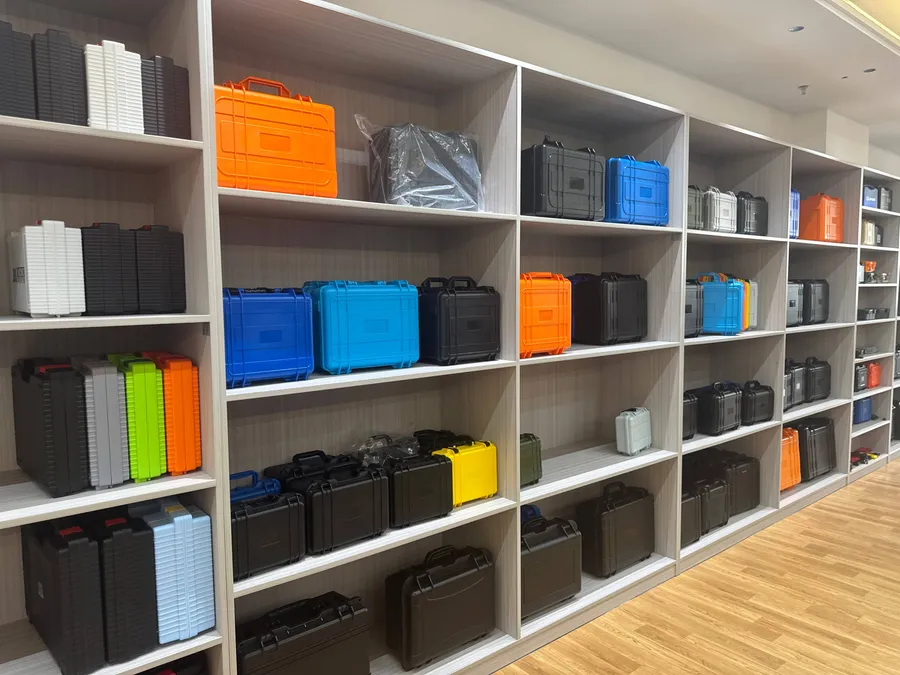
This page is written against our own published file, so each mistake is paired with the field that settles it. The file covers 155 active models across seven series. On the seal side it is deliberately narrow: one recorded seal construction on 124 listings, an explicit none-offered statement on 31, one material-family line on all 155, and seven protection fields recorded as not measured on every model. That narrowness is the argument of this page. A buyer who knows exactly what those few lines do and do not say can specify seals on our range correctly in one email; a buyer who fills the gaps with assumptions is the one who finds out on the receiving bench.
Mistake one: assuming every hard shell case has a seal
The most expensive habit in this category is reading a moulded lid as sealing evidence. Our file records a seal on 124 of 155 listings and records the phrase none offered on this shell on 31 of them. The 31 are not prototypes or clearance stock; they are current models in familiar series. In the Series 7 large-equipment group none of the six listings records a seal, so a 470 x 360 x 148 mm KX-707 with a 2.5 mm wall and a 20.2 L interior ships as an unsealed shell. In the Series 1 small protective group, five of seven listings - KX-2614, KX-3114, KX-4710, KX-4713 and KX-4716 - carry the same none-offered record. Size does not sort the list either: KX-6922 is a 685 x 500 x 220 mm shell with a 50.4 L interior and no seal record, while KX-62205, at 222 x 128 x 50 mm and 0.8 L, records a gasket in a moulded channel.
The corrected habit is a one-field check on the exact model number: read the seal line, and read whether it is recorded as measured or as a configuration option. Sealed listings are concentrated in the heavier tooling: Series 6 has a seal record on all 20 listings, Series 8 on 58 of 62, the telescopic T series on 18 of 19 and Series 9 on 14 of 18, while the compact Series 0 splits 12 sealed against 11 unsealed. If a listing does not answer the question, ask for it in writing before the purchase order rather than after the first consignment - the same sentence you need for a supplier who says yes without a document.
Mistake two: reading the EPDM line as a published specification
Every listing in our file prints the same material-family sentence for the seal: EPDM or equivalent compressible gasket. It is recorded as a manufacturer option, and it appears on all 155 models - including on the 31 shells that record no seal at all. Buyers routinely read that line three ways it cannot support: as a compound specification for the part actually fitted, as proof that a gasket exists on that model, and as a basis for assuming ageing behaviour. None of those three is a published fact. What is published is a family name and the statement that the compound is supplied to configuration; what is not published on any listing is durometer, cross-section area, bead length, splice method, compression-set figure, low-temperature brittleness or an ozone-resistance grade.
The practical consequence is that an EPDM reference in a specification document is not a procurement instruction unless the writer says what it governs. If the goal is chemical exposure - machine-shop coolant, marine atmosphere, insect repellent, silicone-based lubricants - the question to ask is which compound is being quoted for that order and what the supplier is prepared to test, not which family name appears in a datasheet footer. If the goal is a spare part, the EPDM line tells you nothing about whether the bead can be ordered at all, which is mistake seven below. Treat the material line as an opening position in a conversation, and put the agreed compound in the order text.
Mistake three: checking the lid instead of the wall the channel is moulded in
A seal on a moulded thermoplastic case is a channel-and-wall fact before it is a rubber fact. Our file publishes a wall thickness on 148 of 155 listings, with 26 distinct values from 2.0 mm to 6.0 mm and a median of 3.9 mm, and the two populations do not overlap: all 124 sealed listings publish a wall of 3.0 mm or more, with a median of 4.2 mm and 18 distinct values, while all 24 unsealed listings that publish a wall sit between 2.0 mm and 2.9 mm, median 2.2 mm, with 8 distinct values. No sealed model is published at 2.5 mm or thinner. Fifty-six listings publish 4.5 mm or more and 30 publish 5.0 mm or more, and 25 of them share exactly one value, 5.0 mm. Reading the wall section therefore predicts the seal record across the whole published range with no exceptions.
Seven listings publish no wall figure at all, and all seven are in the unsealed group: KX-84814, KX-84815, KX-84823 and KX-84824 in Series 8, KX-95419 and KX-6922 in Series 9, and KX-5126 in the rolling T series. That is the mistake in operational form: a buyer compares a 463 x 370 x 231 mm shell against a neighbour with a stated wall, finds no number, and assumes the absence is cosmetic. It is not. When a field is blank on our listing, the honest reading is that we have not published it for that model, and the correct action is to ask for the section drawing or a sample before the geometry is trusted for a channel, a fastening or a stack.
Mistake four: tightening one latch to stop a corner leak
Water and grit arrive at a corner, the reflex is to load that corner harder, and the result is a lid that tilts and opens a gap at the diagonal. The number that governs this is the length of the run the closure has to load. Computed from the two longest published external plan dimensions of each sealed listing - added and doubled, as an arithmetic reading of published data rather than a measured bead length - the run ranges from 700 mm on KX-62205 to 3,020 mm on KX-814641, with a median of 1,582 mm across the 124 sealed listings. A hundred and ten of them are at or above 1,200 mm, 57 at or above 1,600 mm, 28 at or above 2,000 mm and six at or above 2,500 mm. A rim that long is a distribution problem, and over-tightening one point converts it into a lever.
The distribution itself is not published, which is the second half of the mistake. Our file records the latch line on all 155 listings as a count specified per configuration; no listing carries a numeric count, a spacing figure or a closing force. The padlock note is equally narrow: the measured note states only that the latch body accepts a standard padlock, which is a hasp shape, not a compression promise and not a security claim. So the corrected order text says how many closures, where they sit, and that they are to be closed in a crossing sequence in which every latch on the rim reaches its catch - which is also the field maintenance routine, and the only seal instruction that costs nothing.
Mistake five: packing to the internal volume and lifting the lid
The leak that starts inside the case is a volume-reading mistake. Our listings publish an internal volume and a usable interior volume, and on the sealed group the usable figure is smaller on every single listing: the median difference is 3.5 L across 124 listings, the largest is 27.9 L on KX-88442 - 139.5 L internal against 111.6 L usable - and the smallest published difference is 0.1 L. Packing to the internal number means the contents press the lid away from the bead. A sealed lid that cannot seat is not a defective gasket; it is a foam-layout decision that was made twice, once in the drawing and once by a packer with a spare carrier.
Lid travel is the second half of this mistake and it is published far less often than buyers assume. Lid depth appears on 100 of 155 listings; among sealed models only 76 publish it, ranging from 25 mm to 320 mm with a median of 127.5 mm. Eleven listings publish a lid of 200 mm or more and all eleven record a gasket - eight rolling T shells and three Series 8 shells - and on one shared 843 x 592 mm plan the same 2,870 mm sealing run sees lids of 145 mm on KX-88421, 240 mm on KX-88434 and 320 mm on KX-88442. Five sealed listings go the other way, with a deeper base than lid: KX-4318 and KX-4319 at 38 and 140 mm, KX-5321 and KX-6621 at 43 and 149 mm, and KX-97227 at 42 and 168 mm. Ask for the foam layout and the lid figure together, and treat a kit that needs both as a drawing conversation.
Mistake six: treating a seal as a waterproof rating
A gasket is a construction; a protection class is a test result. Our file keeps those two apart on purpose, and the fields that would collapse them are recorded as not measured on all 155 listings: waterproof, dust resistance, UV resistance, temperature range, stack load, load capacity and protection class. The protection-class note says it plainly - no IP code is stated, and accredited testing is quoted per configuration. The impact note follows the same discipline, publishing the wall figure while refusing a drop height without a test. What the file does record as measured is a construction fact: the presence of the moulded channel and compressible bead on 124 listings, corrosion resistance on a thermoplastic shell with no ferrous path, and the presence of hinges and feet on every listing.
The mistake is reading the first list as a failure to answer and the second as a licence to answer for it. If a tender or an internal standard names an ingress protection class, the correct sequence is to ask which edition and test method the words refer to, which submerged or spray condition and duration, which laboratory ran it and what the report number is, and whether the sample was a production unit or a prepared one; a rating without a method and a report is a sentence, not evidence. Where we have not measured something we say so, and where a customer needs a figure we quote accredited third-party testing against the named method for the configuration being ordered. Tender language that names military-style environmental standards, explosion protection, static-dissipative materials or air-drop performance falls in the same place: not something our published file claims, and testable per configuration if the programme requires it.
Mistake seven: expecting a replaceable gasket bead
Most buyers carry a mental model from aluminium-frame flight cases, where a profile gasket is a loose part cut to length and ordered by section code. Our shells are different by construction: the seal is a compressible bead in a continuous moulded channel, and the file publishes none of the four things a spare-part order needs - no cross-section, no bead length, no durometer and no splice position. It also records a frame of none on all 155 listings, so there is no extruded rail to unbolt and re-gasket, and CAD data as not published on all 155, so there is no profile drawing a mender can work from. Assuming a serviceable bead is therefore assuming a construction our range does not use.
The consequence is not that a sealed shell cannot be maintained - the maintenance routine on the rim is real and cheap - but that a replaceability promise has to be designed rather than assumed. Where a programme genuinely needs a field-replaceable sealing element, that is a channel-and-tool question: it belongs on a new tool or an existing-tool modification, agreed on a sample, with the compound and the cross-section named in the order text. The same rule runs the other way: an unsealed shell does not become sealed because a bead was pressed into a moulding that was never formed to hold one.
The eight common mistakes in case seals, and the published check that replaces each
Use the table as a pre-order review sheet. Each row pairs one recurring mistake with the field in our published file that settles it, so a specification can be closed on paper before a purchase order is raised instead of argued after a delivery. Nothing in the right-hand column needs a laboratory, a sample or a negotiation; it is all already in the listing or in one sentence of order text.
| The Mistake | What The Published File Says | The Check That Replaces It |
|---|---|---|
| Assuming every hard shell case has a seal | Seal recorded on 124 of 155 listings; none offered on this shell recorded on 31, including all six Series 7 listings | Read the seal record on the exact model number and ask whether it is measured or configuration |
| Reading the EPDM line as a published specification | One material-family sentence printed on all 155 listings as manufacturer option, including the 31 unsealed shells | Ask which compound is quoted for this order, and on what evidence |
| Checking the lid instead of the wall the channel is moulded in | Sealed listings publish 3.0 to 6.0 mm walls with a 4.2 mm median; no listing below 3.0 mm records a seal | Compare wall figures across candidate models before comparing gaskets |
| Tightening one latch to stop a corner leak | Derived sealing run 700 to 3,020 mm on sealed listings, median 1,582 mm; latch count recorded as specified per configuration on 155 of 155 | State count, spacing and a crossing close sequence in the order text |
| Packing to the internal volume and lifting the lid | Usable interior volume sits below internal volume on every sealed listing; median gap 3.5 L, largest 27.9 L on KX-88442 | Specify the foam layout against the usable figure, not the internal one |
| Treating a seal as a waterproof rating | Waterproof, dust, UV, temperature, stack load, load capacity and protection class recorded as not measured on all 155; no IP code stated | Ask for method, condition, laboratory and report number, then order testing per configuration |
| Expecting a replaceable gasket bead | No cross-section, bead length, durometer or splice published; frame recorded as none on 155 of 155 and CAD as not published | Treat field replaceability as a tooling decision confirmed on a sample |
| Copying one seal line across a size family | One 843 x 592 mm plan carries lids of 145, 240 and 320 mm over the same 2,870 mm derived run | Re-take the seal decision for each height in a family, per model number |
Where seal mistakes cost the most: reading across the published range
For electronics and instrument programmes shipped as a mixed fleet, the recurring error is the family copy - one hardware line quoted across a run of Series 8 shells that do not share a lid depth. The 62 Series 8 listings carry the widest distribution in the file, 58 of them with a seal record, lids published on a subset and no net weight printed on any of the 62. A specification that treats the series name as the model name inherits those gaps without seeing them. For field and telecommunications kits the dominant error is wall anchorage and the run length: those cases are closed in the dark, with gloves, on vehicle racks, and a 2,000 mm rim with four closures loaded unevenly leaks at exactly the point nobody looked at.
For ammunition and outdoor bulk orders the mistake is the volume reading, because the kits are dense and the usable figure is smaller than the internal one on every listing that publishes both. For rolling and long cases the mistake is expecting the latches to carry something they were never designed to carry: 18 sealed listings are recorded as non-stackable, all of them telescopic rolling shells including KX-97227 at 6.0 mm wall and 10,000 g net weight, and stack load is recorded as not measured on all 155 models. Mass is the other silent variable - 93 of 155 listings publish a net weight, the 66 sealed figures run from 250 g to 15,320 g with a median of 2,035 g, and a 15 kg lid left on a rack in the sun is a different sealing problem from a 250 g one.
Customising a seal: configuration, existing-tool change, or a new tool
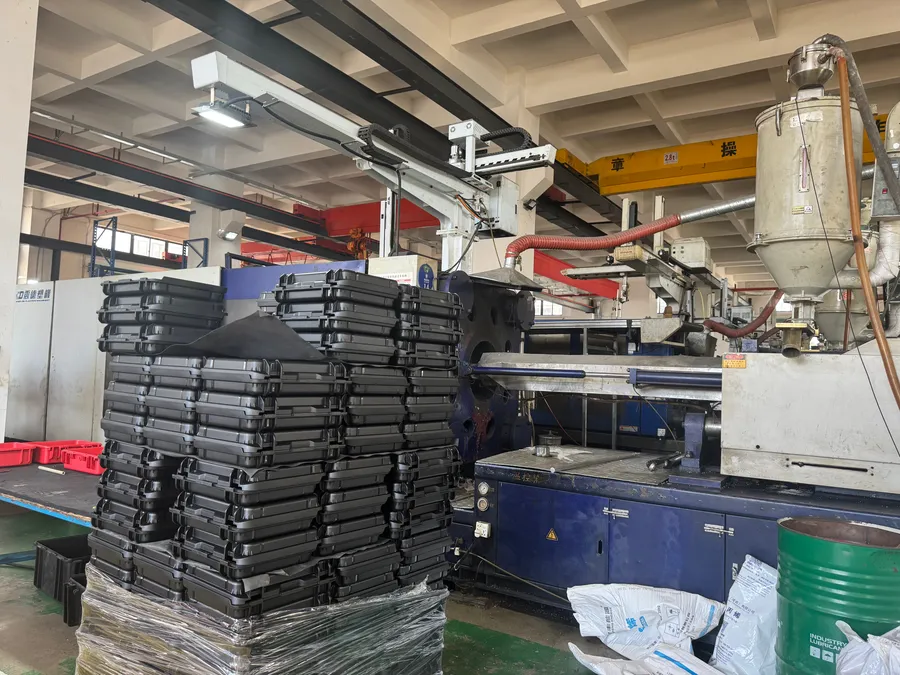
Three different things get confused in seal customisation. Choosing a model that already carries a moulded channel is a selection, not a modification. Changing the closure fitted to an existing shell - hardware type, metal or polymer by configuration, colour, a lockable variant, the gasket compound quoted for the order - is a configuration change on an existing tool, which we lead at 45 days for an OEM first article with a minimum order of 300 pieces for logo, colour or OEM work. Changing the moulding itself - forming or removing a channel, altering the interference between lid and base, or engineering a field-replaceable bead - is a new tool: 125 days and a minimum of 3,000 pieces per component, agreed against a drawing or a physical sample.
What we do not offer is a promise that a pressed-in bead will seal a shell that was never formed to hold one, and we do not convert an unsealed listing into a sealed one with an adhesive. If a programme needs the second, it needs the tool. Sample policy follows the same line: we work from a drawing, a photograph of the packed kit or a physical sample, and the sealed sample is the document that closes the seal conversation.
Procurement notes: the six lines to write into the order text
First, the model number, and a restatement of its seal record in the supplier's own words - channel present or none offered. Second, the wall section that the channel is formed in, or an explicit statement that no figure is published for that listing. Third, the closure: count, position and sequence, because our file records the count only as specified per configuration. Fourth, the compound actually being quoted for this order, if the EPDM family line in the datasheet is not what the programme wants. Fifth, the usable interior volume and the foam layout, signed off against a packed sample. Sixth, any test the programme needs - the method, the condition, the laboratory and who pays - so that an unmeasured field stays unmeasured on paper rather than being assumed satisfied in transit.
Commercial terms are the same for every order size: wholesale and OEM or ODM manufacture only, EXW or FOB, no retail, no DDP and no overseas warehouse. Payment is 30 percent deposit with the balance after inspection, and third-party inspection and factory audits are welcome. Pack data follows the same publication discipline as the rest of the file: 64 listings publish pack information, 58 publish pieces per carton, nine of them a single case per carton including KX-6922 and KX-97227, and pallet and container figures are calculated from the carton footprint against your pallet and supplied with the quotation rather than printed as a standing claim.
What we do not state about case seals, listed plainly
So that a silence cannot be read as a claim: our 155-model file states no IP code, no ingress protection class, no immersion depth or duration, no spray result, no drop height, no vibration profile, no temperature range, no UV or ozone grade, no compression-set figure, no durometer, no gasket cross-section, bead length or splice position, no latch count or closing force, no service interval, no leakage rate and no accelerated ageing result. Those fields are recorded as not measured or as configuration, and we would rather leave them that way than print a number we cannot produce a report for. Where a programme genuinely needs one, we quote accredited third-party testing against the method the customer names, on the configuration being ordered, and publish the result on that model afterwards.
What the file does state is on the seal side narrow but real: 124 listings record a compressible gasket in a continuous moulded channel as a measured construction; 31 record that none is offered; all 155 record the seal material as EPDM or equivalent to configuration; hinges and feet are recorded on all 155; and corrosion resistance on a thermoplastic shell is recorded as measured because there is no ferrous path to corrode. That is the whole list. A buyer who specifies against it, and asks for a test when a test is what the programme needs, gets a seal that behaves the way the paperwork says it should.
Customisation
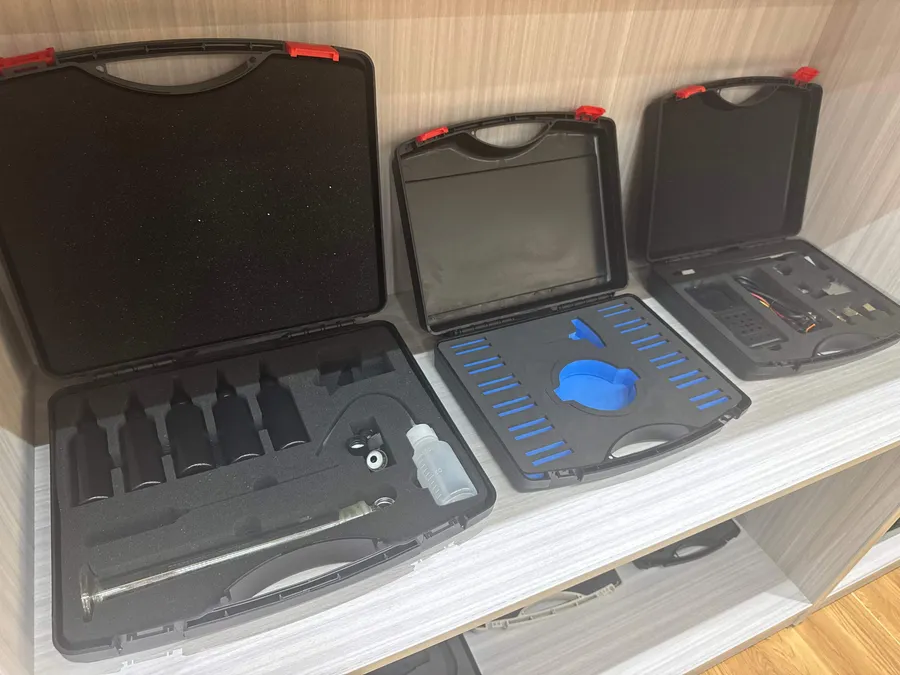
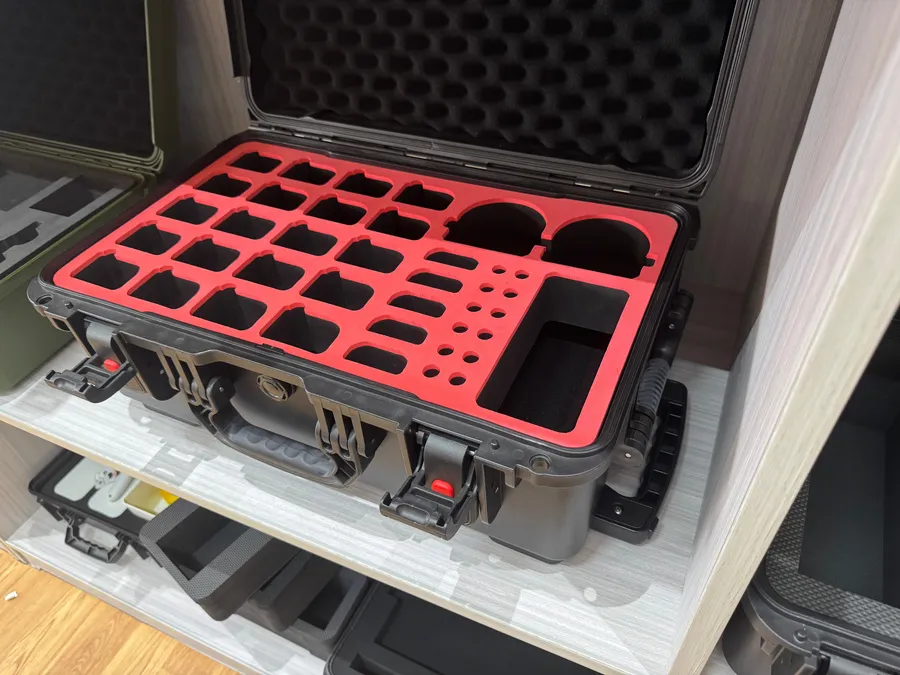
Everything described above is configurable on a standard shell: interior layout (pick-and-pluck, die-cut or CNC-cut), foam grade and thickness, colour, logo method, latch and lock count, pressure-equalisation valve, cable ports, document holder and identification plate. A bespoke exterior geometry requires a new mould — 125 days, from 3,000 units per moulded component.
Procurement considerations
| Question | What to send us |
|---|---|
| Which shell fits? | Equipment L × W × H as packed, plus required clearance per axis |
| What does it cost? | Order quantity and estimated annual quantity — the two drive different answers |
| Is tooling needed? | Whether an existing shell clears the envelope with usable foam depth |
| Lead time? | Your required delivery date, not just the order date |
| Certification? | The exact standard your tender names — we will say whether we can test to it |
| Freight? | Destination and preferred terms; carton and pallet data supplied with the quotation |
Comparison and selection guide
The tables on this page exist because a protective case is chosen by comparing three things: the envelope, the environment and the handling chain. Where no table applies, the rule below is.
| Situation | What To Do |
|---|---|
| Sea freight | Sealed configuration plus desiccant; salt spray is a handling issue, not a material issue. |
| Air freight | Mass and external dimensions drive cost more than volume. |
| Repeated movement | Replaceable latches, hinges and gaskets; keep a spares kit with the first order. |
- Size on internal dimensions plus clearance, never on a product name.
- Choose the carrying method before the shell: it changes the series, not just the price.
- Specify the interior last, and decide up front whether the end user will reconfigure it.
What are the common mistakes in case seals for equipment transport cases? relates to Logistics & Packing Guide. Related families: Equipment Transport Cases / Custom Protective Cases / Electronics Cases / Waterproof Cases / Military Protective Cases / Field Equipment Cases / Instrument & Equipment Cases / Outdoor Protective Cases / Ammunition Storage & Transport Boxes. Related sectors: field and industrial equipment. Continue in the Logistics & Packing Guide cluster.
This page is written from our own production data. If your requirement differs, send the dimensions and we will tell you which of the 155 models fits, or whether a custom route is needed.


