How should case locks be specified in a protective case RFQ?
Specify case locks in a protective case rfq as a closure package rather than as one word. Six lines make it answerable: what the lock has to do (deter, seal, or control access across a fleet), whether a padlock passes through a latch body or a lock has to be built into the closure, how many latch points you want and where they sit relative to the parting line, the wall thickness they will be fastened into, whether the same closure has to compress a gasket, and the key or combination control regime with the order quantity. Our published file supports the first two lines with a fact and the rest only with a configuration, because across 155 models the lock field states one thing and states it the same way every time: the latch body accepts a standard padlock.
Key points
- Padlock readiness is the only lock fact in our file: 155 of 155 listings state that the latch body accepts a standard padlock, recorded as measured rather than as an option.
- No latch count is published anywhere in our file; all 155 listings record that the count is specified per configuration, so the RFQ has to state the number you want.
- Our file has no field for lock type, keyway, hasp size, combination mechanism or a supplied padlock, so a lock specification written as a catalogue match cannot be answered as written.
- Wall thickness, the material a lock fitting is threaded into, is published on 148 of 155 listings, from 2.0 mm to 6.0 mm with a median of 3.9 mm.
- Seal and closure are one decision: 124 listings state a seal and 31 state none, and every one of the 24 listings published below 3.0 mm wall thickness sits inside that unsealed 31.
- Hardware material is published as metal or polymer by configuration on all 155 listings, which is why a corrosion or torque line in your RFQ needs an order reference, not a series name.
- A closure change that fits existing moulded inserts is configuration at MOQ 300 with a first sample in 45 days; moving or adding a latch boss is a new mould at 125 days and MOQ 3,000 per component.
The short answer: specify the closure, not the word lock
A lock in a moulded hard case is a role played by a closure, and the RFQ has to describe the role before it can describe the part. Three roles cover most enquiries: deterrence, where a padlock through the latch body is enough and no key register is needed; environmental duty, where the same latch points also have to compress a gasket around the parting line, so count and position become a sealing question; and access control, where a fleet has to be opened by one key schedule or by a combination that can be changed without a tool. Each role lands on a different part of our file. The first is answered by a published fact on 155 listings; the second by the seal record, which is stated on 124 listings and refused on 31; the third by a configuration drawing, because our file records no lock type, keyway or supplied lock for any model.
What our 155-model file states about locks and latches
The hardware block on every listing carries the same nine keys, and the closure-relevant ones behave as follows. Lock is recorded as measured with the note that the latch body accepts a standard padlock, on all 155 models. Latch is recorded as a value of count specified per configuration on all 155, which is the file saying plainly that no catalogue page fixes a number. Hinge and feet are recorded as measured and present on all 155. Pressure valve, document holder and shoulder strap are recorded as manufacturer options with no published figure on all 155. Hardware material is stated once for the whole catalogue as metal or polymer by configuration.
| Closure Field | What Our File Says | Claim Status | How To Write It In An Rfq |
|---|---|---|---|
| Padlock acceptance | Stated on 155 of 155 listings: the latch body accepts a standard padlock | measured | State padlock intent and shackle range you will use, and ask us to confirm the latch body geometry against the ordered SKU |
| Latch count | Count specified per configuration on 155 of 155 listings; no number published | manufacturer_option | Give the number of latch points and their spacing along the parting line, not an average taken from a photograph |
| Lock type, keyway, combination mechanism | No such field exists in the file for any listing | not published | Describe the access-control rule you must satisfy and ask for it as a drawing line with a part reference |
| Supplied padlock or lock body | Not recorded; the file states readiness of the latch body only | not published | Say whether you need hardware supplied, fitted loose in the carton, or omitted so your own locks are used |
| Hinge | Recorded present on 155 of 155 listings | measured | State which face is hinge side so latch positions and the load path are quoted on the same drawing |
| Pressure relief | Manufacturer option with no published value on all 155 listings | manufacturer_option | Name the altitude or temperature swing you expect, and ask whether a valve is fitted, omitted or quoted as an add-on |
| Ingress or protection rating | Waterproof, dust, UV, temperature range, stack load and load capacity are recorded as not measured | not_measured | Name the standard and clause you must satisfy, and budget for accredited third-party testing of the ordered configuration as a separate work package |
The six closure lines that belong in the RFQ
Write the lock requirement as six lines at the top of the enquiry and most of the round trips disappear. Line one is the role: deter, seal, or control access. Line two is the count and geometry: how many latch points, at what spacing along the parting line, and on which face relative to the hinge. Line three is the fastening context: the wall thickness your hardware goes into and whether you are threading into plastic or asking for a metal insert, because our file publishes wall thickness on 148 of 155 listings, from 2.0 mm to 6.0 mm with a median of 3.9 mm, and a fitting designed for a 5 mm flange will not behave the same in a 2.2 mm wall.
Line four is the environmental duty: whether the closure has to compress a gasket, which puts the latch count in the same conversation as the seal record. Line five is control: key numbering, keyed-alike groups, or a changeable combination, stated as the register you have to maintain rather than as an adjective. Line six is commercial: annual and first-order quantity, spares for latch and lock hardware as separate line items, the delivery term and destination, and what has to be evidenced at receiving. Those six lines are also the difference between a quotation we can build to and a catalogue guess, because five of the six are configuration decisions our file deliberately leaves open.
Latch count, parting line and the gasket: one decision, not two
Latch count is where a lock specification quietly becomes a sealing specification. A closure point is a place where lid and base are pulled together, so the number of points and their spacing decide how evenly a compressible gasket is loaded around the rim. Our file records the seal as EPDM or equivalent compressible gasket as a manufacturer option on all 155 listings, and records seal availability as true on 124 listings and absent on 31. Those 31 sit in three catalogues, 13 in military-protective cases, 10 in outdoor protective cases and 8 in tactical equipment cases, and they include every one of the 24 listings our file publishes with a wall thickness below 3.0 mm, which is a useful shortcut when a buyer is trying to work out whether a thin light shell was ever intended as a sealed one.
The parting line geometry belongs in the same enquiry. Lid depth is published on 100 of 155 listings, from 16 mm to 320 mm with a median of 97.5 mm, and base depth on 100 listings, from 15 mm to 168 mm with a median of 44 mm. A deep lid on a tall shell puts its latch points further from the stiffest part of the wall, so a two-latch closure that behaves well on a shallow box can flex open on a 320 mm lid, and a specification that fixes the latch count without stating the lid depth is specifying half a mechanism.
| Listing As Published | External Mm | Lid Depth Mm | Wall Thickness Mm | Empty Mass G | Seal Stated | Why It Matters For Closures |
|---|---|---|---|---|---|---|
| WL8-8442 Trolley | 843 x 592 x 415 | 320 | 5.0 | 15320 | yes | Deepest published lid in the file: latch spacing and gasket compression are quoted together |
| WL6621 | 662 x 495 x 210 | 43 | 6.0 | 6420 | yes | Thickest published wall, so a lock fitting threads into more material than most of the range |
| WL4710 | 466 x 387 x 102 | 45 | 2.5 | 1370 | no | Thin-wall unsealed shell: padlock deterrence is realistic here, gasket compression is not the design intent |
| WL2808 | 275 x 230 x 82 | 38 | 2.2 | 430 | no | One of the 24 listings published below 3.0 mm wall, all of which are inside the unsealed 31 |
| WL8-5726 Trolley | 576 x 363 x 257 | 155 | 4.2 | 5600 | yes | Rolling shell with a medium lid: closure points share the wall with the wheel and column bosses |
Padlock readiness is not a lock specification
Padlock acceptance is the most over-read field in the whole catalogue. It tells you that a shackle can pass through the latch body, which is a real and useful fact on 155 listings, and it tells you nothing about the shackle size that fits, the hasp geometry, whether the hardware is metal or polymer in your configuration, or what happens to that latch under a lever load. A buyer who writes lockable in an RFQ and receives a padlock-ready latch has both been accurate and been disappointed, because the word described an intention and the field recorded a hole.
Where an access-control regime is the actual requirement, name it in the RFQ as a rule with evidence: keyed alike across a fleet of a given count, keyway restricted to your own store, a combination that a supervisor can change without a tool, or a lock that must be removed at a security checkpoint without leaving the case open. Each of those is a hardware drawing and a supply question rather than a catalogue filter, and each should be quoted against the ordered SKU with the part reference written on the drawing so a re-order four years later buys the same thing. Supply of the padlock itself is not recorded in our file, so say explicitly whether you expect locks in the carton or in your own stores.
Where the lock fastens: wall thickness and the load path
Closure hardware carries load in shear and in pull-out, and the material it is fastened into is the limit. Our published wall figures take three broad bands: 24 listings below 3.0 mm, 68 between 3.0 mm and 4.4 mm, and 56 at 4.5 mm or more, with 7 listings publishing no wall thickness at all. That is a specification-grade difference: the same latch and the same fitting behave differently in a 2.2 mm utility box and in a 6.0 mm shell, and a lock added to a thin-wall listing concentrates load on the two fastenings nearest the latch body rather than along the rim.
The same caution applies to ratings a lock is often asked to imply. Stack load and load capacity are recorded as not measured in our file, shock and impact resistance are recorded as a manufacturer option that depends on a specified foam layout rather than on the shell alone, and the corrosion note we can give is that the shell is thermoplastic with no ferrous corrosion path, while the hardware itself is stated only as metal or polymer by configuration. Where a tender demands a pull-out figure, a torque figure or a cycle count, ask any supplier for three things in one document: the value, the method it came from, and whether it was measured on the finished shell you are buying or taken from a component datasheet that shares its name.
| Published Wall Band | Listings | Typical Use | Closure Note |
|---|---|---|---|
| Below 3.0 mm | 24 | Light utility and storage shells | All 24 are inside the 31 listings that state no seal; add metal insert or backing plate as a drawing item before specifying a lock |
| 3.0 mm to 4.4 mm | 68 | Instrument, electronics and field kit | Standard latch and padlock duty; state fastener length and pitch so the fitting is not quoted against the wrong depth |
| 4.5 mm and above | 56 | Large and rolling shells, heavier kits | Most latch points and the deepest lids cluster here, so parting-line spacing belongs in the drawing |
| Not published | 7 | Mixed | Confirm wall thickness on the ordered sample before committing lock hardware to a purchase specification |
Pressure, hinges and the re-opening problem nobody calls a lock issue
A sealed case that has been closed in a warm workshop and driven up a hill will hold a lid shut harder than any latch was designed for, and the reverse happens on descent: the difference makes the closure feel like it has failed when the hardware is intact. Our file records a pressure relief valve as a manufacturer option with no published value on all 155 listings, which means it is a configuration decision we can quote and not a feature you can read off a page. If your kit travels by road to altitude, by air as cargo, or between conditioned and outdoor environments, put the environment change in the RFQ next to the closure lines rather than discovering it at the first site visit.
The hinge side belongs in the same paragraph, because a latch on the opposite face decides the load path. Hinge and feet are recorded as measured and present on every listing, and stackable is stated as true on 136 listings and false on the 19 rolling ones. Where cases are racked in layers with a padlock fitted, the lock body occupies space under the lid of the case above, so tell us the storage arrangement before you fix the latch positions, or the closure that passed the sample will fail the store.
Customising closures: configuration on an existing tool versus a new mould
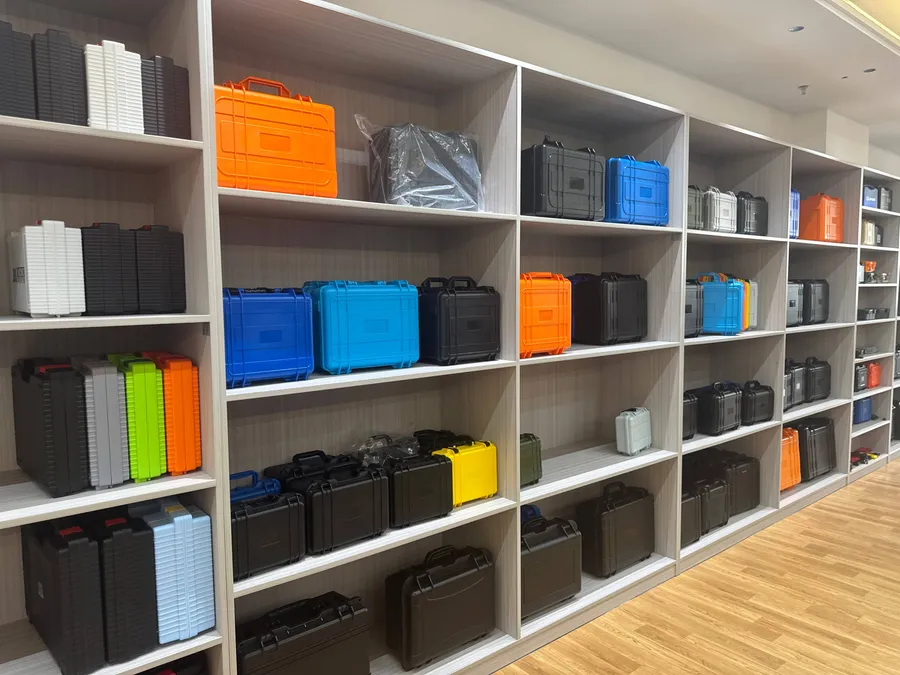
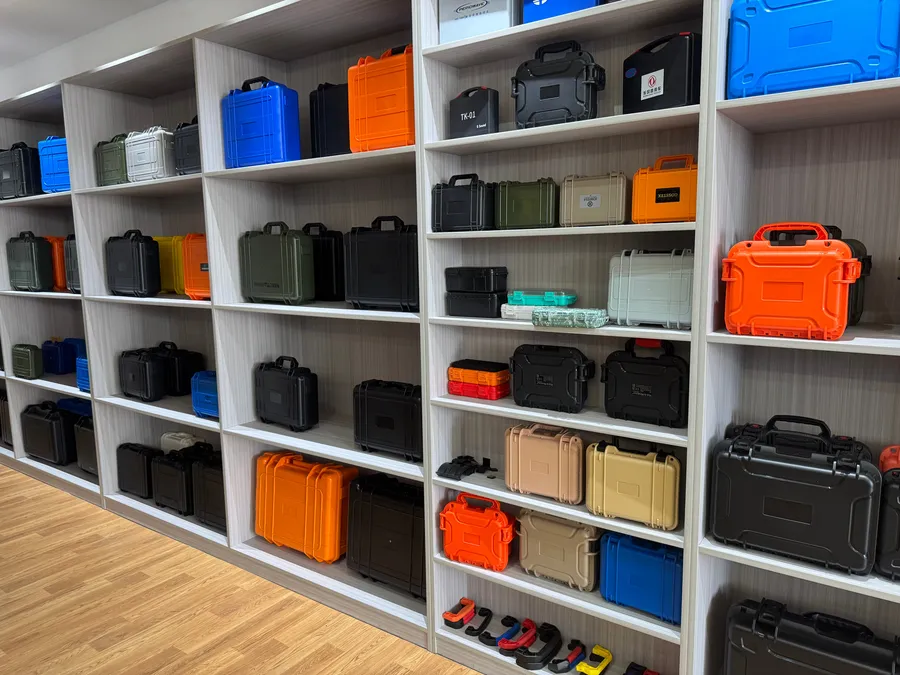
Custom hardware is recorded as available on all 155 listings alongside custom foam, colour, logo, packaging and private label, so most lock work is configuration: a different latch body in the existing position, a metal rather than polymer fitting, an added hasp for a second padlock, or a colour and marking change. Those sit inside the published commercial frame of MOQ 300 pieces for logo, colour and OEM work with a first sample on an existing mould in 45 days, 30 percent deposit and the balance after inspection.
What is not configuration is a change that needs moulded geometry the tool does not have: moving a latch point, adding a boss where none exists, changing the parting line, or integrating a lock body into the shell wall. Those are new-mould items, published at 125 days with MOQ from 3,000 pieces per component. The distinction is worth writing into the RFQ as a question, because an integrated lock requested late in a programme is a tooling decision with a four-month tail, and the same security outcome is usually reachable as configuration on a listing that already exists.
Applications: how the lock line differs by kit
For instruments and electronics in a service van, the closure usually has to seal first and deter second, so the enquiry should start from the 124 listings that state a seal and then fix latch count and spacing against the lid depth rather than the other way round. For ammunition and field storage, the padlock-through-latch pattern is the whole requirement and the interesting lines become stackability, which is stated as true on 136 listings, and the wall thickness your fitting goes into.
For law-enforcement and evidence work, the controlling fact is the key register rather than the hardware, which is exactly the part our file does not publish: ask for it as a drawing with a part reference and a supply term. For rolling deployments, remember that the 19 T Series listings share their wall with wheel and column bosses, so a new latch position competes with structure. For outdoor and tactical storage, note that 18 of the 31 unsealed listings sit in those two catalogues, which is often the honest answer to a request that assumes a lock and a seal come together.
Purchasing notes and acceptance at receiving
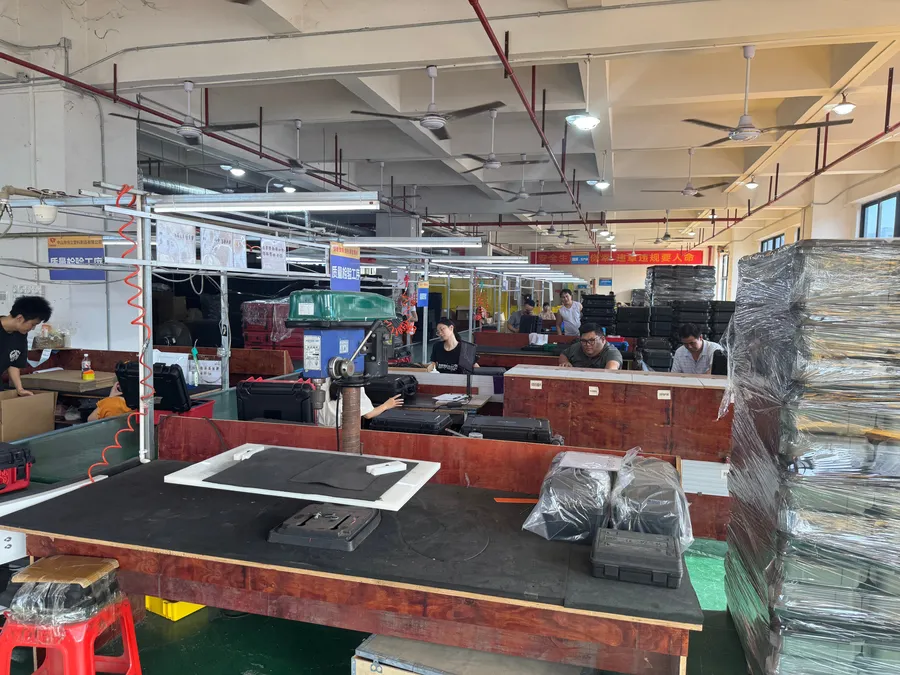
We work wholesale and OEM only, on EXW or FOB terms: we do not retail, we do not quote DDP, and we hold no overseas warehouse. The published minimum order figures are one piece for a standard listing and for custom foam, 300 pieces for logo, colour and OEM work, and 3,000 pieces per component for a custom mould, with first sample on an existing mould in 45 days and a new mould in 125 days. Freight planning for a closure change is quoted rather than assumed: pallet quantity in our file is recorded as not measured and is calculated from the carton footprint against your pallet size, carton data is published on 64 of 155 listings, and 20GP, 40GP and 40HQ figures are supplied with the quotation.
Two clauses close a lock specification at order stage. The receiving clause should read: latch count and position against the drawing, padlock shackle passage through the fitted latch body, lid closure without a visible gap on a sealed configuration, and no cracking around fastenings on the sampled shell. The documentation clause should name the evidence your procedure requires, because where a specification demands a rating we cannot show, we say so in the quotation and offer the honest path of accredited third-party testing of the ordered configuration as a separate priced work package with the method and the laboratory agreed before the work starts. Third-party factory audits are welcome, and naming the agency in the enquiry keeps the inspection hold inside the 45-day sample path instead of adding it afterwards.
What we do not publish about locks on any listing
So this page can be used as evidence, the negative list is explicit. For none of our 155 models do we publish a latch count, a lock type, a keyway, a combination mechanism, a hasp dimension, a supplied padlock, a fastener torque, a pull-out load, a cycle count, a latch material named to specification, or any ingress protection rating. Stack load and load capacity are recorded as not measured, and no drop height is claimed for any shell without a test record on that configuration. What we do publish is stated the same way on every model: the latch body accepts a standard padlock, hinges and feet are present, hardware is metal or polymer by configuration, and the seal is EPDM or equivalent compressible gasket as an option on 124 listings that state a seal.
Customisation
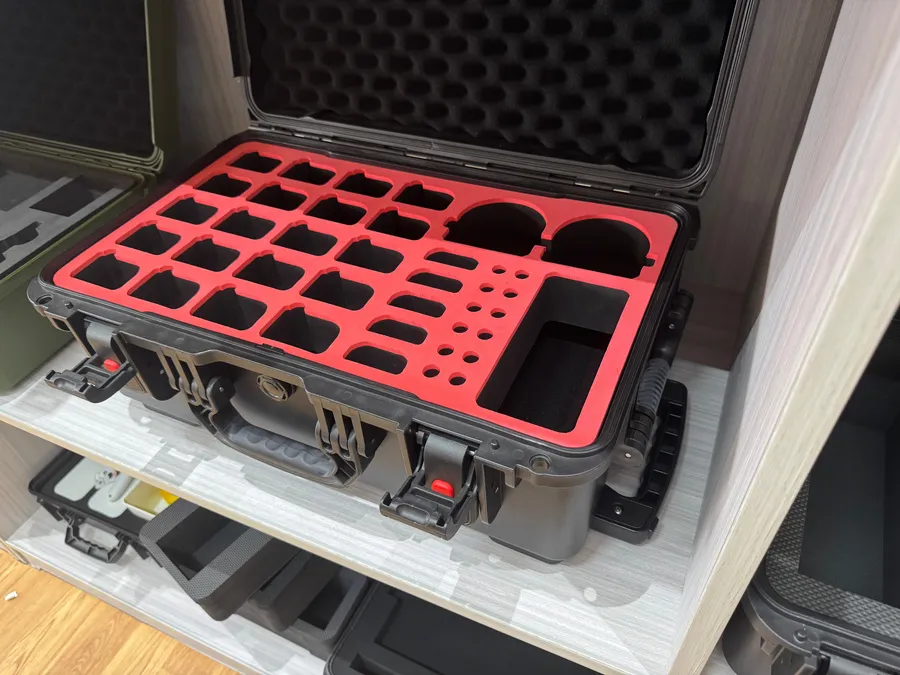
Everything described above is configurable on a standard shell: interior layout (pick-and-pluck, die-cut or CNC-cut), foam grade and thickness, colour, logo method, latch and lock count, pressure-equalisation valve, cable ports, document holder and identification plate. A bespoke exterior geometry requires a new mould — 125 days, from 3,000 units per moulded component.
Procurement considerations
| Question | What to send us |
|---|---|
| Which shell fits? | Equipment L × W × H as packed, plus required clearance per axis |
| What does it cost? | Order quantity and estimated annual quantity — the two drive different answers |
| Is tooling needed? | Whether an existing shell clears the envelope with usable foam depth |
| Lead time? | Your required delivery date, not just the order date |
| Certification? | The exact standard your tender names — we will say whether we can test to it |
| Freight? | Destination and preferred terms; carton and pallet data supplied with the quotation |
Comparison and selection guide
The tables on this page exist because a protective case is chosen by comparing three things: the envelope, the environment and the handling chain. Where no table applies, the rule below is.
| Situation | What To Do |
|---|---|
| Fastest | Standard shell plus CNC foam — typically 45 days from approved drawing. |
| Branded | Standard shell plus custom colour and logo — MOQ applies to the resin colour. |
| Bespoke geometry | New mould — 125 days, MOQ from 3,000 units per component. |
- Size on internal dimensions plus clearance, never on a product name.
- Choose the carrying method before the shell: it changes the series, not just the price.
- Specify the interior last, and decide up front whether the end user will reconfigure it.
How should case locks be specified in a protective case RFQ? relates to Logistics & Packing Guide. Related families: Custom Protective Cases / Military Protective Cases / Waterproof Cases / Ammunition Storage & Transport Boxes / Electronics Cases / Tactical Equipment Cases. Related sectors: field and industrial equipment. Continue in the Logistics & Packing Guide cluster.
This page is written from our own production data. If your requirement differs, send the dimensions and we will tell you which of the 155 models fits, or whether a custom route is needed.


