How do buyers compare case seals across protective case suppliers?
Buyers compare case seals by counting the fields a supplier actually states for the model being quoted, then by testing the closure that compresses the seal. On our own file of 155 published models the seal picture is flat and thin. A seal is stated as present on 124 listings and explicitly as none on the other 31, and every one of those 124 records the same value: a compressible gasket set in a continuous moulded channel. Nothing finer is published on any listing. No seal material, no cross-section shape, no durometer, no compression set, no service interval and no ingress figure appear anywhere in the file, and the protection field records an ingress code as not stated, quoting accredited testing per configuration instead. What you can compare today is what the seal works against: wall thickness is published on all 124 sealed listings from 3.0 mm to 6.0 mm with a median of 4.2 mm, versus 2.0 mm to 2.9 mm on unsealed shells, and lid depth on 100 of 155 listings runs to 320 mm. So a seal comparison is a drawing-and-order-text conversation, not a datasheet conversation. Take these publication counts to every supplier, demand the three geometry numbers, and write the seal details nobody publishes into the purchase order line, because a seal nobody described is a seal nobody has to deliver.
Key points
- A seal is stated present on 124 of 155 listings and explicitly none on 31; every sealed listing records the same value, a compressible gasket in a continuous moulded channel.
- Nothing finer is published: seal material, cross-section, durometer, compression set and service interval appear on 0 of 155 listings, so they belong in the order text.
- Seal presence splits our file cleanly on wall thickness: all 124 sealed listings sit at 3.0 mm to 6.0 mm, all 31 unsealed at 2.0 mm to 2.9 mm.
- Deep lids are sealed lids: all 11 listings with a lid of 200 mm or more publish a gasket, topped by KX-88442 at a 320 mm lid, 5.0 mm wall and 15,320 g net.
- No listing states an ingress code; the protection field records it as not measured, so hold suppliers to stated fields and a drawing, not to an IP-style number.
- A seal is only as good as the hardware that closes it: locks on 155, latches as a per-configuration count, hinges on 155, a pressure equalisation valve quoted per configuration and fitted on 0 listings.
What buyers are actually comparing when they compare case seals
A seal is the arrangement that keeps air, dust and splash out of a closed shell, and it is the specification line most often dressed up with adjectives. When buyers compare case seals across protective case suppliers they usually compare photographs and marketing words: whether a bead looks fitted, whether the page says watertight, whether a colour looks black or grey. That comparison is not wrong, it is just not decision-grade. The decision-grade version asks four questions in this order: does the datasheet state a seal at all for the exact model you are quoting, what does it actually say about the seal, what is the wall thickness the channel is moulded into, and what closes the lid hard enough to compress the bead. Two of those can be answered from our own file of 155 published models today; the finer seal detail and any ingress figure cannot be answered from any listing in it, and knowing which ones cannot is the whole skill.
The reason a stated field matters so much is that wholesale and OEM orders are placed against numbers, not against pictures. We supply wholesale and OEM only, on EXW or FOB terms, not retail, and a quotation line that reads seal present, continuous moulded channel, wall 4.5 mm is auditable at receiving inspection while a photograph of a black bead is not. A supplier who will not put a seal construction statement on the spec sheet is rarely the one who loses the argument at delivery; they are the one who never had a position to argue from.
The seal fields our own file publishes, and their publication rates
Count fields, do not read adjectives. Below is our own file counted out, which doubles as the benchmark you can hold any supplier to: which seal facts are realistic to ask for, and which ones you will have to create yourself in the order text because no catalogue in this trade carries them. On our listings the seal is recorded one of two ways on every model, and the wording is exact and repeated.
| Seal Field | Listings Stating It (Of 155) | How It Is Recorded In Our File | What To Ask Any Supplier |
|---|---|---|---|
| Seal stated as present | 124 | Compressible gasket in a continuous moulded channel, claim recorded as measured | Is that statement per SKU, or copied across a series? |
| Seal stated as none | 31 | None offered on this shell, claim recorded as not measured | Show me the line that says none, so I know what I am not buying. |
| Seal material (elastomer type) | 0 | Not recorded; bead material is a configuration answer | Which elastomer is on the drawing you are quoting? |
| Gasket cross-section (D, P, tubular, blade) | 0 | Not recorded on any listing | What profile seats in this channel, and at what squeeze? |
| Durometer and compression set | 0 | No such record exists for any model | Which of these two numbers is measured on this SKU? |
| Ingress / protection code | 0 | Protection rating recorded as not measured; no code is stated | Send the accredited test report for the configuration ordered. |
| Wall thickness at the channel | 148 (124 of them sealed) | Published per model; sealed shells 3.0 mm to 6.0 mm, median 4.2 mm | What wall does the channel form in on this SKU? |
| Lid depth the seal must close over | 100 | Measured split, 16 mm to 320 mm, median 97.5 mm overall | How deep is the lid, and is it guided as it closes? |
| Pressure equalisation valve | 0 fitted on a listing | Recorded as a configuration option on all 155, value empty | Is a valve on this build, or is it a separate line? |
| Seal service life or replacement interval | 0 | Not recorded; it is a maintenance-plan question, not a datasheet one | Is a spare bead a stock item for this build? |
Protective case seal types, and which question each one answers
This section is buyer education, not a product claim. Our listings state that a compressible gasket sits in a continuous moulded channel; they do not state which elastomer, profile or hardness it is, and we will not turn a general description into a specification. The families a buyer meets when comparing hard-shell seals are roughly these. A moulded-in-place bead pressed into a continuous channel is what our file records: the sealing face is the bead, the channel is a moulding feature, and the closing path is guided by the shell walls. A loose stick-on or drop-in gasket sits in a machined or clipped groove and is easier to replace but depends on the groove staying clean and the adhesive or retainer holding. A knife-edge or lip seal deforms a thin flap against a mating face and needs precise closure alignment. A double seal puts two lines in series so one can fail and the shell still resists, at the cost of tighter tolerance and higher cost.
What the seal works against: wall thickness
A seal channel is only as stable as the wall it is moulded into, and this is the field our file carries better than any seal description. Wall thickness is published on 148 of 155 listings, and it splits the file on the seal question almost perfectly: all 124 sealed listings sit between 3.0 mm and 6.0 mm with a median of 4.2 mm, while every one of the 31 unsealed listings with a published wall sits between 2.0 mm and 2.9 mm, median 2.2 mm. There is no unsealed model in the file at 3.0 mm or above and no sealed model below it. Read that as a design rule rather than a coincidence: a compressible bead has to be closed against a stiff rim, and thin shells simply do not give the channel a stable seat. At the heavy end KX-97227 pairs a 6.0 mm wall with a 10,000 g net and KX-6621 with a 6.0 mm wall at 6,420 g; at the light end the thinnest sealed shells such as KX-1905 and KX-3609 sit right at the 3.0 mm floor with 250 g and 900 g nets. If a supplier quotes you a seal on a 2.5 mm wall, that is the conversation to have before the sample, not after.
What closes the seal: lid depth, latches, locks and the hinge line
A compressible bead only seals if something presses the lid onto it evenly, and that something is the closure hardware, not the seal itself. In our file a lock is stated on 155 of 155 listings, a hinge on 155 of 155, and the latch as a count specified per configuration rather than a fixed number per model; a lid that closes under unequal latch load shows up first as a leak path far from the latch. The geometry that sets how hard the lid has to be pulled down is lid depth, published on 100 of 155 listings, 16 mm to 320 mm with a median of 97.5 mm. The two facts come together in our file: all 11 listings with a lid of 200 mm or more publish a gasket, and the deepest lids are rolling T-range shells such as KX-88442 (320 mm lid, 5.0 mm wall, 15,320 g) and KX-88337 (280 mm lid, 5.0 mm wall, 10,866 g). A tall sealed lid is a heavy lid, and a heavy lid hung on a hinge line and clamped by a few latches is the classic way an otherwise sound seal closes out of square. Compare a 38 mm shallow instrument lid against a 320 mm rolling lid and the closing question changes completely, even though the seal value on the datasheet reads the same.
Pressure difference: the seal problem nobody puts in the spec
Sealed shells create an opening and closing problem that is not a bead problem at all. After a temperature swing, the pressure difference across a closed gasketed lid can make the first centimetre of lift the hardest part of opening, and it can pull the lid toward the seal on the way down, so the bead is squeezed unevenly rather than squarely. That is exactly why a pressure equalisation valve exists as a configuration option in our file: all 155 listings record it as available per configuration, and 0 listings record a valve fitted to a specific model, because it is chosen at build rather than moulded into every shell. The seal-maintenance and valve articles on this site carry the reasoning in full, and if your fleet will see altitude, cold-soak or hot-deck cycles, the valve belongs in the order text long before a leak complaint does.
A seal comparison sheet you can send to every supplier
Put these six lines on one sheet, send the identical sheet to every supplier on your shortlist, and score the returns by how many lines came back answered for the exact SKU you intend to buy. Four out of six is a supplier with a seal specification. One out of six is a supplier with a seal photograph and a price.
| Line On The Sheet | Why It Decides The Purchase | Our Own File | Follow-Up Question |
|---|---|---|---|
| 1. Seal statement per SKU | A line-level statement is auditable at receiving; a series-level adjective is not | 124 of 155 listings state a continuous moulded gasket channel, 31 state none | Is that statement per SKU or copied across the series? |
| 2. Bead material and profile | Sets oil, ozone and temperature behaviour and the squeeze needed | 0 of 155 publish either, so both go in the order text | Which elastomer and which profile is on this channel? |
| 3. Wall thickness at the channel | Decides whether the channel holds the bead under closing load | Published on all 124 sealed listings, 3.0 mm to 6.0 mm | What wall does the channel form in on this SKU? |
| 4. Closure and latch alignment | Uneven clamping shows up as a leak path away from the latch | Lock and hinge on 155 of 155; latch count per configuration | How many latches, and where do they land relative to the channel? |
| 5. Ingress expectation | A number is a test result, not a catalogue adjective | 0 of 155 publish a code; accreditation is quoted per configuration | Which standard, and against this build or a sibling? |
| 6. Spares and serviceability | Determines whether a cut bead retires the case or costs one part | Custom hardware is available across all 155 listings | Is a replacement bead a stocked spare for this build? |
Where the seal comparison decides the choice
For electronics and instrument kits opened many times a day on a bench, dust and splash matter more than immersion, and a modest lid is fine: our sealed small shells KX-1905 (190 by 190 by 45 mm, 25 mm lid, 3.0 mm wall) and KX-3609 (360 by 310 by 90 mm, 40 mm lid) sit at the light end of the sealed group. For field equipment, survey gear and electronics that leave a vehicle, the case is opened in rain and sand and closed damp, so the wall and channel stability matter: KX-85427 (150 mm lid, 4.5 mm wall, 6,100 g) and KX-85726 (155 mm lid, 4.2 mm wall, 5,600 g) are typical. For long-equipment and heavy rolling shells the closing-square question dominates, and KX-88442 and KX-814641 belong to that conversation.
Customising seals: what changes on an existing mould and what needs a new one
Custom hardware is available on all 155 listings in our file, and the seal channel itself is a moulding feature. On an existing mould, the changes that do not move the sealing rim are configuration work: bead fitted to an already-moulded channel, colour, logo, and choosing a build that already runs a pressure equalisation valve. Changing where the channel sits, converting a continuous channel into an interrupted one around hardware, adding a second seal line, or moving the bead into a thinner wall are mould questions, because each one changes the sealing rim itself. The commercial frame is fixed and worth stating before anyone plans a launch, because seal upgrades are often quoted as if they were free. OEM on an existing mould quotes at 45 days to first sample with a MOQ of 300 pieces; a new mould runs 125 days with a MOQ from 3,000 pieces per component; custom colour and custom logo sit at 300 pieces. Payment is a 30 percent deposit with the balance against inspection before shipment, terms are EXW or FOB, we do not sell retail, we do not quote DDP and we hold no overseas warehouse. Third-party factory audits are welcome.
Procurement notes on case seals
Write the seal terms into the purchase order line rather than the email chain: stated present, channel described, wall thickness, lid depth, latch arrangement and alignment, whether a valve is fitted, and the spares arrangement. Order a seal spares kit per batch band you operate, because beads and any retainer are serviceable items and the cost of a spare is trivial against a shell taken out of service. At receiving inspection, close the lid on a gasketed shell, mark the bead with tape, reopen and check for a continuous, evenly flattened witness line all the way around; a broken or light patch is where water will go first. Mould flash in a channel is a tooling artefact that appears on the first shots after a maintenance cycle, which is exactly when a seal complaint is cheapest to raise. Our own file publishes pallet and container figures as calculated against your pallet size rather than as measured values, and the datasheet and catalogue pages carry the numbers that are stated, so send the drawing request with the quote request rather than after it. Fred Zhao and the KeXin Sales Team answer seal configuration questions on WhatsApp at +86 135 3588 0002.
What we do not publish about case seals
No listing in our file states a seal material, a cross-section profile, a durometer, a compression set, a service interval, an ingress code or a gross weight, and no listing publishes a CAD file per model. We do not add any of those to a page to make a seal look more specified than it is, and we do not let a seal description imply an ingress or impact figure that no record supports: our protection fields are recorded per model, and where nothing was measured the listing says so rather than borrowing a number from a sibling. What we do state is measured shell geometry - external and internal dimensions on all 155 listings, wall thickness on 148, lid and base depth on 100, net weight on 93 - plus the one honest seal statement the file carries. Where a compliance file needs more than that, accredited third-party testing against a standard of your choosing is quoted as a separate work package for the configuration you order.
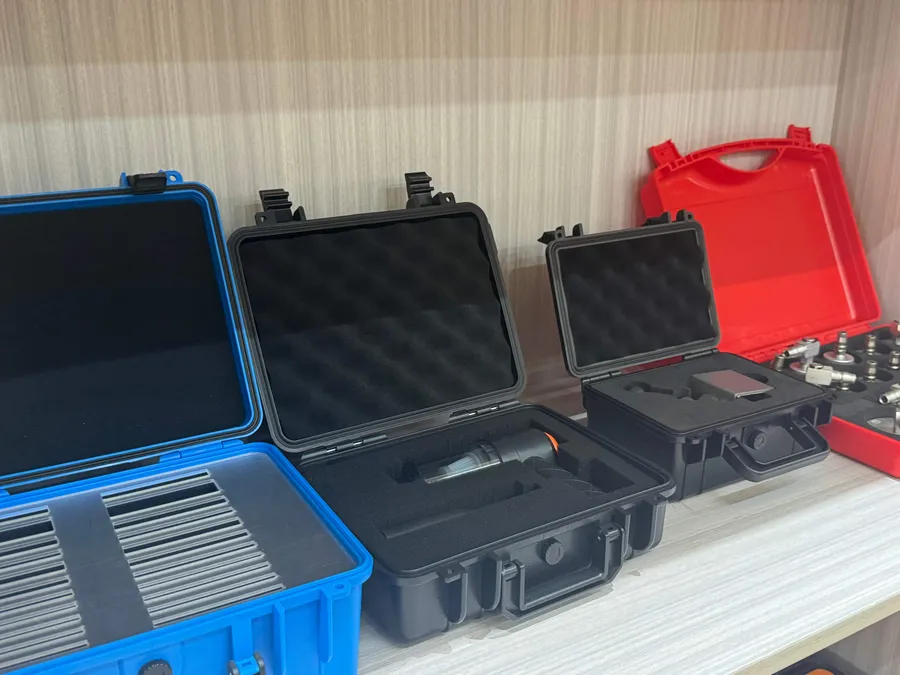
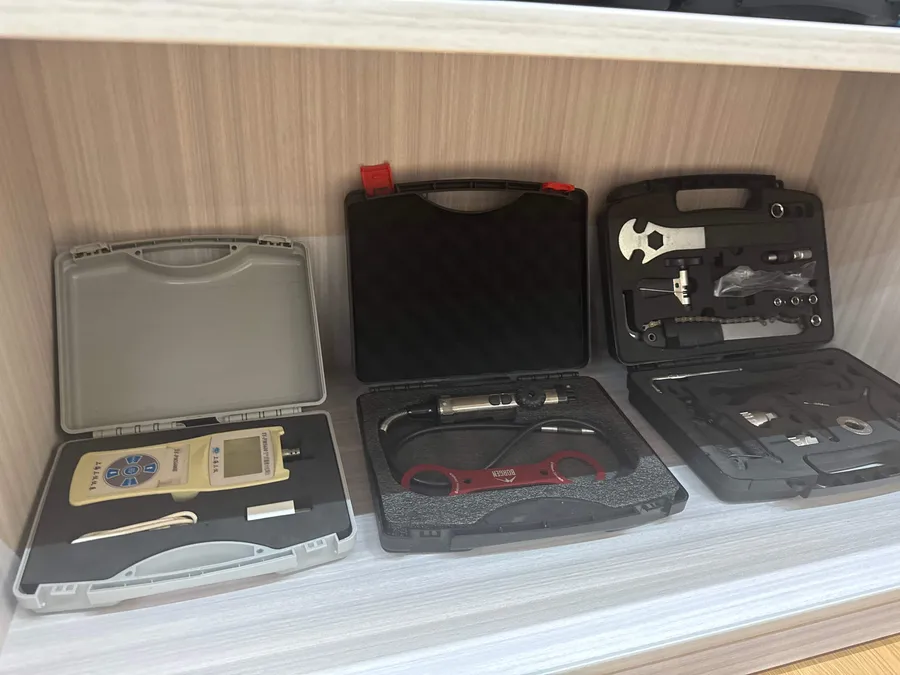
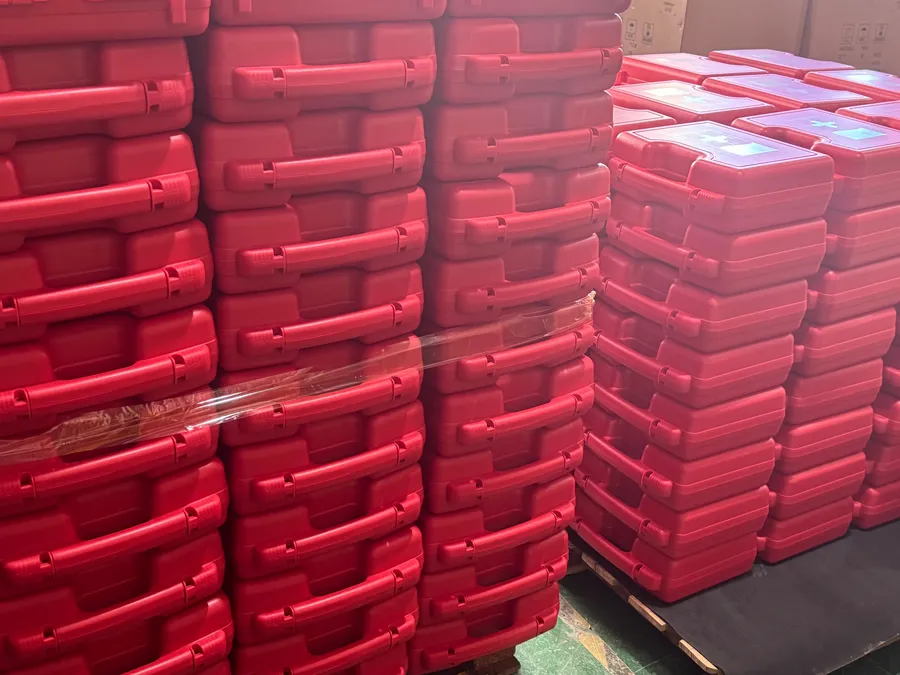
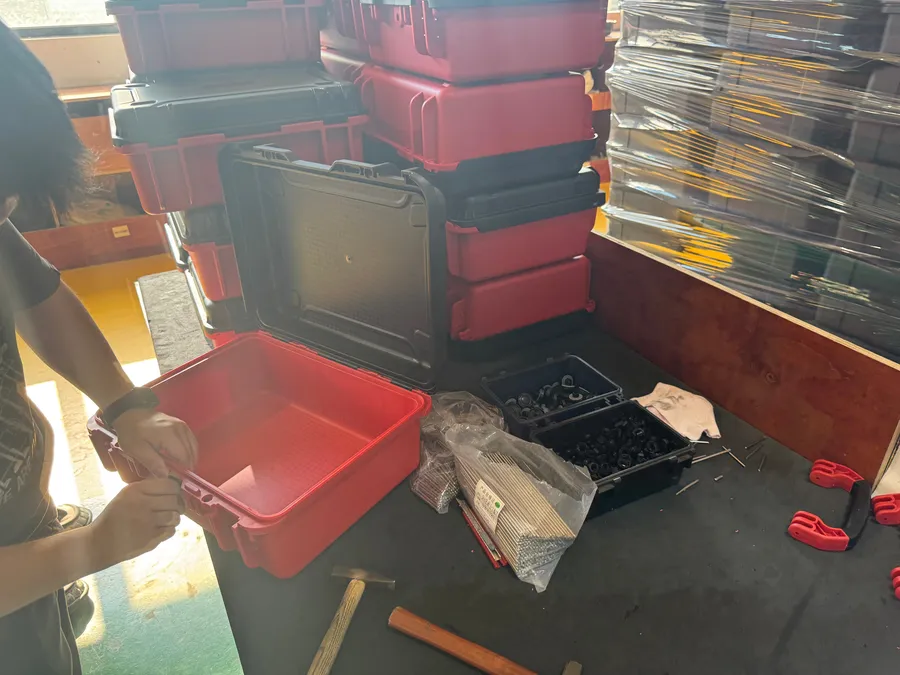
Customisation
Everything described above is configurable on a standard shell: interior layout (pick-and-pluck, die-cut or CNC-cut), foam grade and thickness, colour, logo method, latch and lock count, pressure-equalisation valve, cable ports, document holder and identification plate. A bespoke exterior geometry requires a new mould — 125 days, from 3,000 units per moulded component.
Procurement considerations
| Question | What to send us |
|---|---|
| Which shell fits? | Equipment L × W × H as packed, plus required clearance per axis |
| What does it cost? | Order quantity and estimated annual quantity — the two drive different answers |
| Is tooling needed? | Whether an existing shell clears the envelope with usable foam depth |
| Lead time? | Your required delivery date, not just the order date |
| Certification? | The exact standard your tender names — we will say whether we can test to it |
| Freight? | Destination and preferred terms; carton and pallet data supplied with the quotation |
Comparison and selection guide
The tables on this page exist because a protective case is chosen by comparing three things: the envelope, the environment and the handling chain. Where no table applies, the rule below is.
| Situation | What To Do |
|---|---|
| Fastest | Standard shell plus CNC foam — typically 45 days from approved drawing. |
| Branded | Standard shell plus custom colour and logo — MOQ applies to the resin colour. |
| Bespoke geometry | New mould — 125 days, MOQ from 3,000 units per component. |
- Size on internal dimensions plus clearance, never on a product name.
- Choose the carrying method before the shell: it changes the series, not just the price.
- Specify the interior last, and decide up front whether the end user will reconfigure it.
How do buyers compare case seals across protective case suppliers? relates to Logistics & Packing Guide. Related families: Custom Protective Cases / Electronics Cases / Military Protective Cases / Rolling Cases / Long Equipment Cases / Ammunition Storage & Transport Boxes / Field Equipment Cases / Instrument & Equipment Cases. Related sectors: field and industrial equipment. Continue in the Logistics & Packing Guide cluster.
This page is written from our own production data. If your requirement differs, send the dimensions and we will tell you which of the 155 models fits, or whether a custom route is needed.


