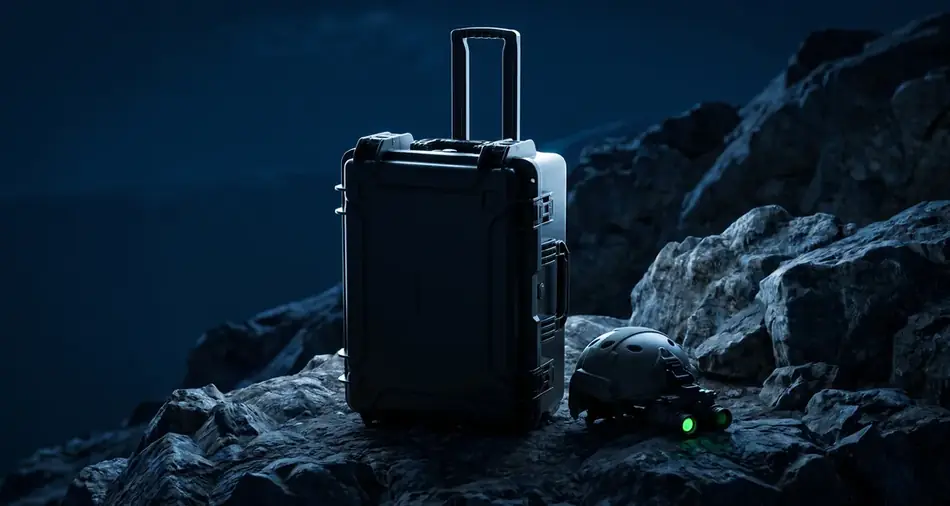
What are the common mistakes in case wheels for equipment transport cases?
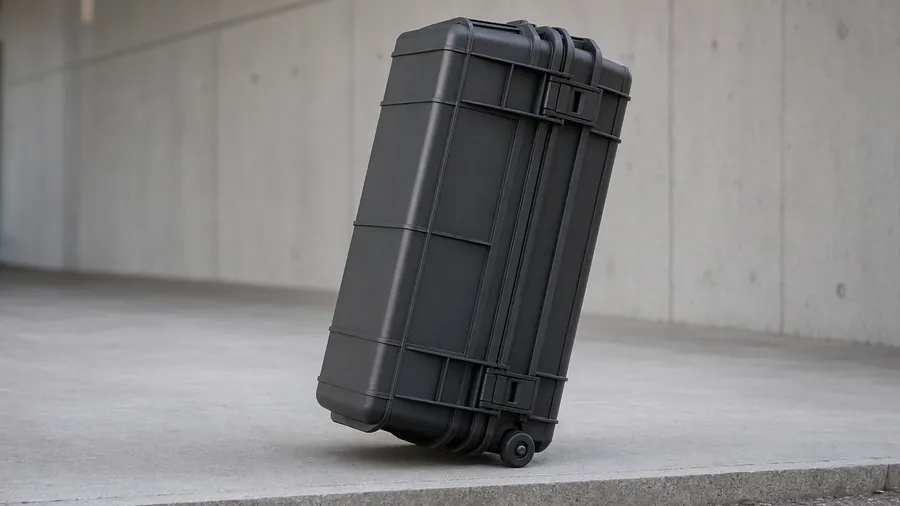
Six mistakes explain almost every complaint about wheeled shells: choosing case wheels from photographs instead of published fields, adding wheels to a case that has none without asking what the tooling says, assuming wheels cancel the lift, missing the raised handle in a rack or vehicle plan, keeping the stacking claim in the same quotation as the wheel option, and putting rolling hardware on shells whose length was never meant to track. Our published file settles each one with numbers. The wheel count is stated on all 155 listings - 2 on every one of the 19 T Series rolling shells and 0 on the other 136 - while diameter, wheel material, bearing, brake and per-wheel rating are stated on none of them. All 19 wheeled listings publish stackable as false and all 136 wheel-free listings publish true. The empty masses in the rolling range run from 4,912 g to 15,320 g with a median of 8,500 g, which is what an operator handles the moment a stair, kerb or soft surface breaks the route. The common mistakes in case wheels for equipment transport cases are therefore not random bad luck: each one substitutes an easy number, or a picture, for the published field that was recorded for the decision being made.
Key points
- Mistake one is a photograph: wheel count is published on 155 of 155 listings (2 on the 19 rolling shells, 0 elsewhere), while diameter, material, bearing and brake are published on none.
- Mistake two is tooling: adding wheels to a case that has none means cutting new bosses - a 125-day new mould at MOQ from 3,000 per component, not a 45-day configuration change.
- Mistake three is mass: all 19 rolling listings publish 4,912 g to 15,320 g, median 8,500 g, and the first stair, kerb or soft surface hands that number back to an operator.
- Mistake four is the plan: telescopic figures are published on 11 of 19 rolling models, from 240 mm to 485 mm; the eight blanks are open questions before a rack deck is cut.
- Mistake five is the quotation: all 19 wheeled listings state stackable false while all 136 wheel-free listings state true - a quote offering both describes a mould that does not exist.
- Mistake six is size: the rolling set stops at an 843 mm plan, while KX-814641 at 1,356 mm and KX-89616 at 956 mm are published wheel-free and stackable.
- All six are prevented by the same habit: ask which published number belongs to which model, which fields are measured and which are recorded as not measured, before the sample is approved.
Why mistakes in case wheels repeat across industries
Wheel mistakes follow the same pattern in electronics, medical, telecommunications and field programmes: a number that is easy to see gets used for a job it was never recorded for. The hardware photograph gets used for the component specification, because diameter and polymer are not in the frame. The wheel option line gets used while the stacking flag stays copied from the wheel-free sibling, because the two fields sit in different paragraphs of the same quotation. The internal cavity gets used while the raised handle stays retracted in the drawing, because rack sketches are made from shell dimensions. None of these are ignorance; they are substitutions, and they are all mechanical to prevent.
The prevention is a reading discipline rather than expertise. For every claim about the rolling behaviour of a case, name the published field behind it and the model it belongs to. Our file, 155 listings, is used below as the worked example - including the places where it is honest about being blank - because a specification written against stated fields survives receiving inspection, while one written against impressions does not survive its first kerb.
Mistake one: choosing case wheels from photographs instead of published fields
Choosing case wheels from photographs is the mistake that starts most of the others. A picture shows a shell at an angle with hardware that looks robust, and it states nothing a purchase order can enforce. The fields that can be enforced today, on our own file and on any competent catalogue, are a short list: wheel count, which is published on 155 of 155 listings as 2 or 0; handle record, with all 19 rolling shells stating a telescopic handle beside a fixed folding handle, and all 155 models stating feet and a padlock-ready latch body; and net mass, published on 19 of 19 rolling listings. The blanks are just as short: case wheel diameter, width, tread or wheel polymer, bearing type, brake, caster selection and load rating per wheel are recorded on 0 of our 155 listings.
Read the blanks honestly. A supplier whose catalogue fills five of those component lines has a bought-in wheel with a part number behind it, and is ahead of us on that field rather than showing off. What matters in a comparison is being told which figure was measured on the shell you are buying and which was copied from the wheel vendor's page, because the difference shows up as a seized bearing at month three or a wheel that will not clear the expansion joint at month one. Ask for the drawing pack, not the hero shot.
Mistake two: adding wheels to a case that has none without the tooling question
The second mistake is treating wheels as accessories that can be hung on any shell after the fact. Wheel bosses, the handle channel and the base geometry are cast in the mould: every rolling listing in our file is a T Series tool, and all 19 record the same handle configuration, telescopic plus fixed folding, from the factory. Adding bosses to a shell that was tooled without them, or moving a boss outside the gasket line, is new mould work - on our commercial frame that means about 125 days and MOQ from 3,000 pieces per component. Substituting an equivalent bought-in wheel on an existing fixing, changing hardware colour or adding bolt-on parts to moulded inserts is configuration work, quoted against OEM terms on an existing mould at 45 days to first sample from a MOQ of 300 pieces, with custom hardware recorded as available on all 155 listings.
The consequence buyers miss is that conversion is never only about the wheels. A two-wheel shell converted from a stackable tool loses the stacking rim, changes how the loaded interior tips on a long pull, and can put a new fastener line across the seal channel that the 18 gasket-stating rolling models rely on. When a retrofit conversation starts, the first question should be which drawing the delivered shells were built to, and the second should be what the change costs the fields you already approved.
Mistake three: assuming wheels remove the lift
The third mistake is the one that injures people: booking a rolling configuration and forgetting that a wheel only works while the ground agrees. Our 19 rolling listings publish empty shell masses from 4,912 g on KX-85021 to 15,320 g on KX-88442, a median of 8,500 g, and every one of those figures is before contents and foam. A stair, a kerb, a mud apron, a lift threshold or a vehicle tailboard ends the wheeled part of the journey and hands the whole loaded number to whoever is standing there. If the route has more than one interruption, the case should be priced as a lift and the wheels treated as a convenience between obstacles, not as the reason the order exists.
There is also a tilt geometry to respect. KX-88442 carries a 320 mm lid over a 44 mm base, so a loaded shell tilted onto its wheels keeps most of its usable cavity above the axle line - fine on smooth concrete, unwieldy on an edge. And mass alone does not require wheels: five wheel-free listings publish at or above 4,000 g (KX-6621 at 6,420 g, KX-6922 at 6,140 g, KX-65522 at 4,860 g, KX-5321 at 4,810 g, KX-5723 at 4,680 g) while staying stackable, and the smallest published shell in the catalogue, KX-1204, leaves the mould at 100 g. Match the hardware to the route, not to the anxiety.
Mistake four: the raised telescopic handle in the transport plan
The raised telescopic handle in the transport plan is a field most sketches simply omit, because it is invisible when retracted and it changes the envelope when it is not. Eleven of our 19 rolling listings publish a telescopic figure: five at 295 mm, two at 240 mm, two at 310 mm, one at 385 mm and one at 485 mm - the tallest published figure in the file, on KX-97227, whose shell itself stands 270 mm tall. Eight rolling models publish no figure at all, and the honest reading of an empty cell is an open question for the supplier, never a zero.
Put the raised number into every shelf pitch, rack deck, vehicle floor and lift doorway the case will meet, and check the hardware interaction at sample stage: the stages should latch cleanly at every height, the folded handle should still seat flat, and the latch line should clear the hinge with your actual interior fitted. The fixed folding handle beside it is not decoration - it is the grip the second person uses at exactly the moments the wheels stop helping.
Mistake five: wheels and the stacking claim that cannot both survive
Wheels and the stacking claim live in the same quotation, and in a careful catalogue they never both survive on one line. Our file is unambiguous: all 19 listings published with two wheels state stackable as false, and all 136 wheel-free listings state true. The correspondence is exact because the base that carries the wheel bosses and handle channel is not a base another case can rest on. A supplier who offers the wheel option while keeping the stacking sentence from the sibling model is describing a mould that does not exist - and the error is only discovered when the pallet plan fails at the forwarder, not when the sample arrives looking fine.
The freight picture follows the same logic. Six of the 19 rolling listings publish a carton, each recording one case per carton: KX-97227 at 715 x 515 x 280 mm, KX-96127 at 640 x 625 x 280 mm, KX-66232 at 620 x 465 x 355 mm, KX-96027 at 580 x 250 x 415 mm, KX-5126 at 520 x 405 x 270 mm and KX-85022 at 495 x 375 x 245 mm. The remaining thirteen record packing per order rather than copying a sibling figure; pallet quantity is calculated from the carton footprint against your pallet size, and 20GP, 40GP and 40HQ container numbers come with the quotation. Make every supplier state the stacking consequence on the same line as the wheel option, and read it as a freight decision, not a handle preference.
Mistake six: rolling hardware on shells that were never meant to roll
The sixth mistake is size-driven. The rolling set in our file spans 463 mm to 843 mm on the longest external axis; the wheel tooling stops there because a longer shell will not track straight through a doorway, an aisle or a vehicle side door, and the tilt angle puts the load further out from the operator. The two longest listings in the catalogue make the point deliberately: KX-814641 at 1,356 mm on its longest axis and KX-89616 at 956 mm are published without wheels and with stackable as true, because long equipment is a two-person lift at the folding handles.
The clearest teaching example is a shared footprint. KX-88442 and KX-88434 roll on an 843 by 592 mm base and state stackable as false, while KX-88421 keeps the same plan at 212 mm deep, publishes zero wheels and states stackable as true. Same footprint, opposite answer, decided per build. If a fleet needs rolling considered on a size the T Series tools do not reach, that is a new-mould conversation with the stacking and doorway consequences priced in - not an accessory request.
The six mistakes and the published checks, side by side
Run the table below as a pre-order checklist. Each row pairs one recurring mistake with the published field that replaces it, so a specification review can be finished before the purchase order is raised rather than argued about after the delivery.
| The Mistake | The Published Check Instead |
|---|---|
| Hardware chosen from photographs | Count written fields: our file states wheel count on 155 of 155 listings and diameter or material on 0 of 155 |
| Wheels treated as a bolt-on for any shell | Ask which moulding the batch is built to; new bosses are 125-day tooling at MOQ from 3,000, not an option line |
| The lift assumed away by the wheel option | Read net mass per model: 4,912 g to 15,320 g on the 19 rolling listings, median 8,500 g, contents extra |
| The raised handle missing from rack and vehicle sketches | Add the telescopic figure where published - 11 rolling models, 240 mm to 485 mm - and query the eight blanks |
| The stacking claim kept while wheels are added | Read stackable per model: 19 rolling listings false, 136 wheel-free listings true; only one can be true per line |
| Rollers specified for long equipment | Read the size ceiling: rolling stops at an 843 mm plan; the 1,356 mm and 956 mm shells are published wheel-free |
What we do not claim about wheels on any model
So that silence cannot be read as a claim, here is the explicit list of what this page does not assert about case wheels. No wheel diameter, width, tread or wheel polymer is published for any of our 155 models, so no rolling behaviour figure is implied here. No bearing type, brake, caster selection or load rating per wheel is recorded on any listing. No gross shipping mass is published on any model, and 62 listings publish dimensions without a net weight, so a packing number for those configurations has to be quoted, not assumed.
No protection grade belongs to a wheel or a rolling shell. Across the file the protection rating is recorded as not measured on all 155 models, stack load is recorded as not measured on all 155, no IP code is stated for any model, and impact notes are published with wall thickness stated and no drop height claimed. Anti-static and ESD questions are the same shape: no electrical figure for any wheel is published anywhere in the file, and a dissipative path would have to run wheel, axle, boss and shell in one continuous circuit to mean anything. Where a tender names a requirement we do not hold data for, we say so plainly in the quotation and price accredited third-party testing of the ordered configuration as a separate work package, with the method and the sample state agreed in advance.
Buying case wheels without the surprises: reading order and commercial frame
Fix the reading order and the six mistakes stop being available. First, map the route and count its interruptions; that decides whether rolling belongs in the specification at all. Second, read the published fields for the named model: count, handle record, net mass, gasket and stacking flag - and ask, in writing, for whatever the datasheet leaves blank instead of letting a sibling figure slide in. Third, put the raised handle into the rack, deck and doorway sketch. Fourth, price the freight consequence of the stacking flag on the same line as the wheel option. Fifth, order a spares kit per quantity band, because wheels, stanchion assemblies and grip covers are serviceable items and a spare costs almost nothing against a case that cannot move.
The commercial frame is fixed: we work wholesale and OEM or ODM only, quoted EXW or FOB, with no retail orders, no DDP terms and no overseas warehouse. OEM on an existing mould runs 45 days to first sample from a MOQ of 300 pieces; custom colour and custom logo sit at 300 pieces; a new mould runs 125 days from 3,000 pieces per component; payment is a 30 percent deposit with the balance after your inspection, and third-party factory inspection is welcome. Send the equipment dimensions, the route description and the mass an operator is allowed to handle, and the answer comes back with published figures for named models. Fred Zhao, KeXin Sales Team, WhatsApp +86 135 3588 0002. Written by KeXin New Materials (Guangdong) Co., Ltd.
Customisation
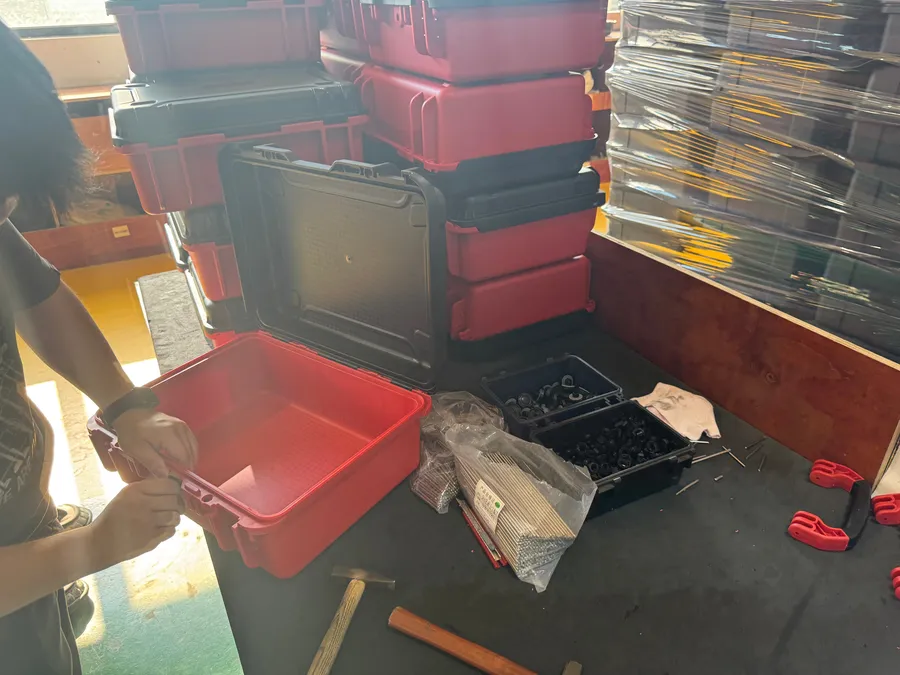
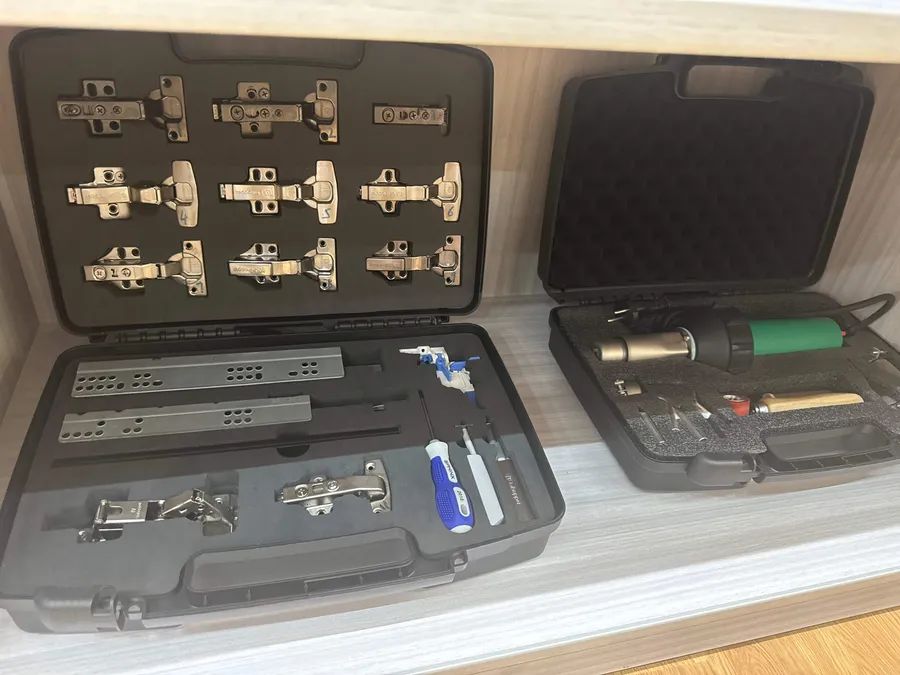
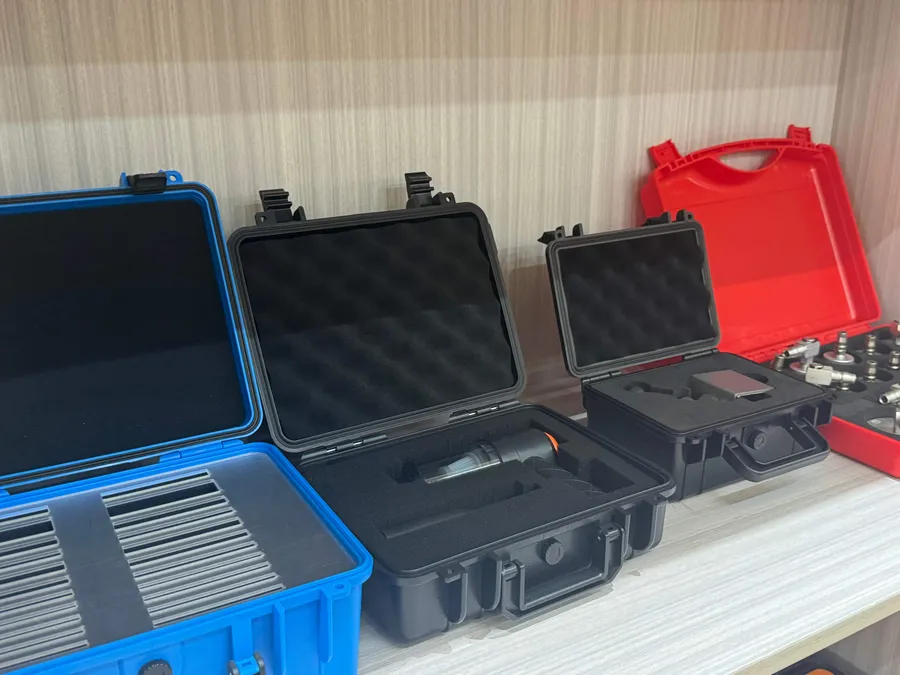
Everything described above is configurable on a standard shell: interior layout (pick-and-pluck, die-cut or CNC-cut), foam grade and thickness, colour, logo method, latch and lock count, pressure-equalisation valve, cable ports, document holder and identification plate. A bespoke exterior geometry requires a new mould — 125 days, from 3,000 units per moulded component.
Procurement considerations
| Question | What to send us |
|---|---|
| Which shell fits? | Equipment L × W × H as packed, plus required clearance per axis |
| What does it cost? | Order quantity and estimated annual quantity — the two drive different answers |
| Is tooling needed? | Whether an existing shell clears the envelope with usable foam depth |
| Lead time? | Your required delivery date, not just the order date |
| Certification? | The exact standard your tender names — we will say whether we can test to it |
| Freight? | Destination and preferred terms; carton and pallet data supplied with the quotation |
Comparison and selection guide
The tables on this page exist because a protective case is chosen by comparing three things: the envelope, the environment and the handling chain. Where no table applies, the rule below is.
| Situation | What To Do |
|---|---|
| Airport and road transfer | Check the external dimensions against cabin and boot constraints, not just the internal volume. |
| Rough ground | Larger wheels and a wider track matter more than shell volume. |
| Stored upright | Confirm the case can stand on its base with the handle retracted in your racking. |
- Size on internal dimensions plus clearance, never on a product name.
- Choose the carrying method before the shell: it changes the series, not just the price.
- Specify the interior last, and decide up front whether the end user will reconfigure it.
What are the common mistakes in case wheels for equipment transport cases? relates to Logistics & Packing Guide. Related families: Rolling Cases / Equipment Transport Cases / Military Protective Cases / Military Transport Cases / Custom Protective Cases / Medical Equipment Cases / Electronics Cases / Long Equipment Cases. Related sectors: field and industrial equipment. Continue in the Logistics & Packing Guide cluster.
This page is written from our own production data. If your requirement differs, send the dimensions and we will tell you which of the 155 models fits, or whether a custom route is needed.