How do buyers compare case weight across protective case suppliers?
Compare case weight only after you have agreed what the number is. A supplier figure may be the empty shell, the shell with its foam, the shell with a carton, or a delivered weight including pallet and packing, and those four can differ by a wide margin on the same product. Our own catalogue publishes a measured net weight for 93 of 155 models, and publishes no gross weight for any of them, so the honest comparison starts by asking which definition is on the sheet. Then normalise before you rank: divide the published mass by the published internal volume, because a 1,030 gram shell enclosing 15.9 litres and a 310 gram shell enclosing 0.8 litres are not the same design decision expressed in two numbers. Across the 93 weighted models that ratio runs from about 0.06 to 0.39 kilograms per internal litre, with a median near 0.13, which means two suppliers quoting the same external size can legitimately be three times apart in mass for reasons that have nothing to do with one of them cutting corners. Ranking raw grams without the volume, the wall figure and the hardware list is not a comparison, it is a coincidence.
Key points
- Ask which definition a weight figure uses: empty shell, shell plus foam, carton weight, or delivered pallet weight.
- Normalise by dividing published mass by published internal volume; our 93 weighted models run 0.06 to 0.39 kg per litre.
- Treat a lower gram figure as a design result to be explained, not an automatic saving, because wall thickness is usually the lever.
- Compare wall thickness and hardware on the same row as the mass, since wheels, seals and valves all add to the number.
- Confirm whether the figure covers a moulded family or one model, because per-model published numbers are the only auditable kind.
- Judge freight on carton mass and external volume, not on the net weight of the empty case.
Four numbers that all get called weight
The first is net shell mass, the empty case with its lid, handles, latches, hinges and feet, with no foam and no contents. That is the figure we publish per model where we have it, and it is the right number for judging how a case feels in the hand and what it adds to a load the team carries. The second is shell plus interior, which matters as soon as a custom foam cut is specified, because a dense base carrier and a pluck layer can add a noticeable amount that the net figure does not include.
The third is carton weight, which is what a forwarder quotes on, and the fourth is delivered pallet weight, which is what a receiving dock sees. We do not publish a gross weight for any of our 155 models, so a supplier who offers a single unlabelled gram figure is not giving you a worse number, they are giving you an unusable one. Asking one sentence, is that the empty case, settles more of the comparison than any amount of spreadsheet work afterwards.
Normalising mass before ranking suppliers
Absolute grams rank a catalogue by size, not by design. Take KX-706 at 1,030 grams and KX-62205 at 310 grams: the second looks less than a third of the first, yet KX-706 encloses 15.9 litres of internal space and KX-62205 encloses 0.8 litres, so per litre of protected volume KX-706 is about 0.065 kilograms and KX-62205 about 0.39. On that basis KX-706 is the far lighter design and the heavier-looking catalogue line is the efficient one.
Doing the same division across the 93 models with a published net weight gives a range of roughly 0.061 to 0.387 kilograms per internal litre with a median of about 0.131, and the spread is real rather than an artefact of rounding. The most efficient published example is KX-4616 at 1,395 grams around 22.8 litres, about 0.061 kilograms per litre, while the densest is the small ABS shell KX-62205 at 0.387. Normalise the other way as well: mass per external litre, which is the space a shipment actually occupies, runs from 0.053 kilograms per litre on KX-706 to 0.250 on KX-1204, with a median near 0.092.
Published figures side by side
| Model | Series | Net Weight G | Internal Litres | Kg Per Internal Litre | Published Wall Mm | Shell Material | Wheels |
|---|---|---|---|---|---|---|---|
| KX-1204 | 0 | 100 | 0.3 | 0.33 | 2.6 | PP | no |
| KX-2005 | 0 | 175 | 1.0 | 0.18 | 2.0 | PP | no |
| KX-3308 | 0 | 575 | 5.8 | 0.10 | 2.3 | PP | no |
| KX-62205 | 6 | 310 | 0.8 | 0.39 | 3.5 | ABS | no |
| KX-706 | 7 | 1030 | 15.9 | 0.065 | 2.1 | Engineering PP | no |
| KX-4616 | 0 | 1395 | 22.8 | 0.061 | 3.0 | PP | no |
| KX-6621 | 9 | 6420 | 48.9 | 0.13 | 6.0 | Engineering PP | no |
| KX-85021 | T | 4912 | 22.1 | 0.22 | 4.5 | Engineering PP | yes |
| KX-88442 | T | 15320 | 139.5 | 0.11 | 5.0 | PP | yes |
How to read a weight specification on two quotes
Put five fields on the same row for each supplier and each model: net mass, internal volume, wall thickness, shell material and hardware. Those are the levers that explain the mass, and without them a gram figure cannot be argued with. In our own table the models published with a wall of 3.0 millimetres or thinner have a median net weight of about 800 grams, while those published at 4.5 millimetres or thicker have a median of about 6,050 grams, but the second group is also a much larger case, which is exactly the trap this comparison is meant to avoid.
Read material the same careful way. ABS is the denser engineering choice and it shows: the 22 ABS models with a published net weight sit between about 0.11 and 0.39 kilograms per internal litre, with a median near 0.144, while the 29 engineering polypropylene models sit between 0.065 and 0.222 with a median near 0.118. Plain polypropylene spans 0.061 to 0.333 with a median near 0.127, because the plain PP group contains both the smallest boxes and some of the largest. Material shifts the number; it does not replace the per-model figures.
Hardware, wheels and the parts of the number you can see
A meaningful share of a published net weight is not shell at all. Every one of the 93 weighted models carries a fixed handle in its published hardware, and latches, hinges, feet, lock hardware and pressure valves are all counted in the same figure. Sealed models are heavier as a group: the 66 weighted models published with a seal available have a median net weight near 2,035 grams, against about 630 grams for the 27 published without one.
Wheels are the clearest step change. All 19 models published with wheels and a telescopic handle are T Series trolleys, and their median net weight is 8,500 grams against 1,200 grams for the 74 weighted models without wheels. That gap is the wheel housings, the frame and the handle columns, and it also buys the ability to move a 10 kilogram shell across a tarmac. The same figures explain why those 19 are published as not stackable while the 74 unwheeled models are published as stackable: a trolley is a logistics object shaped for one load at a time, not a brick in a wall of cases.
Where mass becomes the deciding constraint
Hand-carried field loads are the first place. A team carrying two cases a person, for eight or ten hours, is constrained by the combined shell and contents mass, and a lighter shell at the same internal volume means headroom for the equipment rather than for the box. Normalising is what makes the trade visible: KX-4616 gives 22.8 litres for 1,395 grams, while KX-85021 gives 22.1 litres for 4,912 grams, and the reason for the difference is on the specification row, with a 4.5 millimetre wall, wheels and a telescopic handle.
Mounted and racked installations push the constraint somewhere else, because there the mass of the empty case is a fixed cost that recurs in every vehicle and every rack position. Ammunition and stores handling goes the other way: a thick-wall box is bought to survive stacking in a store, and its mass is the evidence of what it is made of rather than an inconvenience. Wherever the load is a long body, the mass also changes how the case is carried, since a shell with an internal length near 1,280 millimetres is awkward at any weight and is usually specified against a trolley instead.
Custom work, where the weight is set on purpose
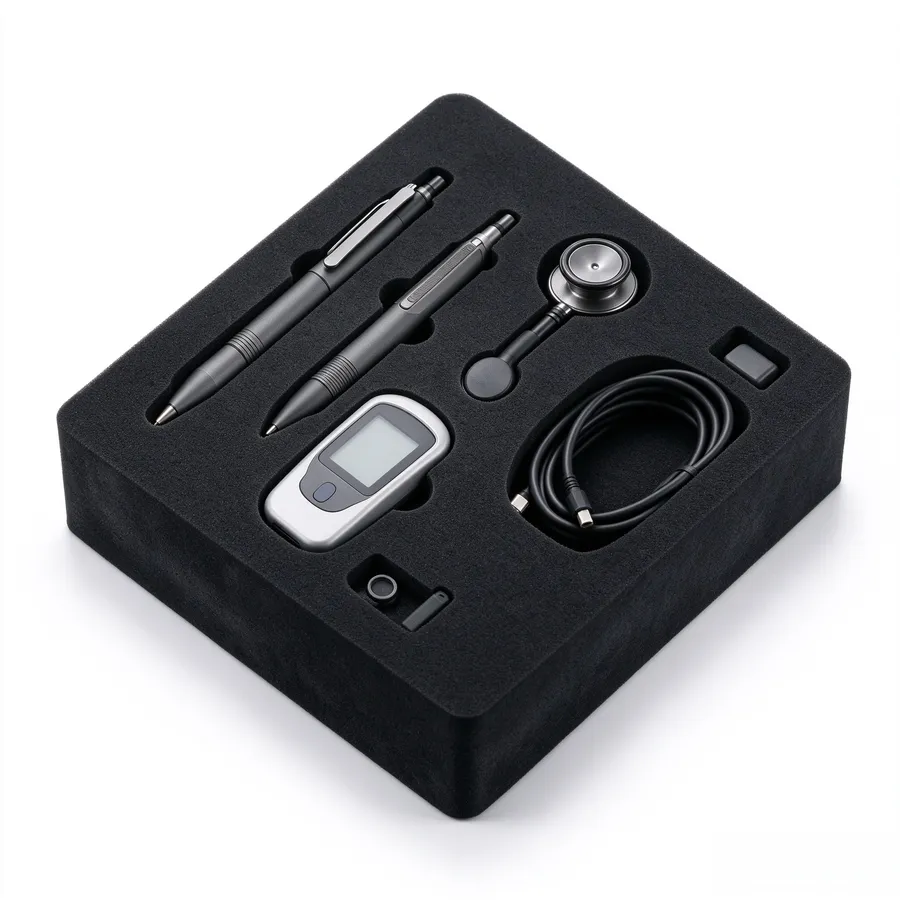
Weight is one of the few specification fields that a bespoke programme can dial deliberately. Starting from an existing tool, the levers are the interior rather than the shell, and the mass added by a custom foam cut is visible before the order is placed. On our terms a custom interior carries a minimum of one unit, while a logo or a colour change starts at 300 units, and a first sample against an existing mould runs about 45 days.
Where the target is a genuinely lighter case at the same internal volume, the conversation is about wall, rib pattern and hardware selection, and it ends in new steel. New tooling runs up to about 125 days and begins at 3,000 units, with a 30 percent deposit, because changing a shell mass changes the mould, not just the recipe. Either way the published figures are what make the programme checkable: internal and external dimensions and wall thickness per model, net weight where it has been measured, and no extrapolation of one model's number across a family.
Purchasing notes and the parts we do not publish
We work wholesale and OEM only, quoted EXW or FOB with a 30 percent deposit, without retail sales, DDP terms or overseas warehouse stock. Freight is therefore priced on your own shipment, and the mass figure that matters at booking is the packing mass, not the net weight of an empty case. Where a model publishes a carton size and a pieces-per-carton figure we can multiply it out: 40 units of KX-2005 at 175 grams is about 7.0 kilograms of cases per carton, and 3 units of KX-6621 at 6,420 grams is about 19.3 kilograms, both before the carton, the interior and the contents.
Two gaps are worth stating up front, because they are the ones that cause disputes later. We do not publish a gross weight for any model, and we do not publish pallet quantities or container loading figures, so a pallet plan has to be built from the published external dimensions and the carton data for the specific order rather than taken from a general table. And we do not state protection performance for a model unless it was measured for that model; mass, dimensions and wall thickness are published per model as measured, and anything beyond that is a separate request, not something a weight figure can be used to infer.

Customisation
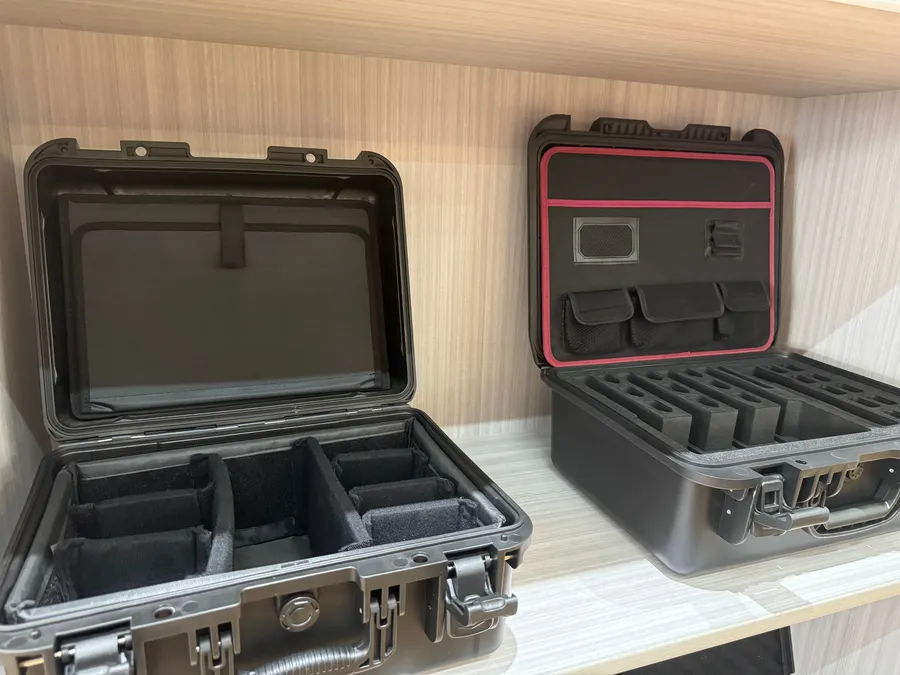
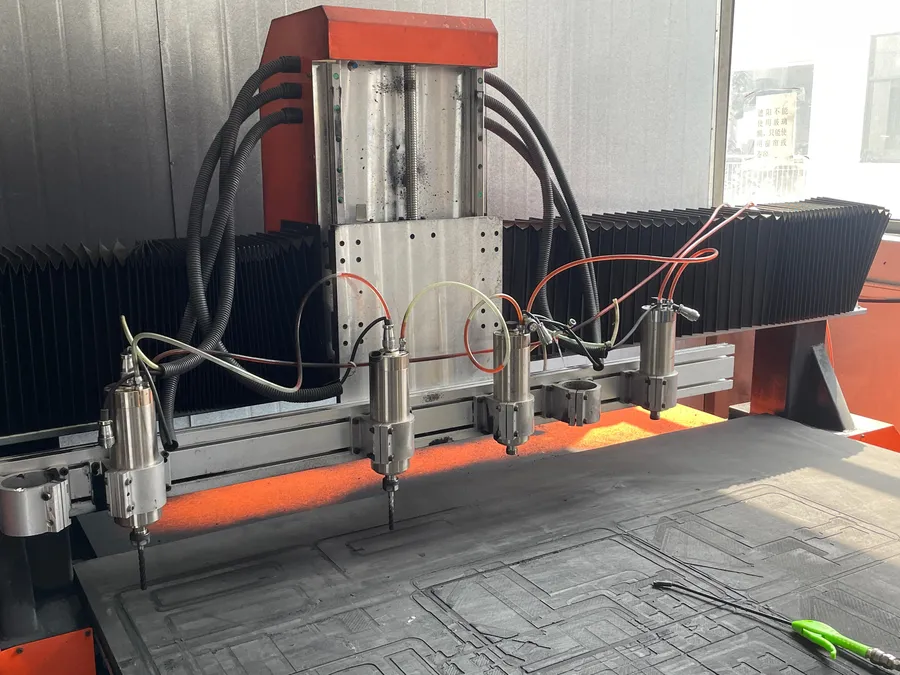
Everything described above is configurable on a standard shell: interior layout (pick-and-pluck, die-cut or CNC-cut), foam grade and thickness, colour, logo method, latch and lock count, pressure-equalisation valve, cable ports, document holder and identification plate. A bespoke exterior geometry requires a new mould — 125 days, from 3,000 units per moulded component.
Procurement considerations
| Question | What to send us |
|---|---|
| Which shell fits? | Equipment L × W × H as packed, plus required clearance per axis |
| What does it cost? | Order quantity and estimated annual quantity — the two drive different answers |
| Is tooling needed? | Whether an existing shell clears the envelope with usable foam depth |
| Lead time? | Your required delivery date, not just the order date |
| Certification? | The exact standard your tender names — we will say whether we can test to it |
| Freight? | Destination and preferred terms; carton and pallet data supplied with the quotation |
Comparison and selection guide
The tables on this page exist because a protective case is chosen by comparing three things: the envelope, the environment and the handling chain. Where no table applies, the rule below is.
| Situation | What To Do |
|---|---|
| Sea freight | Sealed configuration plus desiccant; salt spray is a handling issue, not a material issue. |
| Air freight | Mass and external dimensions drive cost more than volume. |
| Repeated movement | Replaceable latches, hinges and gaskets; keep a spares kit with the first order. |
- Size on internal dimensions plus clearance, never on a product name.
- Choose the carrying method before the shell: it changes the series, not just the price.
- Specify the interior last, and decide up front whether the end user will reconfigure it.
How do buyers compare case weight across protective case suppliers? relates to Logistics & Packing Guide. Related families: Equipment Transport Cases / Military Protective Cases / Rolling Cases / Custom Protective Cases / Outdoor Protective Cases. Related sectors: field and industrial equipment. Continue in the Logistics & Packing Guide cluster.
This page is written from our own production data. If your requirement differs, send the dimensions and we will tell you which of the 155 models fits, or whether a custom route is needed.