What affects case weight for a hard-shell equipment case?
Case weight is set by five things, in this order of how much they move the scale: the outside size of the shell, the wall thickness published for that shell, the shell material, the hardware built into it (handle, latches, hinges, feet, seal, and on wheeled models the wheel frame and telescopic handle), and the interior you order in front of it. On our own specification file the published weight of a finished empty case runs from 0.10 kg for the smallest model, KX 1204 at 120 x 90 x 40 mm, to 15.32 kg for the largest, KX 88442 at 843 x 592 x 415 mm, with a median of 1.48 kg across the 93 models that publish a net weight. Size dominates: across the 90 models that publish both a wall figure and a volume, external volume tracks published weight far more closely than wall thickness does, which is why two cases can enclose the same litres and still be a factor of two apart in grams. Before you compare any supplier's number, divide it by the external volume it surrounds.
Key points
- Five levers set the number: outside size, wall thickness, shell material, hardware and interior. Size is the biggest single lever.
- Across our 155 published models, 93 carry a measured net weight from 0.10 kg to 15.32 kg, with a median of 1.48 kg and no gross weight on any of them.
- Two cases enclosing 19.6 litres and 19.8 litres can weigh 1.03 kg and 2.10 kg; wall and material, not litres, explain the difference.
- Divide published grams by published external litres before you rank anything: our models run from 53 to 250 g per litre, median 92 g.
- Wheels are the clearest step change: the 19 models published with wheels and a telescopic handle have a median 8.5 kg against 1.2 kg for the 74 without.
- Wall thickness is not a strength certificate. Our file records no water or dust test result for any model, so a grade claim needs a lab report, not a gram figure.
- Weight is set on purpose in OEM work: interior changes run 45 days on an existing mould, a lighter shell means new tooling at about 125 days.
What affects case weight, in the order the grams actually arrive
The fastest way to argue about case weight is to name what is on the scale. The figure we publish per model is the finished empty case: shell, lid, the fixed handle that every one of our 155 models carries, the latches and hinges, the feet, and any seal or hardware fitted to that model. It is not the packed carton and it is not the case with your equipment inside. Five things move that number, and they do not move it equally. The outside size of the shell is the first, because a bigger body needs more material in every wall. Wall thickness is second and it multiplies with size rather than adding to it. Material is third: our file lists 94 polypropylene shells, 38 engineering polypropylene shells and 22 ABS shells, and ABS is the denser engineering choice at equal volume. Hardware is fourth and is the part buyers can order on and off. The interior is fifth, and it is the one that depends entirely on the foam layout you specify.
A useful sanity check you can run on any datasheet, ours or a competitor's: multiply the shell's outside surface area by the published wall thickness and divide the published weight by the result. Doing that arithmetic on the 90 models in our file that publish both figures gives a spread from about 620 to about 1,535 grams per square metre per millimetre, with a median near 1,020. The low end is a big thin shell; the high end is a small shell with heavy hardware and deep ribs. That spread is not a material certificate, it is a signal that the gram figure and the drawing disagree.
Hard shell equipment case weight across our published range
Our specification file covers 155 active models. 93 of them publish a measured net weight; the other 62, all of them in the 8 Series, publish dimensions but no weight, and for those the honest answer is to ask for the figure for that model rather than to borrow one from a neighbouring shell. No model publishes a gross weight, so nothing on our site should be read as a shipping weight. The published masses run from 0.10 kg to 15.32 kg, with a median of 1.48 kg and a mean of about 2.98 kg, and the shape of that distribution is worth a look before you set a specification.
| Weight Band | Models | What It Usually Is |
|---|---|---|
| Published net weight | Models in our file | Typical build in that band |
| Under 0.50 kg | 15 of 93 | Small PP boxes such as KX 1204 (0.10 kg) and KX 2005 (0.175 kg) |
| 0.50 to 1.00 kg | 17 of 93 | Compact shells such as KX 3207 (0.57 kg) and KX 62810 (0.90 kg) |
| 1.00 to 2.00 kg | 25 of 93 | The busiest band: KX 706 (1.03 kg), KX 4616 (1.395 kg), KX 3315 (1.67 kg) |
| 2.00 to 5.00 kg | 16 of 93 | Deep ABS and thick-wall shells such as KX 64114 (2.10 kg) and KX 64618 (2.775 kg) |
| 5.00 to 10.0 kg | 13 of 93 | Wheeled trolleys, from KX 85021 (4.912 kg) to KX 86830 (10.16 kg) |
| Over 10.0 kg | 7 of 93 | Large T Series trolleys, up to KX 88442 (15.32 kg) |
Case weight by size and wall thickness: which one moves the scale
Buyers usually ask about thickness first, but the data does not rank it first. Taking the 90 models that publish an external volume and a wall thickness together, external volume tracks published weight very closely, and wall thickness on its own tracks it loosely, because a 6.0 mm wall on a 323 mm box still produces a light case while a 4.5 mm wall on a 495 mm box produces a heavy one. Wall thickness multiplies with area: our published walls run from 2.0 mm to 6.0 mm across 148 models, median 3.9 mm, and the mass of the shell is roughly area times wall times the density of what it is moulded from. That is why the same material can appear at 1.03 kg and at 2.10 kg in two different bodies.
Height is the third number people forget. Median lid depth explains less of the weight than total volume does, but a deep lid adds wall area on four sides plus a larger parting line. On our file the 19 models that publish wheels also publish the heaviest masses, and the 11 models that publish a telescopic handle height list it between 240 mm and 485 mm of extension, which changes the envelope a forwarder sees without changing the case mass by much.
Same outside size, different case weight: five matched pairs from our file
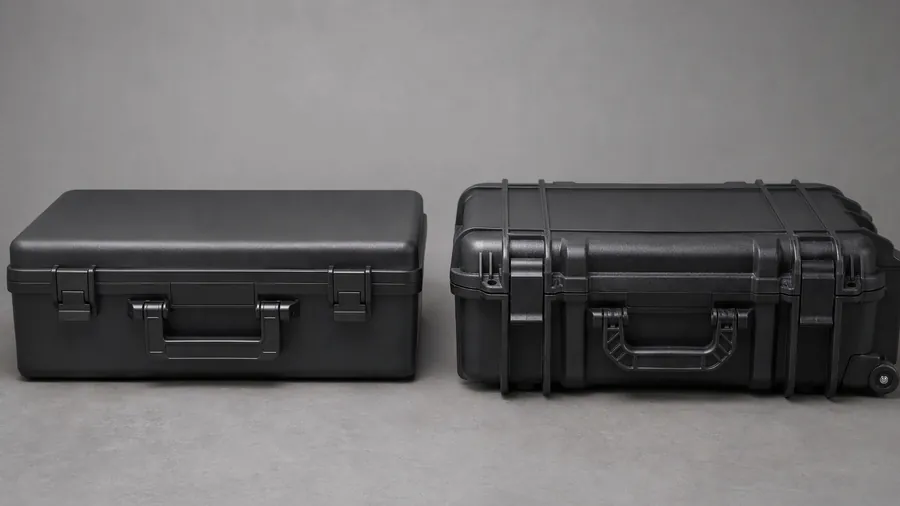
The pairs below have near-identical external envelopes, so litres cannot explain the difference. What separates them is wall thickness and shell material. Read them as a warning against quoting a weight target without the drawing that produces it: on the same footprint, an ABS shell at 4.0 mm can weigh roughly twice a thin engineering polypropylene shell, and the thicker case is not automatically the better one for your use.
| Model | External Mm | Wall Mm | Material | Net Kg | Litres |
|---|---|---|---|---|---|
| Model | External, mm | Published wall | Shell | Net weight | External litres |
| KX 706 | 450 x 330 x 132 | 2.1 mm | Engineering PP | 1.03 kg | 19.6 L |
| KX 64114 | 405 x 362 x 135 | 4.0 mm | ABS | 2.10 kg | 19.8 L |
| KX 707 | 470 x 360 x 148 | 2.5 mm | Engineering PP | 1.36 kg | 25.0 L |
| KX 64618 | 450 x 305 x 176 | 4.7 mm | ABS | 2.775 kg | 24.2 L |
| KX 3114 | 305 x 260 x 140 | 2.2 mm | PP | 0.675 kg | 11.1 L |
| KX 63612 | 356 x 267 x 120 | 3.5 mm | ABS | 1.30 kg | 11.4 L |
| KX 3218 | 315 x 260 x 180 | 3.0 mm | PP | 0.90 kg | 14.7 L |
| KX 3315 | 334 x 287 x 150 | 4.1 mm | Engineering PP | 1.67 kg | 14.4 L |
Protective case weight per litre: the normalisation that makes comparison possible
Absolute grams rank a catalogue by size, so they cannot compare designs. Dividing published weight by published external volume gives protective case weight per litre, and on our 93 weighted models that ratio runs from 53 g per litre (KX 706, KX 705 and KX 4616 sit at that floor) to 250 g per litre (KX 1204, a 100 g shell around 0.4 litres), with a median of 92 g per litre. Two suppliers quoting a similar box can therefore be several times apart in mass for legitimate engineering reasons, and a third can look efficient only because its datasheet omits the hardware.
Material is the clearest reason for the spread. Median published net weight is 0.90 kg across the 41 polypropylene models that carry a weight, 1.48 kg across the 29 engineering polypropylene models and 1.815 kg across the 22 ABS models, and part of that is size mix rather than density alone. Where we can hold volume roughly constant, ABS still sits heavier: KX 63612 at 11.4 litres publishes 1.30 kg against KX 3113 at the same 11.4 litres and 1.06 kg in engineering polypropylene, and the small ABS shell KX 62205 publishes 310 g against 250 g for KX 1905 at 1.6 litres.
Hardware, seal and wheels: the weight you can order on and off
A meaningful share of a published weight is not shell at all. Every model in our file is published with a fixed folding handle; latches, hinges, feet and the padlock-ready latch body sit in the same figure, and the hardware list is configurable, so latch count, shoulder strap, pressure valve and document holder are quoted per configuration rather than assumed. 124 of our 155 models publish a seal as available. Among the 93 weighted models, the 66 published with that option have a median net weight near 2.035 kg against about 0.63 kg for the 27 published without, though that gap is confounded with body size: the sealed group is also the larger group, so treat it as a correlation in our file, not as the mass of a gasket.
Wheels are the step change nobody should miss. All 19 models published with wheels are T Series trolleys with a fixed handle plus a telescopic pull handle, they carry wheel housings and a reinforcing frame, and their published weights run from 4.912 kg (KX 85021) to 15.32 kg (KX 88442) with a median of 8.5 kg, against 1.2 kg for the 74 weighted models without wheels. If the load has to cross a ramp or a car park that mass is worth carrying; if it goes on a shelf it is pure penalty. The same T Series bodies are published as non-stackable, which is a racking consequence of the frame rather than a weight number.
The interior, and the parts of the weight that are not our shell
Foam is where a specification gets dishonest. Pick and pluck, die-cut, CNC-cut, EVA, PE and EPE are all layouts we can supply, in top, base, egg-crate, layered or custom-cut form, and each one adds mass that is set by your drawing rather than by our mould. We publish no per-model foam mass, because a 20 mm base layer in one kit and a 50 mm CNC pocket in another are not the same order, so the interior mass is quoted from the layout you approve before production. Note also that usable interior volume is smaller than internal volume once an insert is fitted; on our file usable litres are published per model alongside the cavity, and the insert, not the shell, is what consumes the difference.
Does a heavier case mean a stronger case?
No, and this is the single most expensive misunderstanding in case weight. Mass is material times volume plus hardware; resistance to a drop, to a stack in a store, or to water ingress is a tested property that has to be demonstrated by a report, not inferred from a scale. Our file records wall thickness per model because that is a manufacturing fact we can measure, and it records no water or dust test result for any of the 155 models, because we have not run those tests on them. So a 2.775 kg ABS shell at 4.7 mm is not 'more protected' than a 1.03 kg engineering polypropylene shell at 2.1 mm; it is heavier, stiffer in one mode, and more expensive to fly. Where a thicker wall is bought deliberately, it is bought for stacking, for rack abuse or for tool handling, and the trade is carrying mass.
Two more traps sit in this question. First, ribs, hinge towers and lid depth can add grams without adding the property you wanted, which is why we ask what a weight is being spent on before agreeing to it. Second, two shells built to the same cavity can still publish different masses: KX 4318 and KX 4319 share the same 407 x 187 x 178 mm internal dimensions, the same 3.0 mm published wall and the same 38 plus 140 mm lid split, yet they publish 1.97 kg and 1.587 kg, because the hardware and the moulding actually fitted differ. That is a good argument for reading the model page rather than the series page.
What we do not claim about grades, tests and certificates
Buyers searching around case weight often arrive with a protection grade, a military standard, a drop height, an anti-static level or an explosion-protection scheme in the specification. Our position on this is blunt: none of our 155 models has a recorded water or dust test result, no grade or standard code is printed for any model, and we do not describe a shell as tested, approved or level-compliant without a report behind it. What a grade does mean is this: it is the outcome of a named procedure, run by somebody, on one configuration, on a date. So the question to put to any supplier, us included, is which laboratory ran it, which revision of which procedure, what condition the sample was in (bare shell, with gasket, with foam, with cable ports), and whether the report covers the model and size you are actually buying.
If a tender requires a specific grade, we say plainly whether we hold data for that configuration. Where we do not, we can quote accredited third-party testing of the exact configuration as a separate work package, with the sample built to the shipping specification, and we will tell you that the result describes that configuration only. What we will not do is convert a wall thickness or a gram figure into a protection claim, and we would rather lose the order than put an unmeasured code on a datasheet that an inspector later has to reconcile.
How to reduce case weight without changing the mould
If the target is grams rather than litres, the levers differ depending on whether the shell is already tooled. On an existing mould we can change the interior (a lighter foam layout or a thinner specified insert, quoted against your drawing), the hardware set (latch count, strap, valve, document holder), the seal option and the colour or logo programme; MOQ on our file is 1 unit for standard cases and for custom foam, 300 units for a logo, colour or OEM change, and first samples against an existing mould run about 45 days. What an existing mould cannot do is shed shell mass, because wall thickness is steel. That conversation ends in new tooling: about 125 days, MOQ from 3,000 units per component, 30 percent deposit with the balance after your inspection, EXW or FOB.
We work wholesale and OEM or ODM only, with no retail, no delivered-duty-paid terms and no overseas warehouse stock, and third-party factory audits and inspection agents are welcome on site. Send the equipment dimensions, the carrying method and the mass you are being asked to hit, and we will answer with published figures for the specific model, the model page link, and an explicit statement of which numbers are measured and which are not. Fred Zhao, KeXin Sales Team, WhatsApp +86 135 3588 0002. Signature: KeXin New Materials (Guangdong) Co., Ltd.
Customisation
Everything described above is configurable on a standard shell: interior layout (pick-and-pluck, die-cut or CNC-cut), foam grade and thickness, colour, logo method, latch and lock count, pressure-equalisation valve, cable ports, document holder and identification plate. A bespoke exterior geometry requires a new mould — 125 days, from 3,000 units per moulded component.
Procurement considerations
| Question | What to send us |
|---|---|
| Which shell fits? | Equipment L × W × H as packed, plus required clearance per axis |
| What does it cost? | Order quantity and estimated annual quantity — the two drive different answers |
| Is tooling needed? | Whether an existing shell clears the envelope with usable foam depth |
| Lead time? | Your required delivery date, not just the order date |
| Certification? | The exact standard your tender names — we will say whether we can test to it |
| Freight? | Destination and preferred terms; carton and pallet data supplied with the quotation |
Comparison and selection guide
The tables on this page exist because a protective case is chosen by comparing three things: the envelope, the environment and the handling chain. Where no table applies, the rule below is.
| Situation | What To Do |
|---|---|
| Fastest | Standard shell plus CNC foam — typically 45 days from approved drawing. |
| Branded | Standard shell plus custom colour and logo — MOQ applies to the resin colour. |
| Bespoke geometry | New mould — 125 days, MOQ from 3,000 units per component. |
- Size on internal dimensions plus clearance, never on a product name.
- Choose the carrying method before the shell: it changes the series, not just the price.
- Specify the interior last, and decide up front whether the end user will reconfigure it.
What affects case weight for a hard-shell equipment case? relates to Logistics & Packing Guide. Related families: Custom Protective Cases / Equipment Transport Cases / Tactical Equipment Cases / Military Protective Cases / Rolling Cases / Outdoor Protective Cases / Electronics Cases / Tool Cases. Related sectors: field and industrial equipment. Continue in the Logistics & Packing Guide cluster.
This page is written from our own production data. If your requirement differs, send the dimensions and we will tell you which of the 155 models fits, or whether a custom route is needed.


