What affects case gaskets for a hard-shell equipment case?
Six things govern the gaskets on our hard-shell cases, and only one of them is the rubber. The first is construction: 124 of our 155 published models record a compressible gasket in a continuous moulded channel as a measured fact, and 31 record that none is offered on that shell, so there is no such thing as a generic gasket claim across the range. The second is the section the channel is moulded in - every sealed listing publishes a wall of 3.0 mm or more, median 4.2 mm, while no listing published below 3.0 mm records a gasket at all. The third is the length of the run being loaded, computed from published plan dimensions at 700 mm to 3,020 mm on the sealed group, median 1,582 mm. The fourth is the closure, which our file records only as specified per configuration on 155 of 155 listings. The fifth is what the interior pushes back with, and the sixth is ageing: temperature, UV and dust are recorded as not measured on every model, and no cross-section, durometer, bead length, compression-set figure or service interval is published anywhere.
Key points
- A gasket on our range is a construction record, not a material claim: 124 of 155 listings state a compressible gasket in a continuous moulded channel, and 31 state that none is offered.
- The channel exists because of the wall: all 124 sealed listings publish 3.0 mm or more, median 4.2 mm, and every listing published between 2.0 mm and 2.9 mm records no gasket.
- Run length is the variable nobody quotes and everybody can compute: 700 mm on KX-62205 to 3,020 mm on KX-814641, median 1,582 mm, with 57 sealed listings at or above 1,600 mm.
- Closure load is unpublished by design: the latch line reads count specified per configuration on 155 of 155 listings, so gasket compression belongs in the order text.
- Deep lids are the interesting case, not the exception: 11 listings publish a lid of 200 mm or more and all 11 record a gasket, and five sealed listings have a deeper base than lid.
- Ageing is unmeasured, not assumed: temperature range, UV resistance and dust resistance are recorded as not measured on all 155 models, and no compression-set or service interval is published.
- Replaceability has no published answer: no bead length, cross-section, durometer, splice position or CAD profile exists on any listing, and a frame is recorded as none on 155 of 155.
What affects case gaskets, arranged by what actually changes the contact line
A gasket does only one job: it is squeezed enough, along its whole length, to turn a moulded joint into a contact line. Everything that affects case gaskets on a hard-shell equipment case therefore sits in one of six places - the channel that holds the bead, the wall that carries the channel, the length of the run, the closure that loads it, the contents that push back, and time. Our published file speaks to the first five with real numbers and to the sixth with a candid silence: it records what has been measured on each model and leaves unmeasured fields unmeasured rather than filling them with a family average.
That distinction matters when you read this page against a competitor datasheet. Where we quote a figure it is because it exists per model in our file of 155 active listings - external and internal dimensions, wall thickness, lid and base depth, net weight, internal and usable volume, seal record, hardware record. Where we describe a mechanism, we say it is a mechanism and not a result. Case gaskets for a hard-shell equipment case are usually discussed as if the elastomer decided the outcome; on a moulded thermoplastic shell the elastomer is the most forgiving part of the system and the geometry is the unforgiving part.
The one gasket statement our file makes, and the fields it leaves out
Across 155 listings there is exactly one gasket construction recorded as measured: a compressible gasket set in a continuous moulded channel, printed on 124 models. The other 31 carry an explicit none-offered record, held as not measured. Alongside that sits one material-family sentence - EPDM or equivalent compressible gasket - recorded as a manufacturer option on all 155 listings, which is why it appears even on shells that record no gasket. Everything a mender, a spares buyer or a validation engineer would normally ask for is absent by design: no cross-section, no bead length, no durometer, no compound grade per model, no splice position, no compression-set figure, no service interval and no CAD profile, which our file records as not published on every listing.
The practical reading is that our gasket data answers construction questions and defers performance questions. It tells you whether a given model has a moulded channel with a bead in it, and it tells you the section that channel is formed in. It does not tell you how long the bead is, how hard it is, how much it is compressed, or how any of that changes after two years in a rack. Those are the questions the rest of this page works through, variable by variable, with the published field attached to each one.
| Field In Our File | What It States | Coverage |
|---|---|---|
| Seal construction | Compressible gasket in a continuous moulded channel | 124 of 155 listings, recorded as measured |
| Seal construction | None offered on this shell | 31 of 155 listings, recorded as not measured |
| Seal material | EPDM or equivalent compressible gasket | Printed on all 155 listings as a manufacturer option |
| Wall section carrying the channel | 2.0 mm to 6.0 mm, 26 distinct values, median 3.9 mm | Published on 148 listings; sealed group 3.0 to 6.0 mm |
| Gasket cross-section, bead length, durometer | Not published | Absent from all 155 listings |
| Compression, closing force, service interval | Not published | Absent from all 155 listings |
| Pressure equalisation valve | Manufacturer option, no fitted value | All 155 listings, including the 124 gasketed shells |
| Frame or bolt-on sealing rail | None recorded | All 155 listings |
| CAD or profile drawing | Not published | All 155 listings |
| Waterproof, dust, UV, temperature, protection class | Recorded as not measured | All 155 listings; accredited testing quoted per configuration |
Variable one: the gasket channel and wall thickness it is moulded into
A channel is a local thinning of a wall. Form a groove into a moulded lid rim and you have changed the section that resists the closure, which is why the gasket record and the wall figure travel together in our file so cleanly. Of the 148 listings that publish a wall thickness, all 124 gasket models sit at 3.0 mm or above with a median of 4.2 mm and 18 distinct values, while every one of the 24 ungasketed listings that publishes a wall sits between 2.0 mm and 2.9 mm, median 2.2 mm, eight distinct values. Fifty-six listings publish 4.5 mm or more, thirty publish 5.0 mm or more, and 25 share the single value 5.0 mm. Sixteen sit exactly at 3.0 mm, which is the floor of the gasketed population - KX-1905, KX-3207 and the rest of the 3.0 mm group in Series 0 all record a moulded channel.
The seven listings that publish no wall figure at all - KX-84814, KX-84815, KX-84823, KX-84824, KX-95419, KX-6922 and KX-5126 - are also, without exception, in the group that records no gasket. That coincidence is worth reading carefully because it is the honest edge of the data: on those models we have published neither the section nor a sealing construction, and a buyer who wants a channel there is asking for a tooling conversation, not a part change. Where a wall figure exists, it is per model, and we do not generalise a 5.0 mm shell into a range-wide capability statement.
The gasket picture series by series, on published numbers only
The table reads the gasket record against the geometry that governs it, series by series. Run length is arithmetic, not a measurement: for each listing we add the two longest published external plan dimensions and double the result, which is the distance a bead has to hold. On the gasketed population it runs from 700 mm on KX-62205, a 222 x 128 mm lid, to 3,020 mm on KX-814641, a 1,356 x 154 mm long case, with a median of 1,582 mm; 110 of the 124 sit at or above 1,200 mm, 57 at or above 1,600 mm, 28 at or above 2,000 mm and six at or above 2,500 mm. Nothing in this table is a performance claim, and where a field is thin - lid depth is published on only 100 of 155 listings - that is shown as a coverage problem rather than smoothed over.
| Series | Listings | Gasket Record | Published Wall Mm | Derived Run Mm | Lid Depth Published | Interior L |
|---|---|---|---|---|---|---|
| 6 Series, mid-size equipment | 20 | 20 sealed | 3.0 - 5.3 | 700 - 1,368 - 1,970 | 1 of 20 | 0.8 - 37.1 |
| 8 Series, heavy-duty large | 62 | 58 sealed, 4 none | 3.3 - 5.0 | 970 - 1,584 - 3,020 | 33 of 58 sealed | 3.5 - 72.4 |
| T series, telescopic rolling | 19 | 18 sealed, 1 none | 4.2 - 6.0 | 1,666 - 2,126 - 2,870 | 14 of 18 sealed | 22.1 - 139.5 |
| 9 Series, deep-body heavy | 18 | 14 sealed, 4 none | 3.0 - 6.0 | 1,010 - 1,451 - 2,314 | 14 of 14 sealed | 4.5 - 48.9 |
| 0 Series, mini and compact utility | 23 | 12 sealed, 11 none | 3.0 - 3.5 sealed | 760 - 1,340 - 1,654 | 12 of 12 sealed | 1.2 - 22.8 |
| 1 Series, small protective | 7 | 2 sealed, 5 none | 3.0 - 3.4 sealed | 1,300 - 1,400 - 1,500 | 2 of 2 sealed | 6.6 - 10.7 |
| 7 Series, large equipment | 6 | 0 sealed, 6 none | 2.1 - 2.8 | 950 - 1,365 - 1,660 | 6 of 6 unsealed | 3.6 - 20.2 |
Variable two: the length of the gasket run on a case lid
Length is the variable that converts a good moulding into a leaking one. A 700 mm rim with two closures is a solved problem; a 2,870 mm rim is a distribution problem, and moulded thermoplastic does not stay flat over that distance at either end of the temperature range it will see in a vehicle or on a dock. Take one shared footprint in our file: KX-88421, KX-88434 and KX-88442 all measure 843 x 592 mm over the base, all publish a 5.0 mm wall, all record a moulded channel - and all three therefore carry the same 2,870 mm derived run. What differs is the lid: 145 mm, 240 mm and 320 mm, over a 44 mm base. Same bead length, three different lever arms.
Two consequences follow, and both are specification items rather than material ones. First, a long run needs the closure decision made explicitly, because the number of closures and their positions are the only thing that turns a channel into a pressure line - our file records that count as specified per configuration on 155 of 155 listings and as a number on none. Second, corners are where an unpublished tolerance shows up: at a moulded corner two walls meet, the bead path turns 90 degrees, and the elastic recovery on either side of the corner is not identical. Where a programme is sensitive to that, the right instrument is a closed-and-marked sample with a paper strip under the rim, not a paragraph about elastomer quality.
Variable three: the closure that actually loads the bead
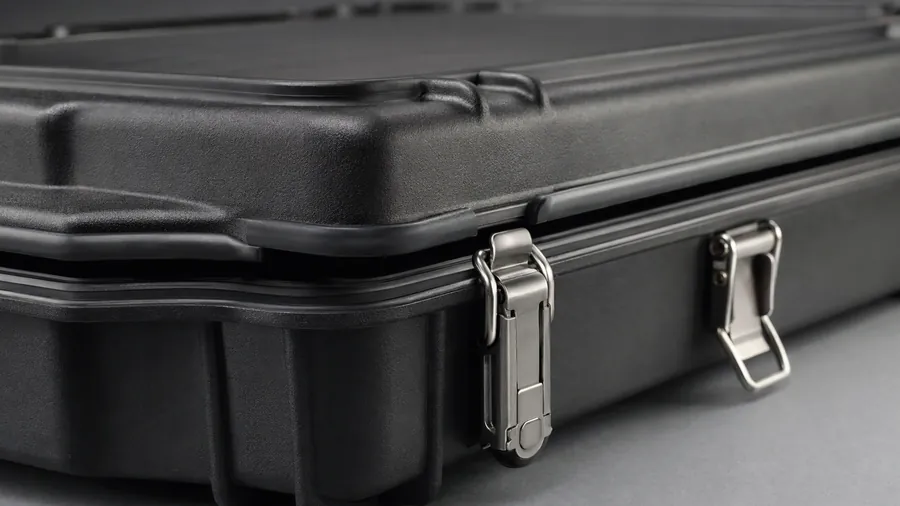
Nothing in a moulded channel pushes the gasket down; the lid is pulled onto it. Our hardware file is unusually clear about the limits of that statement. The latch line records a count specified per configuration on all 155 listings. The lock line records, as a measured construction fact on all 155, that the latch body accepts a standard padlock - which describes a hasp, not a security grade and not a compression figure. Hardware material is recorded as metal or polymer by configuration. Hinges and feet are recorded on every listing, and a frame is recorded as none on every listing, so there is no bolt-on rail whose bolt spacing could be read as the closure plan. Handles split 136 fixed-folding against 19 telescopic-plus-fixed, and it is the 19 rolling shells that carry the longest lids in the file.
The consequence for gaskets is that the pressure line is a drawing decision, not a catalogue attribute. A case with four closures at the corners of a 1,200 mm rim and a case with six closures at 400 mm intervals present the same channel record and the same bead, and they will not leak the same way after a year of handling. If the closure is what loads the seal, the closure is what has to be specified: count, position, whether every closure reaches its catch when the lid is laid down unassisted, and what happens if one is left open - which is the single most common field failure and the only one that is free to prevent.
Variable four: lid travel, deep lids and the shape of the rim
Lid depth is published on 100 of 155 listings, and on the gasketed group only 76 of 124 publish it, which is itself a fact worth knowing before a specification relies on it. Where it exists the range is wide: 25 mm to 320 mm on sealed shells, median 127.5 mm, against 16 mm to 92 mm and a median of 39 mm on the unsealed group. Eleven listings publish a lid of 200 mm or more and all eleven record a moulded channel - eight T-series rolling shells and three Series 8 shells - the deepest being KX-88442, whose 320 mm lid sits over a 44 mm base in a 5.0 mm wall. KX-97227 runs the opposite way at 6.0 mm wall, with 42 mm of lid over 168 mm of base.
That inversion matters more than it looks. Five sealed listings have a deeper base than lid - KX-4318 and KX-4319 at 38 and 140 mm, KX-5321 and KX-6621 at 43 and 149 mm, and KX-97227 at 42 and 168 mm - which means in those shells the bead is carried by the base wall and the lid comes down over it like a cap. A cap lid protects the bead from handling damage and from direct sun, and it changes what a cleaning cloth can reach. Where the lid carries the bead, the exposed element is the one that gets scuffed by a bench edge. Base depth on the sealed group runs from 15 mm to 168 mm with a median of 45 mm, and knowing which half of the joint carries the channel is a question any supplier should be able to answer in one sentence.
Variable five: the contents pushing back against the lid
A gasket is loaded by the difference between what the closures apply and what the interior resists. Our file publishes both volumes for every model, and on the gasketed listings the usable interior figure is smaller than the internal figure without exception - a median gap of 3.5 L across 124 listings, a minimum published gap of 0.1 L and a maximum of 27.9 L on KX-88442, whose 139.5 L internal volume leaves 111.6 L usable once the published foam allowance is taken out. Packing to the internal number is a way of holding the lid a few tenths of a millimetre off the bead along the whole run, which no compound can compensate for.
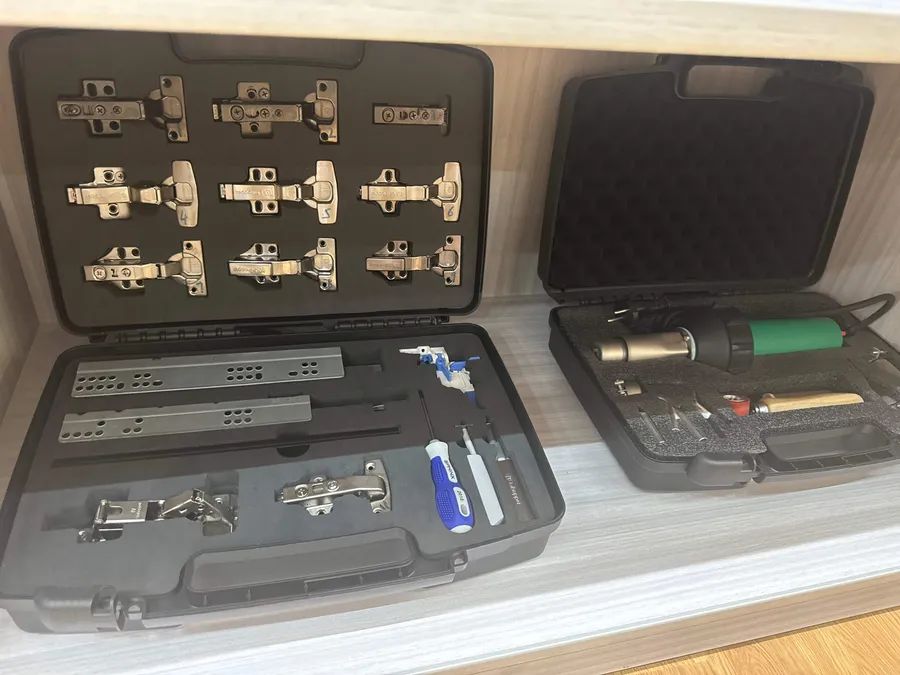
Two other interior facts belong in this variable. Foam is recorded as a configuration item on all 155 listings - cross-linked PE, EVA or EPS by zone, with pick-and-pluck, die-cut, CNC-cut and layered structures available, and a drawing, a photograph of the packed kit or a physical sample required to start - and shock protection is recorded as a manufacturer option rather than a property of the shell, because it depends on the layout, not the moulding. Cable and conduit pass-throughs are not recorded anywhere in our file, which means a penetration is a specification item you have to raise: a shell with a bead in its channel and a hole cut for a cable has a gasket and no sealing plan at the same time.
What makes a case gasket stop sealing: the ageing paths, and what we leave unmeasured
There are five credible ways a moulded-channel bead stops doing its job, and our published file answers none of them with a number, which is why this section is written as a mechanism rather than a result. The first is permanent set: an elastomer held compressed for months recovers less, so a case stored closed with the latches loaded, in a warm space, ages its rim faster than the same case stored open. The second is temperature: our file records a temperature range as not measured on all 155 listings, so low-temperature embrittlement and high-temperature softening are compound-family questions, not published model data. The third is light and air: UV resistance is recorded as not measured on every listing, and the EPDM family is named in industry precisely because of its behaviour in ozone and sunlight - a reason to ask which compound is being quoted, not a reason to assume one.
The fourth is contamination and abrasion: grit in a channel is a wear mechanism, and dust resistance is recorded as not measured across the range, so the honest statement is that a dirty rim is a leaking rim long before any rating is involved. The fifth is mechanical damage at the exposed edge, which is why the lid-carries-the-bead versus base-carries-the-bead question above is worth asking. What our file does record as measured is corrosion resistance, on the straightforward ground that a thermoplastic shell has no ferrous path to corrode - a hardware and channel question rather than a rubber one, but one that quietly decides how long a joint stays true. Where a programme needs an ageing figure, we do not infer one; we quote accredited testing against a method the customer names.
Variable six: what a protection class does to a gasket specification
Ingress protection classes, military-style environmental standards, explosion-protection markings, static-dissipative grades and air-drop performance all appear in tender language about gaskets, and none of them is a construction attribute. Our file records a protection class as not measured on all 155 listings and states plainly that no IP code is printed for any model, with accredited testing quoted per configuration. The impact note follows the same discipline: it publishes the wall figure and refuses a drop height without a test. A gasket therefore tells you what the joint is built from; a class tells you what somebody measured, under which condition, following which procedure.
When a class appears in your specification, four questions turn it into something you can buy: which published test method and revision is being invoked, which condition and duration - spray, immersion, dust concentration, cycle count - was actually applied, which laboratory ran it and what is the report number, and whether the item tested was a production unit or a prepared sample with the bead installed the way yours will be. A supplier who cannot answer those four has not tested anything, whatever the datasheet says. If your programme needs the evidence, name the method and we will quote accredited third-party testing on the configuration being ordered, and state clearly which items we have not tested.
Can a case gasket be replaced, and what that answer costs
On a moulded channel, not from a catalogue. Nothing in our file supports a spare-part order: there is no cross-section, no bead length, no durometer, no splice position, no part code and no CAD profile, which is recorded as not published on all 155 listings, and a frame is recorded as none on every model - so there is no extruded rail to unbolt, exchange a profile in and torque back. The bead is held by the shape of the moulding, and the moulding is what determines whether an element can be lifted out and another put back with any confidence that the contact line survives.
What we can do is answer the same need from the other direction. Send the model number, a photograph of the channel and a piece of the existing bead if it is still in place, and we will tell you whether that shell can be restored to its published construction, whether the answer is a closure adjustment, or whether the requirement is really for a field-replaceable element - which is a tooling change on a new mould at 125 days with a minimum of 3,000 pieces per component, or a modification on existing tooling quoted with the 45-day OEM first article. That is a longer sentence than a spare-part number, and it is the honest one.
The gasket variables, the published field, and the question for any supplier
Use the table as a specification walk-through. The middle column is only ever something our own file publishes; the right-hand column is what settles the same variable with another manufacturer. If a supplier cannot fill the right-hand column for a model number you are actually buying, the gasket conversation with them is not finished, whichever compound name appears in their datasheet footer.
| Variable | What Our Published File States | What To Ask Any Supplier For |
|---|---|---|
| Construction of the joint | Compressible gasket in a continuous moulded channel on 124 listings; none offered on 31 | The seal record for that exact model number, stated as measured or as an option |
| Wall carrying the channel | Sealed listings publish 3.0 to 6.0 mm, median 4.2 mm; nothing published below 3.0 mm records a gasket | Section drawing or wall figure at the rim, per model |
| Length of the run | Derived from published plan dimensions: 700 to 3,020 mm, median 1,582 mm | Bead length and splice position, or an admission that neither is published |
| Closure that loads the bead | Latch count recorded as specified per configuration on 155 of 155 listings | Count, position and closing sequence in the order text |
| Lid travel and rim shape | Lid depth published on 100 of 155; sealed group 25 to 320 mm; 11 listings at 200 mm or more, all gasketed | Lid and base depth for the height you are buying, not the series |
| Interior load against the lid | Usable volume below internal volume on every sealed listing; median gap 3.5 L, largest 27.9 L | Foam layout against the usable figure, signed off on a packed sample |
| Ageing of the elastomer | Temperature range, UV resistance and dust resistance recorded as not measured on all 155 | Compound datasheet, plus an aged test report if your specification needs one |
| Protection class in a tender | No IP code stated; protection class recorded as not measured; accredited testing quoted per configuration | Method, condition, laboratory and report number |
Which shells carry no gasket, and what that means for selection
The 31 listings that record none offered on this shell are not rejects or old stock; they are current models chosen for a different job. All six Series 7 large-equipment shells sit in this group, walls published from 2.1 mm to 2.8 mm, interiors from 3.6 L on KX-701 to 20.2 L on KX-707 at 470 x 360 x 148 mm. So do five of the seven Series 1 shells, including the 466 x 387 mm family - KX-4710, KX-4713 and KX-4716 at 102 mm, 132 mm and 162 mm high - each publishing a 2.5 mm wall and an internal width of 345 mm that narrows to 308 mm at the nudge. Eleven of the 23 compact Series 0 shells are unsealed, KX-1204 and KX-2005 among them, and four Series 9 shells, four Series 8 shells and one rolling T shell, KX-5126, complete the list.
Read as a selection rule, that distribution says something useful: the unsealed population is where light tooling, thin sections and low net weight live - unsealed listings that publish a weight run from 100 g to 6,140 g with a median of 630 g, against 250 g to 15,320 g and a median of 2,035 g on the 66 gasketed listings that publish one. If a programme needs a cheap, light, open-handling box for interior movement, an unsealed shell is the right answer and pretending otherwise wastes money on a channel nobody uses. If the programme needs a dust line at a rack, the wall section that carries the channel is the reason to move up a series - and the seal record on the model number is the only field that decides it.
Specifying a gasket on an OEM order: configuration, tooling change, or new tool
Three requests get conflated. Choosing a model whose listing already records a moulded channel is a selection. Changing what is fitted to an existing tool - closure type and count, hardware in metal or polymer, colour, a lockable variant, a pressure equalisation valve, the compound quoted against an exposure you have named - is a configuration, and an OEM first article on existing tooling leads at 45 days with a minimum order of 300 pieces for logo, colour or OEM work. Changing the moulding, which is what forming or removing a channel or engineering a field-replaceable element actually means, is a new tool: 125 days and a minimum of 3,000 pieces per component, agreed against a drawing or a physical sample.
The line we will not cross is a promise that a bead pressed into a moulding never formed to hold one will behave like a gasket, or that a compound name in an email can substitute for a test. KeXin New Materials (Guangdong) Co., Ltd. works wholesale and OEM or ODM only, on EXW or FOB terms, without retail, DDP or an overseas warehouse. Payment is 30 percent deposit with the balance after inspection, and third-party inspection and factory audits are welcome. Pallet and container figures are calculated from the carton footprint against your pallet and supplied with the quotation; 64 listings publish pack data, 58 publish pieces per carton, nine of them a single case per carton.
Procurement notes: the seven lines to write into a gasket enquiry
First, the exact model number, not the series name, with its seal record quoted back to you. Second, the wall figure at the rim, or a written statement that no wall figure is published for that listing - which applies to seven models in our file. Third, the closure plan: count, position and sequence. Fourth, the exposure you actually have - stored closed for months, vehicle vibration, marine atmosphere, machine-shop coolant, direct sun - so the compound conversation starts from a condition rather than from a datasheet footer. Fifth, the foam layout against the usable volume figure, agreed on a packed sample.
Sixth, any test the programme needs, with method, condition, laboratory and who pays. Seventh, the pack and pallet basis for your order quantity, since a gasket decision and a logistics decision interact: 18 gasketed listings are recorded as non-stackable, all of them telescopic rolling shells, and stack load is recorded as not measured on all 155 models, so a stack plan that loads a lid is loading something we have not measured. Send the list to Fred Zhao or the KeXin Sales Team, WhatsApp +86 135 3588 0002, and you will get a quotation that says what is measured, what is configurable and what needs a tool.
What we do not claim about case gaskets
To keep the silence from being read as a claim: our file states no IP code, no protection class, no immersion depth or duration, no dust test result, no temperature range, no UV or ozone grade, no compression-set figure, no durometer, no bead cross-section or length, no splice position, no closing force, no service interval, no leakage rate and no accelerated-ageing result for any of the 155 models. Where those fields exist in our database they are recorded as not measured or as a manufacturer option, and we would rather leave them there than publish a family average as a model specification.
What we do state is narrow and checkable: a compressible gasket in a continuous moulded channel on 124 listings, an explicit none-offered record on 31, the EPDM-or-equivalent material line as a configuration option on all 155, wall sections from 2.0 mm to 6.0 mm on 148 listings, lid and base depths on 100, volumes on every model, hardware presence on every model, and corrosion resistance measured because a thermoplastic shell has no ferrous path. If your specification needs a number that is not on that list, say so and we will quote accredited testing for the configuration you are ordering.
Customisation
Everything described above is configurable on a standard shell: interior layout (pick-and-pluck, die-cut or CNC-cut), foam grade and thickness, colour, logo method, latch and lock count, pressure-equalisation valve, cable ports, document holder and identification plate. A bespoke exterior geometry requires a new mould — 125 days, from 3,000 units per moulded component.
Procurement considerations
| Question | What to send us |
|---|---|
| Which shell fits? | Equipment L × W × H as packed, plus required clearance per axis |
| What does it cost? | Order quantity and estimated annual quantity — the two drive different answers |
| Is tooling needed? | Whether an existing shell clears the envelope with usable foam depth |
| Lead time? | Your required delivery date, not just the order date |
| Certification? | The exact standard your tender names — we will say whether we can test to it |
| Freight? | Destination and preferred terms; carton and pallet data supplied with the quotation |
Comparison and selection guide
The tables on this page exist because a protective case is chosen by comparing three things: the envelope, the environment and the handling chain. Where no table applies, the rule below is.
| Situation | What To Do |
|---|---|
| Occasional splash | A close-fitting rim without a gasket is cheaper and easier to maintain. |
| Rain and washdown | Sealed configuration, four or more latches, stainless hardware. |
| Immersion or pressure change | Sealed configuration plus a pressure-equalisation valve, and a documented test. |
- Size on internal dimensions plus clearance, never on a product name.
- Choose the carrying method before the shell: it changes the series, not just the price.
- Specify the interior last, and decide up front whether the end user will reconfigure it.
What affects case gaskets for a hard-shell equipment case? relates to Logistics & Packing Guide. Related families: Waterproof Cases / Custom Protective Cases / Equipment Transport Cases / Electronics Cases / Instrument & Equipment Cases / Military Protective Cases / Field Equipment Cases / Outdoor Protective Cases / Ammunition Storage & Transport Boxes. Related sectors: field and industrial equipment. Continue in the Logistics & Packing Guide cluster.
This page is written from our own production data. If your requirement differs, send the dimensions and we will tell you which of the 155 models fits, or whether a custom route is needed.


