What affects case hinges for a hard-shell equipment case?
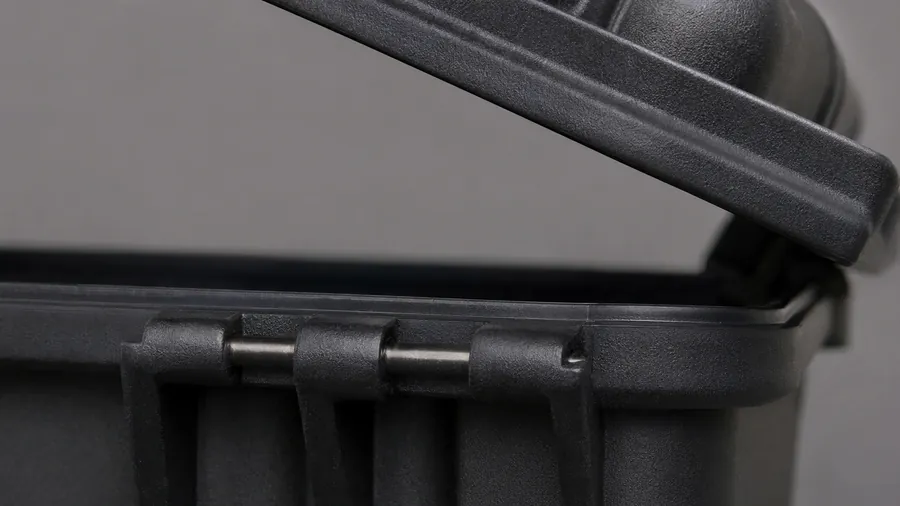
Four published things affect a hinge, and none of them is the hinge itself. Lid depth decides how much shell swings on the hardware, and our file records it on 100 of 155 models, from 16 mm to 320 mm with a median of 97.5 mm. The length of the hinge edge decides the span it works across, and the longest external edge in the file runs from 120 mm to 1356 mm, median 432 mm. The wall the hardware is anchored into is published on 148 models, 2 mm to 6 mm, median 3.9 mm. And the load path is shared: latch count is recorded as specified per configuration on all 155 models, and 19 models are wheeled with stackability switched off. What we record for every model is that a hinge is present; hinge count, length, material and replaceability are not published fields.
Key points
- Hinge presence is a measured field on 155 of 155 models. Hinge count, length, material and replaceability are published on none.
- Lid depth is published on 100 models, 16-320 mm, median 97.5 mm - the swing arc a hinge has to carry is a geometry question.
- Hinge edge length tracks the case: longest external axis 120-1356 mm, median 432 mm, and 43 models clear 500 mm.
- The same footprint with three lid depths is three different hinge jobs: KX-84416, KX-84419 and KX-84430 all measure 436 x 356 mm.
- Anchorage is a published number: wall thickness on 148 models, 2-6 mm, median 3.9 mm; 7 models publish none.
- 124 of 155 shells record a gasket in a continuous moulded channel, and that channel shares the same perimeter the hinge sits on.
- 19 models are wheeled, telescopic-handled and non-stackable - the hinges there see a tilted load, not a shelf load.
What affects case hinges, in the order the lid feels it
A hinge on a moulded thermoplastic case is not chosen in isolation; it is loaded by everything around it. The published file lets you read that load path in a fixed order. First the lid depth, because that is the mass and the lever the hardware holds. Then the length of the edge the hinge runs along, because a long edge twists before a short one does. Then the wall section the fixings bite into, because hinge failure in a moulded shell is usually an anchorage story rather than a hardware story. Then the closure and the carrying arrangement, because latches, feet, wheels and the stacking flag all change what the hinge is asked to do on the same shell.
The hinge field we publish, and the hinge fields we do not
One hinge field exists in the product data and it is recorded for every model: a hinge is present, held as a measured value on 155 of 155 listings. Nothing else about the hinge is published. There is no hinge count, no hinge length, no hinge material, no pin diameter and no replaceability flag in the file, and the hardware material line reads metal or polymer by configuration on all 155 models - a construction option we supply, with the figure depending on the order. That is the honest boundary of this page.
The consequence for a buyer is practical rather than disappointing. Since the hinge itself is a configuration decision, the fields worth comparing between suppliers are the ones that determine what the hinge carries and what it is fixed into: lid depth, external length, wall thickness, seal channel, latch count and the carrying arrangement. All of those are published here, and a hinge claim built on any other basis is a claim about a part nobody has specified.
Lid depth is the first thing a hinge carries
Lid depth is published on 100 of the 155 models and runs from 16 mm to 320 mm, median 97.5 mm, with base depth published on the same 100 models from 15 mm to 168 mm, median 44 mm. Coverage is uneven by series, which is worth knowing before you compare two suppliers on it: 0 Series 23 of 23, 1 Series 7 of 7, 6 Series 1 of 20, 7 Series 6 of 6, 8 Series 33 of 62, 9 Series 16 of 18 and T Series 14 of 19.
Depth matters to a hinge because the lid is the part that swings. KX-88442 is the extreme in our file: a 320 mm lid on an 843 x 592 x 415 mm shell, with a published net weight of 15320 g and a 5 mm wall. At the other end, KX-1204 carries a 16 mm lid on a 120 x 90 x 40 mm box at 100 g - the same hardware question at less than a hundredth of that mass. The eleven models with a lid of 200 mm or more are listed below with every published field beside them.
| Model | Series | Lid Depth Mm | Base Depth Mm | External Mm | Wall Mm | Net Weight G |
|---|---|---|---|---|---|---|
| KX-88442 | T Series | 320 | 44 | 843 x 592 x 415 | 5 | 15320 |
| KX-88337 | T Series | 280 | 49 | 830 x 445 x 374 | 5 | 10866 |
| KX-86836 | T Series | 270 | 45 | 677 x 535 x 364 | 4.8 | 10600 |
| KX-85835 | T Series | 260 | 45 | 588 x 475 x 353 | 5 | 8520 |
| KX-86136 | T Series | 260 | 44 | 612 x 427 x 355 | 5 | 8500 |
| KX-87336 | T Series | 260 | 50 | 733 x 505 x 357 | 5 | 10660 |
| KX-88434 | T Series | 240 | 44 | 843 x 592 x 335 | 5 | 14030 |
| KX-84430 | 8 Series | 230 | 45 | 436 x 356 x 297 | 4.2 | not published |
| KX-86830 | T Series | 210 | 45 | 677 x 535 x 304 | 4.8 | 10160 |
| KX-84825 | 8 Series | 200 | 40 | 482 x 420 x 250 | 4.2 | not published |
| KX-86127 | 8 Series | 200 | 48 | 612 x 427 x 268 | 5 | not published |
Hinge span: the longest edge decides how far the lid can twist
The edge a hinge runs along is the length of the lid opening, and it tracks the case footprint we publish. Across the 155 models the longest external edge runs from 120 mm to 1356 mm with a median of 432 mm, and 43 models exceed 500 mm. At the top of that range sit the long shells: KX-814641 measures 1356 x 154 x 408 mm, KX-89616 measures 956 x 408 x 154 mm and KX-88015 measures 800 x 408 x 153 mm, all three with a 100 mm lid depth and a 5 mm wall.
Long, thin shells are the hard case for a hinge line, and our file shows why in numbers rather than in opinion: a 1,356 mm edge with a 100 mm lid is a wide, shallow panel that wants its fixings spaced along the whole length, while a KX-6621 at 662 x 495 x 210 mm carries a 43 mm lid and a 6 mm wall across a shorter span. Where a supplier quotes a hinge count for a shell like KX-814641, ask what field that number came from, because we do not publish one.
Same footprint, different lid: three hinge jobs from one mould family
The clearest way to see what affects a hinge is to hold the footprint constant and move the lid. Our 8 Series contains exactly that comparison: KX-84416, KX-84419 and KX-84430 share a 436 x 356 mm plan and a 4.2 mm wall while their lids measure 90, 120 and 230 mm on bases of 45 mm. The T Series repeats it: KX-88421, KX-88434 and KX-88442 all measure 843 x 592 mm across, with lids of 145, 240 and 320 mm; the first publishes no net weight, the other two publish 14030 g and 15320 g.
A shallow lid with a deep base is a different arrangement again. KX-97227 puts only 42 mm above the parting line and 168 mm below it, in one of the thickest published walls in the file at 6 mm, while KX-4318 runs 38 mm of lid against a 140 mm base. Same kind of shell, opposite geometry: in one the hinge holds a shallow tray, in the other it holds most of the enclosure.
| Model | External Mm | Lid Depth Mm | Base Depth Mm | Wall Mm | Net Weight G | Wheels |
|---|---|---|---|---|---|---|
| KX-84416 | 436 x 356 x 157 | 90 | 45 | 4.2 | not published | 0 |
| KX-84419 | 436 x 356 x 187 | 120 | 45 | 4.2 | not published | 0 |
| KX-84430 | 436 x 356 x 297 | 230 | 45 | 4.2 | not published | 0 |
| KX-88421 | 843 x 592 x 212 | 145 | 44 | 5 | not published | 0 |
| KX-88434 | 843 x 592 x 335 | 240 | 44 | 5 | 14030 | 2 |
| KX-88442 | 843 x 592 x 415 | 320 | 44 | 5 | 15320 | 2 |
| KX-97227 | 720 x 500 x 270 | 42 | 168 | 6 | 10000 | 2 |
| KX-4318 | 432 x 240 x 186 | 38 | 140 | 3 | 1970 | 0 |
What the hinge is anchored into: wall thickness and shell resin
Fixings live in the wall, and the wall is a published number on 148 of the 155 models: 2 mm to 6 mm, median 3.9 mm. By series the medians are 0 Series 3 mm, 1 Series 2.5 mm, 6 Series 3.9 mm, 7 Series 2.1 mm, 8 Series 4.2 mm, 9 Series 3.9 mm and T Series 5 mm. Seven models publish no wall figure at all - KX-84814, KX-84815, KX-84823, KX-84824, KX-95419, KX-6922, KX-5126 - and for those shells the anchorage question has to be answered from a sample rather than from the file.
The resin matters in the same way. Shell material is recorded on all 155 models: 94 polypropylene, 38 engineering polypropylene, 22 ABS and one listed as PP or ABS. A hinge fixed into a 3.5 mm ABS shell such as KX-62205 and one fixed into a 5 mm T Series wall behave differently under the same lid, which is why we treat hardware as a configuration decision and not as a catalogue constant.
The gasket channel runs the same perimeter as the hinge
Sealing and hinging meet on one face. 124 of the 155 models record a compressible gasket in a continuous moulded channel, and 31 record that no gasket is offered on that shell. The split is uneven: 6 Series 20 of 20 carry the channel, 8 Series 58 of 62, T Series 18 of 19, while 7 Series carry it on none of their 6 models. Where a channel runs continuously, the hinge line sits on the same mating face that has to stay flat.
That is a geometry point, not a performance claim. We record no protection rating for any model - the rating field is marked not measured on all 155 and no IP code is stated anywhere in the file - so the honest advice is to check the two things that are published: whether the shell has a channel at all, and whether lid depth, span and wall on the model you are buying keep that face flat. A pressure-equalisation valve is offered as a configuration option, which is the other field worth naming in the same conversation.
Latches, feet and the load path a hinge shares
A hinge resists what the closures let it resist. Latch count is recorded on all 155 models as specified per configuration, so the number of points pulling the lid down is your decision, not a property of the shell; the latch body on all 155 is recorded as accepting a standard padlock; and feet are recorded as present on all 155. Those three fields, plus lid depth and wall thickness, are what we can put in front of a hinge discussion today.
Stacking changes it again. 136 models are recorded as stackable and 19 are recorded as not stackable - and the non-stackable group is exactly the 19 wheeled models, which are also the 19 models with a telescopic handle. When cases go in a stack, the load travels through shells and feet rather than through the lid; when a case is stood on a bench and loaded from above, the hinge is in that path. We publish no stack load or load capacity figure for any model, so this is a question of geometry and configuration, not of a rating we could quote.
Rolling, tilting and carrying: where hinges get the hardest work
The 19 T Series models are the most demanding hinge environment in our catalogue. Each is recorded with two wheels, a telescopic handle and stackability switched off, and the published telescopic height appears on 11 of them, from 240 mm to 485 mm. A case being dragged on its wheels is held at an angle, so the lid hangs along its hinge line instead of resting on a base.
Mass in that group is published for every model, from 4912 g to 15320 g with a median of 8500 g, so the swinging load can be sized against a real figure: KX-88442 at 15320 g with a 320 mm lid, KX-88337 at 10866 g with 280 mm, KX-86836 at 10600 g with 270 mm. Contrast a fixed-handle shell of similar lid depth: KX-84430 carries a 230 mm lid in the 8 Series and publishes no net weight at all, which is the honest limit of what the file says about that comparison.
Hinge-relevant published fields, side by side
Coverage is the point of this table. A supplier can only compare fields that exist, and the four hinge attributes people expect to find are not among them.
| Field | Models Published | Status | What It Decides |
|---|---|---|---|
| Hinge present | 155 of 155 | measured | Whether the shell is hinged at all |
| Lid depth | 100 of 155 | measured, 16-320 mm | The lever the hardware holds |
| Longest external edge | 155 of 155 | measured, 120-1356 mm | The span fixings must control |
| Wall thickness | 148 of 155 | measured, 2-6 mm | What the fixings bite into |
| Gasket channel | 124 of 155 | measured; 31 shells offer none | The face the hinge line sits on |
| Latch count | 155 of 155 | specified per configuration | How many points pull the lid down |
| Hardware material | 155 of 155 | metal or polymer by configuration | What the hinge is made of on your order |
| Hinge count, length, pin, replaceability | 0 of 155 | not published | Nothing - ask us per configuration |
| Protection rating | 0 of 155 | not measured; no IP code stated | Nothing - accredited testing quoted per configuration |
Selection guide: which hinge decision goes with which shell
Read the decision against the published geometry rather than against a hardware catalogue. A shallow lid on a small plan - KX-1204 at 120 x 90 x 40 mm and 100 g - is a bench case, and the hinge is barely loaded. A deep lid on a wide plan, such as KX-88442 with its 320 mm lid across 843 x 592 mm, is where we expect lid depth, wall section and latch count to be specified together. A long thin shell such as KX-814641 at 1356 x 154 x 408 mm is a spacing question first and a hardware question second.
For gasketed cases, buy the channel and the flatness together: check that the model records a continuous moulded channel (124 shells do) and that lid depth and span on that plan are inside the range you are willing to hold flat. For wheeled cases, check the three flags that come as a set - wheels, telescopic handle and stackability off, on 19 models - before choosing hardware, because the orientation the lid spends its life in is decided there.
Applications where hinge geometry decides the specification
In field and defence deployments a deep-lid T Series case is opened on uneven ground and dragged to a vehicle, which is the widest combination of lid depth, span and mass in our file: 19 models, lids published on 14 of them, masses from 4912 g to 15320 g. In electronics and instrument work the pattern is the opposite - shallow lids on small plans, opened repeatedly on a bench, where the hinge is chosen for the wall it sits in rather than for the load it holds. In industrial service the case lives on a cart and the closures do the work. In distribution 136 of the 155 models are recorded as stackable, so a stacked column loads shells and feet rather than a lid, and the hinge question becomes one of keeping the mating face flat rather than of carrying strength.
Customising hinges: what changes on an existing mould
Hardware is one of the seven customisation routes we record on every model, and on an existing shell it is a fitting and specification decision rather than a tooling one: first article on an existing mould runs 45 days from 300 units, with a 30 percent deposit on custom work. Changing the hinge position, adding fixing points inside a different wall section, or moving the parting line itself is a mould decision - 125 days and 3,000 units minimum for a new tool.
Practically, that means a buyer can specify the hardware material, the fixing arrangement and the latch count against the published lid depth, span and wall of an existing model, and we will build to it. What we will not do is print a hinge count, a hinge length or a cycle figure for a shell we have not recorded, and we do not offer retail quantities, DDP terms or overseas warehouse stock.
Procurement notes and what we do not claim
Everything above is a published field or an explicit absence. We record no hinge count, no hinge material, no pin size, no replaceability flag and no service-life number, because none exists in our data for any of the 155 models. We record no protection rating, no IP code, no drop height and no stack load for any model either; accredited testing against a standard your tender names can be commissioned as a separate work package and quoted per configuration.
Send us the model or the equipment envelope, the lid depth you want, the quantity and the terms you need, and we will answer with the published geometry, the hardware options we can actually fit, and the fields that stay blank. Per-model datasheets, the full catalogue and the RFQ template carry the same statuses shown here.
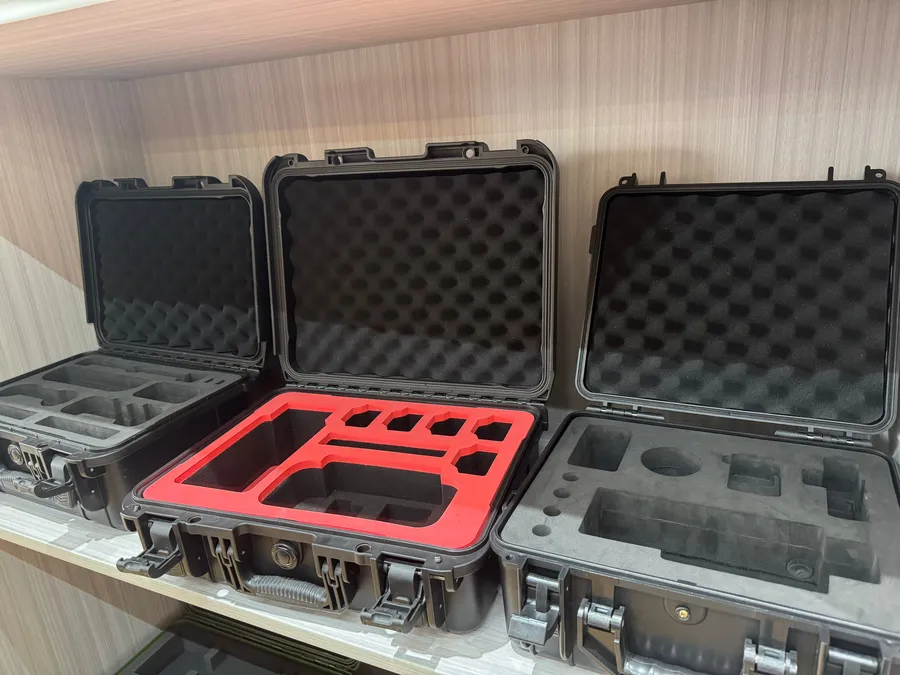
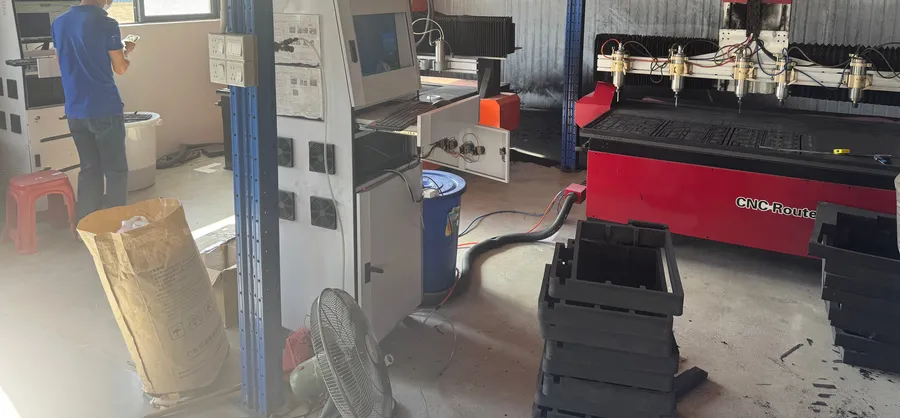
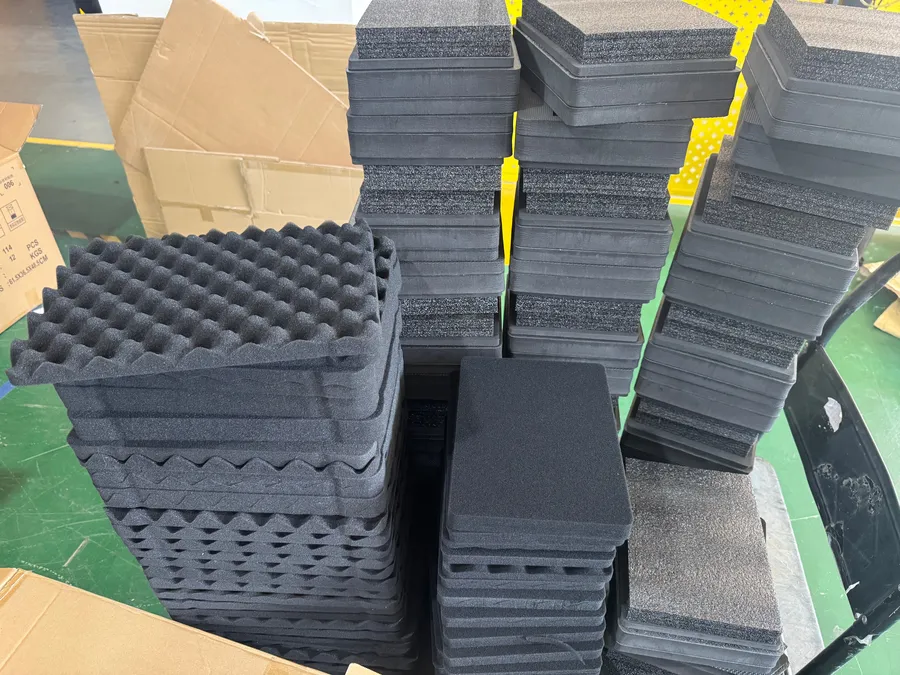
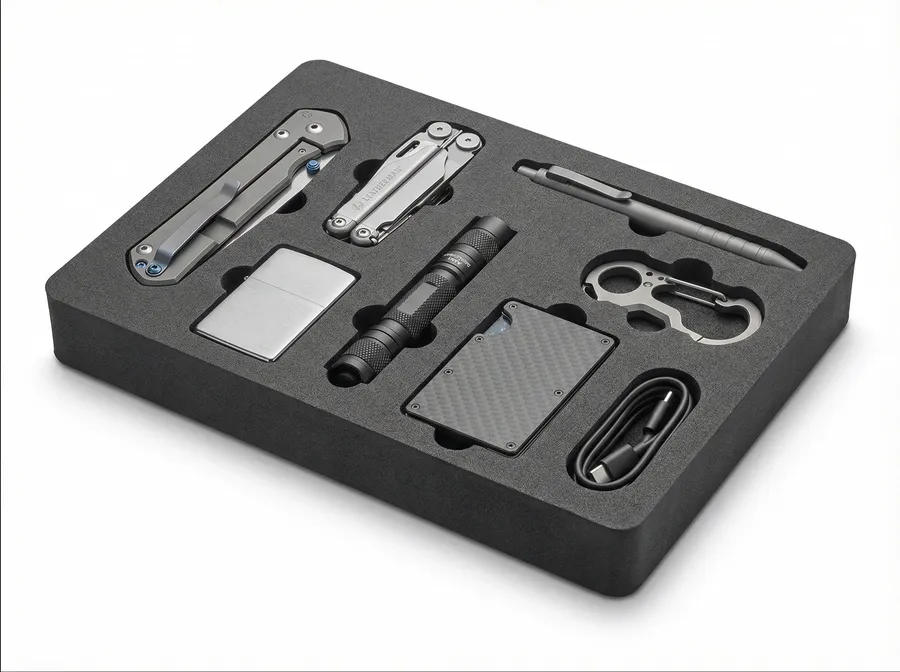
Applications
This matters most where the case is part of a movement chain rather than shelf packaging. In electronics & instruments and field & deployment and industrial equipment the same shell is specified differently because the handling, the environment and the verification requirement differ.
- Electronics & Instruments — Electronic assemblies rarely fail from a single large impact. They fail from repeated small shoc…
- Field & Deployment — Field deployment removes every assumption a depot specification makes: no forklift, no dry stora…
- Industrial Equipment — In an industrial setting the case is a working surface as much as a container, and its interior …
- Military — Military equipment moves through a chain of handlers, none of whom own the equipment and all of …
- Outdoor & Recreation — Consumer and professional outdoor brands buy cases as a component of their product. That means c…
- Telecommunications — Communications equipment is never one object. It is a unit plus a set of accessories that determ…
Customisation
Everything described above is configurable on a standard shell: interior layout (pick-and-pluck, die-cut or CNC-cut), foam grade and thickness, colour, logo method, latch and lock count, pressure-equalisation valve, cable ports, document holder and identification plate. A bespoke exterior geometry requires a new mould — 125 days, from 3,000 units per moulded component.
Procurement considerations
| Question | What to send us |
|---|---|
| Which shell fits? | Equipment L × W × H as packed, plus required clearance per axis |
| What does it cost? | Order quantity and estimated annual quantity — the two drive different answers |
| Is tooling needed? | Whether an existing shell clears the envelope with usable foam depth |
| Lead time? | Your required delivery date, not just the order date |
| Certification? | The exact standard your tender names — we will say whether we can test to it |
| Freight? | Destination and preferred terms; carton and pallet data supplied with the quotation |
Comparison and selection guide
The tables on this page exist because a protective case is chosen by comparing three things: the envelope, the environment and the handling chain. Where no table applies, the rule below is.
| Situation | What To Do |
|---|---|
| Fastest | Standard shell plus CNC foam — typically 45 days from approved drawing. |
| Branded | Standard shell plus custom colour and logo — MOQ applies to the resin colour. |
| Bespoke geometry | New mould — 125 days, MOQ from 3,000 units per component. |
- Size on internal dimensions plus clearance, never on a product name.
- Choose the carrying method before the shell: it changes the series, not just the price.
- Specify the interior last, and decide up front whether the end user will reconfigure it.
What affects case hinges for a hard-shell equipment case? relates to Logistics & Packing Guide. Related families: Custom Protective Cases / Equipment Transport Cases / Electronics Cases / Instrument & Equipment Cases / Military Protective Cases / Rolling Cases / Long Equipment Cases / Tool Cases. Related sectors: Electronics & Instruments / Field & Deployment / Industrial Equipment / Military / Outdoor & Recreation / Telecommunications. Continue in the Logistics & Packing Guide cluster.
This page is written from our own production data. If your requirement differs, send the dimensions and we will tell you which of the 155 models fits, or whether a custom route is needed.



