What affects internal vs external dimensions for a hard-shell equipment case?
Five things create the gap between a hard-shell case's internal and external dimensions: shell wall thickness, the internal rib field, hinge and latch hardware on the parting line, the taper that produces a narrowest internal width, and the lid-to-base depth split. Across the 155 models we publish, the median allowance is 26 mm on length, 57 mm on width and 15 mm on height, and the cavity holds between 53 and 87 percent of the exterior volume depending on the model. Treat the two sets of numbers as separate answers: internal dimensions answer whether the equipment fits, external dimensions answer whether the closed case fits the pallet, the rack or the vehicle.
Key points
- Internal dimensions answer the equipment-fit question; external dimensions answer the pallet, rack and vehicle question. One number can never do the other's job.
- Wall thickness alone does not explain the gap: ribs, hinge towers and latch pockets consume more cavity width than the shell walls do on most mid-size models.
- 36 of our 155 models publish a narrowest internal width sitting a median 25 mm inside the nominal internal width, so a taper check is part of reading any datasheet.
- Only 29 of the 100 models that publish a depth split divide it evenly; lay the kit out against lid depth and base depth, never against total internal height.
- Telescopic handle height, published on 11 models between 240 and 485 mm, raises the outside envelope only and never buys extra cavity depth.
- Every dimension on this site is published per model from our own specification records; we do not generalize one model's allowance into a product-line claim.
What actually sits between the outer shell and the cavity
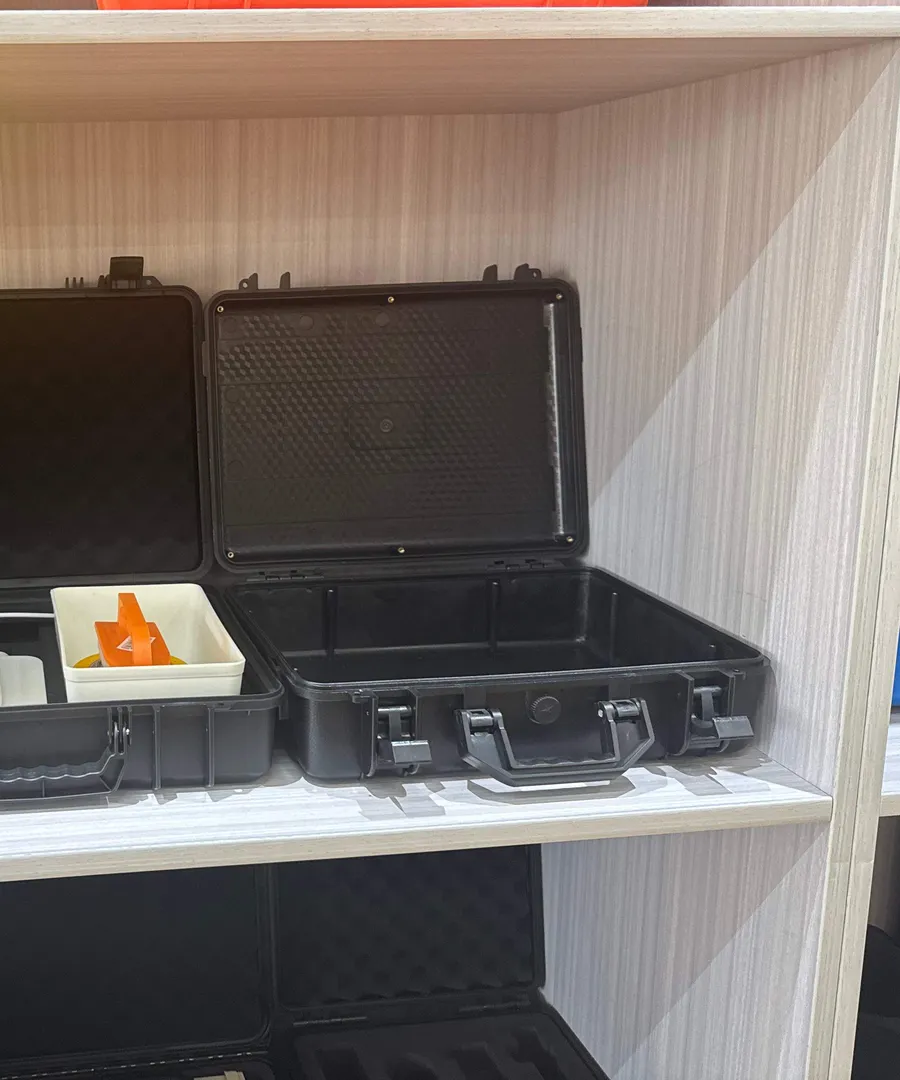
On a drawing, the external envelope and the internal cavity are separated by a stack of small physical decisions: the shell wall, the rib pattern that stiffens it, the hinge knuckles and latch bodies that straddle the parting line, the gasket groove where a seal is fitted, and the taper that lets shells stack and nest. None of these is decoration; each one is paid for in millimetres, and each one shows up as the difference between the two sets of numbers on a datasheet. That is why the real question behind internal vs external dimensions is never just how thick the wall is, but what the total bill for everything between the shell and the cavity comes to.
The published gap across 155 models, in millimetres and litres
Because every model page on this site publishes both envelopes, the gap can be stated from our own records instead of estimated from rules of thumb. Across the 155 models in our published specification file, the median allowance between external and internal dimensions is 26 mm on length, 57 mm on width and 15 mm on height. The median interior volume is 17.5 litres against a median exterior volume of 24.4 litres, and on individual models the cavity holds anywhere from 53 to 87 percent of the exterior volume. The spread is the point: a thin-walled compact shell and a thick-walled wheeled case can differ by a factor of three in how much of the outside you actually get to use.
| Model | External Mm | Internal Mm | Gap L W H | Notes |
|---|---|---|---|---|
| Model | External, mm | Internal, mm | Gap L/W/H, mm | Shell note |
| KX 1204 | 120 x 90 x 40 | 115 x 78 x 32 | 5 / 12 / 8 | 2.6 mm wall, 16 + 16 mm split, narrowest width 70 |
| KX 2406 | 240 x 200 x 55 | 230 x 155 x 50 | 10 / 45 / 5 | 2.0 mm wall, 25 + 25 mm split, narrowest width 140 |
| KX 3207 | 315 x 260 x 70 | 308 x 230 x 64 | 7 / 30 / 6 | 3.0 mm wall, 32 + 32 mm split, narrowest width 205 |
| KX 8-5827 | 588 x 475 x 267 | 500 x 400 x 220 | 88 / 75 / 47 | 5.0 mm wall, 175 + 45 mm split, telescopic handle |
| KX 8-8442 | 843 x 592 x 415 | 740 x 518 x 364 | 103 / 74 / 51 | 5.0 mm wall, 320 + 44 mm split, telescopic handle |
Driver one: wall thickness sets the floor under the gap
Wall thickness is the simplest component of the gap and the only one with a published value per model: 148 of our 155 models state it, from 2.0 mm on small PP shells to 6.0 mm on the largest engineering-PP case we list. Doubling the wall from 2.0 mm to 4.0 mm costs 2 mm per side, so on a compact shell the walls account for roughly half of the width gap, while on large cases the walls are a minor share of it. Seven models, including KX-84814, KX-84815 and KX-84823, do not publish a wall figure yet; for those, the recorded internal and external dimensions still govern, because they are stated per model rather than derived from an assumed wall.
Driver two: ribs, hinge towers and latch pockets take the rest
The wall does not explain most of the width gap on mid-size shells. KX 3207, a 3.0 mm-wall ammunition storage box, drops from 260 mm outside to 230 mm inside, a 30 mm width gap in which the two walls justify only 6 mm; the remaining 24 mm belong to the internal rib field, the hinge knuckles and the latch pockets. The effect grows with case size. On KX 8-5827, a 588 x 475 x 267 mm wheeled shell, the length alone loses 88 mm to the latch and hinge profile, far more than two 5.0 mm walls contribute at both ends combined. This is why two shells with identical wall thickness can offer very different usable cavities, and why we publish the internal number directly instead of asking buyers to subtract.
Driver three: the taper, measured as narrowest internal width
Many shells are not perfect prisms: they taper toward the base or carry inward ribs that make one zone narrower than the nominal internal width. On the 36 models that publish a narrowest internal width, that value sits a median 25 mm inside the nominal internal width, and by up to 37 mm. On KX 1204 the nominal internal width is 78 mm but the narrowest is 70 mm; on KX 2507 the figures are 175 mm and 160 mm. For soft goods, foam sheets and shallow trays the taper is irrelevant; for a rigid electronics assembly, a loaded magazine or a document tray, the narrowest figure is the only width that matters, because that is the width the equipment physically meets at the tightest point of the cavity.
Driver four: the lid and base split, where total height misleads
Internal height is published as one number, but the case divides it into a lid depth and a base depth, and the division is rarely even: 29 of the 100 models that publish a split divide it evenly, while 71 do not. Wheeled military shells are the extreme. KX 8-8442 divides its 364 mm cavity into a 320 mm lid over a 44 mm base, and KX 9-7227 divides its 210 mm cavity the other way round, a 42 mm lid over a 168 mm base. A kit laid out against total height instead of the receiving half will either bridge the parting line and take load on the closure, or sit beneath a lid that cannot close over its tallest component. Read the split, then decide which half holds what.
Driver five: handle hardware moves the outside, never the inside
Telescopic handles, wheel housings and strut channels add hardware outside the cavity, which is why 11 of our 155 models publish a telescopic handle height between 240 and 485 mm on top of the shell height. KX 9-7227 stands 270 mm tall as a shell but reaches 485 mm with the handle raised, a difference that never appears in the internal column yet decides whether the case stands under a shelf, rides a trolley deck or loads into a vehicle rack. All 19 wheeled models are marked not stackable for the same reason: the hardware envelope that helps mobility is exactly the envelope another case cannot rest on. Plan the raised-handle height into any rack, shelf or container sketch.
Which number answers which buyer question
Buyers rarely need every number at once; they need the right number for the decision in front of them. The table below maps the common questions to the published field that answers them, with a real example from each row of our catalogue file.
| Question | Dimension | Example |
|---|---|---|
| Buyer question | Dimension to read | Published example |
| Will the unit fit the foam cavity? | Internal L x W x H plus narrowest internal width | KX 2406: 230 x 155 x 50 mm cavity, 140 mm narrowest width |
| Will the closed case fit the rack pitch? | External L x W x H | KX 1204: 120 x 90 x 40 mm envelope |
| Where can each component sit? | Lid depth and base depth | KX 8-8442: 320 mm lid over 44 mm base |
| Will it stand under a shelf with the handle raised? | External height plus telescopic handle height | KX 9-7227: 270 mm shell, 485 mm raised |
| How many cases fit a carton? | Carton dimensions and pieces per carton | 58 models publish both figures |
Closing the gap on purpose: custom and OEM dimension work
Because the gap is designed, it can also be designed differently. On existing tooling we can add rib reliefs, move the foam line or reserve a deeper base so the same external envelope carries a taller component. OEM work on an existing mould runs in 45 days and a new mould in 125 days against a 30 percent deposit, with MOQs of 300 units for OEM builds and 3,000 units per component for new tooling. Send the equipment drawing, a photograph of the packed kit or a physical sample, and we will return the internal envelope the layout actually needs instead of the nearest catalogue number. The foam line, the shell and the hardware are then quoted as one coordinated package.
Procurement notes for wholesale and OEM buyers
We supply through wholesale and OEM channels only, quoted EXW or FOB; we do not sell single units at retail and we do not ship DDP or operate overseas warehouses. Every figure in this article comes from the per-model specification file published behind this site, and each model page carries its own numbers: both envelopes, wall thickness where recorded, the depth split, the narrowest width and carton packing where recorded. Where our product file records a protection figure as not measured, we say so rather than printing a value. Treat any dimension quoted without a model number as a question to ask, and ask for the datasheet line items whenever a quotation does not state which envelope its numbers refer to.
Customisation
Everything described above is configurable on a standard shell: interior layout (pick-and-pluck, die-cut or CNC-cut), foam grade and thickness, colour, logo method, latch and lock count, pressure-equalisation valve, cable ports, document holder and identification plate. A bespoke exterior geometry requires a new mould — 125 days, from 3,000 units per moulded component.
Procurement considerations
| Question | What to send us |
|---|---|
| Which shell fits? | Equipment L × W × H as packed, plus required clearance per axis |
| What does it cost? | Order quantity and estimated annual quantity — the two drive different answers |
| Is tooling needed? | Whether an existing shell clears the envelope with usable foam depth |
| Lead time? | Your required delivery date, not just the order date |
| Certification? | The exact standard your tender names — we will say whether we can test to it |
| Freight? | Destination and preferred terms; carton and pallet data supplied with the quotation |
Comparison and selection guide
The tables on this page exist because a protective case is chosen by comparing three things: the envelope, the environment and the handling chain. Where no table applies, the rule below is.
| Situation | What To Do |
|---|---|
| Fastest | Standard shell plus CNC foam — typically 45 days from approved drawing. |
| Branded | Standard shell plus custom colour and logo — MOQ applies to the resin colour. |
| Bespoke geometry | New mould — 125 days, MOQ from 3,000 units per component. |
- Size on internal dimensions plus clearance, never on a product name.
- Choose the carrying method before the shell: it changes the series, not just the price.
- Specify the interior last, and decide up front whether the end user will reconfigure it.
What affects internal vs external dimensions for a hard-shell equipment case? relates to Logistics & Packing Guide. Related families: Custom Protective Cases / Equipment Transport Cases / Military Protective Cases / Electronics Cases / Ammunition Storage & Transport Boxes / Tactical Equipment Cases / Outdoor Protective Cases. Related sectors: field and industrial equipment. Continue in the Logistics & Packing Guide cluster.
This page is written from our own production data. If your requirement differs, send the dimensions and we will tell you which of the 155 models fits, or whether a custom route is needed.


