What factors affect shipping costs for protective cases?
The price of moving a batch of protective cases is not driven by the case itself but by what the carrier is willing to bill for, and that usually reduces to four things. First, chargeable weight, which is the greater of the packed mass and the volumetric weight derived from the carton, so a light but bulky carton can be billed as if it were heavy. Second, packing density: how many finished cases fit in one outer carton and whether they nest, which we publish per model as carton dimensions and pieces per carton across 58 of our 155 models. Third, case geometry, including whether the shell stacks, whether it carries wheels and a telescopic handle, and its external footprint, since stacking lets a shipper fill vertical space that a non-stackable shell wastes. Fourth, route and terms: origin, destination, mode, and the Incoterm under which we sell, which for us is wholesale or OEM ex-works or free on board. Order economics such as minimum order quantity and tooling amortisation sit underneath all four because they decide the batch size that freight is then spread across.
Key points
- Chargeable weight, the greater of actual packed mass and volumetric weight, decides most of the freight bill for cases.
- Packing density is where buyers actually save: more nested units per carton lowers cost per shipped case.
- Stackability and external footprint, not internal volume, are what the pallet and the container measure.
- We quote freight on EXW or FOB wholesale terms and supply pallet and container figures with the quotation, not as fixed claims.
- Order quantity and tooling amortisation change effective per-unit landed cost more than small packing tweaks do.
What the carrier actually bills
A freight invoice rarely matches what a case weighs in your hand. Air and express services compare the real packed mass against a volumetric weight computed from the carton's dimensions using a divisor the carrier sets, then bill whichever is higher. Sea and road services lean on cubic metres and on how much of a container or trailer the load occupies. The practical consequence is that the same piece of equipment can be cheap to ship in one carton and expensive in another purely because of empty space. For protective cases, which are by nature large hollow shells, volumetric weight is the usual binding constraint, and the lever a buyer controls is not the shell but how many shells go into the box around it.
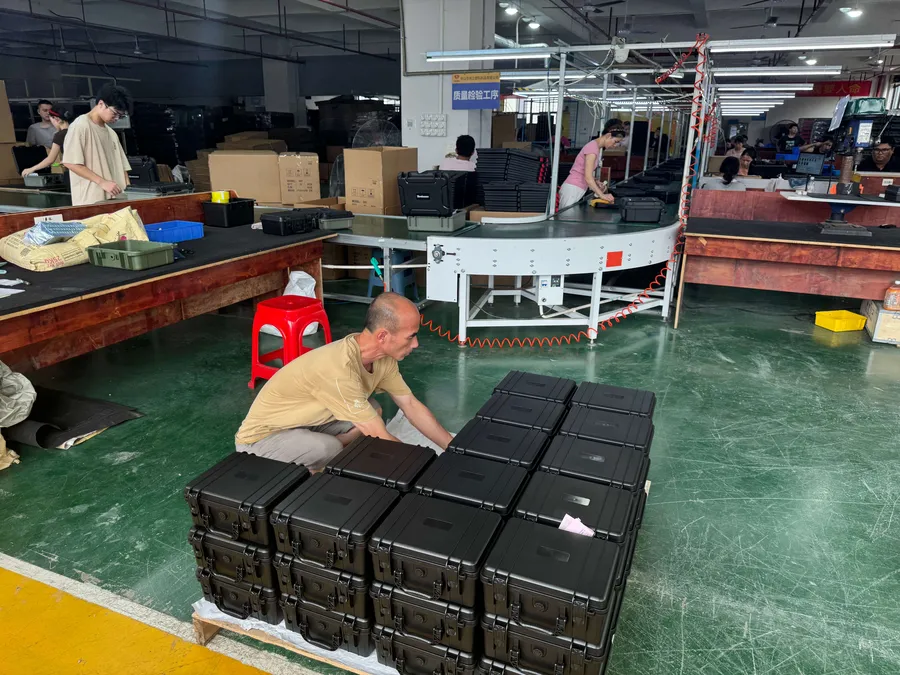
That is why we publish carton dimensions and pieces per carton for the models where the packaging is fixed, and why we recommend treating a case purchase as a packing problem before it is a product problem. On published figures, a small WL2005 with 175 grams of net mass ships forty pieces to a 410 by 360 by 495 millimetre carton, roughly 0.073 cubic metres, so about seven kilograms of cases fill a compact box. A WL9-7227 trolley at 10 kilograms net ships one per carton in a 715 by 515 by 280 millimetre box. Same category of product, opposite cost logic per unit.
Packing density: the biggest controllable cost
Once a case has been made, the single strongest driver of freight cost per shipped unit is how many units share one outer carton. Nested stacks and stackable rims let a packer fill a carton to a high unit count; bulky shells with protruding latches or fixed handles do not. The table below uses real published packaging for models on our site so you can see how steep the curve is. Pallet and container quantities are then calculated from the carton footprint against your pallet size and supplied with the quotation rather than asserted as a fixed figure, because they depend on the carton mix you actually order.
| Model | External Mm | Net Mass G | Carton Mm | Pieces Per Carton | Freight Logic |
|---|---|---|---|---|---|
| WL2005 | 195 x 170 x 46 | 175 | 410 x 360 x 495 | 40 | High unit count; volumetric cost per case is very low |
| WL2406 | 240 x 200 x 55 | 330 | 490 x 410 x 290 | 20 | Halved unit count; per-case volumetric share rises |
| WL5723 | 572 x 405 x 227 | 4680 | 580 x 250 x 415 | 1 | One-off carton; carton is mostly this one case |
| WL9-7227 trolley | 720 x 500 x 270 | 10000 | 715 x 515 x 280 | 1 | Bulky plus heavy; both mass and volume bite at once |
Case geometry the shipper can and cannot recover
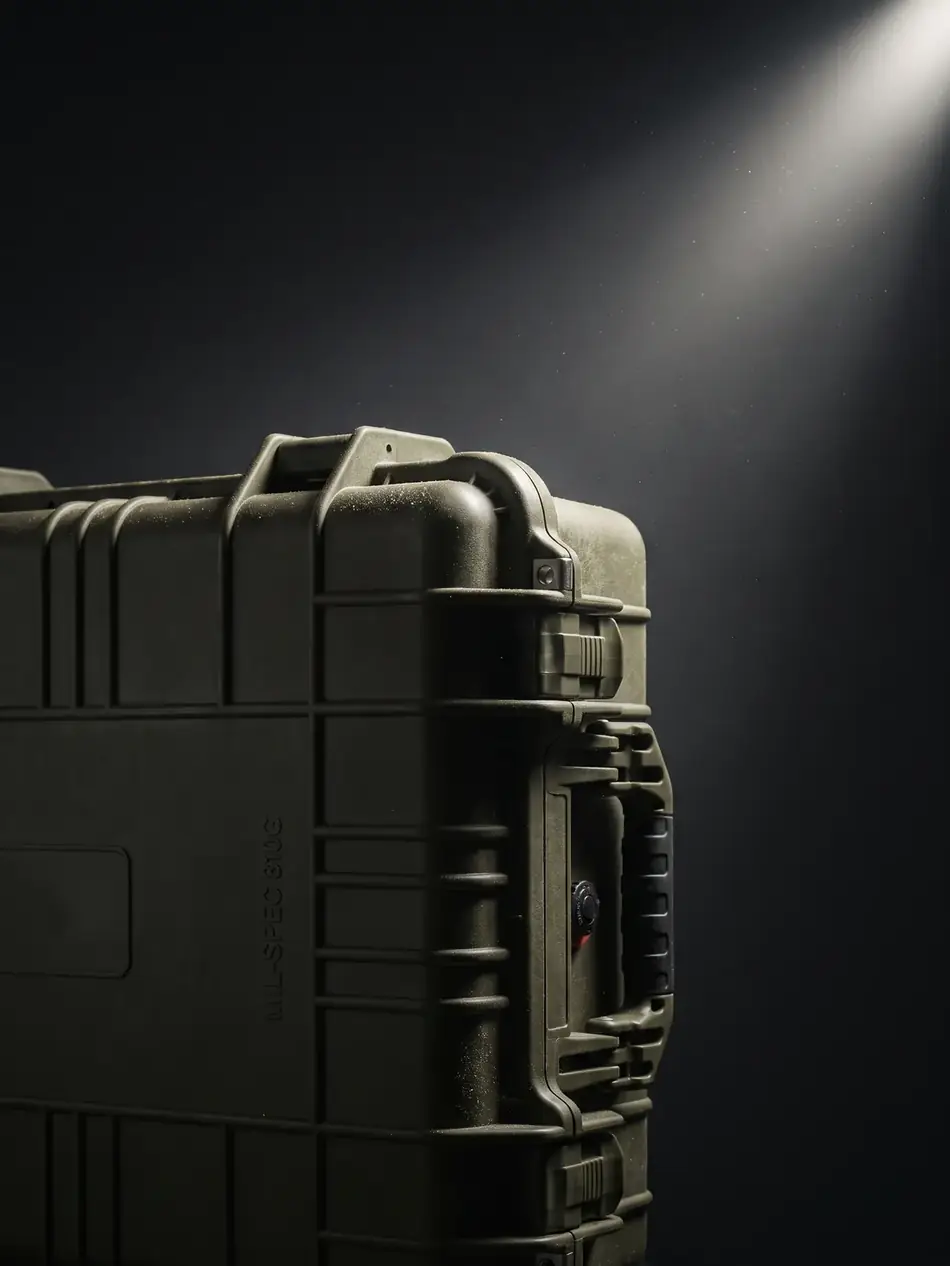
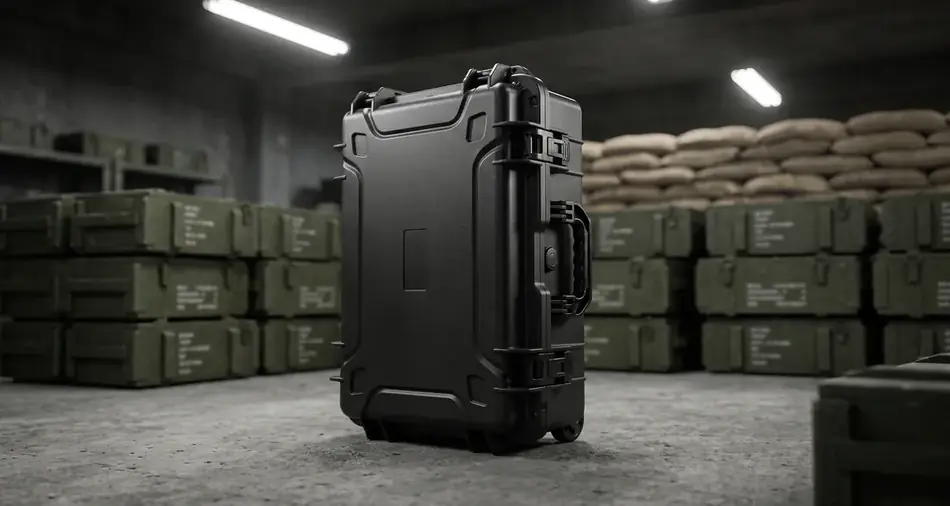
The supply chain does not see your internal volume; it sees the outside of the box you hand over. That is why a case's external envelope, its stackability and any hardware that sticks out matter to freight more than the foam layout does. Of our 155 models, 136 are marked stackable, which means a shipper can put weight on top and reclaim vertical space; the remaining shells are typically rolling cases whose wheels, telescopic handles or castors make stacking pointless and force a single layer on the pallet. Nineteen models ship with wheels and a matching telescopic handle, and each one of those carries the wheel housing on the outside of the case, which is outside the billable envelope even if it is invisible in a product photograph.
Wall thickness also shifts mass without changing the box much. Our shells range from roughly 100 grams on the smallest utility case up to about 15.3 kilograms on the WL8-8442 trolley, with thicker PP and engineering PP constructions sitting above comparable ABS units. That spread matters more on air and express lanes, where the greater of mass and volume drives the number, and matters less on sea, where the cubic-metre figure usually dominates. The rule of thumb a buyer can use is: if the shipment is going by air, minimise mass and nesting voids; if by sea, minimise the outer footprint and maximise stack height.
Route, mode and the Incoterms we sell under
Freight terms change who pays and therefore change what is optimised. We are a wholesale and OEM manufacturer and we quote on EXW (ex-works) or FOB (free on board) terms. That means the buyer, or the buyer's forwarder, controls the main-carriage decision, the mode, the routing and the customs side, and the case supplier's job is to make the packing data honest so the forwarder can plan against real carton numbers. We do not sell retail, we do not offer DDP, and we do not hold overseas warehouse stock, so landed-cost calculations have to be built around a direct factory-destination shipment rather than a local distribution model.
Mode selection interacts with geometry. A dense 40-piece carton of a small case travels well by sea as a palletised load and only becomes expensive by air if the volumetric weight catches the divisor the carrier uses. A one-per-carton trolley reverses the logic: it is bulky, mostly air in the box, and it is the case most likely to trigger a volumetric charge that dwarfs its own mass. When buyers ask us what the shipping cost will be, the honest answer is that it depends on how many of what, going where, by which mode, and under which term, and those are forwarder questions, not factory ones.
Order economics sitting underneath the freight line
Even the cheapest carton is expensive if you are shipping it one at a time. Minimum order quantity, tooling and lead time do not appear on the freight invoice, but they decide the batch size that freight is then divided across, and they change per-case cost more than small packaging tweaks do. On our standard catalogue the MOQ for an existing shell is a single piece, but customised runs are quoted at 300 pieces for a printed logo, 300 for a body colour change, and 3,000 per component if a new mould is required. A new mould is a 125-day tooling project; using an existing shell with a custom interior or a colour change runs around 45 days. Those are business parameters, not freight parameters, but a buyer who plans a 300-piece order against a 3,000-piece tooling threshold ends up with more air-freight top-ups than the original quote imagined.
The practical takeaway is to align the size of the shipping batch to the size of the reorder window. A larger, less frequent container shipment under FOB lets the fixed carton count amortise the freight across many units; a smaller, more frequent air shipment does the opposite, and the packing-density advantage of the small-case cartons is partly wasted when only a few cartons go at a time.
How to size selection to reduce freight cost
Selection is a freight decision before it is a product decision. Start from the equipment envelope and add at least 20 millimetres of clearance on every axis, then look for the smallest existing shell that still fits, because internal volume across our catalogue runs from 0.3 litres to about 139.5 litres and every extra size class you cross is another jump in the outer carton. Prefer a model that already appears on our published pack data with a high pieces-per-carton figure. Prefer stackable over wheeled unless the end user genuinely needs to roll the case across a depot floor. And where the same equipment can go in a single large case or in two stacked small cases, price both: nesting two smaller shells often beats shipping one big one by sea, but the arithmetic flips on air because two cartons carry more protective void.
Where these cases ship and who is buying them
The bulk of the shipping volume we see moves defence and field equipment: radios and communication kits, optronics, survey instruments, drones with their battery sets, medical kits, tool cases and spares. Those tend to consolidate well into a single destination port or an inland rail terminal, and the buyer is usually a distributor, a systems integrator or an OEM re-branding programme rather than an individual. That shape of demand favours palletised FOB shipments of dense cartons, which is exactly where packing density and stackability earn their keep. Rolling cases for depot or field use ship in smaller quantities and accept the volumetric penalty because the wheels are the point of the case for the end user.
Customisation and its freight consequences
Every option a buyer adds tends to add mass, volume, or both, and it is worth pricing those options against a shipment rather than against a unit. A printed logo or a body colour change sits on the existing shell and does not change the carton. A custom CNC foam interior adds a few centimetres of protective height to the base and lid, which is usually absorbed within the same carton. A custom mould, quoted at 125 days and a 3,000-piece threshold per component, creates a new external geometry and therefore a new carton, and that is where the freight calculation has to start again. We recommend that anyone planning a new mould asks for the projected outer carton dimensions and pieces-per-carton figure at the same time as the unit price, because a 10 percent cheaper shell in a 30 percent worse carton can be a freight net negative.
Procurement notes: what to ask before you quote freight
A shipping-cost conversation with a case supplier should feel like a data exchange, not a promise. Ask for external dimensions and net weight per model, both of which we publish. Ask for the outer carton dimensions and pieces per carton for every model in the order, and expect them to be supplied per configuration rather than as a generic catalogue number. Ask for the projected pallet footprint against your standard pallet size, and expect the pallet quantity and the container figures for 20GP, 40GP and 40HQ to be calculated from that footprint rather than guessed. Ask which term the quote covers, EXW or FOB, and who books main carriage under it. Then let your forwarder price the lanes. Anyone who will not publish the underlying numbers, or who quotes a landed cost including duties they do not control, is not giving you a shipping number, they are giving you a marketing number.

Customisation
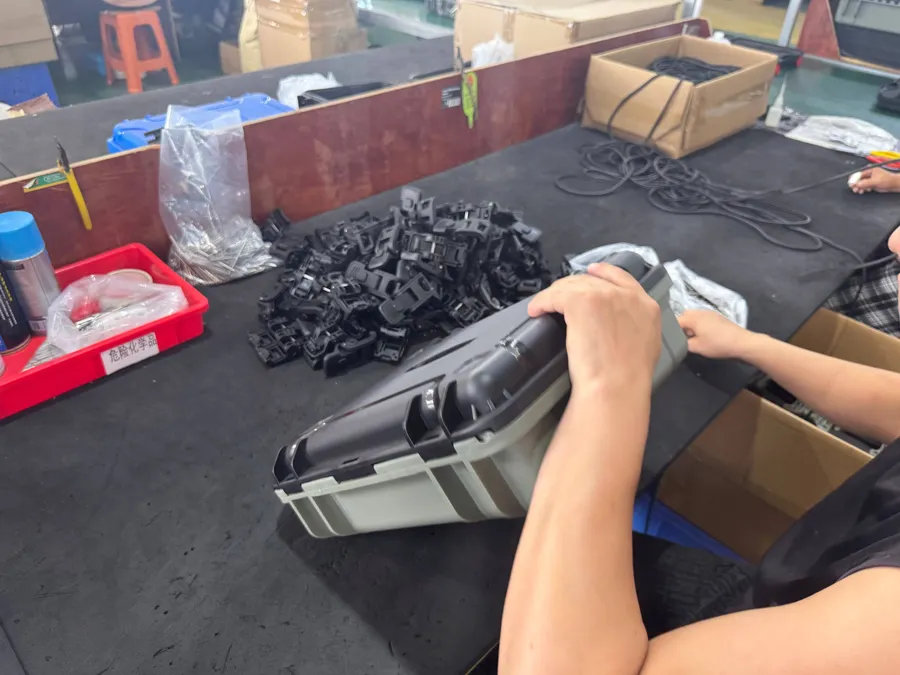
Everything described above is configurable on a standard shell: interior layout (pick-and-pluck, die-cut or CNC-cut), foam grade and thickness, colour, logo method, latch and lock count, pressure-equalisation valve, cable ports, document holder and identification plate. A bespoke exterior geometry requires a new mould — 125 days, from 3,000 units per moulded component.
Procurement considerations
| Question | What to send us |
|---|---|
| Which shell fits? | Equipment L × W × H as packed, plus required clearance per axis |
| What does it cost? | Order quantity and estimated annual quantity — the two drive different answers |
| Is tooling needed? | Whether an existing shell clears the envelope with usable foam depth |
| Lead time? | Your required delivery date, not just the order date |
| Certification? | The exact standard your tender names — we will say whether we can test to it |
| Freight? | Destination and preferred terms; carton and pallet data supplied with the quotation |
Comparison and selection guide
The tables on this page exist because a protective case is chosen by comparing three things: the envelope, the environment and the handling chain. Where no table applies, the rule below is.
| Situation | What To Do |
|---|---|
| Free-drop height | With a 50 mm base foam layer, a 15 kg assembly sees a markedly lower peak deceleration than with 20 mm. Where the case is handled by hand off a vehicle, we specify the deeper base. |
| Stacking | A case that will be shipped stacked needs a wall thickness and rim geometry that carries the load through the shell, not through the lid. |
- Size on internal dimensions plus clearance, never on a product name.
- Choose the carrying method before the shell: it changes the series, not just the price.
- Specify the interior last, and decide up front whether the end user will reconfigure it.
What factors affect shipping costs for protective cases? relates to Logistics & Packing Guide. Related families: Defense Equipment Cases / Equipment Transport Cases / Military Transport Cases / Rolling Cases. Related sectors: field and industrial equipment. Continue in the Logistics & Packing Guide cluster.
This page is written from our own production data. If your requirement differs, send the dimensions and we will tell you which of the 155 models fits, or whether a custom route is needed.