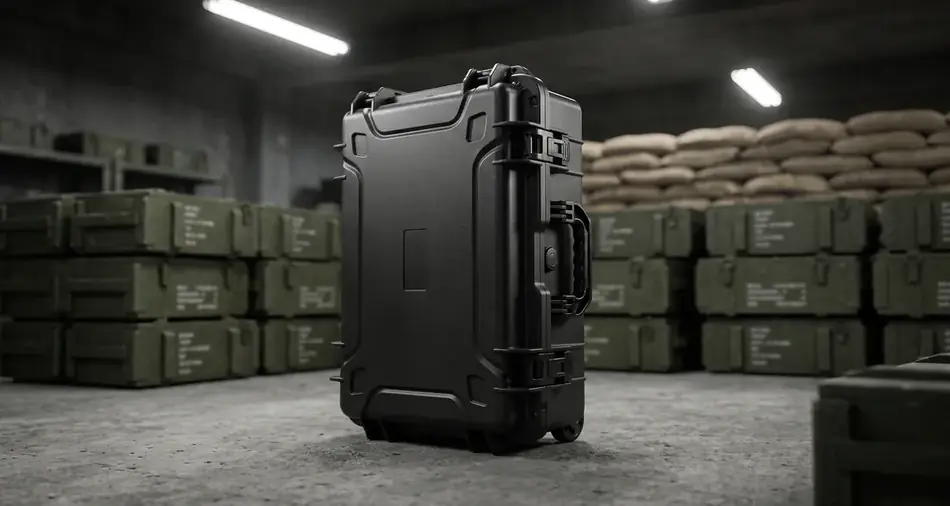
What factors affect protective case selection for logistics?
For logistics, protective case selection is decided by a different set of factors than bench protection: the case is a unit load first and a shell second. The factors that matter most are external dimensions and the published carton pack, because they convert a case choice into a freight calculation; case weight, which compounds across a pallet; stackability, a per-model attribute rather than a family feature; the pallet and container figures, which the factory calculates against your own pallet and supplies with the quotation; and the commercial term, EXW or FOB, because wholesale and OEM supply leaves freight planning with the buyer. Work through them in that order and the shell specification follows from the load plan.
Key points
- Select from the outside in: external dimensions and the carton pack decide the freight maths before the cavity is discussed.
- Pieces per carton is a published per-model line, and it is the number that turns a case choice into a load plan.
- Stackability is a per-model attribute: the deep rolling cases in this range trade stacking for wheels and a telescopic handle.
- Case weight compounds across a pallet, so weigh the fleet plan, not one unit: cited models run from 0.1 kg to 15.3 kg net.
- Pallet and container figures are not guessed: they are calculated from the carton footprint against your pallet and supplied with the quotation.
- Buy wholesale and OEM on EXW or FOB terms so freight, insurance and destination charges stay under your own control.
Factor one: external dimensions and the carton pack
Logistics selection starts from the outside of the case, not the cavity. Every model publishes external dimensions, and many model pages add a packing line: the export carton size and the pieces per carton. KX-3218, a 315 by 260 by 180 millimetre military case, ships twelve to a 645 by 530 by 550 millimetre carton; the slimmer KX-3207 storage box packs twenty-four to a carton; the compact KX-2005 reaches forty to a 410 by 360 by 495 millimetre carton. Those two numbers are what a freight forwarder asks for first, and they belong to the model datasheet rather than to a family average. A case that protects well but wastes carton space taxes every shipment it ever rides on, which is why the outside comes before the inside in a logistics-driven selection.
Factor two: case weight and how it compounds
The second factor is mass, because case weight compounds across every layer of the load. Net weights among the models cited here run from about 0.1 kilograms for the KX-1204 mini shell to 1.0 kilogram for the KX-4010 and 6.4 kilograms for the deep KX-6621, while the KX-88442 rolling case publishes 15.3 kilograms before anything is packed inside it. Multiply a heavy case across forty positions in a container and the shell itself becomes a measurable share of the chargeable load, which is why the weight line on the datasheet belongs in the selection maths next to the protection line rather than after it. Gross weight for transport is then confirmed on the packing documents per shipment, since the case figure is the empty shell.
Factor three: stackability, pallets and container fit
The third factor is how the case behaves in a stack and on a pallet. Stackability is published per model: KX-3218, KX-3207 and KX-4010 are all listed as stackable, while the rolling cases KX-85021 and KX-88442 are not, because their wheels and telescopic handles occupy the surfaces a stack needs. Pallet quantities are deliberately not invented: the datasheet marks them not measured and notes that they are calculated from the carton footprint against your pallet size. The same discipline applies to container loading, where 20GP, 40GP and 40HQ figures are supplied with the quotation rather than claimed in advance. Ask for the calculation against your own pallet drawing and the numbers become exact instead of optimistic.
The factors a logistics buyer weighs, compared
| Factor | What It Decides | Where The Data Sits |
|---|---|---|
| External dimensions | Carton size, pallet tiers, container count | Published per model on the datasheet |
| Pieces per carton | Units per export carton and per pallet layer | Published for many models, e.g. 12 for KX-3218 |
| Net weight | Chargeable mass across the whole load | Published per model, 0.1 kg to 15.3 kg among cited models |
| Stackability | Whether columns survive handling | Published true or false per model |
| Pallet and container figures | Pallet plan and 20GP / 40GP / 40HQ count | Calculated from the carton footprint, supplied with the quotation |
| Commercial term | Who controls freight, insurance and destination charges | Wholesale and OEM, EXW or FOB |
Matching the case to the route
Route character decides how much of the logistics margin should be spent on the shell. A case that spends its life on palletised air freight between hubs can sit in the mid range: KX-4010, with a 3.0 millimetre wall and a seal listed on its datasheet, is that kind of unit. A case that will be fork-lifted, stacked in a field store and driven over rough roads justifies the heavier shells, where the KX-6621 publishes a 6.0 millimetre engineering-PP wall in a 662 by 495 by 210 millimetre footprint. Long equipment forces the footprint question early: the KX-814641 long case publishes a 1356 by 154 by 408 millimetre external profile that will not sit inside a standard pallet square, so its transport mode has to be planned around the case rather than the other way round.
Applications: where logistics-driven selection shows up
The pattern repeats across the applications this range serves. Field deployments standardise on a small number of stackable footprints so that pallets built in one season restack in the next; ammunition supply runs on shallow stackable boxes such as the KX-3207, whose twenty-four-per-carton packing line keeps resupply dense; and communications teams mix rolling cases like the KX-85021 for personal-move equipment with stackable shells for the containerised bulk. In each case the selection question is the same one asked in a different order: not only what protects the equipment, but what moves, stacks and counts cleanly at every handover point along the route.
Customising for logistics efficiency
Custom work also serves the freight plan. Because supply is wholesale and OEM, colour and logo customisation starts around 300 pieces, standard models and custom foam start at one piece, and a bespoke moulded geometry begins around 3,000 pieces with a new mould quoted at about 125 days and a first sample on an existing mould at about 45 days. Packaging, interiors and hardware can be specified on the same order, which matters here: a carton pack planned around your pallet, or a case family chosen so two footprints cover the fleet, is often worth more per shipment than a marginal upgrade in any single specification.
Procurement notes for freight-driven orders
Confirm the logistics lines before the commercial lines. Read the chosen model's published external dimensions, carton size, pieces per carton, net weight and stackability, and treat any field marked not measured as unknown rather than assumed. Send your pallet drawing and destination and ask the factory to return pallet and container calculations against them. Terms are EXW or FOB, wholesale and OEM only, with no retail, DDP or overseas-warehouse arrangement, so freight, insurance and destination charges are planned on your side, and a 30 percent deposit with balance before shipment is the standard frame for custom work. Fix interior, colour and carton marking on the same order so the fleet stays consistent across restocks.
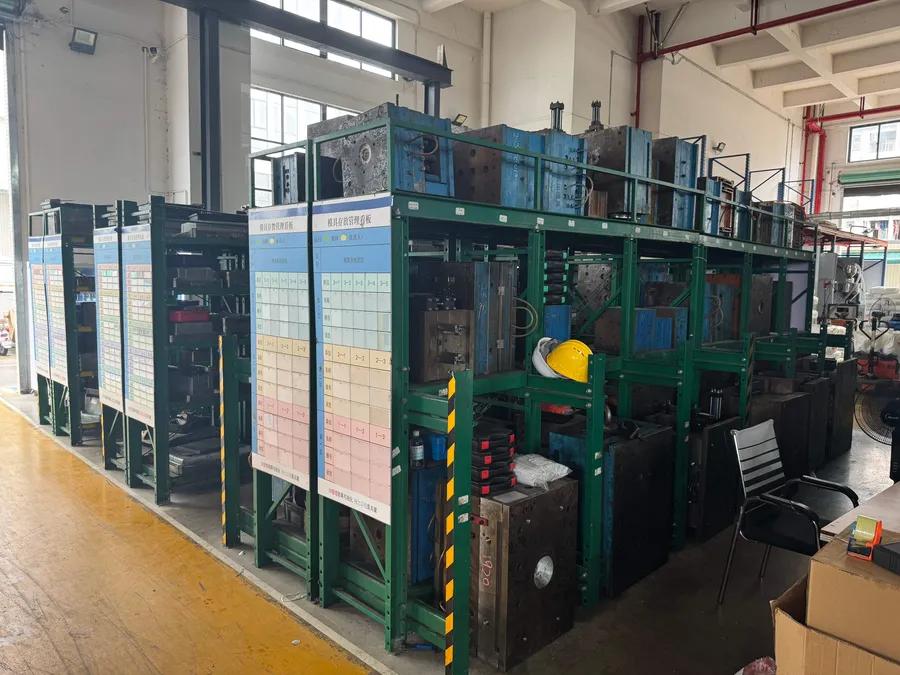
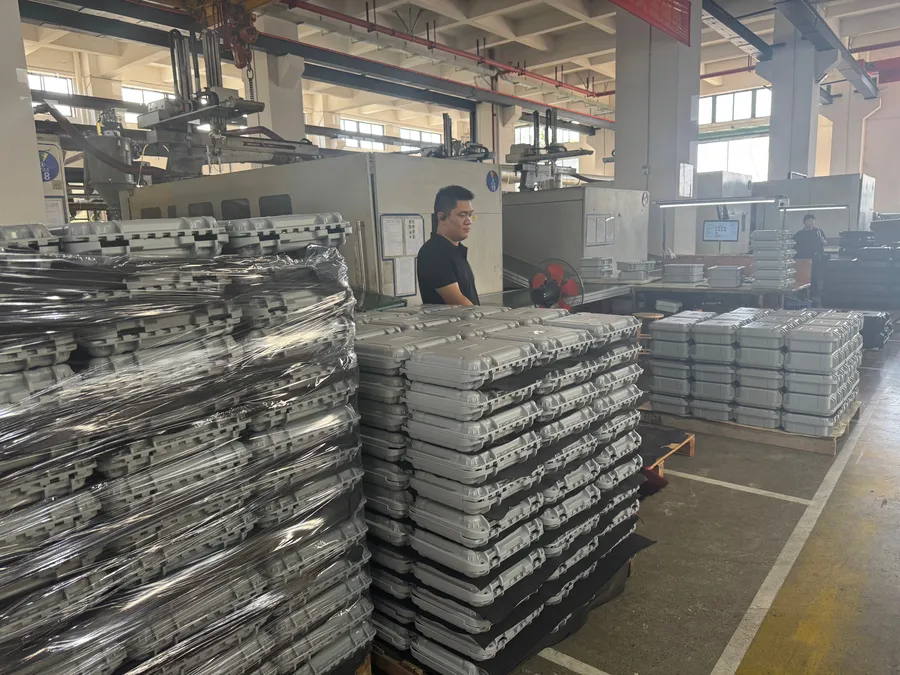
Customisation
Everything described above is configurable on a standard shell: interior layout (pick-and-pluck, die-cut or CNC-cut), foam grade and thickness, colour, logo method, latch and lock count, pressure-equalisation valve, cable ports, document holder and identification plate. A bespoke exterior geometry requires a new mould — 125 days, from 3,000 units per moulded component.
Procurement considerations
| Question | What to send us |
|---|---|
| Which shell fits? | Equipment L × W × H as packed, plus required clearance per axis |
| What does it cost? | Order quantity and estimated annual quantity — the two drive different answers |
| Is tooling needed? | Whether an existing shell clears the envelope with usable foam depth |
| Lead time? | Your required delivery date, not just the order date |
| Certification? | The exact standard your tender names — we will say whether we can test to it |
| Freight? | Destination and preferred terms; carton and pallet data supplied with the quotation |
Comparison and selection guide
The tables on this page exist because a protective case is chosen by comparing three things: the envelope, the environment and the handling chain. Where no table applies, the rule below is.
| Situation | What To Do |
|---|---|
| Start from the equipment, not the case | Measure the tallest, widest and longest points of the packed equipment including antennas, handles and connectors. Add 20 mm minimum clearance per axis before selecting a shell. |
| Then choose the carrying method | Under 8 kg, a fixed handle is lighter and cheaper. Over 12 kg or any journey over 30 m, specify the T series with telescopic handle and wheels. |
| Then decide the interior | Pick-and-pluck for kits that change. Die-cut or CNC-cut for fixed layouts that must be auditable at a glance. |
- Size on internal dimensions plus clearance, never on a product name.
- Choose the carrying method before the shell: it changes the series, not just the price.
- Specify the interior last, and decide up front whether the end user will reconfigure it.
What factors affect protective case selection for logistics? relates to Logistics & Packing Guide. Related families: Military Protective Cases / Military Transport Cases / Equipment Transport Cases / Ammunition Storage & Transport Boxes / Defense Equipment Cases. Related sectors: field and industrial equipment. Continue in the Logistics & Packing Guide cluster.
This page is written from our own production data. If your requirement differs, send the dimensions and we will tell you which of the 155 models fits, or whether a custom route is needed.